The Tower and The Magician: When Collapse Becomes Spellwork
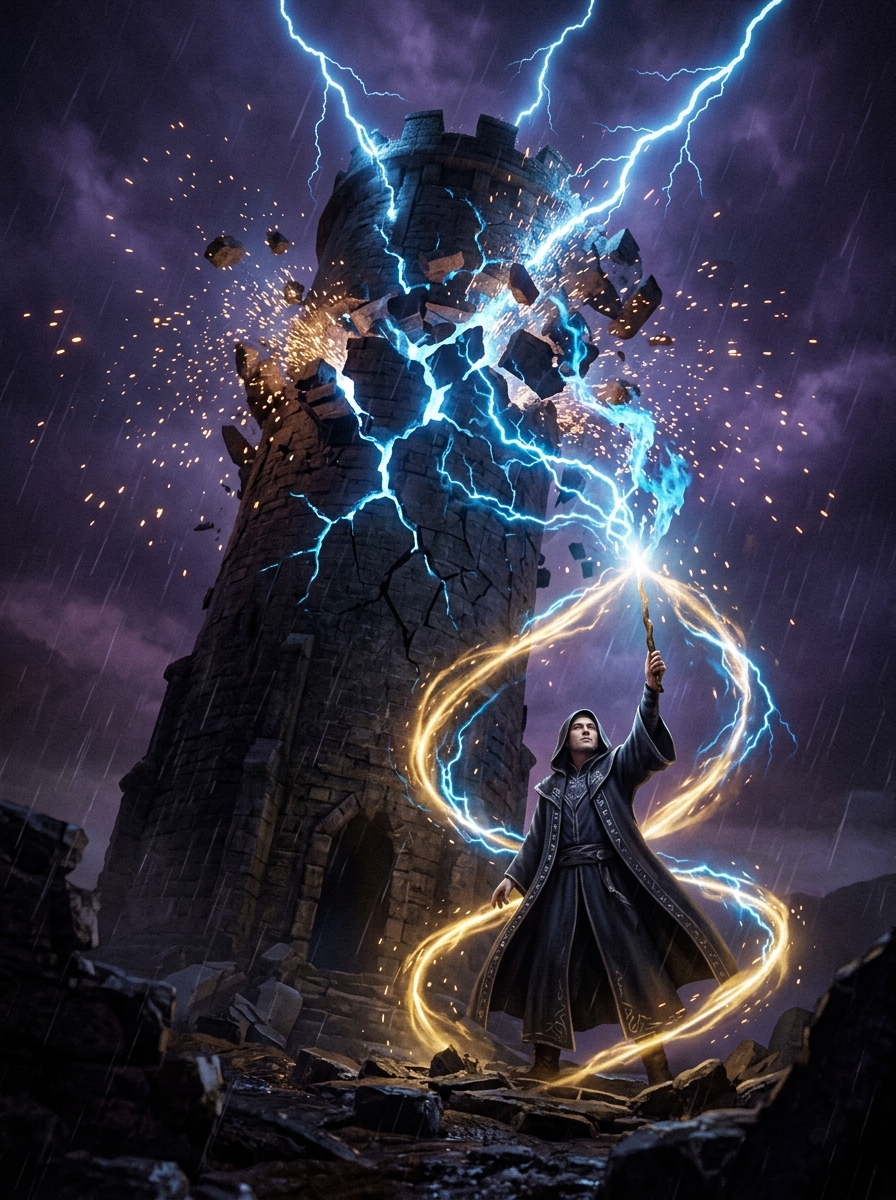
The Tower and Magician together mean this: an old structure is breaking, and you are not powerless inside the break. The reading is not merely about disruption; it is about what kind of mind, voice, and will emerges when illusion is stripped away. Where the Tower exposes falsity through shock, the Magician responds by making something real out of raw material. It is the combination of demolition and direction, catastrophe and craft.
The Core Dynamic: Collapse as Catalyst for Craft
The Tower is Saturnian in that it punishes bad architecture. Lightning hits because something has become too brittle, too inflated, too removed from truth. The Magician, by contrast, is Mercury at full voltage: perception, language, dexterity, timing, and the ability to draw one thing into another. Together, they do not simply say “something ended.” They say, “the false container ended, and now consciousness must become practical.” That distinction matters. This pairing is not passive mourning. It is an emergency of meaning.
The classic Magician stands before the altar with wand, cup, sword, and pentacle: will aligned with available elements. The Tower throws the altar down. In a reading, this often means a person has been relying on charisma without substance, skill without honesty, ambition without structure, or identity without contact with reality. Then the event arrives that cannot be talked around. Once the facade cracks, the Magician asks the only useful question left: what can still be used, and how precisely can you use it?
This combination often appears when the reader needs to stop trying to preserve the image of control and start exercising actual control. If you want a useful parallel, see how the Magician behaves when paired with more stabilizing force in The Magician and The Emperor Tarot Card Combination: Manifesting Will into Structured Reality. Here, however, the structure is not intact. The Tower is what makes the Magician honest.
Psychological Roots: The False Architecture and the Magician's Shadow
The Tower and Magician do not appear randomly. They arise when a person has built a life on a fictional self — an identity sustained by charm, quick thinking, and the ability to manage impressions. The Magician archetype loves a compelling narrative, and when untethered from truth, it becomes a career of sorcery: you talk your way into jobs, relationships, projects that were never structurally sound. The Tower is the moment the foundation gives way.
This is why the pairing often surfaces after a major exposure — a secret revealed, a lie unraveled, a betrayal that was years in the making but struck in an instant. The psychological cost is steep because the false self was not merely a convenience; it was a survival strategy. The Magician's shadow is the manipulator: the one who knows how to say the right thing, mirror the desired image, and deflect accountability until the collapse forces the hand. For a darker exploration of that shadow, The Magician and The Devil Tarot Combination: Willpower, Shadow, and Sovereign Action strips the archetype of its glamour.
Yet the Tower does not destroy indiscriminately. It destroys what is false. The psychological task of this pairing is to distinguish between the parts of the self that were genuinely capable and the parts that were performance. The Magician who emerges from the rubble is not the same one who walked into it. He has been humbled — and that humility makes his skill dangerous in a new way.
The Crucible of Maturation: From Sleight to Sovereignty
When the Tower and Magician mature, they do not produce a repaired version of what was lost. They produce a reconfigured self — leaner, quieter, and far more exact. The Magician learns that true power does not need to dazzle. It needs to be accurate.
This maturation often follows a pattern: first comes shock, then a frantic attempt to control the narrative (the shadow Magician), then exhaustion, then surrender. In that surrender, the Magician stops trying to convince others and starts listening to what is actually present. The wand that once pointed outward now points inward. The swords that were used to slice through conversations become tools of discernment. The cups that held emotional performance now hold real feeling. The pentacles that were status symbols become actual resources.
The pairing can produce a person who, after a Tower event, becomes eerily effective. They are no longer attached to reputation. They have seen the architecture of their own delusion and will not rebuild it. This is the person who can sit in a broken boardroom or a shattered relationship and ask the one question no one else dares to ask: “What is actually true here?” For the version of this transformation that moves through grief into renewal, The Tower and The Star Tarot Combination: From Ego Demolition to Spiritual Dawn shows the aftermath when collapse becomes a starting point.
The shadow persists, of course. A person who has been burned by their own sleight can overcorrect into rigidity, mistaking control for safety. Or they can become cynical, using the Magician's gifts only for survival, never for creation. The test is whether the skill that once served illusion can be redirected toward sovereignty — the ability to act in alignment with reality, not against it.
Applied: The Concrete Shape of the Break
In love, the Tower and Magician combination announces a relationship built on chemistry and narrative rather than mutual truth. One partner may have been a consummate storyteller, the other a willing audience. When the Tower hits — an affair, a confession of incompatibility, a sudden loss of attraction — the question is whether the bond can survive the removal of its plot. If it can, love becomes something sturdier, less enchanted but more real. If not, the Magician inside you learns that not every connection is meant to be saved. Compare the dynamic of choice and entanglement in The Lovers and The Devil Tarot Card Combination: A Deep Psychological and Esoteric Analysis — the Tower turns the stage lights on.
In career, this pairing is often a layoff, a failed pitch, a public mistake that strips away title and borrowed authority. The Magician's response is to inventory real skills: what can you do without the team, the brand, the credential? The work that survives is usually smaller, sharper, and less impressive to outsiders — but it is yours. For the similar pressure of will meeting a breaking point, The Chariot and The Tower: When Willpower Meets Its Breaking Point explores the difference between force and adaptability. Here, the Magician offers adaptability without the need to win on the old terms.
In creative or spiritual work, the Tower and Magician warn against overengineering. The Magician wants a flawless system; the Tower reveals where the system was propped up by wishful thinking. The result is a practice that is stripped of ornament, direct, and alive.
Working with the Pairing: The Discipline of Exactness
To meet this combination without panic, you must understand that it rewards precision, not performance. The Tower has already performed the demolition. The Magician's job is to sort the wreckage.
- Name what broke. Write it down. Do not spin it. The Magician's eloquence is diagnostic, not decorative. If you cannot say “I was lying to myself about X,” you are still inside the collapse.
- Identify what remains. The Tower does not destroy everything. It destroys what was false. The Magician gathers the tools that are still functional — a skill, a relationship that survived the exposure, a piece of clear thinking. Those are the raw materials of the rebuild.
- Act small and exact. The Tower creates a nervous system jolt. The Magician counters with grounding: one deliberate breath, one honest conversation, one item on the to-do list that moves you from reaction to action. In this context, a short email confirming a hard fact is more magical than a thousand affirmations.
For the shadow expression — when the Tower and Magician appear reversed or in a difficult position — watch for a pattern of crisis creation. Some people use the Magician's skills to manufacture emergencies, then step in as the heroic fixer. The Tower here becomes a weapon, not a teacher. If you recognize this in yourself or another, the work is to stop performing competence and start telling the truth about your actual limitations. The pairing loses its toxicity only when the Magician surrenders the need to be the cleverest person in the room.
The deepest message of the Tower and Magician combination is that revelation is not the end of power; it is the end of counterfeit power. What survives is what was real enough to rebuild. For a counterpart that ends in radiant recovery after devastation, The Tower and The Sun Tarot Combination: Archetypal Rupture and Radiant Integration shows the full arc from break to breakthrough. Here, the work is simpler: take the tool that still works, use it on the next truthful thing, and let the rest fall away.
Related
- The Devil and The Tower: When the False Structure Breaks
- The Hermit and The Tower: Solitude After the Collapse
- Death and The Tower Tarot Combination: The Collapse That Clears the Way
- The Magician and Strength: The Art of Directed Power
- Judgement and the Magician: The Sound of Awakening Becoming Action
Comments
Loading comments…