The Hermit and The Tower: Solitude After the Collapse
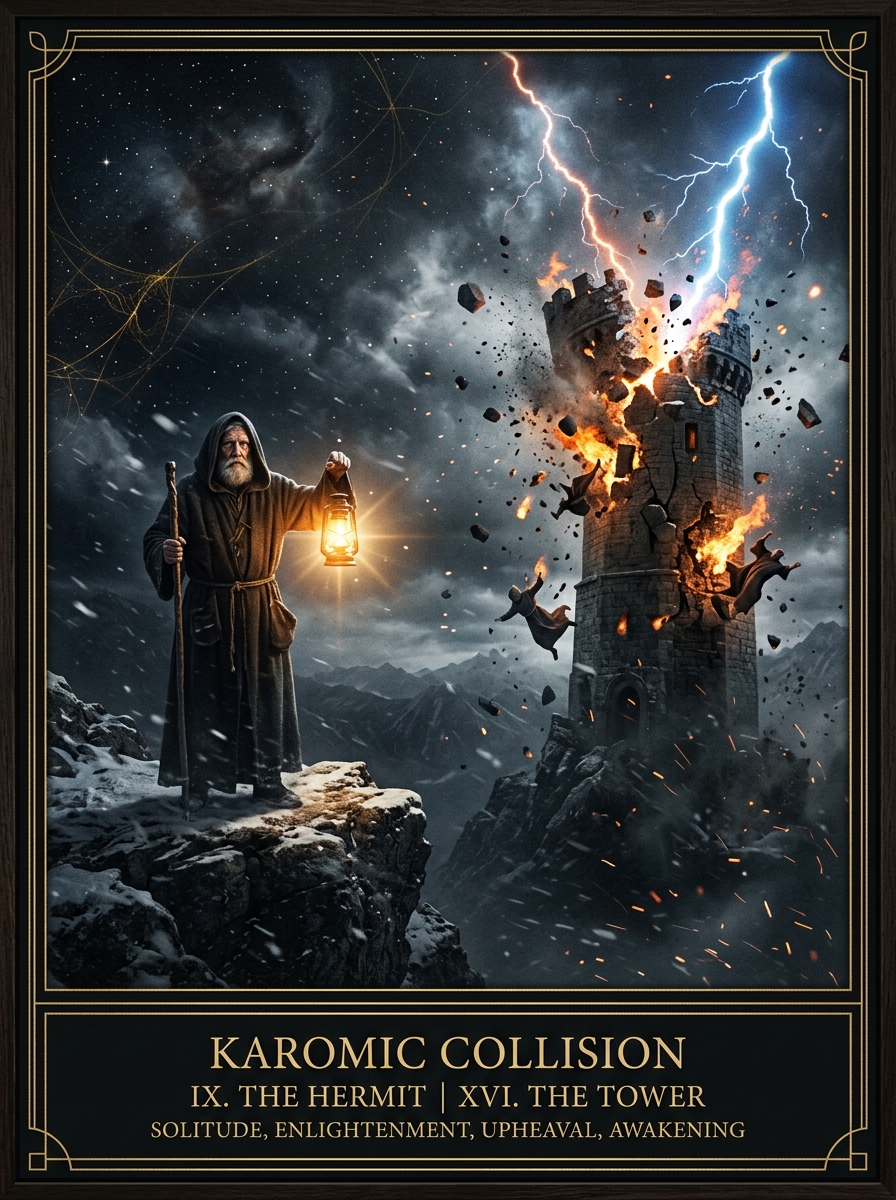
The thesis: light remains after the structure falls
The Hermit and The Tower together describe a soul forced into the desert by a lightning strike. The Tower is the event that demolishes the false shelter — a betrayal, a layoff, a diagnosis, a revelation that strips an entire life-pattern of its credibility. The Hermit is what steps forward when the noise and rubble settle: the solitary figure with the lantern, asking not for sympathy but for truth. The core insight is this: the collapse is not the end of meaning but the end of borrowed meaning. What you built on sand has been shown for what it is, and the Hermit’s lamp now illuminates one step at a time across ground that will no longer lie.
This pairing does not promise repair or consolation. It offers precision. The Hermit already suspected the structure was hollow; the Tower made denial impossible. For a parallel sequence where solitude follows death rather than demolition, see The Hermit and Death, where the release is slower but just as final.
The mechanics: Saturn meets Mars
In the Rider-Waite-Smith system, these cards contain opposing yet complementary energies. The Hermit is Saturnian: contraction, patience, the vertical climb toward inner truth, the refusal to be comforted by company. His lantern is not a spotlight but a searchlight — it finds what hides. The Tower is Martian: sudden discharge, the lightning bolt that short-circuits pride, the crown thrown from the battlements. When these two appear together, the psychological mechanism is brutally simple: an insight that has been ignored long enough to accumulate voltage breaks the container that held it.
This is why the combination often appears in readings for people who have been “managing” a problem — a relationship they knew was hollow, a career that demanded they shrink, a belief system they stopped checking against experience. The Hermit had already withdrawn from the noise. The Tower simply confirmed the withdrawal was necessary. The aftermath is not chaos; it is a cleared field. The question the cards pose: can you sit in that field long enough to know what actually belongs there, or will you scramble to rebuild the same scaffolding in a different shape?
For a closer look at how the Tower’s destruction can turn into a deliberate journey, compare this with The Chariot and The Tower, where willpower meets its breaking point and must be remade from scratch.
The maturation and its shadow
When this pairing matures, the Hermit emerges as a witness who does not flinch. He catalogs the wreckage without dramatizing it. He knows that what fell was never truly his — it was the role, the identity, the story that kept others comfortable. Maturity here looks like a disciplined pause: no immediate pivots, no therapeutic inflation of the crisis into a heroic narrative. Just the cold, clear work of asking what is still true when the audience has left.
The shadow version is more common. The Hermit becomes a hiding place. The person withdraws not to discern but to avoid the mess — to nurse grievance behind a veil of spiritual superiority, to mistake isolation for enlightenment. The Tower then mutates into an obsession with catastrophe: the collapse becomes a story told repeatedly, a scar worn as an identity. The psyche stays locked in the moment of impact, replaying it like a screen that never goes dark. This shadow can be dismantled only by bringing the Hermit back into relationship with the world — which is precisely what the card originally ordered. If this pattern feels familiar, the Shadow Work Tarot Spread offers a structured method for identifying the unconscious attachment to the wound.
How it plays out in a life
In love, the sequence looks like a relationship that depended on a shared fiction. One partner had been emotionally absent in the name of “space”; the other had been performing contentment. The Tower arrives as a confession, a discovery, or a rupture that makes the fiction untenable. What follows is not simply conflict but the collapse of the story that kept the bond livable. The Hermit then demands that each person sit alone with what they have tolerated, withheld, or ignored. Repair is possible, but only after the solitude has been genuine — not the solitude of punishment but of reckoning. For a related tension between desire and bondage, see The Devil and The Tower, where the chain that held you together is simultaneously the thing that must break.
In career, the Tower is almost always an institutional rupture: a layoff, a project that implodes, a manager whose toxicity finally surfaces, a credential that turns out to be worthless. The Hermit refuses the automatic reflex to “get back in the game.” Instead, he asks: what do you actually know how to do, and what are you willing to do for the next ten years? The lesson is not “start over” but “start discriminating.” Expertise earned in solitude — research, craft, consultation, mentorship — becomes more durable than ambition borrowed from the crowd. If you need a map for testing options after disruption, the Career Tarot Spread can help separate fear from signal.
In spiritual terms, this pair is a paradox: revelation followed by retreat. The Tower shocks the psyche into sincerity; the Hermit teaches how to metabolize the shock without inflating it into a new dogma. The lantern does not illuminate a grand temple — it lights one step, then another. The ego, stripped of its pretenses, learns to move slowly. This is where the pairing takes on its distinctly Jungian shape: the persona cracks, and the self that was hidden underneath begins to breathe. That hidden self may be severe, solitary, demanding — but it is more real than the mask that just got demolished. For a quieter, more receptive version of this inner turn, The High Priestess and The Hermit contrasts silent knowing with disciplined withdrawal.
Reading the combination cleanly
The most common error is to reduce this pair to “bad news.” That misses the architecture of the lesson. When The Tower appears first, the emphasis is on rupture that compels withdrawal: the event forces you to stop pretending. When The Hermit appears first, the story is subtler: you were already pulling away, already sensing the need for truth, and the external event merely confirmed what the inner life had been announcing. The distinction matters because one is crisis-driven, the other preemptive wisdom. The first says, “You had to be forced.” The second says, “You knew, and now the world has caught up.”
Surrounding cards also sharpen the read. If water or Venusian imagery appears (Cups, Empress, Star), the emotional story is about denied intimacy or tenderness. If more Saturn or Mars signatures emerge (Emperor, Judgement, other Wands), the issue is control, pride, or emotional austerity. The The Tower and The Sun combination offers a natural next step when the collapse clears the way for radiant integration; here the Tower is followed not by solitude but by light.
The timing matters too. The Hermit is the ninth card, The Tower the sixteenth — both fall in the second half of the Major Arcana, implying a late-stage reckoning. The lesson was available earlier, but the lesson was not taken. That is not moral failure; it is human momentum. Still, the sequence presses the reader: stop romanticizing the collapse. Stop treating it as a sign of special destiny. Start listening to what it made impossible to ignore. The sky has cleared. The lamp is lit. The path is narrow, but it is yours.
Related
- Death and The Tower Tarot Combination: The Collapse That Clears the Way
- The Tower and The Magician: When Collapse Becomes Spellwork
- The Tower and The Sun Tarot Combination: Rupture Into Revelation
- The Devil and The Tower: When the False Structure Breaks
- The High Priestess and The Hermit: Silent Knowing, Solitary Truth
Comments
Loading comments…