The Magician and The Devil Tarot Combination: Willpower, Shadow, and Sovereign Action
The Archetypal Dynamics of the Magician and the Devil
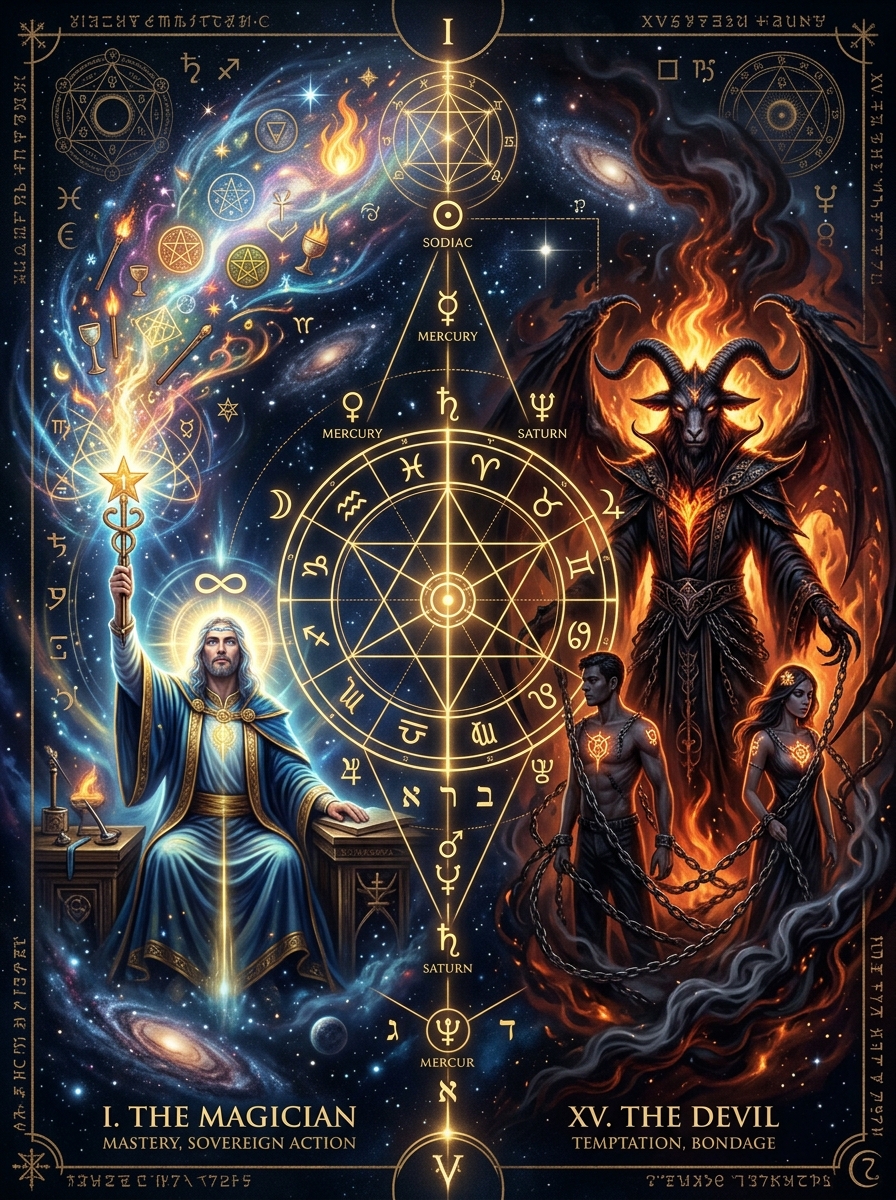
The meeting of Arcanum I, The Magician, and Arcanum XV, The Devil, represents one of the most intellectually charged and magnetically tense polarities in the Tarot's Major Arcana. At its core, this combination explores the delicate line between conscious manifestation and unconscious bondage, representing the cosmic dialogue between Mercury's fluid adaptability and Saturn's dense, structured limitation. The Magician represents the active, conscious ego—the Magus who stands at the altar, channeling the divine spark down into the material plane. He is the archetypal master of tools, utilizing the wand, cup, sword, and pentacle to shape reality according to his focused intent. The Devil, by contrast, is the shadow reflection of this creative impulse. Under Saturnian influence, the Devil represents the material density that traps the soul, the instinctual forces of the chthonic underworld, and the self-imposed illusion of captivity. Together, they challenge the initiate to examine where conscious direction ends and compulsive reaction begins. This combination is a profound spiritual teaching tool, showing that the power of focus is a double-edged sword: the very focus that allows us to manifest our reality can also become the tool that binds us to our creations.
In tarot readings, seeing these two cards together is an immediate call to examine the motives behind our actions. When the Magician is combined with the Devil, the message is rarely subtle; it indicates a time of high stakes, where our intellectual capacity and creative energy are being tested by the gravitational pull of our deepest desires. It warns us that our cleverness can either liberate us or construct a more comfortable cage. This tension is not merely a theoretical conflict but a practical challenge experienced in our daily choices, our relationships, our career ambitions, and our psychological integration. To fully understand this dynamic, we must explore the rich astrological, Qabalistic, and psychological layers that define both archetypes and map their interaction. We must recognize that the Magician's table is not separate from the Devil's pedestal; rather, the pedestal is built from the very materials that the Magician fails to master. When we ignore the spiritual origins of our creative power, we inevitably construct a material prison of our own design, turning the sacred altar of the Magus into a workshop for the shadow.
The Hermetic Conduit of Beth: Mercury's Creative Fire
In the Qabalistic framework of the Tree of Life, The Magician is attributed to the Hebrew letter Beth, which translates literally to "house" or "container." Beth is the path of the double letter that connects Kether, the crown of infinite, unmanifest potential, to Tiphareth, the beauty of conscious selfhood. As the path of Beth, the Magician acts as the focal point through which the formless, transcendent light of the divine is concentrated and directed into a singular vessel. In Western esotericism, particularly as articulated by Aleister Crowley in his seminal work The Book of Thoth, this is the exercise of the True Will. The Magician does not create the energy; rather, he is the conduit through which the wind of spirit blows, translating the invisible into visible form. He stands as the bridge between the macrocosm and the microcosm, declaring "as above, so below."
This Hermetic conduit operates under the planetary influence of Mercury, the messenger god who moves fluidly between the upper and lower worlds. Mercury represents the intellect, cognitive skill, language, and the power of persuasion. Yet, as the cosmic trickster, Hermes is also the master of illusions, thieves, and magic. The Magician's power is linguistic and mental; he commands the symbols of reality. However, when his connection to the higher source is severed, the Magician risks becoming a mere sleight-of-hand artist, an ego-driven manipulator who mistakes his personal cleverness for divine authority. The danger of Mercury is superficiality—the belief that because one can manipulate the symbols of a thing, one has mastered its essence. When the Magician is paired with the Devil, this Mercurial tendency to intellectualize and manipulate is amplified, drawing the Magician's focus down into the chthonic realms where his tools can be used for control rather than creation. This planetary tension emphasizes that without ethical grounding, Mercury's quickness becomes the Devil's trap, turning communication into deceit.
The Chthonic Limitation of Ayin: Saturn's Crystallization
The Devil occupies the path of the Hebrew letter Ayin, which translates to "eye." Ayin connects Tiphareth, the solar ego, to Hod, the intellectual sphere of Mercury. The letter Ayin represents vision, but it is a vision focused downward into the depths of matter—perception bound to the physical eye that sees only the material shell and mistakes it for the absolute reality. The Devil corresponds to the zodiacal sign of Capricorn, ruled by Saturn, the planet of structure, crystallization, karma, and limitation. Where the Magician represents the initial spark of creation, the Devil represents the terminal density of physical manifestation.
In the Rider-Waite-Smith card, the Devil is depicted as a winged, horned beast presiding over two chained figures, who appear to be the lovers from Arcanum VI, now bound to his pedestal. Their chains are loose, indicating that their imprisonment is psychological rather than physical. The Devil represents the chthonic forces—the raw, instinctual drive, the animal nature, and the suppressed desires that the conscious ego tries to control or ignore. While the Magician seeks to rise above and direct the elements, the Devil demands a descent into the mud of raw existence. This is the realm of the Shadow, where the light of Mercury is refracted through the prism of Saturn's material limitations, producing either deep physical mastery or absolute spiritual entrapment. The Ayin path reminds us that the physical eye can be a deceptive organ; it shows us boundaries where there are none and makes us believe we are separate from the universe, leading directly to the fear-based control mechanisms of the ego. By confronting Saturn's structure, the Magician is forced to recognize that true mastery requires passing through the physical tests of time, patience, and material reality.
Love and Relationships: Magnetic Passion and the Shadow of Codependency
When The Magician and The Devil appear together in a relationship reading, they signal an environment of intense, almost hypnotic magnetism. This is not a gentle, romantic partnership; it is a profound, transformative encounter characterized by power dynamics, sexual fascination, and psychological projection. The Magician brings his charm, eloquence, and capacity for deliberate manifestation, while the Devil injects raw passion, primal attraction, and unconscious compulsions. Together, they create a relationship container that behaves like a spiritual crucible, forcing both partners to confront their deepest desires and hidden vulnerabilities. The attraction under this combination is often instantaneous and overwhelming, felt as a physical pull that bypasses the rational mind.
In many cases, this combination describes a relationship where communication is used as a tool of control. The Magician's eloquence, when influenced by the Devil's obsession with possession, can manifest as gaslighting, psychological manipulation, or persuasive guilt-tripping. One partner may use their intellectual superiority to rewrite the narrative of the relationship, making the other feel responsible for all conflicts. The Devil's energy binds the partners to these patterns, making it incredibly difficult to break free. The relationship becomes a closed system, a self-perpetuating loop of drama where the highs are ecstatic and the lows are psychologically devastating. It is a bond built on the thrill of the chase and the fear of abandonment, where vulnerability is weaponized and intimacy is treated as a strategic transaction.
Hypnotic Attraction and the Projection of the Shadow
In the realm of modern psychological astrology, Liz Greene emphasizes that relationship dynamics are rarely about the conscious agreements partners make, but rather the unconscious agreements dictated by their shadows. The Magician and Devil combination in love represents the classic projection of the shadow onto the partner. One partner may adopt the role of the Magician—the capable, articulate, and dominant coordinator of the relationship—while the other plays the Devil, embodying the raw, chaotic, or dependent impulses. Alternatively, both partners may become caught in a feedback loop of mutual fascination, where the intellectual skill of the Magician is used to rationalize the unhealthy dependencies of the Devil.
This combination speaks directly to the phenomenon of trauma bonding and karmic attraction. The Saturnian influence of the Devil creates a sense of fated obligation, a feeling that one cannot leave the relationship despite its destructive elements. The Mercurial Magician uses his communication skills to spin narratives that justify this captivity, labeling toxic behaviors as "soulmate connections" or "spiritual lessons." To navigate this dynamic, partners must learn to withdraw their projections. They must recognize that the intense magnetism they feel toward the other is actually an attraction to their own repressed qualities—their own disowned power (the Magician) or their own unexpressed passion and shadow nature (the Devil).
To move beyond the manipulative potential of this combination, individuals must establish rigorous, healthy boundaries. The Magician's sword must be used not to cut down the partner, but to sever the cords of codependency. True intimacy under this influence is only possible when both partners step off the pedestal of the Devil and abandon the illusion of control. By integrating the primal energy of the Devil with the conscious awareness of the Magician, partners can transform their connection from a prison of mutual manipulation into a temple of shared spiritual sovereignty. This requires an honest acknowledgment of one's own darker desires, admitting that the drama and control are satisfying an unconscious need for intensity or safety. Only then can the relationship evolve into a healthy partnership that respects individual autonomy and encourages mutual growth.
Career, Ambition, and Financial Ethics: The Alchemy of Success
In career and financial contexts, the pairing of The Magician and The Devil is exceptionally potent and highly double-edged. On one hand, it represents the ultimate configuration for material manifestation. The Magician has the vision, the technical intelligence, and the communication skills to pitch ideas, negotiate contracts, and close deals. The Devil provides the raw ambition, the keen sense of material value, and the relentless drive to accumulate wealth and power. Together, they can produce outstanding career success, entrepreneurial genius, and financial abundance. This is the archetype of the master salesman, the charismatic leader who can convince anyone of anything, and the brilliant strategist who knows exactly how to navigate the market to their advantage.
However, the alignment of Mercury and Saturn in this context warns of serious ethical challenges. The Magician's tactical intellect can easily degrade into deception, fraud, and opportunism when influenced by the Devil's obsession with material gain. The drive for success can become a form of workaholism or corporate exploitation, where the individual becomes chained to their own ambitions, sacrificing their ethical compass and personal life for the illusion of control and status. The focus shifts from creating value to extracting value, leading to short-term gains at the expense of long-term stability and reputation. This is where we see the rise of the charismatic but untrustworthy executive who prioritizes short-term stock metrics over the long-term well-being of employees and clients alike.
The Ethics of Persuasion vs. Coercion in Finance
In the workplace, the Magician-Devil combination often manifests as a temptation to cut corners or engage in manipulative negotiations. The Magician is the master of presentation, capable of framing any proposition in a highly attractive light. When paired with the Devil, this ability can cross the line from healthy persuasion into coercion or outright misrepresentation. The individual may justify these actions by pointing to the competitive nature of business, adopting a Machiavellian stance where the end justifies the means. This is a Saturnian trap; Saturn, as the lord of karma, always demands payment for debts accrued through dishonesty or exploitation. It warns us that wealth built on the exploitation of others is a form of spiritual bankruptcy.
To harness this energy productively, a professional must combine the Magician's creative agency with Saturnian discipline and ethical responsibility. This means using the Magician's tools to build sustainable, long-term structures rather than chasing quick, exploitative profits. In negotiations, it requires transparency rather than manipulation. The individual must ask themselves: Am I commanding my ambition, or is my ambition commanding me? When the Magician maintains his connection to his higher principles, he can use the Devil's material focus to ground abstract ideas into highly successful, ethically sound enterprises that benefit the community as a whole. True material alchemy occurs when we manifest abundance without selling our souls in the process, recognizing that financial freedom is meaningless if we are enslaved by the constant fear of losing what we have accumulated. We must strive to become masters of the physical world, not its prisoners.
The Jungian Perspective: Ego Consciousness and the Nekyia Descent
From the perspective of Carl Jung's analytical psychology, the combination of The Magician and The Devil illustrates the essential confrontation between the Ego and the Shadow. The Magician represents the conscious ego, the center of awareness that seeks to order, categorize, and control life through the intellect. He is the persona of the competent achiever, the master of his domain. The Devil represents the personal and collective shadow—everything the ego has repressed, denied, or deemed unacceptable because it does not fit the conscious self-image. It is the repository of our primal instincts, our wildness, and the parts of our personality we have hidden away out of fear of social rejection.
When these cards appear together, they indicate that the ego has reached a point where its conscious strategies are no longer sufficient. The Magician's tricks are failing, and he is forced to look downward. This initiates the Nekyia—the mythological descent into the underworld. In Jungian psychology, the Nekyia is not a punishment, but a necessary phase of individuation. The ego must descend into the dark, chaotic waters of the unconscious to reclaim the vital energy stored within the shadow. Without this descent, the ego becomes dry, sterile, and increasingly neurotic, as it must expend more and more energy to keep the shadow repressed. The confrontation with the Devil is therefore a critical milestone on the path to becoming a complete human being.
The Nekyia: Navigating the Descent and Reclaiming the Self
The descent into the shadow is fraught with danger. If the ego is too weak, it can be overwhelmed by the chthonic forces of the unconscious, leading to inflation, addiction, or psychological disintegration. This is the danger of the Devil's pedestal: the individual becomes possessed by the shadow, acting out their repressed impulses without conscious control. The Magician must maintain his identity as the conscious director while allowing the shadow material to emerge. He must sit with his fear, his anger, his shame, and his desires, recognizing them not as enemies to be destroyed, but as disowned parts of himself that need to be integrated.
Integrating the shadow requires what Steven Forrest refers to as the "evolutionary choice." The individual must look at their own capacity for greed, manipulation, anger, and lust, and acknowledge these forces as part of their psyche. By acknowledging the Devil, the Magician strips the shadow of its autonomous power. Unconscious impulses only control us when we refuse to look at them. When the Magician shines the light of conscious awareness on the chains of the Devil, the chains begin to dissolve. The energy that was previously bound up in maintaining the repression is released, becoming available as raw, creative power. The integrated individual no longer needs to pretend to be perfect; they become whole, combining the intellectual clarity of the Magician with the instinctual vitality of the Devil. This synthesis leads to a grounded, resilient personality that is no longer easily swayed by unconscious triggers, because they have already faced their own internal demons and integrated their wisdom. The shadow, once integrated, becomes a powerful source of instinctual strength, creative drive, and authentic authority.
The Corruption of the Four Elemental Tools
The Magician's altar contains four primary tools, each representing a classical element and a dimension of human experience: the Wand (Fire/Will), the Cup (Water/Emotion), the Sword (Air/Intellect), and the Pentacle (Earth/Physical Reality). When the Devil's shadow falls over the Magician's altar, these tools become distorted, their spiritual purposes corrupted by the pursuit of egoic power, emotional control, and material obsession. Instead of serving as instruments for channeling the divine light, they become weapons of containment and domination. This distortion is subtle, often rationalized by the ego as necessary for self-preservation or success.
Understanding this corruption is essential for anyone working with these archetypes, as it reveals the specific ways we misuse our energy when we fall into unconscious patterns. By examining how each tool is distorted, we can diagnose our own spiritual imbalances and begin the work of purification and realignment. The Devil does not destroy the tools; he simply misdirects their use, turning the sacred instruments of the Magus into the toys of the sorcerer. The goal is to recognize this corruption in its early stages before the patterns become deeply crystallized in our daily life and habits.
Wand and Cup: The Distortion of Will and Emotion
The Wand, representing fire and the spiritual will, is corrupted under the Devil's influence into the raw "will to power." Instead of channeling divine inspiration to create harmony, the Magician uses the Wand to dominate others, asserting control over his environment to mask his inner vulnerability. The creative flame becomes a destructive fire of ambition, driven by the fear of powerlessness. In daily life, this looks like the leader who rules through fear and intimidation, demanding absolute obedience and treating any expression of independence as a threat to their authority. The alignment with the Devil strips the Wand of its higher creative spark, leaving only the dry heat of coercion.
The Cup, representing water and the emotional realm, is corrupted into emotional codependency, manipulation, and obsession. Instead of reflecting the clear, flowing waters of empathy and unconditional love, the Cup becomes a stagnant pool of emotional blackmail and guilt. The individual uses their emotional intelligence to hook others, creating dependencies that keep people bound to them, mistaking possession for love. This is the classic dynamic of the emotional puppet master, who knows exactly which emotional strings to pull to keep their partner or family members compliant and dependent, feeding off their energy to fill their own internal void.
Sword and Pentacle: Intellectual Cages and Material Obsession
The Sword, representing air and the intellect, is corrupted into rationalization, propaganda, and deceit. The Magician uses the Sword not to cut through illusion, but to construct elaborate mental cages. The intellect is weaponized to justify unethical actions, gaslight others, and deny the reality of one's own shadow. Truth is sacrificed on the altar of personal advantage. This is the realm of the sophisticated intellectual who can argue any point, defend any behavior, and convince themselves and others that their selfish motives are actually noble endeavors. The Sword becomes a tool of fragmentation, dividing the mind from the heart.
The Pentacle, representing earth and material reality, is corrupted into greed, materialism, and physical stagnation. The Magician's focus shifts entirely to the accumulation of physical objects, money, or social status. The physical body may be treated as a mere machine to be exploited, leading to addiction, physical exhaustion, or somatic illness as the natural laws of Saturn are ignored. The individual becomes a prisoner of their own possessions, constantly worrying about security and wealth, unable to enjoy the abundance they have accumulated because they are enslaved by the fear of scarcity. The Pentacle, once a symbol of the sacredness of the physical world, becomes a heavy weight that drags the spirit down into inertia.
Evolutionary Guidance: Unlocking the Self-Imposed Chains
The ultimate message of the Magician and Devil combination is one of profound liberation. Although the appearance of the Devil can feel oppressive, it carries the key to its own dissolution. The chains around the necks of the figures in the Devil card are wide enough to be slipped off at any moment. The captivity is voluntary; the cage is open. The role of the Magician is to realize that the keys to the lock have been on his altar all along. The journey of liberation is not about fighting the Devil, but about waking up to the reality of our own power. It is about understanding that the external conditions we blame for our captivity are often reflections of our internal state.
To experience the evolutionary potential of this card combination, one must transition from reactive bondage to conscious sovereignty. This transition begins with the absolute cessation of blame. The Devil thrives on projection—convincing us that our unhappiness is the fault of our partner, our boss, our childhood, or our destiny. The Magician must reclaim his power of agency, recognizing that while he cannot always control external events, he has complete authority over his internal responses and choices. This shift in perspective is the true magic that dissolves the Devil's chains. It is the realization that we are the authors of our experience, not its victims.
By bringing conscious awareness to our automatic behaviors, we break the Saturnian cycle of repetition. The Magician's true magic is not the manipulation of the external world, but the transformation of the self. When we choose to face our shadow, integrate our instincts, and align our will with the higher self, the Devil is transformed from a tormentor into a guardian of hidden wisdom. The journey through the shadow yields a grounded, authentic power that no longer needs to manipulate, because it is anchored in the truth of who we are. We step off the pedestal of illusion, put down the tools of manipulation, and step into our true authority as conscious co-creators of our destiny.
This liberation is a process, not a single event. It requires daily vigilance, a commitment to self-honesty, and the courage to look at our motives. When we catch ourselves using our intellect to justify a compromise of our integrity, or using our emotions to manipulate a partner, we must have the humility to stop. We must remember that every act of manipulation is an admission of fear—fear that we are not enough, that we will not be loved, or that we will not get what we need. By replacing this fear with trust in our own creative capacity, we transform the Devil's prison into the Magician's temple. We learn to stand at the altar with clean hands and a clear mind, directing our energy toward the expression of our highest potential.
Frequently Asked Questions
What does it mean when the Magician and the Devil appear together in a love reading?
In a love reading, this combination indicates a relationship of intense, magnetic attraction that often carries a risk of power struggles, manipulation, or codependency. It suggests that the partners are drawn together by deep shadow projections and karmic lessons. While the connection is highly passionate and sexually charged, both individuals must establish clear boundaries and work to resolve unconscious dependencies to avoid mutual entrapment. The challenge is to move from manipulative attachment to mutual sovereignty.
How does the Magician and Devil combination impact career guidance?
In career readings, this pairing represents a powerful force for material manifestation, blending the strategic intellect of the Magician with the ambition of the Devil. It indicates great potential for financial success and professional advancement. However, it serves as a strong warning against unethical practices, corporate manipulation, and workaholism. The key is to pursue ambition with strict ethical alignment and discipline, ensuring that success is built on genuine value creation rather than exploitation.
Is the Magician and Devil combination always negative?
No, it is not inherently negative. While it highlights themes of temptation, shadow projection, and bondage, it also represents the necessary path of shadow integration. Psychologically, it indicates the descent of the conscious ego to reclaim repressed instincts and power. When navigated with awareness, this combination leads to profound personal growth, authentic self-mastery, and the breaking of self-imposed limitations. It is the crucible where raw instinct is refined into spiritual power.
How do Mercury and Saturn interact in this tarot pairing?
Mercury (ruling the Magician) represents fluid intelligence, communication, and adaptability. Saturn (ruling the Devil's sign of Capricorn) represents structure, density, karma, and limitation. Their interaction forces the intellectual and creative concepts of Mercury to be tested against the concrete, sometimes harsh realities of Saturn. It challenges the individual to move from superficial cleverness to deep, structured wisdom. This planetary partnership shows that ideas must endure Saturnian structure to become truly real.
What is the significance of the loose chains in the Devil card when paired with the Magician?
The loose chains represent the illusion of captivity. Because the Magician is the master of consciousness, his presence highlights that the chains are self-imposed. The individual has the mental and spiritual tools to slip the chains off at any time. The pairing suggests that conscious awareness is the key to unlocking these chains, moving from unconscious compulsion to free, sovereign choice. It reminds us that our primary jailer is our own unexamined mind, and our primary liberator is our own conscious will.
Comments
Loading comments…