Sowilo Rune Meaning: The Sun That Clarifies and Burns
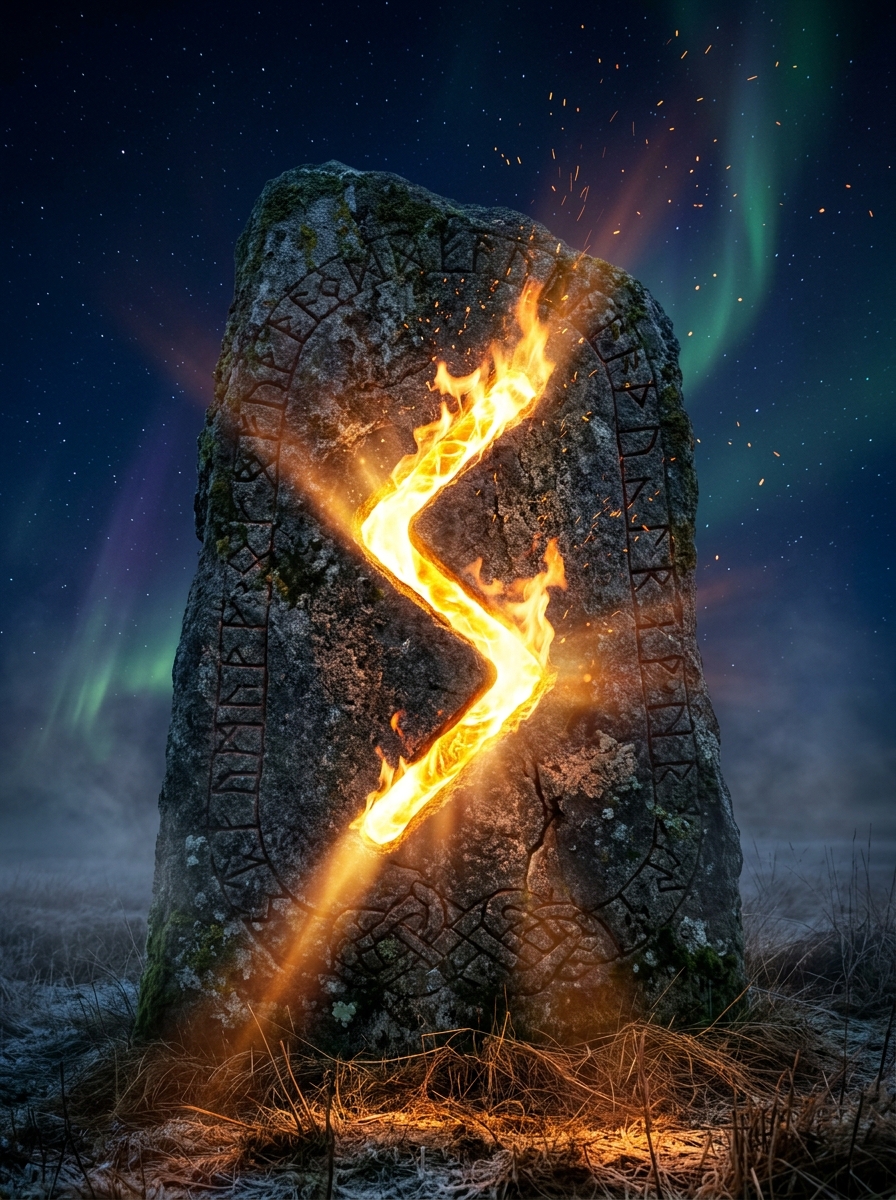
Sowilo is the sun itself in the Elder Futhark — not a metaphor for warmth or optimism but the actual force that makes things visible, legible, and alive to their proper form. It does not speak in compromise; it speaks in alignment. When this rune appears, something in the querent’s life is coming into full view, whether that feels like triumph, relief, revelation, or the uncomfortable exposure that precedes all of those.
The energy is solar in the deepest sense: not decorative brightness but centrality. It gathers scattered material around a living axis. In a reading, Sowilo can signal vitality, successful action, clarity of purpose, confidence, and the kind of illumination that makes evasion unsustainable. But the same light that blesses can also scorch. What is too exposed can burn, and what is too identified with victory can become brittle. The rune contains its own warning.
Name-meaning and the solar field
The Old Norse root behind Sowilo points to the sun as a cosmic fact, not a symbol. In the rune poems, the sun is the force that gives hope to sailors, farmers, travelers, and anyone dependent on timing and the unseen mechanics of the world. The rune carries a practical holiness. It marks the moment when the right thing is simply the bright thing: the truth stated plainly, the direction taken decisively, the effort made without hedging. Success here is not prestige or reward but the rightness of movement. A person under Sowilo is asked to trust what is clear enough to act on.
Upright Sowilo: coherence, momentum, and the rightness of action
Upright Sowilo is one of the most affirmative runes in the Elder Futhark, but “affirmative” should not be mistaken for easy. It confirms that a path is viable, a goal within reach, or that the querent has entered a period of increased power. It can show renewed confidence after confusion, successful timing, public recognition, or the return of energy after depletion. The clearest message is coherence: outer actions and inner will are no longer at odds. Momentum appears in work, a relationship clarifies, an answer arrives, or the next step feels self-evident rather than invented.
Sowilo rarely flatters passivity. It rewards those who step into the open and act in a manner consistent with their own nature. There is a moral component: the rune is associated with success that follows integrity, not aggression. It does not care for masks. In a querent’s life, it can indicate that the best outcome comes from saying what is true, refining the goal, and refusing to split attention between competing selves. The sun does not negotiate with shadows; it reveals them.
Psychological and spiritual texture
From a Jungian perspective, Sowilo reads as a symbol of the Self in its solar aspect: an organizing center that gives form to the personality without erasing it. During a strong Sowilo period, the psyche may feel less fragmented. Dreams become more direct, decision-making sharpens, and a person recovers a sense of their own axis after a season of projection or confusion.
Spiritually, the rune arrives when a life is asking for devotion rather than mere belief. The solar principle disciplines by illumination. If you have been waiting for a sign, Sowilo is often the sign — not a promise that nothing will be difficult, but a confirmation that your way forward is visible enough to trust.
Reversed Sowilo: burnout, false radiance, and compromised sun
The reversed, or merkstave, Sowilo is not simply the opposite of success. It signals distortion in the solar principle: overexertion, ego inflation, exhaustion, or energy that cannot circulate. The light is there, but it is not nourishing. It may be blinded by pride, hidden by weather, or swallowed by fatigue.
When the light becomes too hot
The most common reversed message is burnout. The querent tries to sustain a level of output, visibility, or certainty that the body and psyche can no longer support. Sowilo reversed can show someone running on force of will alone, using charisma in place of substance, or demanding victory while ignoring the conditions that make victory meaningful. In that state, the sun stops being life-giving and becomes consuming.
It can also indicate blocked confidence — not insecurity in the mild sense but an interference in self-expression that feels oddly solar: the person knows they should be visible or decisive, yet something keeps dimming the beam. That obstruction may come from fear of judgment, unresolved guilt, or a situation in which the outer world asks for radiance before the inner life has been properly tended.
Distortion, pride, and the shadow of achievement
The shadow of Sowilo is vanity, and that shadow is never far from “winning.” Reversed, the rune warns against confusing display with power. A person may be trying to look illuminated rather than become clear, more invested in appearing admirable than in being aligned. In those cases, merkstave Sowilo exposes the fragility beneath the performance.
It can also appear when success itself has become spiritually expensive. A job, relationship, or identity may be functioning, but only at the cost of authenticity. The question is not whether the person can continue shining; it is whether the light they are producing is theirs or borrowed. Sowilo reversed asks where the sun has been outsourced.
Symbolism, imagery, and the sun as ordering principle
The visible shape of Sowilo — angular, lightning-like — suggests motion more than stillness, a force that cuts through darkness rather than sitting serenely above it. That visual charge is consistent with its meaning: the sun as directional power, not passive illumination. It is light that acts.
In symbolic terms, Sowilo belongs to the family of images that organize chaos. The sun marks time, seasons, harvests, and orientation. Before it is metaphor, it is infrastructure. That makes the rune especially relevant when life feels disordered. It does not promise “things will get better.” It asks what must become central so that life can be lived with fewer contradictions.
Because the rune is solar rather than lunar, its symbolism tends toward revelation rather than reflection. The moon reveals by softening; the sun reveals by exposing. Sowilo can make hidden motives undeniable, force a decision, or reveal that what looked complex was actually simple. It leaves no place to hide. For someone who has depended on ambiguity, this can feel merciless. Yet this is why the rune is linked with victory: the victorious state is not external conquest but the condition in which truth can no longer be deferred. What survives sunlight belongs; what withers in it probably should.
Reading Sowilo in practice
Sowilo changes tone depending on the surrounding runes, but its core message remains solar: clarify, concentrate, and act from the center. In a spread, it amplifies whatever it touches. With growth runes it accelerates; with challenge runes it reveals the exact nature of the obstacle; with withdrawal runes it asks whether retreat is restorative or avoidant.
In practical readings, Sowilo often answers questions about career, health, confidence, and timing with unusual directness. Career-wise, it favors public-facing success, well-earned recognition, and work that benefits from visibility. In health matters, it can suggest increased vitality — but if reversed or flanked by harsh runes, it points to depletion, feverish overdrive, or the need to stop forcing output. In relationships, it indicates warmth, clarity, and mutual appreciation; reversed, it may reveal a dynamic where one person shines while the other is eclipsed.
The most useful way to hear Sowilo is to remember that sunlight does not just bless gardens. It also exposes rot, dries mud, and reveals dust on the windows. That is not a flaw — it is the rune. Sowilo tells the truth by making it visible. If the life around you is ready, the light feels like blessing. If not, the light feels like pressure. Either way, the instruction is the same: stop negotiating with darkness and find the center that can actually sustain you.
Related
- Wunjo Rune Meaning: Joy, Harmony, and the Cost of Belonging
- Sunstone Meaning and Healing Properties: Solar Courage, Joy, and Clean Power
- Uruz Rune Meaning: The Raw Power of Vital Force
- Eihwaz Rune Meaning: The Axis of Endurance, Thresholds, and Hidden Change
- Othala Rune Meaning: Ancestral Inheritance, Sacred Boundaries, and the Home of the Self
Comments
Loading comments…