Othala Rune Meaning: Ancestral Inheritance, Sacred Boundaries, and the Home of the Self
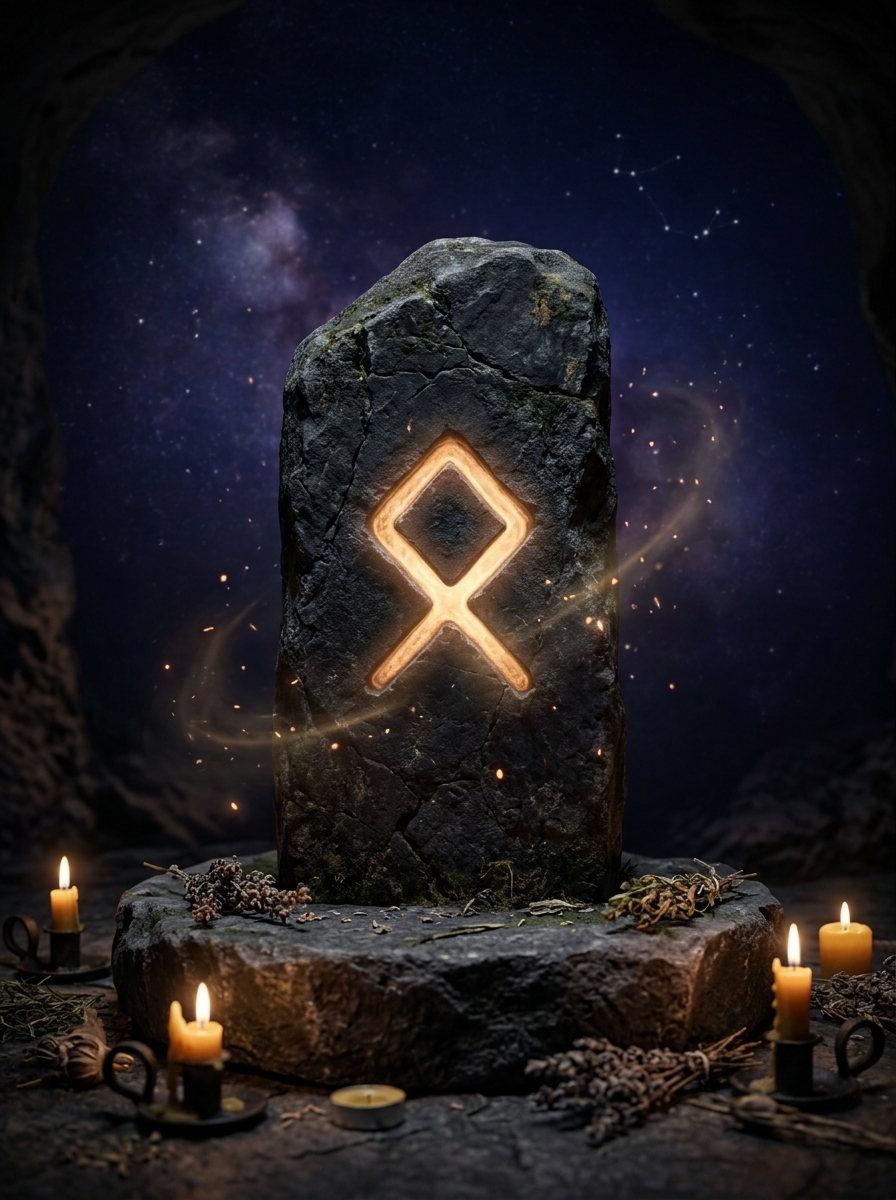
Othala is the rune of legitimate tenure
Othala names what is inherited by right — not only land or property, but the psychic architecture of belonging that makes a life coherent. Its Proto-Germanic root points to ancestral estate, yet the rune’s terrain is larger than deeds and wills. It encodes the idea that a person cannot stand without a place to stand, and that place is always, in some part, received.
The Elder Futhark places Othala last, and that is no accident. The sequence moves from primal creation (Fehu) to shaped experience, and Othala arrives as the container: the house, the lineage, the boundary line that keeps a gathered life from scattering. Without Othala, the energies of the earlier runes have nowhere to stabilize. It is the rune of continuity, of what persists after the work is done — and what must be consciously chosen, not merely accepted.
The enclosure shape and its meaning
Visually, Othala resembles a fenced field or an enclosed courtyard. That form is not decorative. It declares that inheritance depends on a threshold. Land was never just soil in the old Germanic world; it was the visible marker of identity, burial ground, legal standing, and the place where ancestors remained socially present. A person’s worth was tied to the bounded ground they belonged to, whether through birth or sworn allegiance.
This is why Othala can feel both sheltering and confining. A home protects; a lineage blesses. But a boundary also excludes, and a family story can script a life before it begins. The rune does not sentimentalize inheritance. It asks what has been received legitimately, and whether that gift — material or emotional — is still alive.
The psychology of inherited belonging
Othala operates as an inner architecture long before it shows up as a house or legal document. The self is never born into a vacuum; it emerges inside an already-built psychic dwelling: language, family habits, cultural assumptions, the emotional climate of a childhood home. This is the inheritance that matters most — the set of often-unspoken rules about what is safe, what is shameful, what is possible.
When the rune appears upright in a reading, it often signals a period of consolidation. A person is stabilizing after dispersion, finally able to define nonnegotiables. This is not about building from scratch but about recognizing what already belongs — a role, a place, a set of skills, a relationship to tradition. Othala upright asks for discernment: separate what nourishes from what merely repeats trauma or obligation. Not every inherited pattern deserves preservation. The rune supports the conscious editing of one’s legacy, preserving the useful and releasing the rest.
Psychologically, this rune corresponds to what Jung called the ancestral complex — the way family ghosts live through the personal psyche. Othala does not pathologize that inheritance; it insists that you occupy it with awareness rather than habit. The person who draws it may be ready to claim a name, a craft, a land, or a spiritual tradition that was always theirs but never fully inhabited.
The ancestral estate and the final gate
As the concluding rune of the Elder Futhark, Othala carries the weight of completion. The row begins with Fehu (mobile wealth, cattle) and ends with Othala (fixed wealth, land). Between them lie the energies of struggle, transformation, and revelation — but Othala is what remains when the journey has been lived. It is the rune of stewardship, of passing something forward.
In divination, Othala often refers to literal property, family enterprises, or the legal and emotional maintenance of a household. But its deeper resonance is custodial. It asks what you will transmit to the next generation — not only assets but values, stories, curses, and silences. This is why the rune is so tied to place: a piece of ground can hold memory more reliably than abstract identity. A home, a neighborhood, a sacred site can anchor a self that otherwise feels adrift.
The rune’s relationship to ancestral inheritance is not about slavish devotion to the past. Rather, it is about recognizing that the past is active in the present, and that you have the authority to interpret it. The dead do not command; they offer material. Othala makes you the executor of that estate, responsible for what gets kept and what gets given away.
Reversed Othala: fracture and necessary exile
Reversed Othala — often called merkstave in runic tradition — does not announce bad luck; it diagnoses a break in the chain of belonging. This can show up as estrangement from family, loss of home, contested inheritance, or the painful realization that a structure once assumed to be secure no longer holds. The rune’s enclosure shape is breached; the threshold is compromised.
Merkstave Othala often appears when a person carries a lineage that has turned corrosive: expectations that suffocate, inherited guilt, abandonment, or chronic instability. In these cases, the rune does not insist on reconciliation. Sometimes disinheritance is the only path to truth. The question it poses is not “how do I return?” but “where can a true home be rebuilt?”
There is also a subtler reversed expression: clinging to an inheritance after its meaning has gone. A person may keep the family name, house, or image of respectability while the inner life has already left. Othala reversed exposes this as hollow preservation — tradition that has become a mausoleum rather than a living house. The rune’s task here is diagnostic: it shows the fault line so that the reader can decide whether to repair it or to build elsewhere.
Reading Othala in practice
When Othala appears in a spread, listen for language about boundaries, ancestry, property, legacy, exclusion, roots, or the emotional weather of a home. The rune resists simplistic “yes/no” answers. Upright, it affirms what is truly yours by blood, law, love, or labor — but only if that claim is still alive. Reversed, it warns against false belonging, yet it also clears space for a chosen home.
In love readings, Othala upright can indicate a relationship that feels like home, or a partnership rooted in shared legacy (family, culture, land). Reversed, it may point to estrangement or to a bond that perpetuates toxic family patterns. In career matters, upright Othala favors family businesses, real estate, heritage crafts, or any work that stewards something enduring. Reversed warns against inheriting a position that depletes the self.
The deepest reading, however, is always about the inner dwelling: the part of the psyche where the self lives without performance. Othala asks whether that inner home is secure, whether its walls are your own, and whether you have the keys.
---```
Related
- Raidho Rune Meaning: The Road, the Rhythm, and the Right Order
- Eihwaz Rune Meaning: The Axis of Endurance, Thresholds, and Hidden Change
- Algiz Rune Meaning: Protection, Thresholds, and the Sacred No
- Uruz Rune Meaning: The Raw Power of Vital Force
- Hagalaz Rune Meaning: The Hail That Breaks the Pattern
Comments
Loading comments…