Rhodonite Meaning: The Stone That Teaches the Heart to Stay Present
The Core Trade: Repair Without Pretending
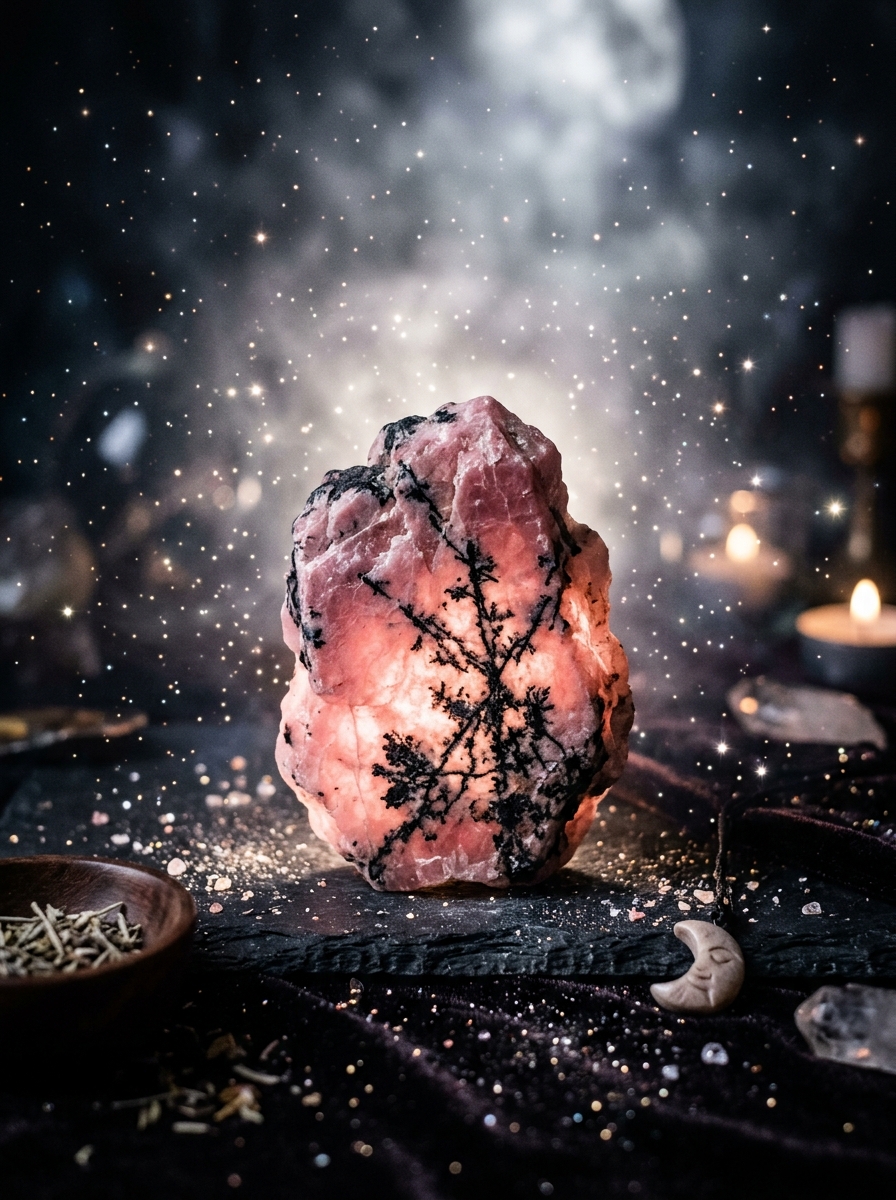
Rhodonite is not a stone of unconditional love. It is a stone of love that has survived disappointment. Its metaphysical signature is the heart that has been broken and decided to stay open anyway — but not naively. Where rose quartz softens, rhodonite clarifies. Where green aventurine attracts luck in emotion, rhodonite metabolizes the residue of what went wrong. The difference is the black matrix that weaves through its pink and raspberry body: a visible record of tension, of the way tenderness and trauma can coexist in the same tissue.
This makes rhodonite the stone of mature attachment. It does not erase the past; it helps the psyche digest it. Someone holding rhodonite after a betrayal is not seeking immediate forgiveness but the capacity to feel the full weight of the hurt without collapsing into bitterness. The stone’s central lesson is that repair does not require forgetting — only integration. That is why it appeals to anyone tracking the shadow side of care: caregivers who resent their own sacrifice, partners who confuse endurance with love, people whose self-blame has become a reflex they mistake for humility.
In Jungian terms, rhodonite works where the heart chakra meets shadow material. It asks the ego to stop performing innocence and instead recognize where pain has hardened into a protective posture. The comfort it offers is not numb; it is the reassurance that your damage does not disqualify you from loving well again. That trajectory — from wound to conscious relationship — is also the arc of the North Node, which describes where growth demands we stretch beyond our default emotional habits. Rhodonite is a practical ally for the friction that kind of stretching provokes.
How It Works: Metabolizing Rather Than Numbing
Rhodonite’s healing function is often described as emotional stabilization, but that phrase only helps if it is made precise. The stone steadies feelings that have a social or relational origin — conflict, rejection, shame, codependency, the kind of anger that turns back on itself. Crucially, it does not anesthetize. It makes feeling more workable by introducing a pause between stimulus and reaction. The nervous system is not told to calm down; it is given a structure within which the anger or grief can be held without destroying the container.
This is why rhodonite is especially useful for people who live in emotional flooding — those whose hearts pour out without boundary — as well as for those who live too far in the head, for whom emotion is an idea rather than a bodily event. The stone draws awareness into the chest and upper torso. It says: feel this, but feel it from a center that can withstand pressure. It is the difference between drowning in a wave and riding it.
The most persuasive evidence of rhodonite’s mechanism lies in its relationship to shame. Shame is a collapsing emotion: “I did something wrong” becomes “I am wrong.” Rhodonite restores moral proportion. It creates space for remorse without self-erasure. That is the precondition for real repair — not absolution, but reintegration. The stone’s capacity to hold that tension makes it a companion for family systems work, estrangement, and long-term resentment. It does not rush reconciliation; it supports the kind of clarity that allows boundaries to be drawn without cruelty.
For a broader symbolic frame, the zodiac provides a language for how archetypes like this one operate: rhodonite’s tone echoes the earthy grounding of Virgo’s discernment and the relational honesty of Libra’s ethics. It is not a stone of easy flow but of conscious alignment.
Chakra and Zodiac: The Heart in the Body of the Sky
Rhodonite belongs most naturally to the heart chakra, but its heart work is embodied rather than airy. It governs the point where feeling becomes action, where empathy must survive contact with real-world limits. Because of that grounding quality, many practitioners also link it to the root chakra as a secondary influence — not from a strict tradition, but from a sensible observation: emotional healing needs safety, and safety has a bodily dimension. Rhodonite’s compassion is not free-floating; it wants the feet on the floor.
Astrologically, the stone resonates with Mars in its matured form — assertion that has learned to pace itself, instinct that no longer needs to dominate. It does not suppress the Martian fire; it channels it into relational truth-telling. This makes rhodonite useful for people with strong Mars signatures who need better emotional pacing, and for anyone trying to turn reactive anger into conscious boundary-setting. It also pairs with Libra (the ethics of reciprocity) and Scorpio (the courage to look directly at what wounds). In a natal chart, the stone often operates like a sextile: it does not force transformation, but it makes the next helpful move more available, enabling the latent potential of a situation without overriding it.
For those working with concentrated emotional complexes, a stellium in the fourth, seventh, or eighth house can intensify the need for exactly this kind of bridge — a stone that does not dissolve the knot but loosens it gently over time.
Using Rhodonite: Contact That Becomes Conversation
The most effective way to work with rhodonite is intimate, repetitive, and specific. It responds to consistent contact because its symbolism is about integration over time. A bracelet or pocket stone worn daily will do more than a display piece on a shelf. Let it accompany the particular emotional weather you want to change. If you are healing from an old breakup, hold it during journaling and name the resentment, the grief, and the boundary you wished you had drawn earlier. If you are navigating a difficult conversation at work, keep it in your pocket — not as a charm, but as a reminder to speak truth without attack.
During meditation, a simple intention works best: Show me what I am still carrying. Place the stone over the heart or rest it in the palm while breathing slowly into the chest. Rhodonite resists escapist visualization; it prefers attention directed toward what has been emotionally split off. That is also why it pairs well with the archetypal pairing of The Emperor and The Sun — the disciplined container and the life-force that shines inside it. Rhodonite sits between those poles, teaching the heart to be sovereign without becoming hard.
In the home, it belongs in the bedroom or a meditation corner — any space where you regroup after contact with the world. On an altar, combine it with objects associated with Venus when you want compassion, or with Mars when you need truthful courage. It also works as a conceptual partner to the Sun sign journey: the stone supports the individuation process by making emotional honesty less frightening.
Choosing and Caring: The Virtue of Memory
Good rhodonite shows pink, rose-red, or raspberry tones interrupted by black manganese veining. That contrast is not a flaw; it is the stone’s identity. Pieces that are too pale may feel gentler but risk losing the corrective edge; darker material carries a more sobering, grounded quality. Choose the one that feels emotionally legible — the right piece often produces a quiet yes in the chest, not a dazzled response.
For cleansing, gentle methods are sufficient: smoke, sound, moonlight, or simply resting the stone on a clean surface. Avoid dramatic or frequent cleansing rituals. Rhodonite’s symbolism is about endurance, and your handling of it should reflect that. If it becomes associated with a specific healing period — a relationship recovery, a period of grief — keep that history. Stones are not always best when they are emotionally blank. Sometimes they are most useful when they remember what they have held.
That is the final virtue of rhodonite: it does not promise perfection, only repair with memory intact. It belongs to people learning to love without erasing the evidence of what love has cost. The heart is strongest when it can remain open after disappointment — not because it forgot, but because it integrated.
Related
- Prehnite Meaning & Healing Properties: The Stone of Quiet Knowing
- Unakite Meaning & Healing Properties: Green Stone of Repaired Feeling
- Peridot Meaning: The Green Fire of Renewal
- Amazonite Meaning & Healing Properties: The Stone of Clear Boundaries
- Smoky Quartz Meaning: Grounding, Protection, and Clear Sight
Comments
Loading comments…