Neptune in Leo: The Sacralization of Creative Self-Expression
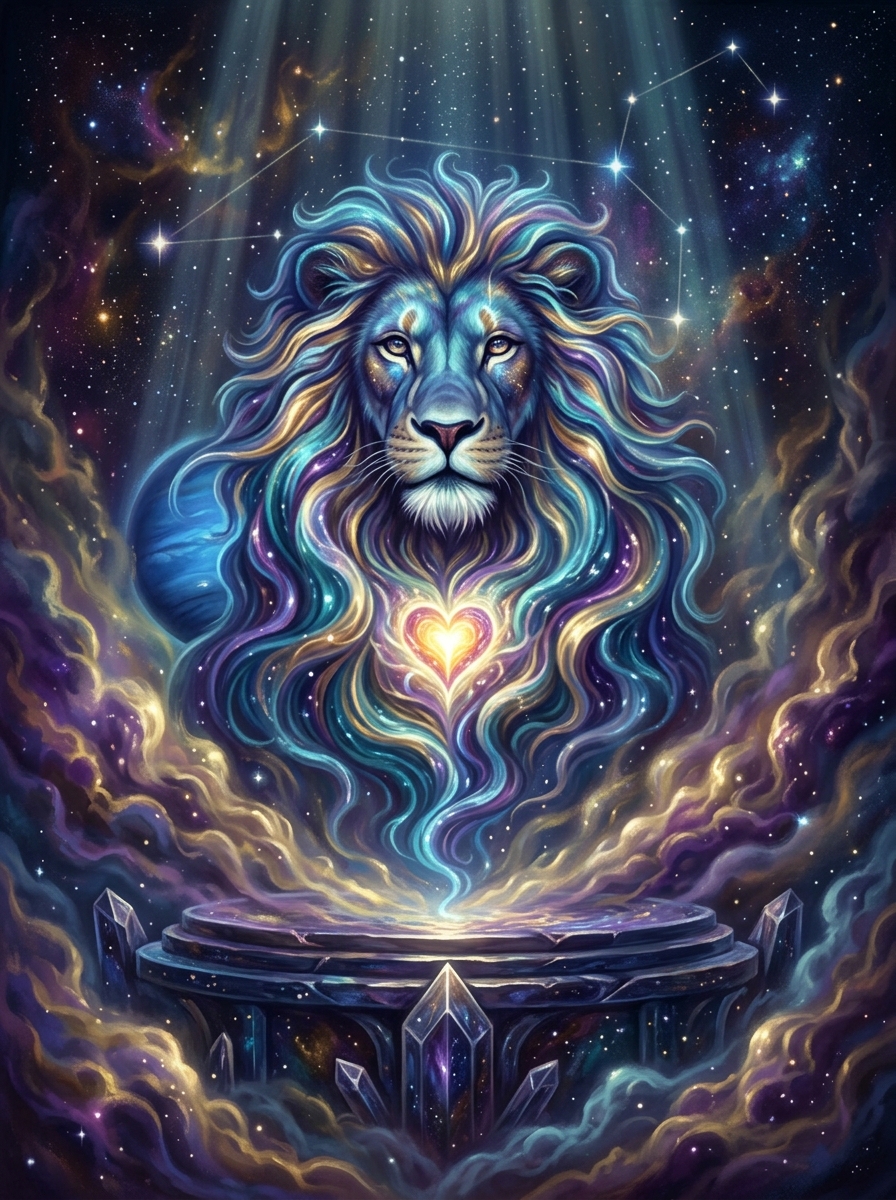
The Alchemy of Fire and Water: Neptune and Solar Leo
The entry of Neptune, the planet of spiritual dissolution, mystical transcendence, and the collective unconscious, into the solar fire of Leo represents one of the most dynamic and contradictory planetary combinations in astrology. Archetypally, Neptune rules the vast, oceanic realms of the formless, representing the desire to merge back into the source, to dissolve the boundaries of the individual ego, and to find redemption through spiritual surrender. Leo, conversely, is ruled by the Sun—the center of our solar system, the source of light, life, and individual consciousness. Leo seeks definition, creative authorship, personal visibility, and the affirmation of the unique self. When the waters of Neptune mix with the solar fire of Leo, we witness a profound alchemical process: the attempt to sacralize the ego, to turn the personal creative voice into a vessel for the divine.
This combination creates an inherent tension between the need to stand out as a unique individual and the spiritual urge to dissolve that very individuality. In psychological terms, Carl Jung wrote extensively about the process of individuation, where the ego must establish itself before it can relate to the deeper contents of the collective unconscious. Neptune in Leo demands this integration at a cultural and generational level. The Leo archetype naturally seeks to build a temple to the self, celebrating personal identity through drama, performance, and creative output. When Neptune is present, this temple becomes a site of mystical worship, where the individual artist or creator is no longer just expressing their personal feelings, but acting as a channel for the transpersonal dreams and illusions of an entire generation.
This alchemical mixing can lead to two main outcomes. At its highest expression, it allows for the manifestation of art that is truly inspired—art that transcends the ego of its creator and connects the audience directly to the divine source. The solar fire of Leo provides the warm, radiant container through which Neptune’s formless visions can take shape, giving structure and light to what would otherwise remain a nebulous and unreachable realm. However, if the Leo ego is not sufficiently mature or self-aware, the influx of Neptunian waters can lead to inflation, confusion, and a state of psychological glamour. The individual may mistake the collective archetypal forces flowing through them for their own personal power, leading to a state of spiritual and creative delusion.
Ego Dissolution vs. Ego Affirmation
The core struggle of Neptune in Leo lies in the delicate balance between ego dissolution and ego affirmation. Leo demands that we say, "I am here, look at what I have made," while Neptune whispers, "You are nothing, and what you have made belongs to the infinite." For the individual with this placement in their birth chart, this can manifest as a deep, underlying confusion regarding their personal worth and creative identity. They may feel a powerful urge to create, to be seen, and to be celebrated, yet whenever they attempt to step into the spotlight, they are met with a sense of emptiness or a feeling that the person they are presenting is merely a mask, an illusion.
This tension is beautifully analyzed by astrologer Liz Greene, who notes that the shadow of Leo is often found in its desperate need for external approval and its fear of insignificance. When Neptune is placed in this sign, the need for validation becomes tied to the search for spiritual redemption. The individual may seek to dissolve their sense of isolation through the adoration of an audience, using creative expression as a drug to numb the pain of the separate ego. In this state, the creative act is not a genuine expression of the self, but a desperate attempt to escape the limitations of the self. To resolve this conflict, one must learn to view the ego not as the ultimate destination, but as a necessary instrument—a solar prism that breaks the white light of Neptune's infinite inspiration into a spectrum of tangible, creative acts.
The Mystical Heart of the Solar King
To understand the deeper spiritual potential of Neptune in Leo, we must look beyond the external drama and focus on the mystical heart of the solar king. Leo is associated with the heart center, the seat of courage, generosity, and unconditional love. When Neptune influences this center, it introduces a element of universal compassion and divine devotion. The Leo drive to rule and to be admired is transformed into a desire to serve through inspiration. The ruler becomes the spiritual guide, and the act of creative expression becomes an act of sacred play, what the esoteric traditions call lila—the divine game of creation.
Steven Forrest, in his evolutionary approach to astrology, highlights the importance of the Sun as the symbol of the present moment and the active will. With Neptune in Leo, the active will must learn to surrender to the flow of inspiration without losing its capacity for conscious choice. This is the path of the spiritual artist, who creates not to build a monument to their own greatness, but to establish a bridge between the human and the divine. By centering their efforts in the heart, the individual can bypass the trap of solar vanity and allow the oceanic love of Neptune to radiate outward, warming the world with a sense of wonder, playfulness, and sacred joy.
The Generational Signature of 1914–1929
To see the collective manifestation of Neptune in Leo, we must look back at the historical cohort born between 1914 and 1929. This was a generation that came of age during a period of massive global upheaval, defined by the trauma of the First World War, the economic volatility of the 1920s, and the eventual crash of 1929. The planetary cycles of the outer planets describe these collective shifts, and Neptune's transit through Leo shaped the dreams, fantasies, and cultural expressions of this era, giving rise to the Roaring Twenties—an era of unprecedented artistic experimentation, theatricality, and a desperate search for collective transcendence.
The generation born with Neptune in Leo felt a deep, collective urge to reject the rigid, structured realities of the past (which had culminated in the devastation of the war) and instead immerse themselves in a world of fantasy, rhythm, and creative self-reinvention. The cultural landscape of the 1920s was characterized by a distinct Neptunian quality: the dissolution of traditional social boundaries, the rise of mass media, and the idealization of youth, beauty, and glamour. It was a time when the collective unconscious projected its desires onto the silver screen and the jazz club, seeking salvation not through traditional religious structures, but through the intoxicating power of art, music, and performance.
However, this generational signature also carried the seeds of its own dissolution. The euphoria of the Jazz Age was underpinned by a profound sense of disillusionment and existential dread—a classic manifestation of Neptune's shadow. The frantic pursuit of pleasure and self-expression was often a way to escape the haunting memories of a shattered world. The era ended abruptly with the Great Depression, a cold confrontation with material reality that shattered the collective illusion of endless prosperity and artistic omnipotence, forcing the Neptune in Leo generation to ground their creative visions in the harsh realities of survival.
The Jazz Age and the Soundtrack of Transcendence
The rise of jazz music during this transit is one of the most vivid examples of Neptune in Leo’s cultural impact. Jazz, with its emphasis on improvisation, syncopation, and collaborative flow, represents a perfect musical expression of Neptunian dissolution meeting Leo’s expressive fire. In a jazz ensemble, individual musicians take turns stepping into the spotlight to deliver a solo—a purely Leo act of self-assertion and creative authorship. Yet, this individual expression is entirely dependent on, and integrated into, the collective rhythm of the band, dissolving the boundary between the soloist and the group.
The jazz clubs of the 1920s served as modern temples of ecstasy, where people from different social classes and backgrounds gathered to lose themselves in the music. The boundaries of race, class, and gender were temporarily dissolved under the influence of the rhythm, representing a literal manifestation of Neptune’s capacity to break down barriers. The music itself was seen as both liberating and dangerous, reflecting the archetypal fear of the irrational and the oceanic that Neptune always evokes in conventional society. For this generation, jazz was not merely entertainment; it was a spiritual lifeline, a way to experience the sacred fire of life in the midst of a disillusioned world.
Dadaism, Surrealism, and the Screen of Dreams
In the visual arts, the Neptune in Leo generation witnessed the birth and maturation of Dadaism and Surrealism, movements that directly challenged the rational ego and sought to bring the images of the unconscious mind into the light of day. Surrealism, influenced by the psychological theories of Sigmund Freud and Carl Jung, sought to liberate the creative imagination from the control of reason. This is a pure manifestation of Neptune (the unconscious, dreams, fantasy) operating through Leo (artistic creation and self-expression). The surrealist artists did not paint the external, material world; they painted the landscape of their dreams, using their technical skill to give form to the formless.
Simultaneously, the rapid development of cinema during this period transformed the way humanity dreamed. Cinema is the ultimate Neptunian medium—a projection of light and shadow on a screen in a darkened room, creating a shared illusion that feels entirely real. The movie stars of the 1920s became the new solar royalty, idealized icons upon whom the public projected their deepest fantasies of romance, adventure, and beauty. This idealization of the actor and the performer is a direct expression of Neptune in Leo, where the human individual is elevated to the status of a living myth, embodying the collective dreams of millions.
The Myth of the Tragic Genius and the Shadow of Leo
Every astrological archetype has its shadow, and for Neptune in Leo, this shadow is exceptionally dramatic, colorful, and destructive. When the ego-affirming drive of Leo is infected by the boundaryless, escapist tendencies of Neptune, it can give rise to the myth of the "tragic genius." This myth suggests that true artistic greatness requires suffering, isolation, and ultimately, self-destruction. The individual with this placement may come to believe that their creative gifts are inextricably linked to their pain, leading them to actively cultivate a life of drama, chaos, and instability in order to fuel their art.
The shadow of Neptune in Leo is also characterized by a profound sense of creative entitlement and narcissistic inflation. Because Leo seeks to be the center of attention, and Neptune represents the divine, the combination can lead to the belief that one's personal creative output is of cosmic importance, and that the ordinary rules of human conduct and responsibility do not apply to the artist. This inflation can isolate the individual from healthy, grounding relationships, creating a feedback loop where they become increasingly dependent on their own fantasies and the adoration of a real or imagined audience to sustain their fragile sense of self.
When the external world fails to validate this inflated self-image—as it inevitably must—the individual is plunged into a state of deep Neptunian disillusionment and despair. The transition from the solar heights of creative inspiration to the oceanic depths of depression and hopelessness can be rapid and severe. To escape this pain, the individual may turn to various forms of addiction or escapism, further fueling the cycle of self-destruction and reinforcing the very myth of the tragic artist that entrapped them in the first place.
Narcissistic Idealization and Ego Inflation
At the heart of the Neptune in Leo shadow is the process of narcissistic idealization. In psychological terms, idealization occurs when we project our internal image of perfection onto an external object, person, or, in this case, our own creative persona. The individual may become enamored with the image of themselves as a great, misunderstood creator, focusing more on the glamour of being an artist than on the actual, disciplined work of creation. This is what Aleister Crowley might describe as a form of spiritual vanity, where the seeker becomes obsessed with the psychic phenomena and the status of attainment rather than the actual attainment itself.
This ego inflation is particularly insidious because it often hides behind a mask of sensitivity and artistic vulnerability. The individual may present themselves as too delicate, too spiritual, or too creatively refined for the mundane world, using their sensitivity as a shield against criticism and accountability. They demand that others treat them with the reverence due to a solar deity, while offering little genuine warmth or reciprocity in return. This dynamic destroys relationships and creative partnerships, as the individual is unable to see others as separate, valuable human beings, but only as mirrors meant to reflect their own Neptunian glory.
The Cycle of Addiction and Self-Destruction
When the illusions of the inflated ego begin to crumble, the Neptunian urge for escape often manifests as addiction. Whether through alcohol, drugs, toxic relationships, or compulsive drama, the individual seeks to numb the pain of their perceived creative failure or lack of recognition. In the historical generation of 1914–1929, this was represented by the legendary excesses of the Jazz Age, where the desperate pursuit of the "high" was a direct response to the spiritual void left by the war and the rapid modernization of society.
This self-destructive pattern is often romanticized, but astrologer Steven Forrest warns that it represents a failure to integrate the archetype. True Neptunian transcendence does not require the destruction of the physical vessel or the neglect of earthly responsibilities. Instead, the individual must learn to find their spiritual connection within the discipline of their craft. By treating the creative process as a form of spiritual practice—a daily ritual of showing up and doing the work—they can ground the solar fire of Leo and allow the waters of Neptune to cleanse and inspire them, rather than drown them in escapism.
The Sacralization of Art: Creative Expression as a Path of Redemption
Despite the significant dangers of its shadow, Neptune in Leo offers a profoundly beautiful path of spiritual redemption through the sacralization of art. When we treat creative expression not merely as a career, a hobby, or a means of self-promotion, but as a sacred duty and a spiritual discipline, we align with the highest potential of this placement. In this view, the studio, the stage, and the writing desk become altars where the artist performs a ritual of transformation, translating the formless, divine inspirations of Neptune into the radiant, solar forms of Leo.
This approach requires a fundamental shift in how we view the role of the creator. The artist is no longer seen as the sole owner or originator of their ideas, but as a humble custodian, a translator of the collective unconscious. This perspective is deeply aligned with the psychological views of Carl Jung, who believed that great art arises from the deeper layers of the psyche, carrying messages that the conscious mind needs to hear. By surrendering the ego's demand for control and ownership, the artist can become a pure channel for these healing, archetypal images, offering them to the world as a source of collective renewal and inspiration.
When art is sacralized in this way, the creative process itself becomes redemptive. The act of shaping raw material—whether paint, words, sound, or movement—forces the creator to engage with the limitations of the physical world, grounding the airy, elusive visions of Neptune. At the same time, the focus on beauty, harmony, and expression elevates the creator’s consciousness, connecting them to a sense of purpose that transcends their personal worries and anxieties. The work of art becomes a mirror in which both the creator and the audience can catch a glimpse of their own divine, solar nature.
The Artist as a Spiritual Conduit
To act as a spiritual conduit, the individual with Neptune in Leo must cultivate a state of receptive awareness. They must learn to quiet the noisy demands of the solar ego—the desire for fame, the fear of failure, the need to impress—and listen to the quiet, intuitive impulses that arise from the Neptunian depths. This requires a high degree of psychological maturity and inner discipline, as the creator must be able to distinguish between genuine, transpersonal inspiration and the ego's own desires and fantasies.
This process is akin to the tarot card of the Star, which represents hope, inspiration, and the pouring out of spiritual waters upon the earth. The figure in the Star card kneels, showing humility, while pouring water from two pitchers—one onto the land (representing the grounding of inspiration in physical form) and one into the water (representing the return of the soul's energy to the universal source). This is the ideal posture for the Neptune in Leo creator: humble, receptive, and committed to sharing the divine waters of inspiration with the world, without seeking to hoard or claim them as personal property.
The Future Transit: Neptune in Leo (2079–2093)
Looking ahead to the late 21st century, Neptune will once again enter the sign of Leo, spanning the years 2079 to 2093. While it is impossible to predict the exact details of this future era, we can use our understanding of the archetypal dynamics of Neptune in Leo to project how this transit might manifest in a world that will be technologically, socially, and ecologically vastly different from our own. This future period will likely witness a profound revolution in how humanity defines identity, art, and spirituality, driven by the integration of advanced technologies and new forms of creative expression.
By 2079, the boundaries between the physical and virtual worlds will likely have dissolved to a degree that is difficult for us to imagine today. We can expect Neptune in Leo to manifest through these new digital landscapes, transforming them into sites of collective myth-making and spiritual exploration. The Leo drive for self-expression and visibility will find new outlets in virtual reality, artificial intelligence, and synthetic media, allowing individuals to create and inhabit entirely new identities and worlds. This could lead to an unprecedented democratization of artistic creation, but also to new, highly sophisticated forms of illusion, projection, and psychological escape.
Furthermore, as the world faces the ongoing challenges of ecological transition and social restructuring, the Neptune in Leo generation of the late 21st century will be tasked with finding new sources of hope, inspiration, and collective identity. They will need to cultivate a new form of spiritual courage—a solar heart that can face the uncertainties of the future with love, playfulness, and a commitment to co-creating a more beautiful and harmonious world.
Technological Expression and Virtual Identities
During the 2079–2093 transit, we are likely to see the emergence of art forms that merge human consciousness directly with technological systems. Neptune rules telepathy, merging, and the dissolution of boundaries, while Leo rules the creative act. We might see the rise of "neural art," where artists project their inner mental images, feelings, and dreams directly into digital spaces, allowing audiences to experience them not just visually or auditorily, but as direct sensory and emotional experiences. This would represent the ultimate realization of Neptune's desire to dissolve the boundary between the artist's inner world and the outer reality of the audience.
However, this technological dissolution of boundaries will also bring significant challenges. The temptation to escape from the difficult realities of the physical world into highly idealized, customized virtual paradises will be immense. The Leo shadow of narcissistic inflation could run rampant in a world where anyone can create a virtual universe in which they are the undisputed, solar ruler. The collective challenge of this period will be to ensure that these powerful technologies are used to enhance human connection, empathy, and genuine spiritual growth, rather than to isolate individuals in loops of digital self-absorption and illusion.
Integrating Neptune in Leo: Personal and Astrological Growth
For those who carry the signature of Neptune in Leo in their birth charts, or for anyone seeking to work with this energy during its transits, the path to integration requires a conscious effort to balance the fire of the self with the water of the soul. It is a journey of learning how to shine brightly without blinding oneself or others, and how to surrender to the divine flow without losing one's footing in the physical world. This integration is not a one-time event, but an ongoing, daily practice of self-awareness, creative discipline, and spiritual humility.
To begin this integration, one must first recognize the areas where they are prone to Neptunian illusion and Leo vanity. This requires a willingness to examine one's motivations for creating and performing. Am I seeking to share something beautiful and healing with the world, or am I merely trying to feed a hungry ego that fears its own insignificance? By bringing the light of conscious awareness—the solar Sun—to these shadow dynamics, the individual can begin to dissolve the illusions that hold them back, clearing the path for genuine, inspired creation.
Ultimately, the goal is to develop what the esoteric traditions call the "witness consciousness"—the ability to observe one's thoughts, feelings, and creative impulses without immediately identifying with them or reacting to them. From this neutral, centered space, the individual can act as a conscious channel for Neptune's inspiration, choosing which visions to bring into physical reality through their Leo creativity, while allowing the rest to flow back into the collective reservoir of the soul.
Overcoming Creative Blocks and Glamour
One of the most common challenges for those working with Neptune in Leo is the experience of profound creative blocks. These blocks are often caused by the fear of failing to live up to the idealized, Neptunian standard of perfection that the individual has set for themselves. They may have a vision in their mind that is so beautiful, so divine, and so boundaryless that any attempt to translate it into the limited, imperfect medium of physical reality feels like a betrayal. As a result, they may choose to remain in the realm of fantasy, never actually producing any work, or starting projects only to abandon them when the reality of the work fails to match the beauty of the dream.
To overcome this block, the creator must practice the art of conscious imperfection. They must accept that physical form is inherently limited, and that a completed, imperfect piece of art is far more valuable and spiritually redemptive than an unmanifested masterpiece of the mind. By embracing the Leo qualities of playfulness, curiosity, and childlike joy, they can lower the stakes of the creative act and allow themselves to experiment, make mistakes, and learn. This process of grounded creation slowly dissolves the glamour of the "tragic genius" and replaces it with the quiet, sustainable satisfaction of the dedicated craftsman.
Frequently Asked Questions
What does it mean to have Neptune in Leo in a birth chart?
In a personal birth chart, Neptune in Leo indicates that your search for spiritual meaning, redemption, and transcendence is deeply connected to your creative expression, self-image, and heart center. You may possess a highly active imagination, a love for drama and theatricality, and a deep appreciation for beauty and the arts. However, you may also struggle with creative blocks, a tendency to idealize your own talents or those of others, and periods of self-doubt or ego inflation. The key to this placement is learning to use your creativity as a spiritual practice, channels of universal love, and finding a balance between expressing your unique identity and surrendering your ego to the collective flow of inspiration.
How does the Neptune in Leo generation differ from other Neptune generations?
Each Neptune generation (spanning roughly 14 years) reflects a collective shift in how humanity dreams, escapes, and seeks spiritual connection. For example, Neptune in Cancer (1902–1915) dreamed of idealized family structures, homeland, and emotional security, while Neptune in Virgo (1929–1943) sought redemption through service, work, and practical efficiency during the Great Depression and World War II. The Neptune in Leo generation (1914–1929) was uniquely focused on the sacralization of the individual, seeking transcendence through the explosion of art, cinema, music (the Jazz Age), and the pursuit of personal glamour and creative freedom.
What is the relationship between Neptune in Leo and the "Roaring Twenties"?
The "Roaring Twenties" was the cultural peak of the Neptune in Leo transit. During this decade, the collective energy manifested as a desperate, ecstatic search for pleasure, beauty, and self-expression as a way to escape the trauma of World War I. This era saw the rise of jazz music, silent and early sound cinema, modernist art movements like Dadaism and Surrealism, and a general obsession with youth, fashion, and social celebrity. The sudden end of this era with the stock market crash of 1929 represents the classic Neptunian pattern of sudden disillusionment and the popping of a collective bubble of illusion.
How can I heal the shadow aspects of my Neptune in Leo placement?
Healing the shadow aspects of Neptune in Leo—such as narcissistic inflation, creative entitlement, and self-destructive escapism—requires grounding your creative energy in practical discipline. Instead of waiting for perfect, divine inspiration or focusing on the glamour of being an artist, commit to a daily routine of creative practice. Work on cultivating humility by recognizing that your inspirations are gifts to be shared, not personal possessions that make you superior to others. Additionally, seek out healthy, grounding relationships that challenge your tendency to create unnecessary life drama, and practice finding spiritual peace in the simple, quiet moments of daily life.
What can we expect from the next Neptune in Leo transit in 2079–2093?
While the future is unwritten, the next transit of Neptune in Leo will likely bring a massive revolution in art, technology, and identity. We can expect to see the boundaries between physical and digital self-expression dissolve entirely, perhaps through neural interfaces and highly immersive virtual realities. The collective will search for new forms of meaning and hope in a highly automated and ecologically altered world. The challenge of this future generation will be to avoid the trap of escaping into customized, narcissistic virtual worlds and instead use these technologies to foster genuine global empathy, heart-centered collaboration, and creative play.
Comments
Loading comments…