Uranus in Leo: The Revolutionary Sovereign and the Fire of Individual Will
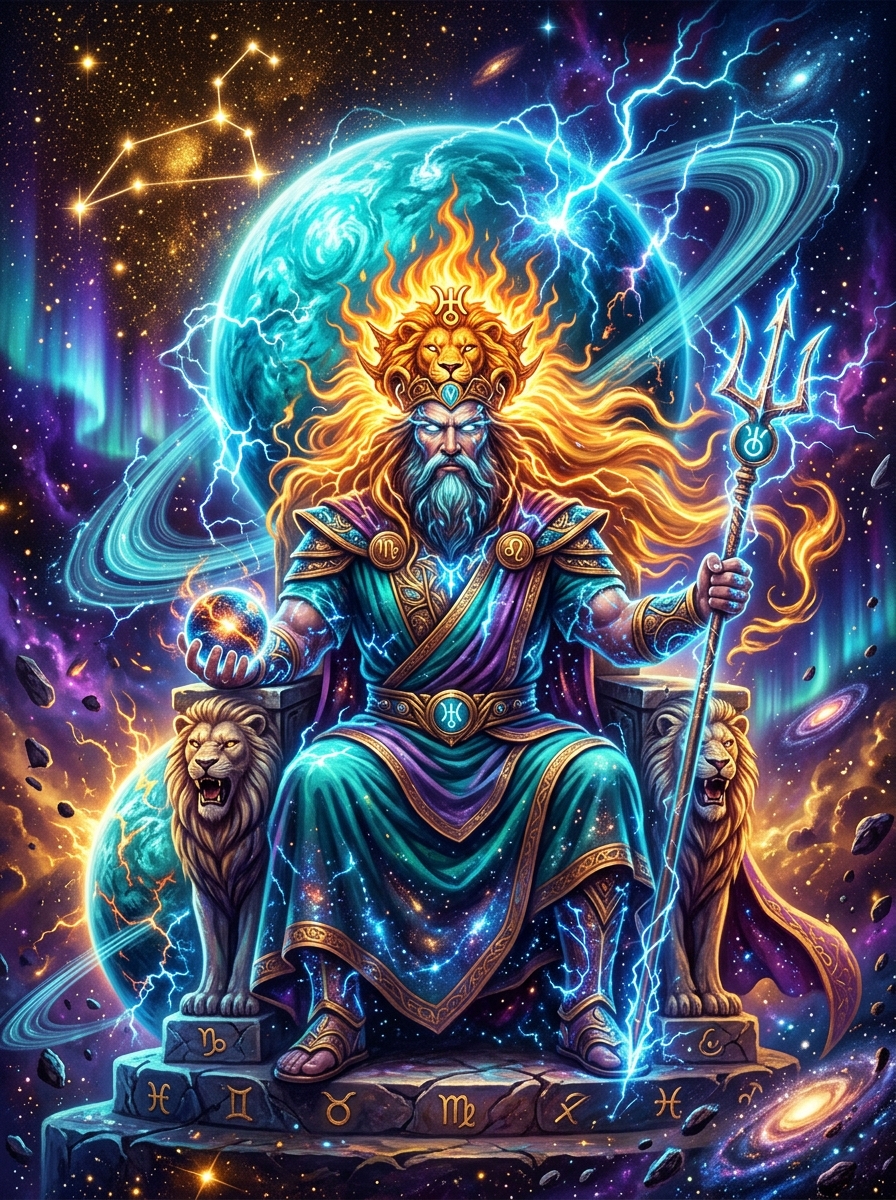
The Promethean Fire in the House of the Sun: Uranus in Detriment
In the vocabulary of classical and psychological astrology, the placement of a planet in its detriment, or exile, signals a fundamental tension between the intrinsic nature of the planetary archetype and the stylistic demands of the zodiacal sign it occupies. Uranus, the sky-god associated with sudden illumination, collective evolution, systemic disruption, and the objective, transpersonal realms of consciousness, finds its natural home in Aquarius. Aquarius is a sign of cool, air-mediated objectivity, social systems, and the collective hive-mind. When Uranus transits Leo—the fixed fire sign ruled by the Sun, representing the radiant center of the individual ego, subjective self-expression, and the mythic quest for personal sovereignty—it enters its detriment. This positioning forces a dramatic, often turbulent synthesis: the transpersonal lightning bolt of Uranus must channel itself through the highly personal, localized lens of the Leo ego.
Liz Greene, in her seminal work on the psychological dimensions of the outer planets, notes that Uranus in detriment creates an acute psychological conflict between the need to belong to a broader collective purpose and the burning desire to be recognized as an utterly unique, self-begotten individual. Uranus demands reform, objectivity, and the deconstruction of personal attachments in favor of universal progress. Leo, by contrast, operates on the principle of subjective centering; it is the child-king of the zodiac, seeking to radiate outward from its own creative core, demanding validation, loyalty, and personal visibility. When these two forces collide, the Uranian urge for revolution is personalized, and the Leo urge for self-expression is radicalized.
This results in a psychological posture where the individual does not merely advocate for freedom in the abstract; they demand that their personal freedom, their creative output, and their unique identity be recognized as a revolutionary event. Carl Jung’s concepts of the ego and the collective unconscious are highly instructive here. In the birth chart, Uranus represents the sudden intrusion of transpersonal psychic material into the conscious mind, a force that disrupts the established ego-boundaries to facilitate a wider individuation. In Leo, the ego attempts to capture this transpersonal lightning, identifying itself with the archetype of the liberator. Instead of serving as a neutral channel for progressive change, the Leo personality may proclaim, "I am the revolution itself."
This displacement of transpersonal energy into personal pride generates a distinct form of existential tension. The individual feels an innate, persistent pressure to break away from standard conventions, yet this rebellion is not quiet or detached. It is dramatic, expressive, and deeply concerned with legacy and impact. The challenge for those with Uranus in Leo is to learn how to tolerate the decentering energy of Uranus without letting it shatter the ego, and conversely, how to express their creative genius without succumbing to the delusion that they are the sole creators of the light they channel. It is the complex task of marrying the objective truth of the sky-god with the subjective warmth of the solar king, a process that requires the transmutation of raw willful pride into conscious, heart-centered sovereignty.
The Exile of the Transpersonal in the Domain of the Personal
Under the influence of Uranus in Leo, the transpersonal dimension of life is stripped of its safety features. In Aquarius, Uranus can remain safely abstract, formulating theories for the betterment of humanity from a comfortable intellectual distance. In Leo, however, these theories must be lived, felt, and expressed through the physical vehicle of the creative self. The transpersonal becomes deeply personal. When the Uranian archetype of the rebel-reformer is filtered through fixed fire, it manifests as an intense subjective urgency. The individual cannot simply support a cause; they must embody it, often leading to a state of creative isolation where they feel simultaneously superior to the collective and deeply alienated from it.
This tension is further compounded by the fixed modality of Leo. Leo stabilizes, concentrates, and preserves. When combined with the erratic, volatile nature of Uranus, this fixed quality can lead to an ideological rigidity. The individual may develop highly unconventional, radical beliefs, but once those beliefs are formed, they defend them with solar stubbornness. The revolutionary impulse becomes institutionalized within their own psyche. They become dogmatic about their non-conformity, creating a paradox where their pursuit of absolute freedom manifests as a rigid refusal to adapt to changing external realities. To resolve this, the individual must allow the air of Aquarius—the polarity sign—to cool the fires of Leo, introducing a capacity for self-reflection and objective evaluation that prevents the creative spark from turning into a consuming inferno of self-righteousness.
The Sovereign Rebels: The Generational Wave of 1955–1962
Astrologers view the transit of outer planets through the zodiac as generational markers, shaping the collective unconscious and defining the historical zeitgeist of specific eras. Uranus transited the sign of Leo from approximately 1955 to 1962, a critical epoch in modern history that witnessed the dismantling of post-war social structures and the birth of the modern counterculture. This generation was born into a world defined by the rigid conformity of the early 1950s, characterized by the Cold War, the rise of suburban homogenization, and the traditional authority of the nuclear family. Uranus in Leo acted as a collective detonator, infusing this cohort with an instinctual, non-negotiable need for personal liberation, creative autonomy, and the overthrow of patriarchal constraints.
Steven Forrest has written extensively on the evolutionary necessity of generational transits, describing how each cohort brings a specific medicine to the culture. The Uranus in Leo generation brought the medicine of radical self-dramatization and creative defiance. It was during this period that rock 'n' roll emerged as a dominant cultural force, transforming music from passive entertainment into a visceral, somatic medium of youthful rebellion. Artists like Elvis Presley, Little Richard, and Chuck Berry embodied the raw, solar charisma of Leo fused with the shocking, taboo-shattering energy of Uranus. The body itself became a site of revolution; the way young people moved, dressed, and wore their hair became a direct challenge to the gray-flannel-suit orthodoxy of their parents' generation.
This generation did not merely ask for permission to be different; they seized it through dramatic self-assertion. The rise of Pop Art, led by figures who challenged the boundary between high culture and commercial design, reflected this Uranian dismantling of artistic hierarchies. The canvas was no longer reserved for historical myths or abstract landscapes; it became a space to celebrate and deconstruct the everyday icons of American consumerism. This was also the era that saw the initial stirrings of the sexual revolution, the Civil Rights Movement, and the early stages of second-wave feminism. While Uranus in Cancer (the preceding generation) shook the foundations of the home and family, Uranus in Leo took the battle to the public square, demanding that individual rights, personal pleasure, and the sovereignty of marginalized identities be recognized.
As this cohort matured, they carried this signature of sovereign rebellion into the institutions they inhabited. They became the pioneers of the self-help movement, humanistic psychology, and expressive arts therapies, seeking to democratize the process of individuation. They championed the idea that the ultimate human duty is not to conform to state, church, or corporate expectations, but to become an authentic, self-realized individual. The legacy of the 1955–1962 generation is the widespread cultural acceptance of self-expression as a fundamental human right, a shift that permanently altered the landscape of modern education, art, and personal relationships.
Rock 'n' Roll, Pop Art, and the Cult of Personality
The cultural phenomena of the late 1950s and early 1960s were not accidental occurrences; they were the direct materialization of Uranus in Leo’s archetypal signature. The explosion of rock 'n' roll was the auditory expression of fixed fire being disrupted by electric, Uranian currents. The guitar became a lightning rod, and the stage became a solar altar where the performer radiated a wild, uninhibited individuality. This era also marked the birth of the modern teenager as a distinct demographic and cultural force. Before this transit, youth culture was largely an imitation of adulthood; Uranus in Leo created a distinct, rebellious youth identity that refused to align with traditional adult values.
Simultaneously, the rise of television during this period democratized the "cult of personality." Uranus, ruling technology and broadcasting, joined forces with Leo, the sign of performance and visibility. The home television screen became a mirror reflecting new, radical archetypes of identity directly into the suburban living room. This technological democratization of image-making allowed individuals to see themselves as the protagonists of their own lives, fueling a collective shift toward self-consciousness and personal styling. It was a time when the personal truly became political, and the act of standing out from the crowd was elevated to a moral imperative.
Natal Chart Manifestation: Uranus in Leo Through the Houses
In an individual birth chart, the house placement of Uranus indicates the specific area of life where the person is called to experience radical shifts, breakthroughs, sudden disruptions, and the challenge of establishing authentic individuality. When Uranus is in Leo, these house manifestations are colored by the need for creative control, personal recognition, and a refusal to submit to external authority. The individual will seek to be a sovereign ruler in the affairs of that house, often encountering sudden reversals or self-induced revolutions as they attempt to maintain their independence.
The First House: The Self as a Creative Disruption
When Uranus in Leo occupies the First House, the house of self, physical appearance, and primary identity, the Uranian need for non-conformity is written directly onto the persona. These individuals do not slip quietly into a room; their very presence is a statement of defiance. They project an aura of intense, solar electricity, often characterized by a dramatic personal style, unique expressive gestures, and a refusal to adapt their behavior to suit social etiquette. Psychologically, there is an intense identification with the archetype of the rebel or the outsider. They may deliberately court controversy or shock others to test the strength of their own identity.
This placement suggests a life path punctuated by sudden, dramatic shifts in self-perception and life direction. The individual may periodically "shed" old identities like a snake, reinventing themselves overnight in response to an internal urge for freedom. The challenge here is the integration of the solar ego. Because the First House is the lens through which we view the world, these individuals can easily fall prey to the belief that their personal perspective is the only valid one. They must learn to balance their need for radical authenticity with a capacity to see others as equally sovereign beings, avoiding the trap of using their uniqueness as a weapon to keep others at a distance.
The Fifth House: Radical Self-Expression and Play
The Fifth House is the natural home of Leo, representing creativity, romance, children, play, and the spontaneous joy of being. With Uranus placed here in Leo, this house becomes a theater for radical, experimental self-expression. These individuals are drawn to unconventional forms of art, avant-garde performance, and creative practices that push the boundaries of societal acceptability. They do not create to please a patron or fit into a specific school of thought; they create to discharge an electric, inner vision that demands form. Their creative process is often characterized by sudden bursts of inspiration followed by periods of intense stagnation, reflecting the erratic nature of Uranus.
In matters of romance, Uranus in Leo in the Fifth House demands absolute freedom and excitement. Traditional, predictable relationships feel suffocating to these individuals. They may be drawn to highly unusual partners, open relationships, or sudden, intense love affairs that end as abruptly as they began. The concept of play is also radicalized; they find joy in risk-taking, intellectual games, and activities that challenge their limits. In relation to children, they are likely to adopt an highly progressive, non-traditional approach to parenting, encouraging their offspring to develop independent minds and unique identities from an early age, sometimes to the point of refusing to provide necessary boundaries.
The Seventh House: The Revolutionary Other and Relational Instability
When Uranus in Leo is positioned in the Seventh House, the sector of committed partnerships, marriage, and open adversaries, the Uranian need for freedom and disruption is projected onto the partner. These individuals often attract partners who are highly eccentric, independent, artistic, or unstable—living representatives of the Uranus in Leo archetype. Through these relationships, the individual is forced to confront their own repressed need for independence and rebellion. If they attempt to maintain a conventional, highly controlled partnership, the relationship will inevitably experience sudden, disruptive breakups or external crises that shatter the status quo.
The psychological tension here is profound. Leo in the Seventh House naturally desires a loyal, stable, and adoring partner who acts as a mirror for their own solar majesty. However, Uranus’s presence guarantees that any partner they choose will refuse to play the role of the quiet admirer. The partner will demand their own sovereignty, leading to a constant struggle for dominance and independence within the relationship. To find peace, the individual must internalize the Uranus archetype, acknowledging their own need for relational freedom and creating partnerships based on mutual autonomy, intellectual respect, and a shared commitment to personal growth, rather than traditional ownership or emotional codependency.
Planetary Contacts: Aspects to the Personal Planets
The specific aspects Uranus in Leo makes to personal planets in the birth chart refine and focus its revolutionary energy. These planetary contacts determine how easily the individual can integrate their need for radical self-expression with their basic drives for identity, love, and action.
Solar Ignition: Sun Aspecting Uranus in Leo
When the Sun, the natural ruler of Leo, forms an aspect to Uranus in Leo (especially the conjunction, square, or opposition), the core identity is infused with electric, Promethean energy. This is a configuration of raw, creative genius and intense restlessness. The individual feels an innate, non-negotiable calling to break new ground, challenge established dogmas, and act as a catalyst for change in their chosen field. They possess a powerful, magnetic charisma that can draw others to their cause, yet they are also prone to sudden outbursts of temper and a stubborn refusal to cooperate with any authority they deem illegitimate.
Psychologically, this contact creates an ongoing battle between the desire for social recognition (Sun) and the urge to remain an independent iconoclast (Uranus). The individual may sabotage their own success just as they are about to receive traditional validation, fearing that acceptance by the establishment will compromise their authenticity. To resolve this, they must develop a deep internal security that does not depend on external praise, allowing them to shine their solar light without needing to burn down the temple to prove they are free.
Disruptive Desire: Venus and Mars Contacts
Aspects between Uranus in Leo and the planets of desire and action—Venus and Mars—translate the Promethean impulse into the realms of relationship and drive. When Venus is in contact with Uranus in Leo, the aesthetic sense and relational values are highly unconventional. The individual is attracted to beauty that is jarring, modern, or avant-garde. In love, they require constant stimulation and intellectual compatibility, often experiencing sudden attractions that challenge their existing values. They value autonomy above all else in relationships, and any attempt by a partner to control or domesticate them will result in an immediate withdrawal of affection.
When Mars aspects Uranus in Leo, the drive for action, sexual energy, and willpower are electrified. This is the aspect of the activist, the pioneer, and the radical innovator. The individual acts with immense speed and decisiveness, driven by sudden impulses that can border on recklessness. They have zero tolerance for inefficiency or delay, and their working style is characterized by intense, concentrated efforts rather than steady, routine labor. The danger with this placement is a tendency toward explosive anger and physical accidents, as the high-voltage energy of Uranus can overload the nervous system and the physical body. Learning to ground this energy through physical discipline and structured creative outlets is essential.
The Mythopoetic Clash: Prometheus vs. Apollo in Fixed Fire
To fully grasp the archetypal dimensions of Uranus in Leo, we must look to the mythic narratives that underpin these astrological symbols. This placement represents a profound mythopoetic clash between two distinct expressions of the divine: Prometheus, the titan associated with Uranus, and Apollo, the solar deity associated with Leo. This clash takes place within the psychic landscape of fixed fire, a modality that intensifies and stabilizes the conflict, making it a central theme in the individual's psychological development.
Prometheus is the archetype of the forward-thinking rebel, the champion of humanity who steals the divine fire of knowledge and technology from Mount Olympus to liberate mankind from the tyrannical rule of Zeus. He represents transpersonal intelligence, the urge to transcend limitations, and the willingness to suffer exile and punishment for the sake of future progress. Apollo, on the other hand, represents the solar principle of order, harmony, light, beauty, and conscious ego-awareness. He is the god of the sun, the center of the pantheon, radiating stability, measure, and the civilized arts. Apollo demands reverence for the light, the establishment of clear forms, and the preservation of the cosmic hierarchy.
graph TD
    A[Uranus in Leo] --> B[Prometheus Archetype: Rebel / Liberator]
    A --> C[Apollo Archetype: Solar King / Order]
    B --> D{Psychic Conflict}
    C --> D
    D --> E[Exile & Detriment: Tensions of Fixed Fire]
    E --> F[Synthesized Individuation: Conscious Creative Will]
When these two deities are forced to share the same space in the psyche under the influence of Uranus in Leo, a dramatic tension arises. Prometheus wishes to distribute the fire to all of humanity, destroying the hierarchy and leveling the playing field (an Aquarian, Uranian impulse). Apollo wishes to remain the central source of light, maintaining his unique, exalted status as the sun god (a Leo impulse). The individual with this placement feels this conflict as an internal division: should they use their creative fire to elevate themselves and stand above the crowd as a unique, Apollonian creator, or should they use it to serve the collective, Promethean evolution of humanity, even if it means losing their personal specialness in the process?
Aleister Crowley, in his writings on esoteric astrology, often alluded to the need to balance the individual will (Thelema) with the universal law of love. In the context of Uranus in Leo, this means realizing that the "fire" we possess is not our personal property; it is a spark of the universal divine light. The Promethean theft is only justified if the fire is brought down to warm the hearths of all humanity, not to light a private spotlight for the ego. Arthur Edward Waite, in his design of the Sun card in the tarot, depicted a young, innocent child riding a white horse under a radiant sun, symbolizing the pure, uncorrupted expression of the solar ego aligned with the divine will. For Uranus in Leo, the goal is to achieve this state of conscious, child-like innocence, where the ego is no longer a rigid fortress defending its pride, but a transparent vessel through which the transpersonal light of the sky-god can shine clearly.
Integration and Shadow Work: Navigating Ego Inflation and Narcissism
Every astrological placement has its shadow expression, and for Uranus in Leo, this shadow is particularly potent due to the planet's state of detriment. The primary psychological hazard of this placement is ego inflation—a state where the personal ego identifies with the transpersonal power of the Uranus archetype, leading to feelings of grandiosity, narcissism, and a pathological need to be perceived as unique or revolutionary.
Because Leo rules the heart and the creative ego, and Uranus rules sudden disruption and detachment, this combination can produce a personality that is highly charismatic but emotionally cold. The individual may love "humanity" in the abstract (Uranus) while treating the actual human beings in their immediate life with indifference or contempt, viewing them as mere spectators for their solar performance. This is the classic signature of the narcissistic reformer, who believes that their vision for the future is so superior that they are exempt from the basic rules of human relationship and ethical behavior. They may use their non-conformity as a shield to avoid genuine intimacy, claiming that others are simply "too conventional" to understand them, when in reality, they are terrified of the vulnerability required to meet another person as an equal.
graph LR
    A[Unintegrated Shadow] --> B[Ego Inflation & Narcissism]
    A --> C[Anti-Authoritarian Dogmatism]
    A --> D[Relational Alienation]
    E[Integrated Sovereignty] --> F[Saturnian Creative Discipline]
    E --> G[Heart-Centered Vulnerability]
    E --> H[Humility before the Transpersonal Light]
To integrate this placement, the individual must engage in deep shadow work focused on their relationship to authority and validation. They must examine their anti-authoritarian impulses to determine if they are fighting for genuine freedom, or if they are simply throwing an ego-tantrum because someone else is currently holding the spotlight. True authority, as Liz Greene points out, does not come from defying others; it comes from establishing an internal relationship to the Self, the psychic center that transcends both the ego and the collective.
Grounding this electric, Leo-Uranian fire requires the cultivation of Saturnian discipline. Uranus provides the sudden flash of creative genius, but without the structure, patience, and labor of Saturn, that flash will remain a fleeting spark that leaves behind nothing but ashes. The individual must learn to commit to the tedious, daily practice of their craft, allowing their ideas to be tested, refined, and shaped by the limits of reality. By subjecting their unique vision to the fire of practical execution, they transform their volatile rebellion into a lasting, conscious sovereignty that can serve as a genuine source of illumination for the world.
Grounding the Spark: From Rebellion to Creative Mastery
The shift from reactive rebellion to conscious creative mastery is the ultimate task of the Uranus in Leo individual. This shift requires a willingness to surrender the superficial pleasure of shocking others in favor of the deeper satisfaction of creating works of lasting value. It demands that they cultivate a capacity for listening, empathy, and collaboration, recognizing that true genius is not isolated, but exists in dialogue with the culture and the community.
When the Leo ego learns to bow before the transpersonal light of Uranus, a beautiful alchemy occurs. The individual becomes a conscious co-creator with the universe, utilizing their unique style, warmth, and charisma to make the revolutionary insights of Uranus accessible and inspiring to others. They no longer need to demand attention; their work shines with an innate, solar authority that naturally draws others to its light. They become the true sovereign: self-ruled, creatively free, and deeply committed to the liberation of the collective.
Frequently Asked Questions
What does it mean that Uranus is in "detriment" in Leo?
A planet is in detriment when it occupies the sign opposite to the one it rules. Uranus rules Aquarius, a sign of collective networks, objectivity, and mental detachment. Leo is the sign of the individual ego, subjective self-expression, and personal drama. Therefore, when Uranus is in Leo, its natural transpersonal, disruptive energy is forced to express itself through the personal, subjective lens of Leo. This creates a psychological tension between the urge to merge with the collective and the desire to stand out as a unique individual. It is a placement that requires constant work to balance personal pride with transpersonal service.
How did the Uranus in Leo generation impact modern society?
The generation born between 1955 and 1962 carried Uranus in Leo as a collective birthmark. They were the catalysts for the modern counterculture, dismantling the rigid social conformity of the post-war era. They birthed the rock 'n' roll revolution, popularized Pop Art, and initiated major social movements centered on personal liberation, civil rights, and early environmentalism. Their long-term impact was the normalization of self-expression, self-realization, and individual authenticity as fundamental cultural values, shaping modern psychology, education, and lifestyle choices.
What are the main shadow aspects of Uranus in Leo?
The primary shadow aspects include ego inflation, narcissism, ideological rigidity, and a pathological need to be seen as special or rebellious. Individuals may identify too strongly with the archetype of the reformer, believing they are above the rules that govern others. This can lead to relational alienation, where they reject conventional intimacy out of a fear of losing their independence, using their non-conformity as a defense mechanism to avoid vulnerability.
How does Uranus in Leo affect personal relationships?
In relationships, Uranus in Leo demands high levels of independence, excitement, and mutual respect. Traditional, controlling relationship dynamics often trigger sudden breakups or dramatic conflicts. Those with this placement need partners who respect their creative autonomy and do not demand constant submission or validation. When integrated, it allows for relationships based on conscious partnership, where both individuals are encouraged to shine in their own right without threatening the other's sovereignty.
What career paths are best suited for individuals with Uranus in Leo?
Individuals with this placement thrive in careers that allow for creative autonomy, innovation, and personal leadership. They make excellent entrepreneurs, avant-garde artists, progressive educators, and technology pioneers who use their personal charisma to introduce revolutionary ideas. They struggle in highly bureaucratic, rigid corporate structures where they are expected to conform without question, requiring professional environments where their unique voice and disruptive insights are valued.
Comments
Loading comments…