The Lunar Nodes: A Complete Guide to Your Karmic and Evolutionary Axis
What Are the Lunar Nodes? Astronomical Calculations, Movement, and Mythological Origins
To understand the Lunar Nodes, one must first step away from the physical bodies that populate our solar system. Unlike Mars, Venus, or the Moon itself, the Lunar Nodes do not possess physical mass. They are not spheres of rock, dust, or gas orbiting the Sun. Instead, they are mathematical points of intersection—dynamic thresholds where the Moon's orbit around the Earth crosses the ecliptic, which is the Sun's apparent path across the sky from our perspective on Earth. Specifically, the point where the Moon moves from south to north of the ecliptic is designated as the North Node, and the point where it crosses from north to south is the South Node. Because they are calculated based on the relationship between the Earth, Sun, and Moon, they represent a synthesis of our core astrological components: the Sun (the conscious self, vital purpose, and future direction), the Moon (the subconscious mind, emotional patterns, and past conditioning), and the Earth (the physical arena where these energies are integrated and lived).
In terms of astronomical movement, the nodal axis moves backward through the zodiac. While the Sun, Moon, and planets move forward through the signs (with occasional periods of retrograde motion), the Lunar Nodes maintain a precessional, retrograde motion as their primary state, completing a full circuit of the zodiac approximately every 18.6 years. This backward movement immediately marks them as distinct, representing a counter-current to the forward flow of conscious chronological time. It signals that we are dealing with something pre-personal, karmic, and deeply linked to the unconscious undercurrents of the psyche.
Astronomical Intersection of Sun and Moon
The geometry of the nodes is essential to their metaphysical meaning. The ecliptic represents the path of the Sun—our light, our destiny, our conscious evolution. The Moon's path represents our instinctual, emotional, and historical self. Where these two paths intersect, we find the nodes. This intersection is the only place in the heavens where eclipses can occur. When a new moon or full moon happens in close proximity to the Lunar Nodes, the alignment is precise enough that one body casts a shadow over the other, creating a solar or lunar eclipse. Metaphysically, this indicates that the nodes are portals where the past (the Moon) and the future (the Sun) collide, forcing a realignment of the soul's path. The retrograde motion of the nodes reinforces this, indicating that growth along this axis is not a straightforward, linear progression but a spiral that requires us to look backward into our history in order to move forward cleanly into our destiny.
The Mythological Dragon: Rahu and Ketu
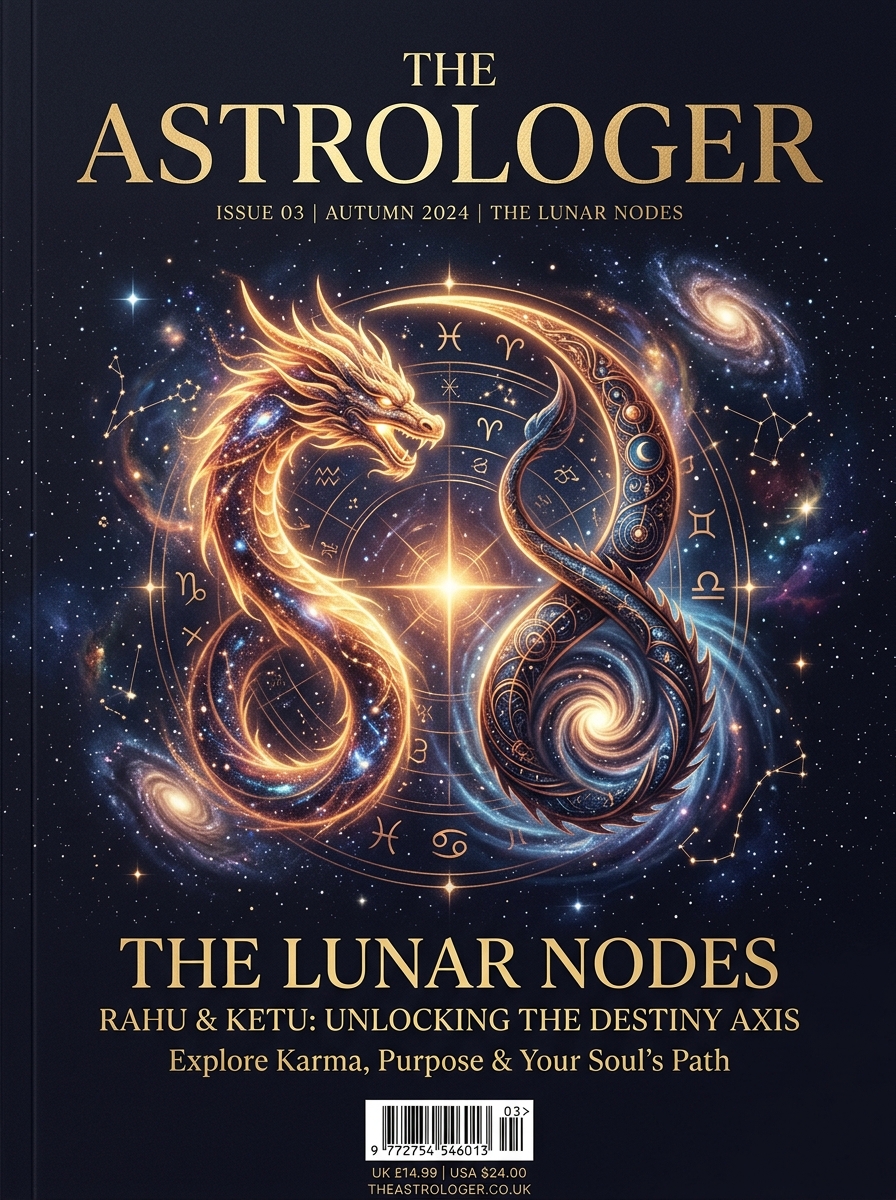
In ancient systems of astrology, particularly in Vedic astrology which shares deep roots with Western esoteric traditions, the Lunar Nodes are personified as the body of a celestial dragon. The North Node is Rahu, the Dragon's Head, and the South Node is Ketu, the Dragon's Tail. In mythology, Rahu is the severed head of a demon who drank the nectar of immortality. Because the head has no body, its hunger is insatiable; it represents intense desire, obsession, and the drive to consume new experiences, mirroring the North Node's push toward unexplored territory. Ketu, the Dragon's Tail, represents the bodiless torso, which has no eyes or mouth but carries the deep, silent memory of what has been. It is a symbol of absolute detachment, past-life mastery, and the instinctual habits we carry without conscious thought. In Western evolutionary astrology, this dragon imagery is integrated psychologically: the South Node is the tail where we release what we have already digested, and the North Node is the head where we take in new spiritual nourishment.
The Evolutionary Axis: Integrating Past Talents with Future Growth
In the realm of evolutionary astrology, popularized by authors like Steven Forrest, Jeffrey Wolf Green, and Mark Jones, the Lunar Nodes are viewed as the primary axis of the soul's evolution. Rather than viewing the chart as a static map of personality traits, evolutionary astrology treats the natal chart as a dynamic record of the soul's ongoing journey across lifetimes. In this context, the South Node represents the baseline of the soul—the cumulative experiences, deep-seated habits, and instinctual survival mechanisms brought into this lifetime. It is the path of least resistance, representing talents that feel completely natural, but also subconscious patterns that hold us back from true individuation.
Conversely, the North Node represents the soul's evolutionary future. It points to the qualities, experiences, and challenges that we must consciously develop in order to achieve alignment and balance. Because the North Node represents unfamiliar territory, it often feels intimidating, awkward, or even threatening to the ego. The ego naturally prefers the comfortable, well-worn grooves of the South Node, even when those grooves lead to stagnation or repetitive behavioral loops.
The South Node as the Safe Haven of Past Talents
The South Node is often described as a cozy, warm room that we never want to leave. It represents innate talents that we do not have to work for; they are already present within us as default settings. For example, a person with a South Node in Libra is naturally skilled at diplomacy, reading others' needs, and maintaining social harmony. However, when relied upon too heavily, this safe haven becomes a prison of codependency, people-pleasing, and indecisiveness. The goal is not to abandon the South Node, but to recognize when its patterns are being used defensively to avoid the growth demanded by the North Node. The talents of the South Node are meant to be repurposed as tools to support our forward journey, not as hiding places from the challenges of life. Carl Jung's concept of the Shadow is highly applicable here: the South Node's shadow is the comfortable trap of security that prevents the ego from moving toward the Self.
The North Node as the Soul's Metaphysical Compass
The North Node acts as a compass pointing toward the unknown. It represents the qualities we lack and must actively cultivate to feel whole. Returning to the example of the Libra South Node, the corresponding North Node is in Aries, which demands the development of courage, self-assertion, and the willingness to stand alone. Walking toward the North Node feels like learning to write with your non-dominant hand; it is clumsy and uncomfortable at first, but it is the only way to achieve psychological balance. Liz Greene and Carl Jung's concepts of individuation are highly relevant here: the North Node represents the integration of the shadow and the development of the unlived life, leading to a more complete, integrated self. By striving toward the North Node, we do not destroy the South Node; rather, we elevate both, allowing the past to serve the future in a state of psychological harmony. Individuation is not about leaving our history behind, but about evolving our relationship to it so we can live with conscious purpose rather than unconscious compulsion.
The Twelve Nodal Sign Axes: The Six Pairs of Polarities
The Lunar Nodes always occupy opposite zodiac signs, creating a single axis of polarity. To understand your nodes, you must look at them not as two separate points, but as a unified spectrum of energy. There are six primary nodal axes, each representing a distinct developmental challenge.
The Dance of Polarities from Aries to Pisces
Aries-Libra Axis: The Balance of Self and Other
- Aries North Node / Libra South Node: The challenge here is to move away from excessive compromise, codependency, and the habit of viewing oneself only through the eyes of others. Individuals with this placement often default to people-pleasing, sacrificing their own needs to keep the peace. The evolutionary goal is to develop personal agency, healthy self-assertion, and the courage to take independent action, stepping out of the shadow of others to find their own identity.
- Libra North Node / Aries South Node: The evolutionary direction is to move away from aggressive isolation, impatience, and an overly self-centered approach to life. The natural instinct is to fight or run solo. The goal is to learn cooperation, diplomacy, active listening, and the art of mutual relationship, discovering that true strength can be shared without being diminished.
Taurus-Scorpio Axis: The Balance of Stability and Transformation
- Taurus North Node / Scorpio South Node: The soul must move away from constant crisis, psychological drama, and emotional entanglement. The default setting is to expect betrayal and to live in a state of high emotional intensity. The goal is to build self-reliance, simple material stability, healthy boundaries, and a sense of peace and personal worth rooted in the physical world.
- Scorpio North Node / Taurus South Node: The path involves moving away from rigid attachment to material comfort, stubborn resistance to change, and superficial security. The default is to hoard possessions or cling to routine. The goal is to dive into deep psychological self-examination, embrace transformation, and share emotional and material resources with others through trust.
Gemini-Sagittarius Axis: The Balance of Facts and Wisdom
- Gemini North Node / Sagittarius South Node: The challenge is to move away from dogmatic beliefs, philosophical self-righteousness, and ignoring the local details. The default is to lecture others from a place of assumed absolute truth. The goal is to cultivate curiosity, learn to listen to different perspectives, ask questions, and communicate clearly in everyday life.
- Sagittarius North Node / Gemini South Node: The soul must move away from superficial gossip, intellectual scatter, and gathering endless facts without a cohesive meaning. The default is to become lost in trivia. The goal is to search for a broader personal truth, synthesize information into wisdom, and embrace a guiding life philosophy that gives direction to the intellect.
Cancer-Capricorn Axis: The Balance of Feeling and Structure
- Cancer North Node / Capricorn South Node: The challenge is to move away from cold professionalism, emotional suppression, and an obsession with status and control. The default is to hide behind achievements and professional duties. The goal is to embrace vulnerability, emotional nurturing, family, and the cultivation of a rich inner emotional life, recognizing that feelings are not weaknesses.
- Capricorn North Node / Cancer South Node: The direction is to move away from emotional dependency, moodiness, and hiding in the domestic sphere to avoid responsibility. The default is to play the child who needs protection. The goal is to step into personal authority, build solid structures, and accept leadership roles in the outer world.
Leo-Aquarius Axis: The Balance of Individuality and Collective
- Leo North Node / Aquarius South Node: The soul must move away from detached intellectualism, hiding in the crowd, and prioritizing the group's agenda over personal creativity. The default is to remain a cool, objective observer. The goal is to step onto the stage of life, express unique creative talents, and cultivate heart-centered confidence and personal warmth.
- Aquarius North Node / Leo South Node: The challenge is to move away from ego-centered drama, the constant need for personal validation, and pride. The default is to demand the spotlight. The goal is to align with collective causes, foster egalitarian community relationships, and work for the greater good of humanity as an equal member of the tribe.
Virgo-Pisces Axis: The Balance of Order and Surrender
- Virgo North Node / Pisces South Node: The path is to move away from vague escapism, boundarylessness, and spiritual bypassing. The default is to drift through life, avoiding commitments. The goal is to learn practical competence, daily discipline, attention to detail, and humble service in the material world, bringing order to chaos.
- Pisces North Node / Virgo South Node: The challenge is to move away from neurotic perfectionism, excessive worry, and over-analyzing every detail. The default is to attempt to control everything through logic. The goal is to develop trust in the universe, embrace spiritual surrender, practice compassion, and connect with the mystical flow of life.
Lunar Nodes Through the Astrological Houses: Comfort Versus Evolution
While the signs of the Lunar Nodes show the style of energy we are developing, the houses show the areas of life where these energies play out. Like the sign axes, the houses exist in polarities (1st/7th, 2nd/8th, 3rd/9th, 4th/10th, 5th/11th, and 6th/12th).
The house containing the South Node is the area of life where we feel naturally comfortable, but where we also tend to over-function and fall into defensive habits. The house containing the North Node represents the area of life that we must actively enter, even if it feels intimidating, because it holds the key to our evolutionary expansion.
For instance, if the South Node is in the 4th House and the North Node is in the 10th House, the individual is incredibly comfortable in the private, domestic sphere. They know how to care for family and manage the home, but they might use this comfort to avoid stepping into the professional world or claiming their public authority (10th House). Conversely, with the South Node in the 10th House and the North Node in the 4th House, the person might bury themselves in career demands and external success to avoid facing the vulnerable, intimate terrain of their own home and emotional foundations.
The Axis of Relationships and Resources
The 1st House/7th House axis focuses on the relationship between self and other. A 1st House South Node suggests a natural reliance on self-sufficiency, which can manifest as isolation. The 7th House North Node demands learning to share life's stage with a partner. The 2nd House/8th House axis deals with resources: the 2nd House represents self-earned assets and personal values, while the 8th House deals with shared resources, inheritance, and psychological depth. A 2nd House South Node indicates a comfort in handling one's own finances, but a resistance to the deep trust required to merge assets or explore shared psychological truths in the 8th House.
The Axis of Beliefs, Creativity, and Spiritual Surrender
The 3rd House/9th House axis is the path of learning and understanding. A 3rd House South Node represents a strong comfort in gathering details, writing, and logical debate, but the 9th House North Node demands that we synthesize these details into a unified worldview, belief system, or philosophy of life. The 5th House/11th House axis is the domain of personal and group creation. A 5th House South Node represents an ease with personal creative expression, but can slide into self-centered drama; the 11th House North Node asks us to bring our gifts to support the collective, organizing with communities and working toward larger social goals. Lastly, the 6th House/12th House axis represents the boundary between the material and the spiritual. A 6th House South Node indicates a hyper-focus on physical routines, daily checklists, and health, which can lead to chronic worry. The 12th House North Node invites the soul to let go of control, practice meditation, embrace spiritual surrender, and trust in the cosmic flow.
Analyzing the house placement allows us to ground the abstract archetypes of the signs into daily reality. A person with an Aries North Node in the 11th House will express their independent courage through group projects, community activism, and defining their long-term hopes. That same Aries North Node in the 5th House will manifest as a need to take bold risks in creative self-expression, romance, and play. The houses act as the concrete stage where the evolutionary drama of the nodes unfolds, providing a specific context for our growth.
Evolutionary Astrology, Nodal Conjunctions, and Transits
The expression of the Lunar Nodes is rarely simple; it is deeply influenced by the planets that aspect them and the transits that trigger them over time. In evolutionary astrology, any planet that is conjunct one of the nodes acts as a major modifier of the soul's karmic story.
Planetary Conjunctions as Karmic Catalysts
A planet conjunct the South Node represents an energy that was heavily developed in past experiences. It is a familiar tool that the soul has mastered, but it is also a potential source of baggage. For instance, Saturn conjunct the South Node suggests that the individual carries a deep sense of duty, guilt, or restriction from the past. They may default to rigid self-control and fear of authority, and must learn to relax their grip. If Venus is conjunct the South Node, relationship dynamics are highly familiar but may be prone to repeating old patterns of codependency. When the Moon is conjunct the South Node, emotional reactivity and dependency are deeply ingrained, requiring conscious awareness to break free from childish coping mechanisms.
A planet conjunct the North Node acts as a guide and a requirement for the future. The soul must learn to express this planet's energy in its highest form to achieve its life mission. For example, Venus conjunct the North Node indicates that learning to love, cultivate beauty, and form balanced partnerships is central to the soul's development in this lifetime. If Mars is conjunct the North Node, the individual must develop physical courage, leadership, and the ability to initiate actions, as these qualities are essential for their path forward. If Jupiter is conjunct the North Node, the path involves expanding one's horizons, seeking truth, and developing faith, showing that fortune follows when we take calculated risks in the direction of our growth.
Nodal Returns and Eclipse Cycles
Because the Lunar Nodes take approximately 18.6 years to orbit the zodiac, we experience major nodal transits at key developmental milestones in our lives. The most significant of these is the Nodal Return, which occurs around the ages of 18.6, 37.2, 55.8, and 74.4. During a Nodal Return, the transiting Lunar Nodes return to the exact positions they occupied at our birth. This period often coincides with major life adjustments, course corrections, and intuitive realizations about our true path. It is a time when the universe pushes us to align more fully with our North Node, often by dismantling structures that no longer serve our growth.
We also experience the Nodal Opposition (around ages 9.3, 27.9, 46.5, and 65.1), when the transiting North Node conjuncts our natal South Node. This transit forces a review of how well we are integrating both ends of the axis, often highlighting where we have slid back into comfortable but stagnant patterns, requiring us to re-establish a healthy dynamic balance.
Furthermore, because eclipses always occur near the transiting nodes, the seasonal cycles of eclipses act as powerful cosmic triggers. When eclipses fall on or near your natal nodal axis, they act as sudden course corrections, shaking up the houses involved and forcing the release of old South Node habits while accelerating progress toward the North Node destiny. These periods are marked by sudden shifts, endings, and new beginnings that align us with our evolutionary track.
Practical Interpretation, Common Pitfalls, and Mature Integration
Interpreting the Lunar Nodes requires a balanced and psychologically mature approach. It is easy to fall into simplistic interpretations that do not serve the individual's growth. We must view the natal chart not as a static sentence, but as an ongoing dialogue between our heritage and our possibilities.
Formulating a Balanced Personal Interpretation
To interpret your own nodes, follow these structured steps:
- Identify the Sign Polarity: Understand the psychological shift required. What are the qualities of the South Node sign that you default to? What are the qualities of the North Node sign you need to develop?
- Identify the House Polarity: Determine the concrete life areas involved. Where are you hiding (South Node house), and where are you being called to show up (North Node house)?
- Examine Planetary Connections: Look for any planets conjunct or aspecting the nodes. These are the helpers, obstacles, or lessons along the way.
- Synthesize the Axis: Create a sentence that combines them. For example: "I will use my natural capacity for deep research and psychological insight (Scorpio South Node in the 8th House) to build simple, practical daily routines and help others find material stability (Taurus North Node in the 2nd House)."
By working through this synthesis, you can create a highly personalized and practical road map that respects your past while pointing clearly toward your future growth. This prevents you from feeling lost in abstract theory and grounds your astrological practice into concrete, daily choices.
Pitfalls to Avoid: The Trap of Fatalism
The biggest pitfall in nodal interpretation is fatalism—viewing the nodes as a rigid, pre-determined destiny that leaves no room for free will. Evolutionary astrology, as emphasized by thinkers like Steven Forrest, teaches that the nodes represent evolutionary intentions, not fixed events. They show the lessons we are invited to learn, but how we learn them is up to us.
Another common pitfall is the "rejection of the past." Some practitioners mistakenly teach that the South Node must be completely abandoned or suppressed because it is "bad" or "karmically negative." This is a mistake. The South Node is the foundation upon which the North Node is built. Without the roots of the South Node, the tree of the North Node cannot grow. The goal is integration, not rejection. The talents of the South Node must be honored and utilized to fuel the journey toward the North Node. If we amputate the South Node, we cut off the very soil in which our strengths are anchored.
Mature integration of your nodal path requires patience, self-reflection, and often the support of depth psychology or therapy. It is a lifelong process of learning to recognize our automatic habits, gently pausing them, and choosing the more courageous path of conscious evolution. This journey of individuation, as Carl Jung described it, is the work of a lifetime, requiring us to embrace the tension between our past and our future. We must learn to step outside our comfort zone while maintaining appreciation for the foundation that allowed us to stand in the first place.
Frequently Asked Questions
What is the main difference between the North Node and the South Node?
The main difference lies in their evolutionary direction. The South Node represents where we are coming from: our comfortable defaults, past-life experiences, and unconscious patterns that can lead to stagnation if overused. The North Node represents where we are going: our evolutionary future, our life purpose, and the unfamiliar qualities we must develop to achieve psychological balance and soul growth. The South Node is the starting point, while the North Node is the destination. To experience true fulfillment, one must learn to build a bridge from the South Node to the North Node.
Are the Lunar Nodes actual planets or stars?
No. The Lunar Nodes are not physical bodies. They are mathematical points of intersection where the Moon's orbit crosses the ecliptic (the Sun's apparent path). Because they are calculated based on the relationship between the Sun, Moon, and Earth, they represent a psychological and spiritual synthesis of these core parts of the self rather than physical, celestial mass. They are geometric focal points of cosmic relationship.
How do eclipses relate to the Lunar Nodes?
Eclipses can only occur when a new or full moon happens in close proximity to the Lunar Nodes. Because of this astronomical alignment, the nodes act as the conduits for eclipse energy. When eclipses transit your natal nodal axis, they trigger powerful, sudden shifts that accelerate your evolutionary journey and force course corrections, pushing you out of stagnation. They act as doors opening and closing along the path of destiny.
What is a nodal return and when does it happen?
A nodal return occurs when the transiting Lunar Nodes return to the exact zodiac signs and degrees they occupied at the moment of your birth. This happens roughly every 18.6 years (primarily around the ages of 18, 37, 56, and 75). These periods are major developmental milestones that bring course corrections, endings, and a strong push toward your life purpose. They are key moments of existential alignment.
Why shouldn't I completely ignore my South Node?
Ignoring or rejecting the South Node is a major interpretive error. The South Node contains your innate talents, natural gifts, and the psychological foundation of your identity. The goal is to integrate these positive talents and use them as resources to support your journey toward the North Node, rather than using the South Node as a hiding place from growth. Without the support of the South Node, the North Node lacks stability.
How does therapy support the integration of the nodal axis?
Therapy, particularly depth psychology and Jungian analysis, is highly effective for nodal integration. Because the South Node represents unconscious, automatic conditioning, working with a therapist helps bring these hidden patterns to light. This awareness allows you to dismantle limiting habits and consciously cultivate the new behaviors and qualities represented by the North Node, facilitating individuation. Therapy provides the safe container needed to explore the discomfort of the unlived life.
Comments
Loading comments…