The 1st and 7th House Lunar Node Axis: The Horizon of Self and Other
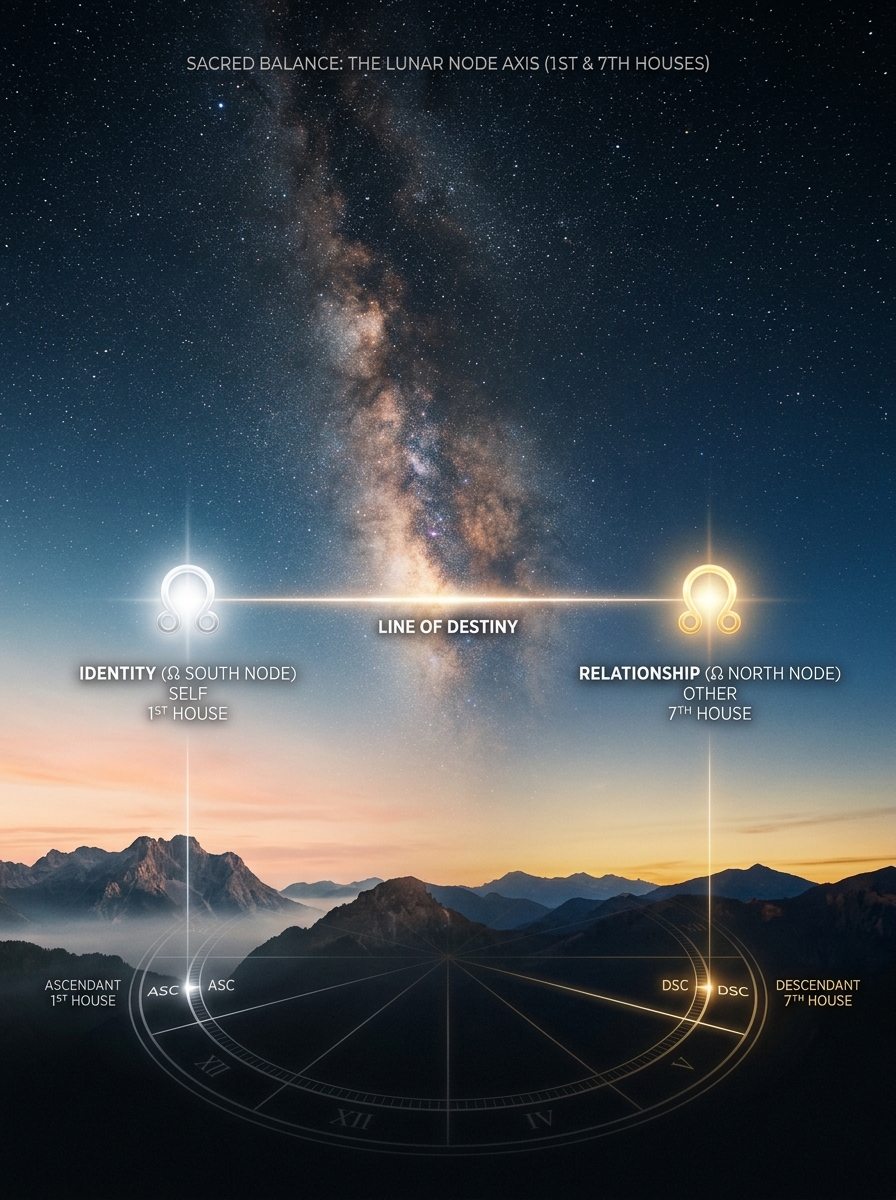
The lunar node axis represents the fundamental evolutionary spine of the birth chart. Unlike the planets, which describe the active components of the personality, and the signs, which show how those components express themselves, the nodes tell the story of the soul's developmental direction. They delineate the trajectory of growth from past habituation to future potential. When this axis falls across the first and seventh houses, it engages the most vital polar tension in human experience: the relationship between the self and the other. This is the horizontal axis of the chart, the line of the horizon that divides the sky into the subjective world of personal emergence and the objective world of relational encounter.
For the native carrying this nodal placement, every day presents a recurring negotiation between the urge to stand alone in absolute sovereignty and the desire to merge in loving partnership. It is the domain where the ego must discover its boundaries, not by isolating itself in a fortress of independence, but by testing its strength in the mirror of the partner. Through the lenses of evolutionary astrology, depth psychology, and Western esotericism, we can map this axis as a sacred highway where the soul learns that the "I" and the "We" are not enemies, but two halves of a single, continuous consciousness.
The 1st and 7th House Axis: The Polarity of Self and Other
The first house, traditionally anchored by the Ascendant, represents the point of self-emergence. It is the moment of birth, the first breath, and the initiation of the physical body into time and space. In psychological astrology, the first house represents the primary lens through which we view reality, the style of our spontaneous activity, and our raw instinct for self-definition. It is ruled by Mars in the natural zodiac, embodying the archetypal warrior who asserts, acts, and protects. Here, the primary question is subjective: Who am I? The first house does not ask for permission; it seeks to exist, to occupy space, and to establish its distinctiveness from the undifferentiated mass of the collective. It is the seat of personal sovereignty and individuation.
In absolute polarity, the seventh house, initiated by the Descendant, represents the point of relationship and objective meeting. It is the setting place of the sun, where the personal ego realizes it cannot exist in a vacuum. It is the home of committed partnerships, marriages, business alliances, and even open adversaries. Ruled by Venus in the natural zodiac, the seventh house represents the capacity for diplomacy, aesthetic harmony, cooperation, and the realization that the other possesses an internal reality as valid as our own. Here, the question shifts from the subjective to the objective: Who are we? The seventh house is where we learn the art of compromise, vulnerability, and the sacred work of sharing a life.
The Horizon of the Birth Chart
The line connecting the first and seventh houses is the horizon of the natal chart, dividing it into the lower, personal hemisphere and the upper, collective hemisphere. Dane Rudhyar, one of the pioneers of modern psychological astrology, described the Ascendant-Descendant axis as the horizon of awareness. The Ascendant is the point of individual focus, where the universal spirit is concentrated into a unique human personality. The Descendant is the point of collective participation, where the individual must offer their uniqueness to the world through relationship. This horizon is not a wall, but a membrane. If the membrane is too rigid, the self becomes isolated, locked in a sterile chamber of hyper-independence. If the membrane is too porous, the self dissolves, becoming a mere reaction to the expectations and desires of the partner.
Understanding the horizon requires recognizing that the first and seventh houses are structurally codependent. An individual cannot have a genuine relationship without a coherent self to bring to it. If the first house is empty of selfhood, the seventh house relationship becomes a process of mutual consumption or codependency, where two half-people attempt to make a whole. Conversely, a self that refuses to enter the seventh house remains immature, never tested by the hard realities of compromise and intimacy. The horizon demands a dynamic, ongoing conversation between the two poles, where the self is constantly refined through the mirror of relationship, and the relationship is constantly strengthened by the sovereignty of the individuals within it.
The Evolutionary Tension between Rahu and Ketu
In Vedic and evolutionary astrology, the lunar nodes are symbolized by the dragon: Rahu, the North Node, is the dragon's head, representing the insatiable hunger for new growth, evolutionary destiny, and the unfamiliar territory we must conquer in this lifetime. Ketu, the South Node, is the dragon's tail, representing our accumulated experiences, past-life habits, and the comfortable defaults we return to when under stress. The South Node is not a toxic place to be destroyed; it is a repository of talent and mastery. However, if we refuse to move toward the North Node, the South Node curdeled into a prison, locking us in repetitive karmic loops.
When the nodal axis lies across the first and seventh houses, the evolutionary tension is particularly acute because it directly threatens our sense of survival. If the South Node is in the seventh house, the native's default is to seek safety through others, often sacrificing their own identity to maintain peace. If the South Node is in the first house, the native's default is to retreat into defensive isolation, viewing any close partnership as a threat to their freedom. The journey along this axis is never a simple, linear walk from one side to the other. It is a slow, cyclical integration where the wisdom of the South Node is repurposed to support the growth of the North Node, allowing the soul to navigate the horizon with balance and consciousness.
The Horizon of Consciousness: Jungian Archetypes of Persona and Shadow in Partnership
Carl Jung's depth psychology provides an invaluable framework for understanding the psychological mechanics of the first and seventh house axis. Jung observed that the human psyche is divided into conscious and unconscious components, and that our growth—which he termed individuation—depends on bringing the unconscious contents into conscious awareness. The first house is closely aligned with the concept of the Persona, the social mask we wear to present ourselves to the world. The Persona is not a lie; it is a necessary psychological tool that allows us to interact with society. However, if we identify too closely with our Persona, we relegate our authentic instincts, desires, and vulnerabilities to the unconscious, creating what Jung called the Shadow.
Because the seventh house represents the "Not-I," it naturally becomes the primary repository for our projected Shadow. The qualities we cannot accept in ourselves, or the traits we have disowned to maintain our Persona, are projected onto the people we attract in our close relationships. If we have disowned our capacity for assertion and anger (first house qualities), we will inevitably attract partners who are highly assertive, hot-tempered, or even aggressive (seventh house shadow). We may believe we are victims of these partners, but in reality, our unconscious is seeking to integrate the disowned Martian energy through the relationship. The seventh house partner is always a mirror reflecting our own unintegrated psyche.
Projection and the Mirror of the Descendant
The Descendant is the exact point where our shadow projections land. In the Western esoteric tradition, relationship is viewed as the ultimate laboratory for shadow work. When we fall in love, we are often projecting our own golden shadow—our unexpressed potential, beauty, and power—onto the beloved. When we experience intense irritation or conflict with a partner, we are projecting our dark shadow—our repressed anger, selfishness, or fear—onto them. This projection mechanism explains why relationships are so emotionally charged and why they are our greatest opportunities for growth.
To withdraw a projection is one of the most difficult tasks in human psychology. It requires us to look at the partner who is frustrating us and ask: Where does this quality live in me? How am I refusing to express this energy in my own life? If we are annoyed by a partner's self-centeredness, we must examine where we are failing to assert our own needs. If we are overwhelmed by a partner's neediness, we must look at where we have repressed our own vulnerability. By treating the Descendant as a mirror, we begin to integrate our shadow, moving from blame and resentment to self-knowledge and compassion. The relationship is transformed from a battlefield of projections into a conscious partnership where both individuals support each other's individuation.
North Node in the 1st House / South Node in the 7th House: Stepping into Personal Sovereignty and Individuation
For the individual born with the North Node in the first house and the South Node in the seventh house, the evolutionary mandate is to step into personal sovereignty. The South Node in the seventh house indicates a soul that is highly sophisticated in the arts of relationship, diplomacy, and compromise. The native arrives in this lifetime with a natural ability to read others, anticipate their needs, and smooth over social friction. They are the peacemakers, the facilitators, and the ultimate partners. However, this mastery carries a heavy cost. The default pattern of this placement is to locate one's center of gravity outside the self, turning the ego into a mirror that only exists to reflect the desires of others.
The North Node in the first house calls the individual to claim their distinctiveness, assert their boundaries, and discover who they are independent of relationships. This is often a terrifying task. Because the South Node is in the seventh house, the native's nervous system equates independence with isolation and conflict with abandonment. To say "I want" or "I choose" feels like a betrayal of the relational harmony they have worked so hard to maintain. They may struggle with chronic indecision, constantly asking others for advice or permission, and adopting the opinions and tastes of their partners. The evolutionary path requires them to cultivate the Martian courage to stand alone, make mistakes, and tolerate the discomfort of being disliked.
Overcoming the Trap of Codependency
The primary trap for the first house North Node native is codependency—the belief that they are responsible for the emotional well-being of others and that their own value is determined by their usefulness in relationships. This often manifests as people-pleasing, chronic pacification, and the suppression of their own anger and desires. The native will stay in unhealthy relationships far past their expiration date, convinced that they can save the partner or that leaving would make them a bad person. They use the seventh house as a hiding place, avoiding the terrifying responsibility of their own life and calling by focusing entirely on the partner.
Overcoming this trap requires a radical reclamation of the first house. The native must learn to develop a strong, defined sense of self, starting with the body. They must learn to recognize their physical boundaries, honor their spontaneous impulses, and express their desires cleanly and directly. They must understand that anger is not a sin, but a vital signal that their boundaries have been crossed. Steven Forrest suggests that for this placement, learning to say "no" is a sacred act of spiritual alignment. By developing a healthy first house ego, the native ceases to be a passive mirror and becomes a solid, authentic individual. Ironically, this does not destroy their relationships; it makes them real. A partnership built on the honest meeting of two distinct selves is infinitely stronger than one built on the self-effacement of one partner.
North Node in the 7th House / South Node in the 1st House: Cultivating Vulnerability and Conscious Union
For the individual born with the North Node in the seventh house and the South Node in the first house, the evolutionary journey is the reverse: they must learn to soften their defenses, let down their guard, and cultivate vulnerability in relationship. The South Node in the first house indicates a soul that is highly practiced in self-reliance, independence, and personal sovereignty. They are the rugged individualists, the pioneers, and the lone wolves. They know how to take care of themselves, make decisions quickly, and survive in isolation. But this strength can easily freeze into a defensive armor, keeping others at a safe distance and treating intimacy as a threat to their freedom.
The North Node in the seventh house calls the individual to move from isolation to cooperation, learning that true strength is not the ability to survive alone, but the courage to be vulnerable and interdependent. The default pattern of the first house South Node is to assume that they must do everything themselves and that asking for help is a sign of weakness. They may enter relationships but maintain a strict emotional distance, keeping their partners at arm's length to protect their independence. The evolutionary path requires them to cultivate the Venusian capacity for compromise, empathy, and deep listening. They must learn to share their lives, consult their partners on major decisions, and allow themselves to be influenced and changed by another.
Softening the Fortress of the Self
The primary defense mechanism for the seventh house North Node native is the building of a rigid ego fortress. They are often hyper-independent, viewing any emotional need—whether their own or their partner's—with suspicion or contempt. Underneath this tough exterior lies a deep fear of engulfment, a terror that if they open their heart and rely on another, they will lose their identity and be destroyed. They may choose partners who are emotionally unavailable, enabling them to maintain their isolation while playing the role of the self-sufficient hero. Or they may initiate conflicts to create distance whenever the relationship becomes too intimate.
Softening this fortress requires a willing surrender to the seventh house. The native must learn that vulnerability is not weakness, but the very portal through which true intimacy enters. They must practice the art of receiving, allowing themselves to be nurtured, supported, and loved by another. They must learn to slow down and listen to the partner's reality, recognizing that compromise is not a loss of freedom, but a voluntary choice to build a shared world. Liz Greene emphasizes that for this placement, the realization that they need other people is a profound spiritual breakthrough. By allowing their ego boundaries to soften, they discover that relationship does not diminish the self, but expands it, allowing them to experience the rich, alchemical magic of conscious union.
The Alchemy of the Planets: Venusian Diplomacy and Martian Courage
To fully understand the first and seventh house axis, we must examine its planetary rulers: Mars, the ruler of the first house, and Venus, the ruler of the seventh house. In classical mythology and Western esotericism, Mars and Venus represent the archetypal polarity of the sword and the mirror, the active force of assertion and the magnetic force of attraction. They are the cosmic lovers whose interaction drives all creation. In the human psyche, Mars and Venus represent the two functions we must integrate to achieve psychological wholeness: our ability to assert our individuality (Mars) and our ability to relate to others (Venus).
graph LR
    subgraph "1st House (Subjective Self)"
        Mars[Mars: The Sword] -->|Asserts| Identity[Individual Identity]
        Mars -->|Defends| Boundaries[Healthy Boundaries]
    end
    subgraph "7th House (Objective Other)"
        Venus[Venus: The Mirror] -->|Attunes| Partnership[Conscious Union]
        Venus -->|Reflects| Projection[Shadow Integration]
    end
    Identity <==>|Alchemical Integration| Partnership
    Boundaries <==>|Dynamic Balance| Projection
Mars represents the principle of separation and individuation. It is the force that cuts the umbilical cord, allowing the child to exist as a separate entity. It provides the energy for desire, ambition, courage, and boundary-setting. Without a healthy Mars, we cannot say "no," defend our values, or pursue our goals. However, Mars running wild becomes raw aggression, selfishness, and isolation. It sees the world as a battleground and the other as an obstacle to be overcome.
Venus represents the principle of connection and integration. It is the force that draws separate elements together to create harmony, beauty, and love. It provides the capacity for empathy, appreciation, art, and cooperation. Without a healthy Venus, we cannot connect with others, appreciate beauty, or find common ground. However, Venus running wild becomes people-pleasing, codependency, and the erasure of all personal boundaries. It sacrifices truth for the illusion of peace, turning relationship into a sterile contract of mutual accommodation.
The alchemical task of the first and seventh house axis is the conscious marriage of Mars and Venus within the psyche. We must learn to wield the sword of Mars with the grace of Venus, and to hold the mirror of Venus with the strength of Mars. This means developing the capacity for assertive relationship—the ability to speak our truth, set our boundaries, and stand in our sovereignty (Mars) while remaining deeply connected, empathetic, and open to the reality of the partner (Venus). When these two forces are integrated, we no longer view relationship as a choice between sovereignty and connection. We realize that a strong Mars provides the necessary container for a deep, vulnerable Venusian love, and that a rich Venusian connection gives Mars a worthy purpose to defend.
Evolutionary Catalysts: Navigating Eclipses and Relational Crises to Harmonize the Horizon
The path along the first and seventh house axis is rarely smooth. Because it involves the foundational structure of our identity and our relationships, the soul often requires powerful external catalysts to shake it out of its comfortable default patterns. In astrology, these catalysts are represented by eclipses falling along the horizontal axis, and by the inevitable relationship crises that arise when the dynamic balance of the horizon is violated. These events are not punishments, but evolutionary course corrections designed to accelerate our growth.
When a solar or lunar eclipse occurs in the first or seventh house, it acts as a cosmic wildcard. Eclipses disrupt the familiar energy flow, bringing sudden beginnings, unexpected endings, and dramatic revelations. An eclipse in the first house may trigger a personal crisis that forces the native to redefine who they are, perhaps through a physical illness, a career change, or a sudden realization that they have been living a life that does not belong to them. An eclipse in the seventh house may bring a sudden shift in a key relationship, such as a marriage, a breakup, or the exposure of hidden secrets that demand immediate resolution. These events force us to look at the horizon and address where we have become out of balance, prompting us to reclaim our sovereignty or surrender to partnership.
### The Crisis of the Pacifier (South Node 7th)
For the native with the South Node in the 7th House, the evolutionary crisis often arrives when their people-pleasing default fails to preserve the relationship. The partner may pull away, demanding that the native show their real face, or the native may experience a physical breakdown from chronically swallowing their own anger. This crisis is a calling to step into the 1st House North Node, realizing that true relationship requires two real people, not one person and a mirror.
<!-- slide -->
### The Crisis of the Lone Wolf (South Node 1st)
For the native with the South Node in the 1st House, the crisis often manifests as intense loneliness or a breakdown of their self-sufficient systems. They may face an obstacle they cannot overcome alone, or they may find themselves deeply in love with someone who refuses to be kept at a distance. The fortress of the self begins to feel like a prison, forcing them to step into the 7th House North Node and risk the vulnerability of relying on another.
<!-- slide -->
### The Alchemical Middle Path
The ultimate goal of both crises is the integration of the horizon. The native learns to walk the middle path: standing firmly in their own first house center while extending their hand across the Descendant to meet the partner in the seventh house. They realize that they do not have to choose between their freedom and their love. By maintaining their personal sovereignty, they build a vessel strong enough to hold the transformative power of conscious relationship.
To harmonize the horizon requires a constant, conscious adjustment of our sails. It is not a static state of balance, but a dynamic dance. There are seasons in a life when we must focus on the first house, retreating from the world to rebuild our boundaries, discover our authentic desires, and strengthen our physical bodies. There are other seasons when we must focus on the seventh house, stepping out of our comfort zones to compromise, cooperate, and offer our lives to another. The wisdom of this nodal axis lies in knowing which season we are in, and having the courage to navigate the transition from one to the other with grace, trust, and consciousness.
Frequently Asked Questions
What happens if I have no planets in my first or seventh houses?
Having no planets in these houses is extremely common and does not mean that your identity or relationships will be lacking. The Ascendant and Descendant cusps are always present in every chart and remain highly sensitive points. When transiting or progressed planets cross these angles, they will trigger major developmental phases regardless of whether the houses are empty. Furthermore, the planetary rulers of the signs on the cusps of your first and seventh houses (for example, Mars for an Aries Ascendant, and Venus for a Libra Descendant) will show how and where you express these energies in your life.
How do nodal returns and oppositions affect this axis?
Nodal returns occur roughly every 18.6 years (around ages 18–19, 37–38, 55–56, and 74–75) and are major periods of evolutionary alignment. During a nodal return, the universe often brings events and relationships that challenge us to release our South Node patterns and step fully into our North Node mission. Nodal oppositions occur halfway through these cycles (around ages 9, 27–28, 46–47, and 65–66), presenting opportunities to test how well we have integrated the two poles. These transits are marked by intense relational or personal pivots, urging us to find a new level of balance on our horizon.
Can a seventh house North Node individual ever have a successful marriage?
Absolutely. In fact, a seventh house North Node suggests that conscious partnership is a vital part of the soul's developmental path in this lifetime. The difficulty is that the native will initially struggle with relationship, often experiencing delays, obstacles, or repetitive failures in their early love life because they are operating from their first house South Node defense mechanisms. Once they begin to consciously embrace vulnerability, compromise, and cooperation, they can build deeply fulfilling, stable, and evolutionary partnerships that serve as containers for their long-term growth.
How does physical health reflect imbalances on this axis?
The body is a primary indicator of nodal alignment along this horizontal axis. A first house North Node native who chronically suppresses their anger and needs to maintain relationship harmony will often manifest physical symptoms in the throat (a tight, unspoken quality), the jaw (bruxism and clenching), and the kidneys (ruled by Libra, reflecting toxic filtration). Conversely, a seventh house North Node native who isolates themselves and resists vulnerability may experience cardiovascular tension or physical exhaustion, as the nervous system remains in a constant state of hyper-vigilance, defending the fortress of the self from the perceived threat of the other.
Is the goal to completely eliminate my South Node behaviors?
No. The goal of evolutionary astrology is integration, not amputation. Your South Node represents a reservoir of past mastery, talent, and wisdom that you have spent lifetimes cultivating. The objective is to refine this energy and use it to support your North Node growth, rather than using it as a defensive shelter. A first house North Node needs the diplomatic, empathetic skills of their seventh house South Node to assert themselves without destroying their relationships. A seventh house North Node needs the self-reliance and strength of their first house South Node to ensure they do not lose themselves in partnership.
Frequently asked questions
- What does the 1st and 7th house nodal axis represent in astrology?
- This axis represents the fundamental evolutionary tension between individual identity, self-assertion, and personal boundaries (1st House/Ascendant) versus committed relationships, compromise, and vulnerability in one-on-one partnerships (7th House/Descendant). It challenges the native to find a conscious balance between these two poles without fully abandoning either.
- What does North Node in the 1st House and South Node in the 7th House mean?
- With the North Node in the 1st House, the soul's evolutionary task is to step into personal sovereignty, self-definition, and healthy self-assertion. The South Node in the 7th House indicates a habit of over-identifying with relationships, people-pleasing, and codependency. The native must learn to exist independently and speak their truth, even if it disrupts the harmony of their partnerships.
- What does North Node in the 7th House and South Node in the 1st House mean?
- With the North Node in the 7th House, the soul is learning to cultivate vulnerability, deep compromise, and conscious union with another. The South Node in the 1st House represents a tendency toward defensive isolation, hyper-independence, and self-centeredness. The evolutionary goal is to move from isolation toward cooperation, sharing life's journey with a significant other.
- How do Jungian archetypes of Persona and Shadow manifest on this axis?
- The Ascendant (1st House) is closely linked to the Persona, our social mask, while the Descendant (7th House) often holds our Shadow — the qualities we disown and project onto our partners. For those working this axis, relational crises are often opportunities to reclaim projected shadow qualities, realizing that the conflicts they experience with others are actually mirrors of their own inner polarities.
- How do eclipses impact people with placements on the 1st and 7th house axis?
- Eclipses falling along the 1st and 7th house axis act as intense evolutionary catalysts, bringing sudden changes, beginnings, or endings to relationships and personal identity. They force the native to address imbalances between their independence and their commitments, often triggering necessary crises that accelerate individuation and relational maturity.
- Is the ultimate goal of the 1st and 7th house nodal axis to choose one house over the other?
- No. Astrological poles are complementary, not mutually exclusive. The goal is alchemical integration. A person cannot have a healthy 7th House partnership without a strong, defined 1st House self to bring to it. Similarly, a 1st House self is refined and understood through the mirrors of 7th House relationships. The objective is to navigate the dynamic tension between them with consciousness and grace.
Comments
Loading comments…