Judgement and The Hierophant: The Verdict of the Soul and the Law of Meaning
The Verdict and the Vessel
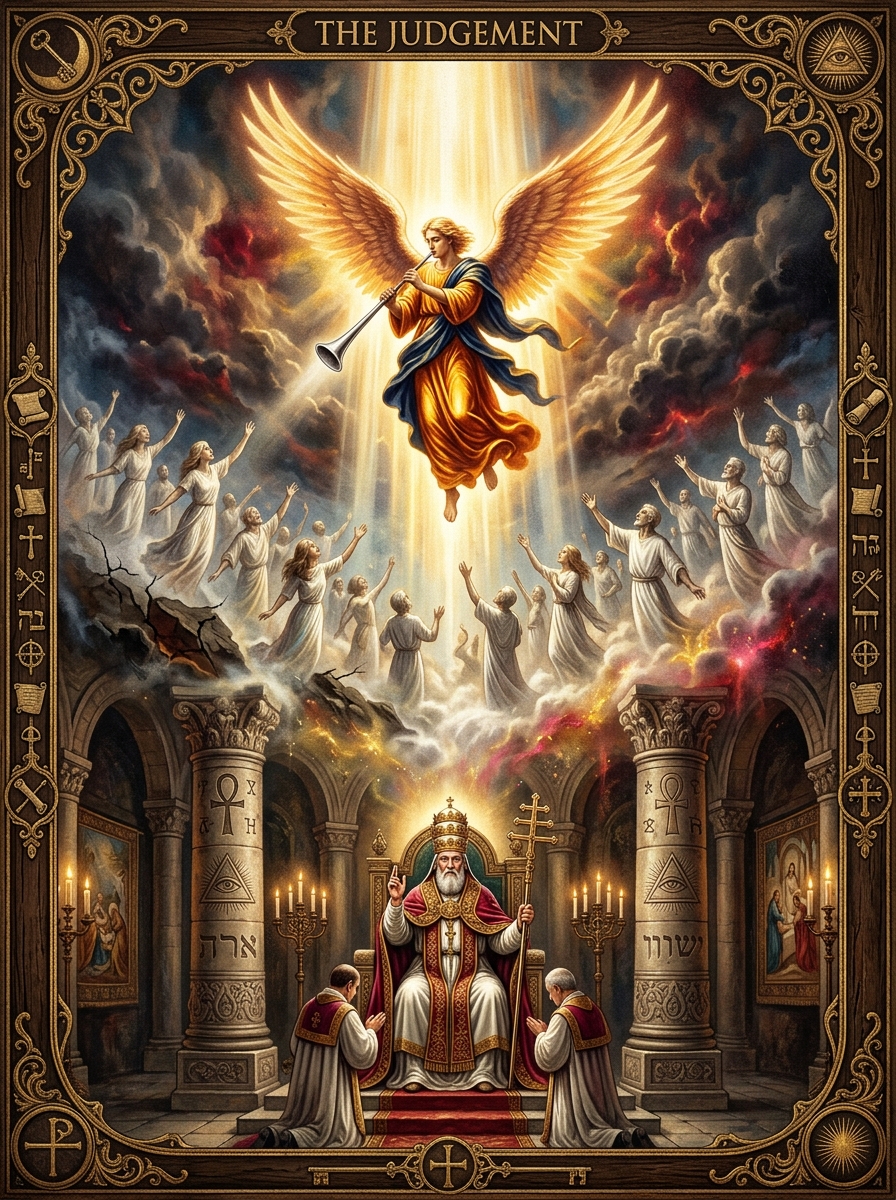
The Judgement card rises like a trumpet blast through the floor of the psyche, calling what was dead to stand up. The Hierophant stands opposite: a figure carved from stone and ritual, guardian of the words that give awakening a shape. Together they describe a reckoning that refuses to stay private. This is not the ecstatic breakthrough you keep to yourself. It is the kind that demands a vow, a confession, a ceremony, a name—a public container large enough to hold the new life.
The central friction is between revelation and authority. Judgement says, “Wake up.” The Hierophant answers, “Now prove that this awakening can bear responsibility.” The soul’s resurrection wants to be witnessed, and the only witness that counts is one that can hold you accountable. That is why this pair never lands as a vague “spiritual growth” message. It lands as an initiation—an invitation to step into a lineage, a code, a role that the old you could not have carried.
This dynamic sits between two neighboring combinations: Judgement and the World, where awakening becomes completion, and The Hierophant and Judgement, where structure meets the call in the reverse direction. Both involve transformation, but this version foregrounds the authority that transformation earns.
How the Pair Forms in the Psyche
Psychologically, Judgement represents the moment the psyche can no longer keep its fragments separate. Something buried—a truth, a grief, a talent—forces integration. But integration alone is not meaning. That is where The Hierophant enters. It supplies the transpersonal order: tradition, sacred language, the mentor who has walked this road before, the ritual that turns chaos into coherence.
In Jungian terms, Judgement is the ego’s confrontation with the shadow and the Self’s call to wholeness. The Hierophant is the archetype of the senex—the wise old man who holds the keys to the collective symbols that make inner experience legible. Without Judgement, you inherit dogma without life. Without The Hierophant, you have revelation without discipline. The healthiest expression of the pair is what depth psychology calls individuation through conscious initiation: the self does not rebel against tradition nor submit to it blindly; it enters tradition as a living participant and reshapes it from the inside.
This is why the combination often surfaces when someone has been through a crisis of conscience—a marriage that survived infidelity, a career that required a moral stand, a spiritual crisis that broke the old orthodoxy. The psyche does not ask you to forget the rupture. It asks you to find the words and the witnesses that let the rupture become a foundation.
The Two Faces of Doctrine
When this pairing operates well, it produces living authority: a person who can stand in public, speak clearly from experience, and remain inwardly awake. They have been tested, and the test gave them a voice that others can trust. Such a person does not need to perform obedience or rebellion; they embody the integration of inner truth and outer form.
The shadow side is moral absolutism. Judgement can inflate into a conviction of being chosen, even messianic. The Hierophant can harden into rigid orthodoxy that punishes nuance. Together they can produce gatekeepers who mistake their own awakening for universal law, or seekers who cloak vulnerability in sacred language to avoid genuine relationship. The difference between the healthy and shadow expressions lies in one question: Is the form serving the living truth, or is the living truth being sacrificed to preserve the form?
A useful diagnostic comes from the surrounding cards or the client’s tone. If the combination appears with The Moon or The Devil, the shadow is likely active—the awakening may be entangled with illusion or attachment. With The Sun or The Star, the integration is probably genuine. For those who want to separate authentic conscience from borrowed fear, a shadow work tarot spread can isolate what belongs to the soul versus what is inherited from a system that no longer fits.
Where It Manifests in a Life
Because the core dynamic is already established, we can now touch love, career, and spirituality as expressions of the same principle, not as separate analyses.
In love, the pair describes a relationship that is haunted by conscience. It rarely appears in casual connections. It shows up when someone must tell the hard truth, make amends, or decide whether the bond can survive the pressure of family, faith, or social expectation. The healthiest version is a covenant—a bond that deepens through shared ethics and mutual accountability, not mere chemistry. The shadow version is a relationship trapped by dogma: inherited rules that suffocate the real connection. In that case, the cards ask whether you are living truthfully or merely complying. A love tarot spread can clarify whether the commitment is freely chosen or inherited.
In career, this combination signals the transition from practitioner to custodian. Your work becomes a calling accountable to standards larger than ambition. This often appears when you are being evaluated by an institution—certification, promotion, licensing—or when you are being asked to mentor others. The energy does not favor lone genius; it wants your experience to become teachable. The shadow appears as credentialism without soul: the title without the inner authority. Compare this with the dynamic in The Emperor and The Hierophant, where control and doctrine merge, but here the emphasis is on moral legitimacy rather than power.
In spirituality, the pair marks an initiation into mature conscience. The trap is confusing the awakening with omniscience. A genuine call does not make you infallible; it makes you answerable. The healthiest path is to find a lineage—a teacher, a tradition, a symbolic language—that sharpens the self rather than shrinking it. This is the territory explored between The High Priestess and The Hierophant, where silent knowing meets spoken law. If you feel lost in the transition, a career tarot spread can help reframe the vocation, or a monthly tarot spread can show whether the next step is immediate or still gestating.
When the Cards Demand Action
The appearance of Judgement and The Hierophant is rarely theoretical. It often arrives when a decision is ready to be made in a formal way: apologize, apply for the role, join the community, renew the vow, tell the truth, or leave a system that can no longer contain your growth. The tone is serious but not punitive. It says that the soul has been given its cue, and now the work is to embody the awakening in a form that others can recognize.
If the rest of the spread is tense—say, with The Tower or The Moon—the message may be to stop negotiating with your own truth. If the spread is harmonious—with The World or The Sun—the message may be to let your life take on a more sacred shape without hesitation. Compare this with the more interior path of The Moon and Judgement, where the call comes through shadow, not through institution. Here, the call comes through structure.
The final image to hold: the trumpet of Judgement and the staff of The Hierophant. One wakes the dead; the other gives the dead a place to stand. The question is never simply “What do I believe?” It is “What am I willing to answer for?” That is the verdict this pair delivers—and it does not let you walk away without an answer.
Related
- Judgement and the Magician: The Sound of Awakening Becoming Action
- Death and Judgement Tarot Combination: The End That Calls You Forward
- The Hierophant and The Lovers Tarot Combination: Marriage of Law and Desire
- The Star and Judgement: Hope Answering the Call
- The Hierophant and Strength: Discipline Tempered by Grace
Comments
Loading comments…