The High Priestess and The Hierophant: The Quiet Authority of Inner Truth and Outer Law
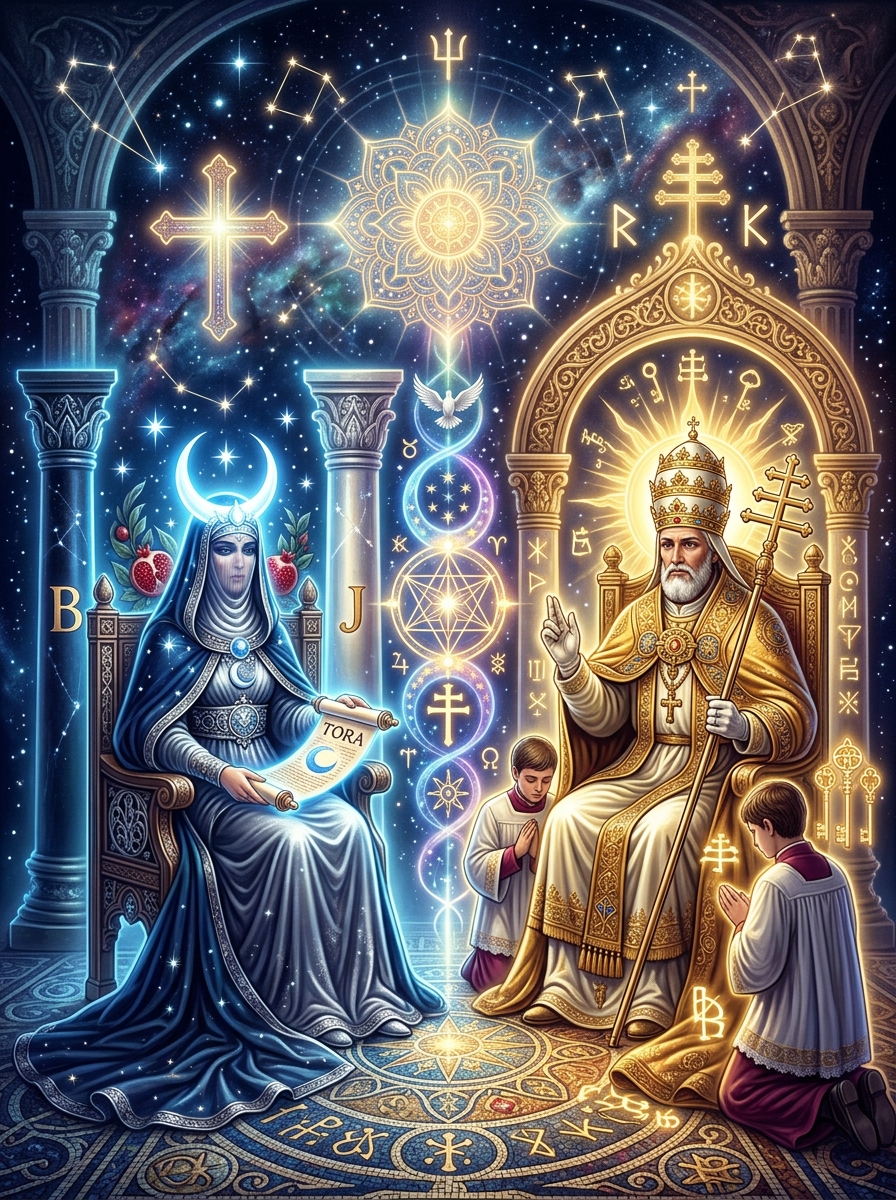
The Core Dynamic: Knowledge That Knows Itself and Knowledge That Knows Its Name
The High Priestess and The Hierophant do not ask you to choose between intuition and tradition. They arrive together when the soul is ready to discover that true authority lives in the seam between them. The High Priestess guards what cannot be spoken—the raw, wordless knowing that arrives before language, before doctrine, before permission. The Hierophant turns that knowing into a form that can be taught, inherited, and held by a community. One keeps the mystery alive; the other ensures the mystery survives.
This is not a pairing of contradiction but of complement. The High Priestess is the inner chamber where the whisper lives; The Hierophant is the temple where that whisper becomes scripture. Together they describe a wisdom that is private in its origin but disciplined in its expression. When they appear in a reading, the question is rarely “Which one should I follow?” but rather “How do I give my inner truth a shape that honors its depth without draining it?”
At the heart of the combination is a tension that is meant to be held, not resolved. The High Priestess is the number II—duality, reflection, the gate between opposites. The Hierophant is V—structure, ordeal, initiation through lived form. Two receives; five translates. The card pair, then, is the moment when silent knowing meets the spoken law. For a fuller look at what each card asks of you alone, revisit The High Priestess Tarot Card and The Hierophant.
The Psychological Roots: How the Tension Forms
Psychologically, this combination often surfaces when a person is caught between what they know in their bones and what the world—family, religion, profession—has told them is true. The High Priestess whispers a truth that does not match the inherited rule, yet the rule itself feels like part of who you are. You are not ready to discard the rule, and you are not able to silence the whisper. That ambivalence is the actual story.
In Jungian terms, The High Priestess belongs to the unconscious—the vast, oceanic knowing that the ego cannot fully command. The Hierophant belongs to the collective structures of culture, belief, and morality. One is the archetype of the Great Mother’s hidden wisdom; the other is the archetype of the wise old man who codifies it. When they appear together, the psyche is attempting to integrate two modes of authority: the personal and the transpersonal, the intuitive and the canonical.
This integration is not peaceful by default. Many people experience it as a crisis of faith—a moment when the inner voice and the outer law no longer say the same thing. The task is not to reject one in favor of the other but to find a third position where the inner truth becomes legible without being flattened. If you have ever felt like your deepest knowing is too private to share yet too real to ignore, this pair describes that very threshold. For a different angle on silent knowing meeting an inner guide, compare The High Priestess and The Hermit.
The Mature Expression: Initiation into Lawful Intuition
In its healthy form, this combination describes a person who has learned to trust their intuition without becoming unmoored, and to honor tradition without becoming rigid. They have undergone what might be called an initiation into lawful intuition—a kind of knowing that is both inwardly alive and outwardly accountable. Such a person can sit in the mystery and also articulate it clearly enough to teach, heal, or guide others.
This is the energy of the mentor who respects the curriculum but knows when to let the student’s direct experience speak louder than the textbook. It is the therapist who holds a theoretical framework but remains open to the living truth of the session. It is the spiritual seeker who studies a lineage without losing the personal revelation that brought them there. The High Priestess gives depth; The Hierophant gives form. Together they make wisdom durable.
In practice, this often shows up in careers that involve teaching, counseling, advising, research, or spiritual care—any role where you are asked to transmit something intangible in a way that others can reliably receive. The key is that the transmission does not drain the mystery. The High Priestess ensures that the teacher remains a student of what cannot be taught. The Hierophant ensures that the student does not mistake a vague feeling for a real insight. If you are entering a field that requires certification or apprenticeship, the cards ask you to respect the structure without losing your own connection to the source. For a more explicitly vocational look at this dynamic, The Career Tarot Spread can clarify whether you are being called to train, to lead, or to deepen your own practice.
The Shadow Expressions: Orthodoxy Without Soul, Intuition Without Form
The shadow of this pairing is not one card overpowering the other—it is the refusal to let them work together. When The Hierophant dominates, doctrine becomes a cage. Ritual is performed without living spirit. The person defends the rule even when it contradicts compassion or common sense. This is orthodoxy as a dead mask: the letter kills while the spirit is exiled.
When The High Priestess dominates, the opposite happens. Intuition becomes an alibi for avoidance. The person hides behind mystery, refusing to commit to any form, any relationship, any teaching. “It’s too sacred to name” becomes a way to avoid accountability. This is not depth; it is drift. The High Priestess without the Hierophant can leave the seeker floating in a private ocean of meaning that never touches shore.
In relationships, this shadow appears as a bond that is either all structure and no intimacy (the dutiful marriage where no one truly knows the other) or all intimacy and no structure (a connection so private it never finds a way to grow). The cards warn against spiritualized silence that masks fear, and against rigid conformity that smothers love. For a reading that pairs this tension with the deeper waters of the subconscious, The High Priestess and The Moon Tarot Card Combination reveals how hidden emotions can twist both intuition and tradition if left unexamined.
Practical Guidance: What This Pair Asks of You
The guidance of The High Priestess and The Hierophant is deceptively simple: you must let your inner truth become a lived discipline. That means neither rushing to declare what you are not yet sure of, nor hoarding your insight until it becomes irrelevant. The timing is not impulsive—this is a card pair that favors consultation, ritual, and reflection. Speak with a mentor, a therapist, a spiritual director if the situation allows. Let the outer structure help you test the inner knowing over time, not just in a flash of certainty.
Ask yourself: Is my intuition coherent enough to guide a decision, or is it just intensity? Is the tradition I am considering flexible enough to contain the truth I already sense? The answer may require you to find a new community, a new set of practices, or a new way of honoring what you know. The cards do not promise ease—they promise integrity. If you are at a crossroads, The Decision Tarot Spread can help you separate genuine conviction from the noise of fear or expectation.
The deepest promise of this combination is that your inner truth is not meant to remain a secret. It is meant to become a form that others can touch—a teaching, a commitment, a code, a relationship. The High Priestess keeps the inner chamber lit. The Hierophant opens the temple doors without profaning what lives inside. Together they say the same thing in two languages: what you know is real, and it is ready to be made worthy of its own truth. For tracking how this tension unfolds day by day, The Daily Tarot Card offers a simple practice to keep the dialogue between mystery and form alive.
Related
- The High Priestess and The Hermit: Silent Knowing, Solitary Truth
- The Magician and the High Priestess: Power That Knows, Silence That Acts
- tarot-combinacao-a-sacerdotisa-e-o-papa
- The High Priestess and The Hierophant: When Silent Knowing Meets the Spoken Law
- The Star and The High Priestess: Hope That Listens in the Dark
Comments
Loading comments…