The Hierophant and The Lovers Tarot Combination: Marriage of Law and Desire
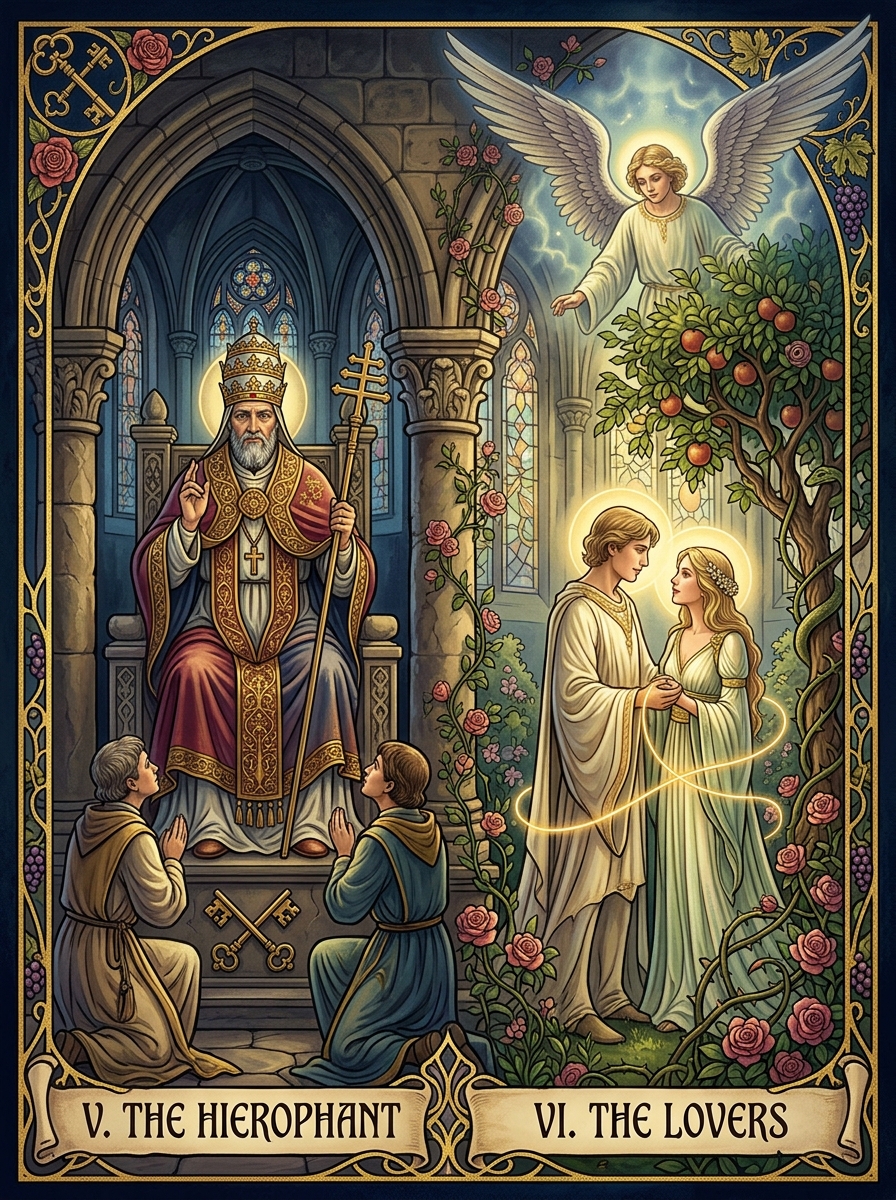
The core dynamic: when choice must become covenant
The Hierophant and The Lovers together do not point to romantic bliss or institutional safety considered separately. They mark the seam where personal desire meets collective value, and where that meeting demands a binding decision. The Hierophant represents inherited structure—religion, law, tradition, transmitted ethics. The Lovers represents the raw act of selection: which person, which path, which truth. When they pair, the question is never simply “What do I want?” but “What am I willing to consecrate?”
This is a threshold of adult choice. The Hierophant brings a frame that already exists; The Lovers brings the heat of lived preference. Together they say that every significant commitment—whether to a partner, a vocation, or a creed—must be both freely chosen and accountable to a higher order. A bond that only pleases the heart may lack root; a bond that only obeys tradition may lack soul. The combination insists on both.
For the foundational symbolism of each card seen separately, the individual card meanings for The Hierophant and The Lovers unpack their inner architecture; here we focus on their fusion.
The psychological architecture: law and longing meet in the self
Jungian psychology offers a precise lens for this pairing. The Hierophant corresponds to the collective unconscious: the archetypal patterns, moral norms, and symbolic systems that precede any individual. The Lovers corresponds to the anima/animus projection—the magnetic pull toward another who mirrors what we most need to integrate. The combination is the negotiation between the inherited Self and the emerging individual.
In practical terms, this often shows up when a person falls in love with someone whose values differ from their family’s, their church’s, or their own earlier commitments. The attraction (The Lovers) forces a reckoning with the internalized authority (The Hierophant). The psyche does not let you keep both in separate compartments. It demands that you either revise the code to include the beloved, or reject the beloved to keep the code intact.
This is why the pairing frequently appears at the moment of engagement, marriage, or religious conversion—life events that require formalizing a private truth into a public vow. The choice is no longer just emotional; it becomes ontological. You are deciding who you will be from now on. The pair with The High Priestess and The Hierophant highlights the contrast between silent inner knowing and spoken law; here, the law must be spoken because the choice is now social.
Devotion versus dependency: the two faces of the bond
A mature reading of this combination produces devotion: a consciously renewed allegiance that honors both desire and principle. An immature reading produces dependency: obedience to convention out of fear, or attachment to a partner out of neediness disguised as love. The difference is agency.
When the Hierophant dominates, the querent may default to what is expected—marrying for family approval, staying in a faith that no longer fits, pursuing a career because it is prestigious. The Lovers then appears as a quiet ache, a sense that something essential was not chosen. In this shadow form, the combination can sustain a life of respectable unhappiness.
When The Lovers dominates without the Hierophant, the shadow is recklessness: following desire without regard for consequence, covenant, or the welfare of others. The relationship may burn bright and collapse because nothing was built to last. The Hierophant supplies the architecture that makes commitment durable.
The health of the pairing depends on whether the choice is conscious. If the querent can articulate why this vow fits both their heart and their ethics, the combination is a sign of genuine maturity. If they cannot, the cards are asking for deeper work—often a confrontation with the internalized “should.” The contrast with The Lovers and The Devil is instructive: where the Devil signifies compulsion and addiction, this pair signals a freedom that chooses its own form.
How it lives: in love, work, and the shape of a life
Because the core dynamic is already defined, we do not need separate sections for each domain. The same principle applies everywhere: a bond must be both chosen and structured.
In love and relationships, the combination most often signals a partnership moving toward formal recognition—marriage, engagement, cohabitation with a public dimension, or integrating families. The relationship is not merely intimate; it becomes a container for shared values. If you are comparing with the more victory-oriented pairing of The Chariot and The World, this one is less about triumph than about consecration. The relationship may also require resolving a values conflict—one partner wants ritual, the other wants spontaneity—and the cards insist that a resolution must be reached, not avoided.
In career and public life, the pairing points to vocations where ethics and influence intersect: teaching, ministry, law, medicine, institutional leadership, publishing. The Hierophant gives authority; The Lovers gives relational intelligence. The question is whether your work coheres with your deepest principles. If you are considering a job that demands a compromise of conscience, the cards show the fork—stay and betray yourself, or leave and rebuild. For a structured layout to separate vocation from environment, The Career Tarot Spread can clarify whether the issue is the role or the system.
In general life decisions, the combination appears at crossroads that feel like a test of integrity. Should you move for a relationship? Should you marry someone of a different faith? Should you leave a family business to pursue art? The cards do not prescribe an answer—they prescribe the process: identify the value system, then test the choice against it. The Hierophant and Judgement pairing, explored in The Hierophant and Judgment, adds the dimension of a summons from the soul; here, the summons is already present, and the only step left is the human one of saying yes or no.
Guidance: how to work this combination in a reading
When these two cards appear together, the cleanest reading move is to locate the Hierophant figure in the querent’s life—parent, church, employer, inner critic—and then ask whether the Lovers choice aligns with or challenges that figure. The energy of the spread will reveal whether the querent is ready to make a vow or still hiding in ambivalence.
A practical technique: ask the querent to name one “rule” they have been following without examination. Then ask what they truly desire. If the two conflict, the cards are demanding a conscious synthesis, not a surrender of one side. Journaling or a spread like The Decision Tarot Spread can externalize the inner dialogue.
The ultimate teaching of this pair is that love and law are not opposites. They are the two pillars of any durable bond. The Hierophant gives the framework; The Lovers gives the fire. The soul’s marriage happens when the fire is kept alive within the framework, and the framework is flexible enough to hold the fire. That is the work this combination asks for: not a choice between desire and duty, but the creation of a life in which both are honored.
Related
- The Hierophant and The Lovers: When Tradition Meets the Crossroads of the Soul
- The Lovers and The Hermit Tarot Combination: The Marriage of Choice and Solitude
- The High Priestess and The Hierophant: The Quiet Authority of Inner Truth and Outer Law
- The Lovers and The Chariot: Desire, Discipline, and the One Life You Choose
- The Hierophant and Strength: Discipline Tempered by Grace
Comments
Loading comments…