I Ching Hexagram 7, The Army: Command, Discipline, and the Cost of Cohesion
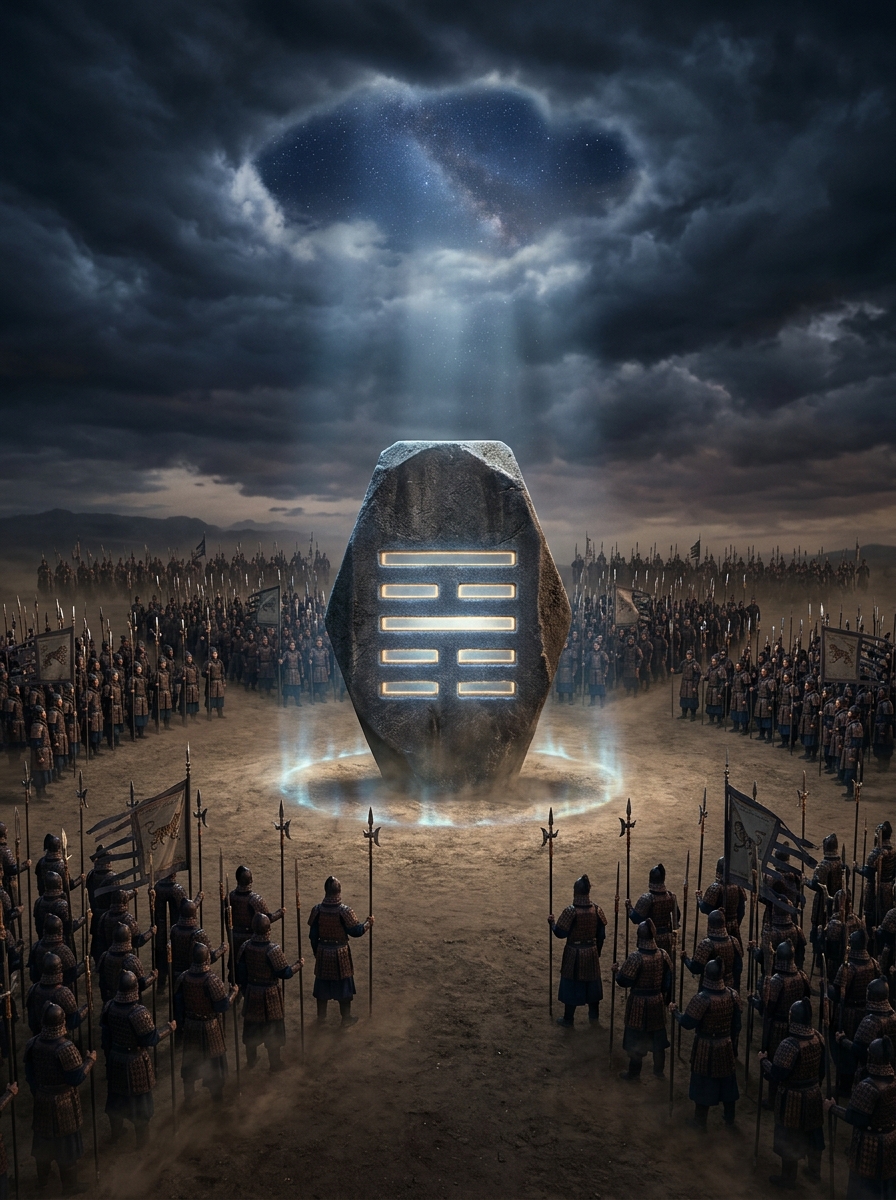
I Ching Hexagram 7, The Army
The Image of Contained Force
Hexagram 7 is Earth over Water — the receptive surface holding a mobile, dangerous depth. The old commentary calls it The Army, yet the emphasis is not on aggression but on containment. Water in the lower trigram behaves like a ravine: hidden, pressing, liable to flood. Earth above absorbs and organizes. This is force that has accepted structure, and that acceptance is what prevents it from becoming destruction.
The judgment is spare: disciplined mobilization brings good fortune if the leader is correct. There is no promise of easy victory. The hexagram asks a single question: Is the power you are gathering coherent, and is its purpose worthy? If the answer is no, the force will rot from within. If yes, it can move through danger without being swallowed.
This imagery is not limited to literal war. A household under strain, a team under deadline, a psyche negotiating competing impulses — all require The Army. The core thesis is that disorder wastes power while command concentrates it. But command must be legitimate; otherwise coercion replaces coherence.
The Judgment: The Moral Weight of Leadership
The Army assumes hierarchy, but not arbitrary hierarchy. The right leader is not the strongest or the most charismatic but the one who carries responsibility without craving admiration. The old texts speak of a “great man” — noble, moderate, impartial. These qualities matter because military force magnifies whatever flaw already lives in the commander. If the leader is egotistical, the army becomes a machine for self-projection. If just, it becomes an instrument of order.
In psychological terms, the “commander” may be conscience, a mature self-image, or a nonnegotiable principle. But the command must be earned. You cannot bully your own soul into coherence for long; you must persuade it to align with a worthy aim. This is where Hexagram 7 separates genuine authority from domination. Domination demands submission; authority invites alignment.
The judgment also insists on perseverance — not impulsive force but sustained, sequenced effort. The hexagram favors campaigns, not skirmishes. It tells you to assemble resources before advancing, clarify allies and obligations, and accept that real change happens by progression rather than surge. Force used prematurely is just panic dressed as action.
The Cost of Cohesion and the Return to Peace
Cohesion always exacts a price. To belong to a structured force is to surrender spontaneity, suppress disagreement, and accept routine. Hexagram 7 does not romanticize this. The pageantry of movement hides fatigue, sacrifice, and the erasure of individual impulse. Yet the hexagram is not anti-life. It recognizes that certain forms of life depend on coordinated restraint: families, institutions, governments, healing plans, disciplined creative work. What you give up is not your soul but your erratic sovereignty. What you gain is effectiveness.
The deeper lesson is that mobilization is not an end state. Armies are assembled for a purpose and then dissolved. This is one of the clearest divinatory truths in The Army: force should not become a lifestyle. A person or institution that cannot stand down after the emergency has grown attached to conflict itself. The hexagram warns against that addiction. It honors necessity, then asks for release.
This is why The Army can appear when you are tempted to over-control, over-explain, or overfight. Its answer is not passivity. It is disciplined action governed by a worthy command. But if the cause is false, do not mistake agitation for destiny.
When The Army Appears in a Reading
Hexagram 7 usually points to a situation where energy is already assembled — or needs to be — around a common purpose. The question is not whether force exists but whether leadership is trustworthy.
In conflict, the issue is less about feelings than about structure. A battlefield is no place for improvisational honesty when what is missing is organization. The hexagram may advise establishing boundaries, defining roles, appointing a spokesperson, or stopping every member of the group from acting as if they were sovereign. Once conflict becomes formalized, ad hoc solutions fail. You need process, agreed rules, clear lines of responsibility.
In work and leadership, this hexagram often concerns management, operations, hierarchy, and execution. It can indicate that someone is being asked to lead — or to submit to a chain of command. Power without legitimacy creates resistance. If you are in charge, your influence must be earned through fairness, consistency, and competence. If you are not, the hexagram may ask you to respect the structure that keeps the whole from collapsing, even if you dislike the particular commander. Success depends on orderliness; a brilliant plan that cannot be administered is weak, while a modest plan that can be executed is strong.
In inner life, The Army often reveals a psyche with too many contending agendas. One part wants safety, another freedom, another approval, another conquest. The hexagram does not moralize these parts; it asks who is coordinating them. The ego may need to act as responsible organizer, but only in service of the Self, not as a petty dictator. Without a center, the inner kingdom becomes a border war. The work is to identify the principle worth serving and let other impulses line up behind it.
The Number Seven and the Ethics of Rank
Seven in the I Ching carries the atmosphere of ordered movement under stress — not a triumphant parade but a measured advance that knows the stakes. The number corresponds to grouping, formation, and the human need to coordinate many parts into one intention. That is why Hexagram 7 is about the social miracle of consent to structure.
Rank is often misunderstood as domination, but the I Ching treats it as a bond of reciprocal duty. The one above must see farther, bear more, and answer for the many below. The one below must trust that the chain of command has purpose. That mutual obligation is what gives The Army its ethical charge. An army without mutual obligation is only organized violence; an army with integrity becomes protection.
This is the clearest test of maturity in the oracle: can power be held without intoxication? Hexagram 7 answers that it can — but only when the leader remembers that the army is temporary, that the cause is the point, and that the cost of cohesion must be repaid by a return to peace.
Comments
Loading comments…