Hexagram 34, Great Power: Force Under Discipline
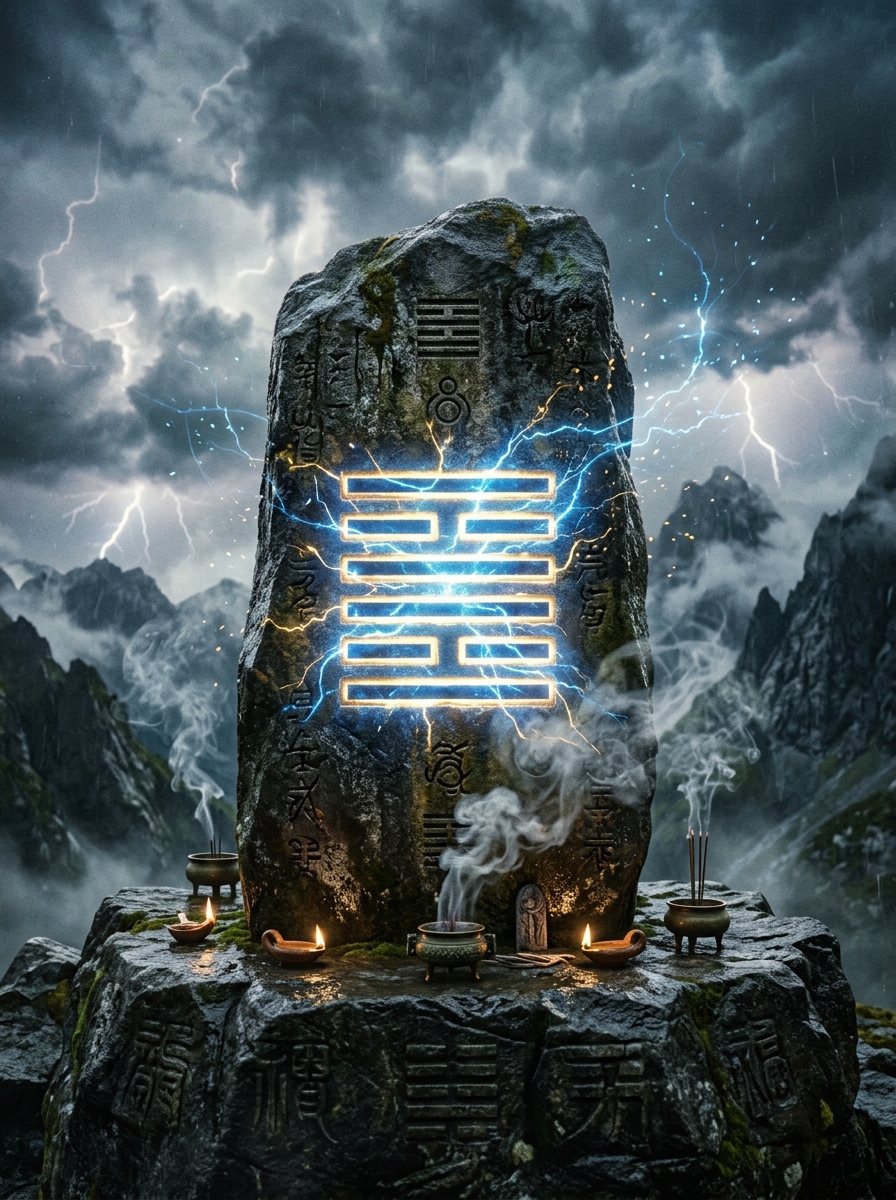
The Core Dynamic: Force That Has Learned Where Not to Strike
Hexagram 34, Great Power, does not celebrate strength. It interrogates it. The image is thunder moving beneath heaven: the lower trigram Zhen — sudden, explosive — pushing upward into the vast, ordered clarity of Qian. Thunder wants to discharge immediately; heaven provides the principle that refuses to let energy become mere impact. Together they generate a single, severe thesis: power becomes legitimate only when discipline governs its expression.
The oracle’s judgment — “Perseverance furthers” — is not a cheer. It is a test. Strength that cannot wait, cannot hold, cannot align with timing and measure, is not Great Power but compulsion. The ram’s horns, traditional emblem of this hexagram, capture the risk: the animal rams forward, but when its horns lodge in a fence, it cannot advance. That image is not an insult. It is instruction. Great Power is not endless forward motion; it is the capacity to stop before the obstruction and recognize that some gates do not open by force alone.
This hexagram answers a question older than strategy: “I have the energy — now what?” The answer is never “use it all.” It is “prove you can govern yourself before you try to govern anything else.” The power is real. The challenge is to make it trustworthy.
The Psychological Roots: How Unprocessed Power Turns to Compulsion
Great Power arises when a person has more energy than the immediate container can absorb — more talent, more anger, more ambition, more voltage. The nervous system wants release. The ego wants confirmation. This is the psychological root of the hexagram’s warning: high energy tempts overreach because the feeling of strength is itself a reward.
The danger is not the force but the addiction to its display. When people feel powerful, they often feel compelled to act visibly — to settle the field, win the room, prove they are not weak. The I Ching names this the shadow of the ram: force that has not been filtered through self-reflection. It is not that the intention is bad; it is that the timing, the target, or the proportion is wrong. In the consultation room, this hexagram often appears when a client has legitimate leverage but has not yet asked whether the context can bear what they intend to do.
The Ego’s Favorite Narrative
The most insidious moment is the one that feels heroic. The ego starts narrating itself as necessary: “I must act now,” “No one else will,” “This requires my full force.” Great Power exposes that story as self-serving fantasy. Courage includes the ability to pause, redirect, or wait. If the strength is real, it does not evaporate in restraint — it concentrates. The psychological task of this hexagram is to distinguish raw capacity from usable authority, and that distinction always begins with self-examination.
Maturation: The Authority That Can Wait
Mature Great Power looks almost understated. The person who embodies it does not announce strength; the strength is evident in the clean decision, the refusal to waste motion, the boundary drawn without apology. This is the authority that has survived the temptation to prove itself.
The maturation process requires a shift from external validation to internal structure. Early expressions of the hexagram’s energy are often theatrical — the leader who grandstands, the lover who overwhelms, the artist who overproduces. With experience, the same energy learns economy. The image of heaven over thunder is the blueprint: the lower force is not annihilated, only ordered. The point is not to become less powerful; it is to become trustworthy with power.
Competence Under Pressure
In practice, mature Great Power shows up as precise response. Move where the obstacle is weakest, not where your temper is strongest. Speak when silence would become cowardice, but do not speak just because your energy is surging. The oracle asks for discernment: where does this force belong, and where would it damage what it touches? That discernment is the hardest discipline, and the most rewarding. It converts raw voltage into durable influence.
The Shadow: When Force Becomes Performance
The shadow of Hexagram 34 is force that has lost its connection to principle. The ram’s horns stuck in the fence are the inevitable result: friction, frustration, humiliation. This happens when a person mistakes velocity for wisdom. The energy is legitimate — even admirable — but its application is wrong.
Psychologically, this shadow corresponds to Mars-like assertion in its unreflective form. Not the planet as a strict symbol, but the archetype of will without proportion. It appears in leaders who have brilliant plans and fail because the timing is off. In lovers who have intense feeling and damage intimacy by pushing too hard. In activists who have moral clarity and lose the field by escalating prematurely. The shadow is not the absence of strength; it is the refusal to let strength be disciplined by reality.
The Warning Against Self-Congratulation
The dangerous moment is always the one that feels most justified. Great Power offers no comfort there. It does not say “you are right to be strong.” It says “your strength must prove itself in restraint before it can be trusted in action.” The fence is reality’s refusal to cooperate with ego. The only way through is to stop, assess, and choose a different angle — or wait until the obstacle shifts on its own.
Living the Archetype: Applications in Love, Work, and Crisis
Great Power is not abstract. It lives in the concrete decisions of daily life.
Love
In relationship, this hexagram warns against overwhelming a partner with intensity. The discipline is to hold your passion until the other person has space to meet it. Force that cannot wait becomes coercion, even when well-intentioned. The lover who embodies Great Power knows when to advance and when to yield — not from weakness, but from a strength that does not need to dominate.
Work
In career, the hexagram often appears at a threshold where ambition exceeds the structure that currently supports it. The temptation is to force a promotion, push a project through opposition, or demand recognition. The mature response is to strengthen the container — build the team, refine the proposal, let the timing mature. Perseverance here means staying aligned with principle while the momentum builds.
Crisis
In moments of conflict, Great Power advises restraint until the opening is clean. Head-on assault hardens resistance. The precise strike, delivered when the opponent is vulnerable and the timing is ripe, carries far more authority than any display of raw force. This is the wisdom of the soldier who knows that victory belongs to the one who can wait for the right moment — not the one who charges earliest.
In every domain, the hexagram’s core dynamic holds: power is real, but it must be governed. The person who can do that becomes more than strong. They become capable of bearing their own weight.
Comments
Loading comments…