I Ching Hexagram 33: Retreat and the Wisdom of Strategic Withdrawal
The Core Thesis: Strategic Withdrawal as Preservation
Hexagram 33, Retreat, is not surrender. It is not cowardice, tactical apology, or the ego’s last-ditch plea for safety. The hexagram names a precise moment when the wisest action is to step back before the field of engagement becomes corrupt enough to contaminate your center. The thesis is almost mathematical: when the dominant force is moving in a direction that cannot be bent by your presence, staying does not improve outcomes — it only depletes your capacity to act later. Retreat, here, is conservation. It gathers energy, clarifies intention, and protects the seed of what matters.
The number 33 — a master-pattern of doubled triadic intensity — reinforces this paradox. The same structure that in Master Number 33 describes spiritual service through compassion appears here as a discipline of purposeful absence. Both systems bind power to restraint: the healer who never withdraws becomes the martyr; the sage who never retreats becomes the noise. Hexagram 33 does not ask you to love obscurity. It asks you to respect your own efficacy enough to avoid being absorbed by an adverse current.
This is not a hexagram of retreat from life, but retreat into form. The body of the teaching — the judgment, the image, the moving lines — all converge on one demand: know when the stage has become structurally hostile, and leave it before the play damages your instrument.
The Image: Mountain Under Sky
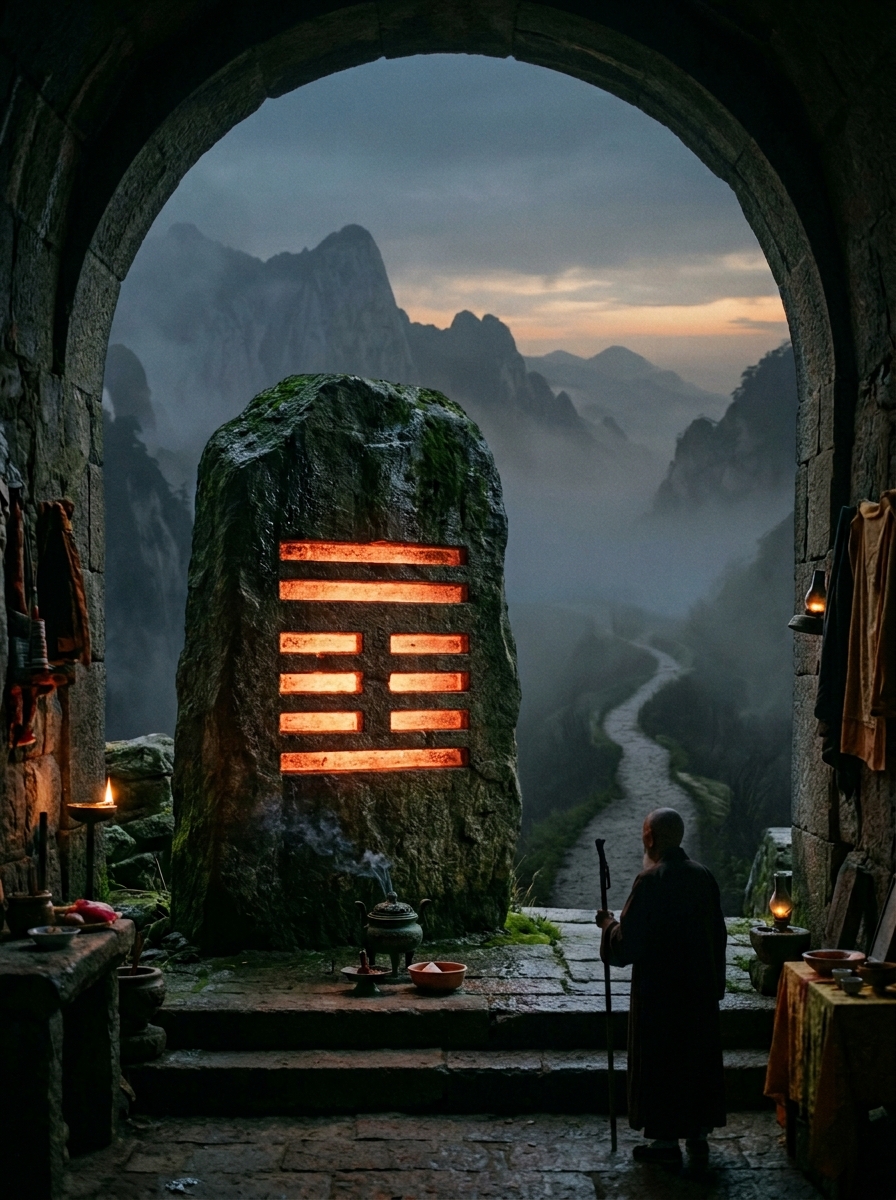
The image of Hexagram 33 is mountain under sky — stillness beneath immensity, a shape that does not argue with what towers above it. In the cosmology of the I Ching, this pairing is decisive. Mountain is the trigram of stopping, of boundary, of the earth that holds its ground without advancing. Heaven is the trigram of movement, aspiration, and overwhelming command. When heaven presses downward and the mountain does not push back, the result is not drama but spacing. Retreat, here, is architectural. It creates a necessary interval between the self and a force too large, too impersonal, or too socially charged to meet head-on.
The Paradox of Stillness Under Pressure
A mountain retreats in a way a person cannot: by remaining exactly what it is. That paradox is central. The prudent response is not panic but elevation of standpoint. You do not abandon your values; you change your position relative to the pressure. The mountain does not “argue” with heaven, and the reading suggests you should not expend your life-force arguing with what cannot be persuaded now. In a consultation, Hexagram 33 often appears when someone is trying to out-muscle a process that asks for containment — a lawsuit that will drain the soul, a relationship that demands self-erasure, a public identity that has become a cage.
This image also clarifies why the hexagram has a cool, unsentimental quality. Retreat is not sentimental self-care. It is boundary intelligence. The same geometry appears in the teaching of Expression Number 33: compassion without porousness, devotion without self-erasure. The mountain preserves form so that its presence remains meaningful later.
The Moving Lines: Where Retreat Deepens
The six lines of Hexagram 33 map retreat as a graduated art — not a single act but a trajectory that changes meaning depending on when and how you move. The traditional text rewards the earliest withdrawal and makes the cost of delay visible.
Line 2: The Yellow Ox Hide
Line 2 speaks through the image of a yellow ox hide — something durable enough to shelter what must be preserved. Yellow signifies the center, moderation, what is neither flashy nor extreme. This is retreat as safeguarding essence. You do not vanish; you cover what is vulnerable until conditions improve. For the diviner, this line often points to discretion: keeping a commitment out of a corrosive public gaze, protecting a fragile creative process from premature exposure, shielding a relationship from the pressure of others’ expectations. The hide is not a wall; it is a temporary membrane. The retreat here is strategic concealment, not disappearance.
Line 6: Retreat Beyond Ambition
Line 6 — the top line — describes complete withdrawal from a situation whose cycle has ended. The field no longer requires your participation, so you depart without regret. This is not exile; it is consummation. The line belongs to those who understand that some victories are won by leaving before the final round. In the context of the 33 master vibration, this is the point at which service is no longer needed because the patient has healed or the lesson has been absorbed. To stay would be to linger as a ghost in a room that has already been winterized. The dignity of this line is its refusal to attach dignity to continued presence.
Between these poles, the other lines mark the psychological cost of hesitation. Line 3 shows the ego sentimentalizing persistence — calling stubbornness loyalty, mistaking fear for responsibility. The hexagram strips that away: if the ground is corrupt, persistence is vanity in a moral costume. Line 5 offers the most graceful form of letting go — generous withdrawal with no backward glance. This is the line of the leader who leaves a role at the right moment, not because they are defeated but because the role itself no longer serves the whole.
The Ethics of Withdrawal: What Retreat Is and Is Not
The old formula attached to Hexagram 33 — the small goes, the great stays — is easy to misread. It does not mean the powerful always win and the weak must yield. It means that the current of the moment favors what is petty, reactive, or strategically encroaching, while the larger principle must not be contaminated by contest. In practical terms, this is the wisdom of not allowing yourself to be dragged into a fight that would shrink you into the very thing you oppose.
Distinguishing Retreat from Avoidance
Retreat is not avoidance when avoidance would merely prolong a necessary reckoning. It is also not a covert punishment, a silent tantrum, or an ultimatum dressed as wisdom. The hexagram’s counsel works only when the departure is clean — leave the battlefield, not the narrative; step away from the role, not from reality. The difference lies in what you carry out with you. If you leave resentment, you have not retreated; you have merely relocated the conflict. If you leave hope, you have retreated with the seed intact. The judgment of the hexagram commends small but steady movement backward — persistence in a modest, unglamorous course rather than theatrical escape.
The Spirit-Work of Not Overextending
If you are drawn to the symbolism of 33 as a master vibration, this hexagram offers its most sobering lesson: service is not proven by overexposure. The most potent healer is not always the most available one. Sometimes wisdom means refusing to be recruited by a system that feeds on your overextension. That is why this hexagram can be deeply liberating. It authorizes the soul to stop over-identifying with the demand for action. Retreat, in its highest form, is how you keep your inner law intact until the world can meet it again.
Retreat in Practice: One Arc Through Life
Because the core dynamic has been set, this single consolidated section can show its concrete expression without re-deriving the theory. Retreat shows up differently in love, work, and spiritual practice, but the logic is the same: create space before the environment forces you to contract further.
In relationships, Hexagram 33 often appears when one partner is moving faster, louder, or more reactively than the other. The retreat is not abandonment but a temporary gap that prevents the smaller issue from inflating into a war of identities. The yellow ox hide — discretion, privacy — may mean not airing grievances publicly, not letting a third party mediate what only time can clarify. The generous withdrawal of Line 5 here is the capacity to let go of being right for the sake of the bond’s survival.
In career, the hexagram can advise stepping out of a political crosscurrent, even if that means looking less impressive for a while. The small goes — the office gossip, the petty competition, the need to be seen as indispensable. The great stays — your competence, your network of genuine allies, your long-term reputation. Retreat here is a form of career strategy that the modern workplace rarely honors but that the I Ching consistently rewards.
In spiritual work, retreat signals a season of interiorization. The outward display of devotion or wisdom would dissipate the deeper process. This is the moment to study, to practice in silence, to let the underground root system thicken before the next visible growth. The Master Number 33 resonance is especially clear here: the healer who never withdraws becomes hollow. The teacher who never stops teaching forgets how to learn. Retreat is the renewal that makes continued service possible, not the end of service.
Hexagram 33 does not promise that withdrawal will feel good. It promises that the alternative — continuing to push against a closed door — will cost more. The question it asks is not “Are you strong enough to stay?” but “Are you clear enough to know when staying weakens what you serve?” To answer that question honestly is to begin the retreat before the season turns hostile. The mountain waits. The sky will pass. The seed remains.
Related
- Hexagram 26, Great Taming: Power Held in Reserve
- I Ching Hexagram 12: Standstill, and the Intelligence of Contraction
- Hexagram 62: Small Exceeding and the Art of Flying Low
- I Ching Hexagram 24: Return and the First Pulse of Renewal
- Hexagram 53, Development: The Slow Architecture of Growth
- I Ching Hexagram 56: The Wanderer and the Logic of Elsewhere
Comments
Loading comments…