Hexagram 52, Keeping Still: The Mountain That Teaches Silence
The Core Dynamic: Stillness as Intelligent Cessation
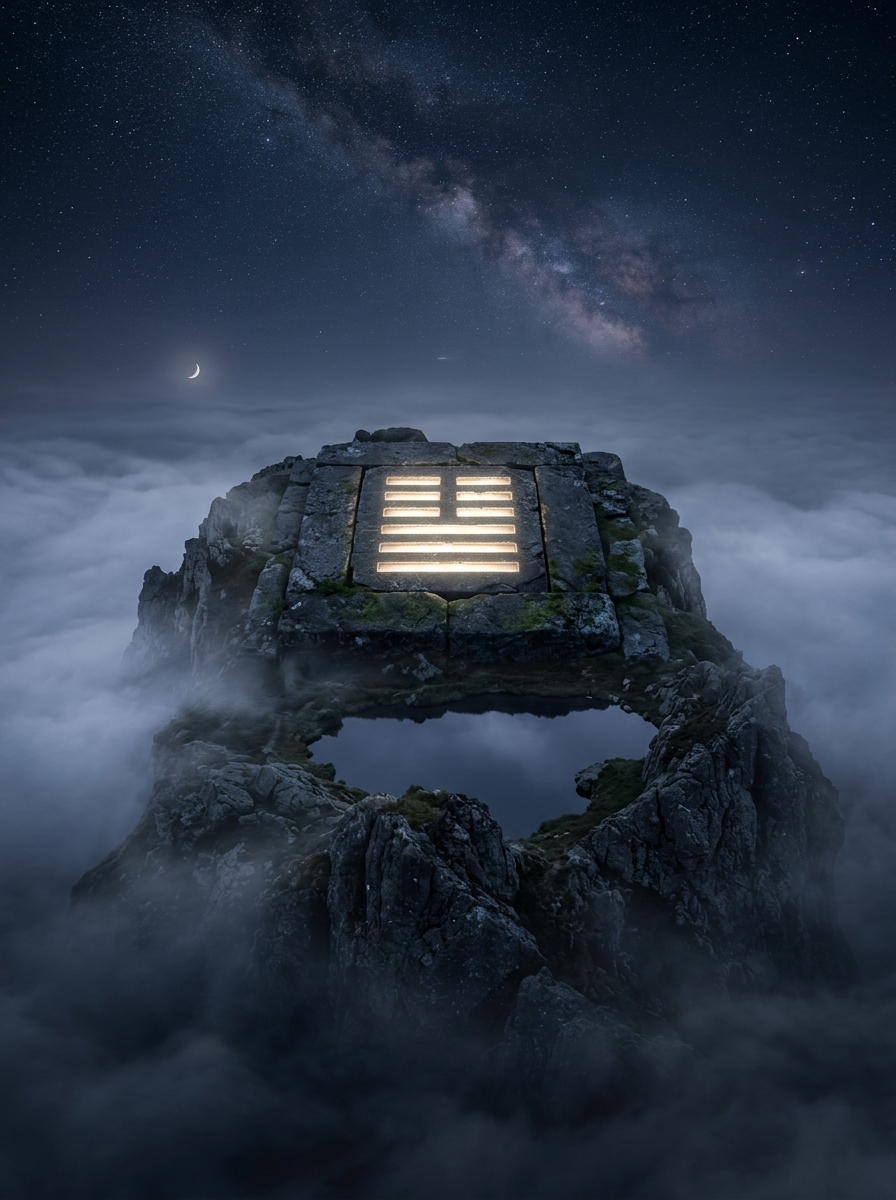
Hexagram 52, Keeping Still is the doubled mountain — lower trigram Gen, upper trigram Gen, the image of one mountain standing on another. This is not inert mass. It is pressure turned inward, movement arrested at its limit. The I Ching presents the mountain as a teaching: the noble response to a situation saturated with motion is to stop with precision. The mountain does not chase, explain, or bargain. It simply is.
That image matters because this hexagram is not about passivity. It is about the intelligence of cessation. The body of the mountain holds the slope; the peak marks a boundary. In divinatory terms, Keeping Still asks where motion has become noise, where thought has become compulsion, where desire keeps moving past the point of usefulness. The mountain does not shame movement. It disciplines it.
The judgment makes this explicit: “Keeping Still. Keeping his back still so that he no longer feels his body. He goes into his courtyard and does not see his people. No blame.” This is an austere statement but not a dead one. The back stills, then the body, then the social field. The sequence matters. Stillness begins in the deepest support system and radiates outward until the ordinary demands of contact lose their grip. The courtyard is not exile; it is a space of regulated intimacy, where only what matters may enter.
The core thesis is simple: there are moments when the right response is not more insight, more speech, or more action, but a disciplined holding of the line. The oracle’s language is severe because it is protecting the psyche from overreach. In a state of overload, the mind keeps trying to solve life by multiplying motion. Keeping Still interrupts that reflex. It refuses the fantasy that every tension must be solved immediately. Some tensions dissolve only when they are not fed.
Psychological Roots: The Back as Support and the Boundaried Mind
Gen is the trigram of the hand on the back, the vertebrae, the cliff-edge of awareness. Its governing organ in traditional correspondence is the back, and that detail is psychologically exact. When Hexagram 52 appears, the issue is often not what you can see, but what you can no longer carry behind you. The back supports, resists, and remembers. To stop there is to recognize that the self has a structure, and structure has limits.
The phrase “keeping his back still” has often been misunderstood as a posture instruction. The older nuance is subtler. The back is the place of support, burden, and reflexive contraction. To still the back is to stop the habit of bracing against the present. That can mean no more argument, no more self-justification, no more reaching behind the current moment to drag in old material. Once the back is at rest, awareness naturally clears; the body no longer floods the field with urgency.
This is why the hexagram can feel like relief when it appears in a reading. It names a threshold condition: a situation in which motion would be premature, or a conversation would only widen the wound. Keeping Still is diagnostic. It tells you that the central issue is not the topic at hand but your relation to momentum itself. The mind has been running ahead of the moment, and the oracle calls it back to the spine.
The courtyard in the judgment is the humanized form of mountain stillness. It is enclosed, visible, and domestic — not wild, not public. That detail gives Keeping Still its moral shape. The hexagram does not prescribe total withdrawal from life; it prescribes the right scale of life. You do not need to vanish into spiritual abstraction. You need to enter a measured space where your center can reassemble itself. “Does not see his people” is not alienation in the clinical sense. It describes a necessary temporary non-participation. In some circumstances, the most ethical act is to cease reacting to the crowd. The mountain does not reject the valley; it simply cannot be manipulated by it. Gen is the art of becoming unbiddable by the collective tide.
Maturation and Shadow: From Poise to Petrification
The six lines of Hexagram 52 trace a movement from bodily rest to refined inwardness to the point where one stops at the proper place. The structure is clear: stilling is not one note but a progression in the art of restraint. It starts in the feet, rises through the body, and settles in the face of the world.
In the I Ching, the body is never merely physical. It is symbolic intelligence. The feet, calves, hips, back, and mouth all represent degrees of impulse and governance. Gen concentrates that governance in the lower body first, because wisdom begins in the refusal to rush. The feet that do not run ahead create the possibility of discernment; the mouth that does not speak too soon preserves truth from distortion. This is the maturation of stillness: breath, posture, speech, and intent brought into one line. True stillness is coherent, not a mask worn over agitation.
But there is a shadow. Keeping Still can harden into stubbornness, emotional freeze, or a refusal to respond when response is needed. A mountain is stable, but a person can become petrified. The difference is subtle but decisive. Mountain stillness serves life; rigidity serves fear. One creates room; the other shuts it down.
The key distinction lies in the quality of containment. The stillness of Gen is aware, embodied, and unpanicked. It permits emotion to exist without enthroning it as the ruler of the moment. This is not repression — repression splits the psyche and drives the disowned material underground. The mountain contains without crushing. It holds the weather without becoming it. When the shadow takes over, containment becomes denial, and the courtyard becomes a prison. The hexagram’s judgment remains merciful: “No blame” does not mean “always stay still.” It means that, in the right measure and at the right time, stopping is not failure. The shadow arises when stopping becomes a permanent identity rather than a strategic pause.
How It Plays Out in a Life: Applications of the Dynamic
In relationship readings, Keeping Still often indicates that someone needs space, that a pattern needs to cool, or that a conversation would be better delayed until each person can re-enter the room without reenacting the past. The mountain image matters here because it distinguishes space from abandonment. A mountain is present by its very immovability. A person practicing Gen may be deeply committed while temporarily unavailable for emotional performance. The hexagram can also expose the exhaustion that comes from over-accommodation. If you have been smoothing, explaining, and absorbing everyone else’s emotional weather, this hexagram returns you to the architecture of selfhood. It asks: where is your back? Where is your support? What are you carrying that was never yours?
In work and decision-making, Hexagram 52 warns against premature launches, reactive emails, and the false urgency of “keeping up.” The mountain knows that not every interval is productive motion. Sometimes the best use of a pause is to let a plan cool until its weak points become visible. If you are trying to force a conclusion, the reading may be telling you that the conclusion must be earned through stillness, not bullied into existence. This is especially important when ambition has become identity. Keeping Still interrupts the fantasy that constant responsiveness equals competence. Competence sometimes looks like restraint, like refusing to add another layer of activity to a structure already straining under its own momentum. The mountain does not decorate itself with motion. It endures.
At its deepest level, this hexagram is about sovereignty. Not power over others, but the ability to remain centered when outer forces invite fragmentation. The mountain image says that your most reliable knowledge may arise after you stop trying to manufacture it. In that sense, Keeping Still is a gateway hexagram: it creates the conditions under which the next true movement can happen. Its meaning is not “do nothing forever.” Its meaning is “do not betray the moment by acting from noise.” When the I Ching gives you mountain upon mountain, it is drawing a line around the sacred field of restraint. Within that field, the self is not diminished. It is gathered.
Related
- Hexagram 26, Great Taming: Power Held in Reserve
- I Ching Hexagram 12: Standstill, and the Intelligence of Contraction
- I Ching Hexagram 33: Retreat and the Wisdom of Strategic Withdrawal
- Hexagram 53, Development: The Slow Architecture of Growth
- Hexagram 15, Modesty: The Art of Power That Does Not Announce Itself
Comments
Loading comments…