Dream About Death: Endings, Warnings, and the Psychology of Renewal
The Core Dynamic: Death as the Mind’s Symbol for Irreversible Change
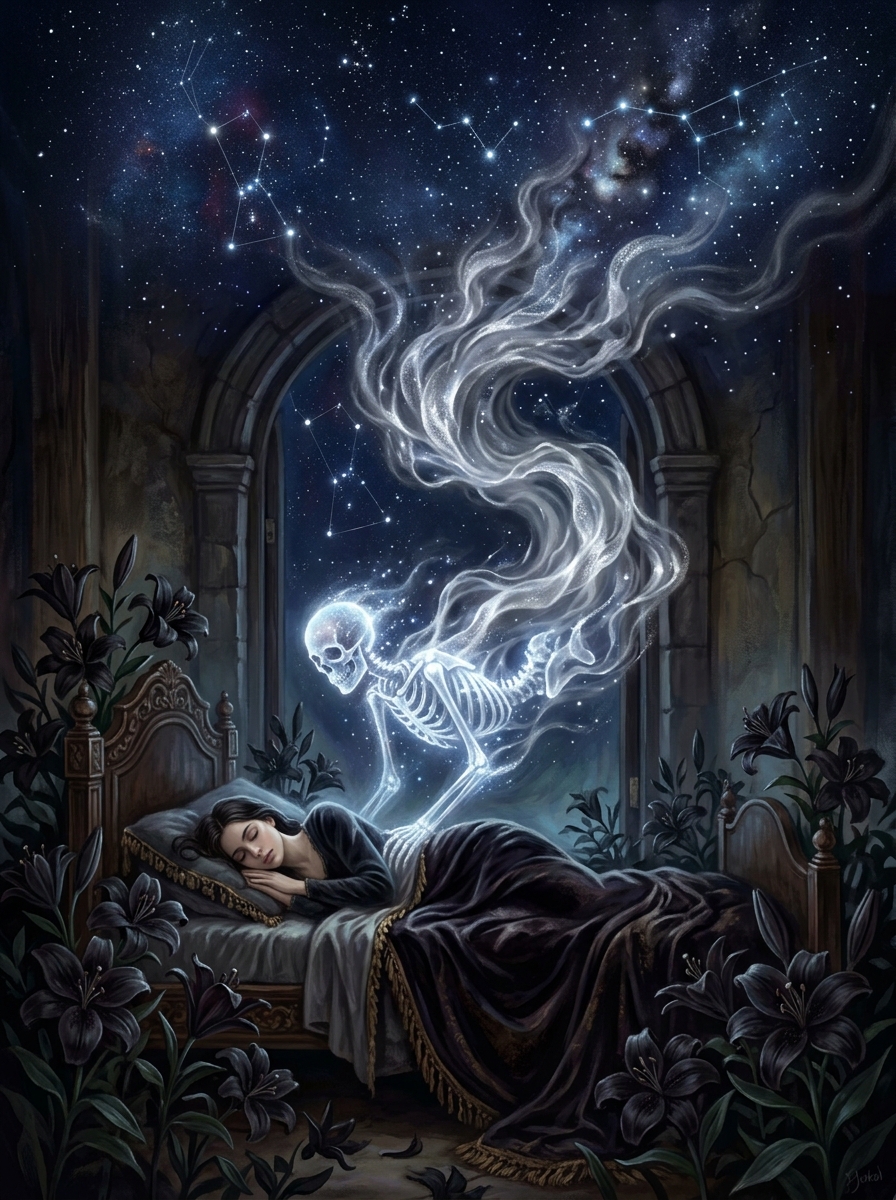
A dream about death rarely functions as prophecy. In the vast majority of cases, the unconscious reaches for death because it is the most absolute symbol available for an ending that has already begun in waking life. An old identity, attachment, habit, or belief has lost its authority, and the psyche stages that loss as a literal death so the dreamer cannot ignore it. This is not fortune-telling; it is psychic diagnosis.
The symbolic grammar here aligns with the Death card in tarot, which carries the same weight: not annihilation, but transformation by irreversibility. Something has reached its limit. A job, a relationship dynamic, a defense mechanism, a role you have outgrown—whatever form the ending takes, the dream gives it a face. The violence or calm of the imagery is proportional to how much the waking self resists the change. When the psyche has to shout, the dream turns theatrical.
Psychological Roots: Why the Unconscious Picks This Image
Death imagery performs one of three distinct psychological jobs. First, it may stage mourning for a real loss that has not yet been fully felt—a breakup, a move, a career reversal whose emotional weight the dreamer has been postponing. Second, it can dramatize separation anxiety, especially when the dream death involves someone the dreamer loves, fears, or depends on: the fear of losing the bond itself becomes a corpse in the dream. Third, and most common in recurring or vivid dreams, it depicts ego change—a part of the personality is dying because another part is trying to emerge. The Jungian term for this is psychic transition: the old container cannot hold the new energy, and the dream’s violence is compression, not punishment.
This is why a death dream can feel terrifying even when the waking life situation is not objectively catastrophic. The unconscious is not predicting disaster; it is expressing the scale of psychological force required to make a change visible. The more the dreamer clings to continuity, the more absolute the dream’s language becomes. In that sense, the dream is a form of honesty.
Who Dies Determines the Message
The first interpretive question is never “Does this mean death?” but “What exactly died, and how did the dream frame it?” The unconscious assigns roles with surgical precision.
Dreaming of your own death
When the dreamer dies in the dream, the core signal is identity pressure. Some old version of the self is under sentence: the overfunctioning self, the obedient self, the romantic self, the self that never asks for help. If the dream is peaceful, the ending may be voluntary or even overdue. If it is violent or panicked, the psyche is dramatizing resistance to a change the dreamer already knows is necessary. Such dreams often surface at major thresholds—divorce, graduation, retirement, sobriety, gender transition, spiritual conversion—where the loss of an old boundary changes social identity.
Dreaming of another person’s death
When another figure dies, the dreamer should first ask what that person symbolizes rather than what they represent as a biographical individual. A parent may stand for authority, a sibling for comparison, a friend for an abandoned trait, a stranger for an unknown aspect of the self. The death of a mother figure, for instance, may signal a shift in dependence or nurture, not maternal mortality. The death of a father figure can announce the collapse of inherited structure or approval. Even the death of an enemy can indicate that a projection is dissolving—the psyche no longer needs the enemy as a container for rejected qualities.
Dreaming of a child, lover, or pet
These dreams carry the most piercing emotional charge because they touch the vulnerable center of attachment. A dying child often represents a threatened innocence or potential—a creative project, a new beginning, a fragile hope. A dying lover may reflect the death of a fantasy about the relationship, not the relationship itself. A pet can stand for instinct, loyalty, or the body’s simpler needs. If the grief in the dream is acute, do not flatten it into symbolism too quickly; the psyche may be processing real fear of loss. But even here, the dream frequently says that the bond has changed shape and needs a new language—not a funeral.
The Emotional Texture: Fear, Relief, Numbness, Curiosity
Dream interpretation falters when it treats death imagery like a fixed codebook. The same image—a corpse, a funeral, a violent death—can mean liberation in one dream and trauma in another. The feeling-tone is the evidence.
If the dream was terrifying, the issue may be overwhelm: too much change with no psychic container. If it was strangely calm, the unconscious may be more ready than the waking self to let go. Relief in a death dream is especially telling; it can indicate that the dreamer secretly experiences an ending as mercy or permission. Numbness suggests the psyche is protecting the dreamer from a feeling too large to metabolize in one night. Curiosity, by contrast, often accompanies genuine transformation—it signals that the dreamer is approaching change with openness, even if fear lingers.
The manner of death also matters. A natural death points to completion, a ripe ending. An accident, murder, or execution indicates a rupture the dreamer did not choose—shock, interference, a break that feels unfair. This is where the dream’s theatricality aligns with tarot combinations like Death and the Tower, where the ending is abrupt, necessary, and impossible to domesticate. When the death is slow and witnessed, the psyche may be processing an extended process of grief; when instant, it registers a sharp, irreversible break.
What Follows the Ending: Renewal and the Wider Symbolic Field
A death dream is not only about what ends. It is equally about what becomes possible once the ending is accepted. The death motif belongs to the same symbolic family as initiation, descent, and return. Something dies so something else can breathe.
This is why the most productive question after a death dream is not “What will happen?” but “What is being asked to change in me?” The answer may be concrete: leave the job, tell the truth, grieve properly, stop pretending. Or it may be subtle: stop identifying with the wound, stop obeying an obsolete fear, stop confusing attachment with loyalty. When the dream carries a note of surrender after resistance, its logic echoes the Hanged Man and Death—suspension yields to irreversible change.
Recurring death dreams are especially significant. When the same image returns, the psyche is emphasizing unfinished business. The dreamer may be delaying a decision, refusing a grief, or preserving a role that has already expired. Repetition is the unconscious knocking harder, not because it is dramatic, but because it is patient.
In the wider symbolic field, the arc does not stop with death. The tarot images that often deepen the meaning show what transformation is for. Death and the Sun points toward renewal after diminution—a brighter self after the old skin is shed. The Fool and Death describes the strange innocence that follows genuine release: not naivete, but willingness to begin without guarantees. And The Lovers and Death demonstrates that choice itself is the death-rebirth hinge, because every true choice kills off another possible life.
A dream about death can be frightening, but it is rarely empty. It appears when life is already changing under the surface and the psyche has decided that subtlety is no longer enough. The dream gives shape to what is ending so the waking mind can stop defending it. In that sense, death in dreams is not the opposite of life. It is one of the ways the psyche keeps life moving.
Related
- Dream About a Dead Relative: Grief, Visitations, and the Hidden Work of Memory
- Dream About a Cemetery: What the Dead Landscape Is Trying to Tell You
- The Wheel of Fortune and Death Tarot Combination: Fate Turns, Forms Fall
- The Hanged Man and Death: When Surrender Becomes the Doorway
- When Teeth Fall in Dreams
Comments
Loading comments…