Dream About Funeral: What the Ending Means Before It Arrives
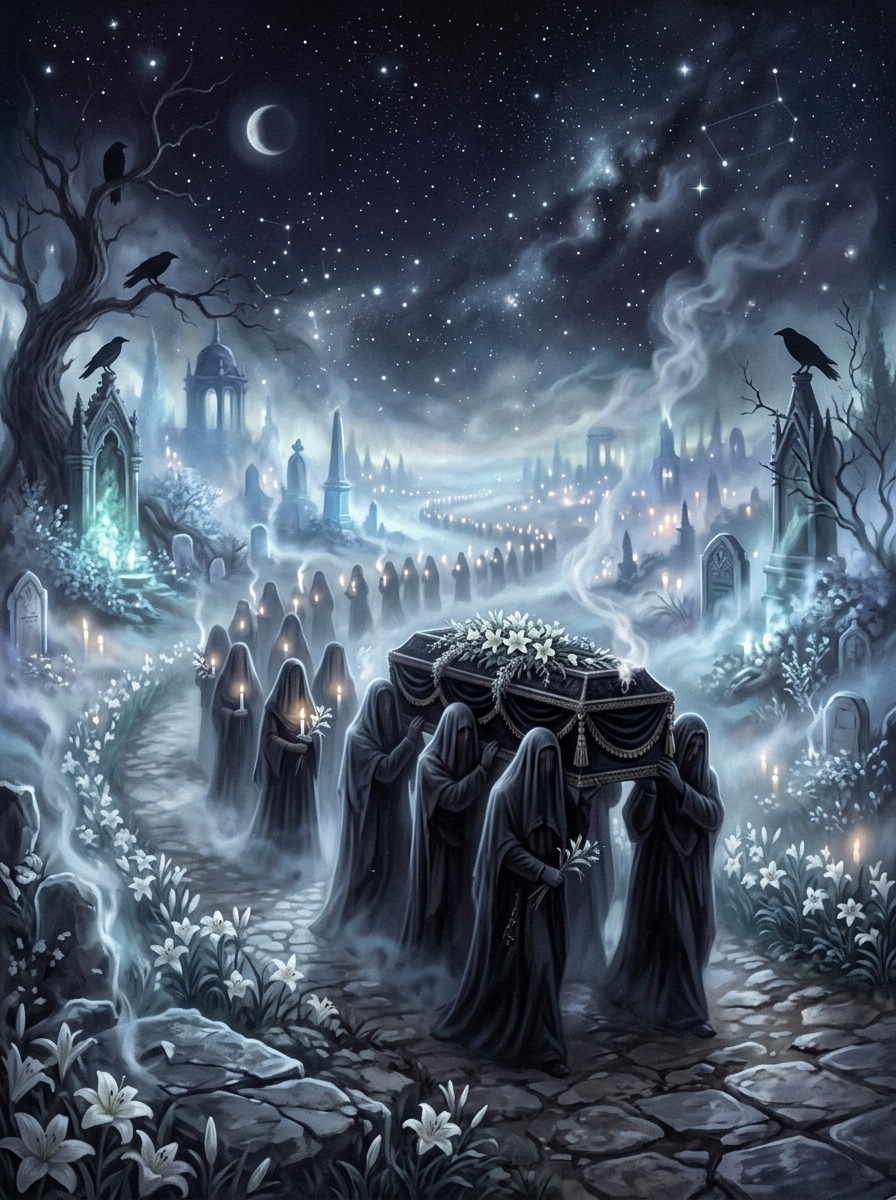
A dream about a funeral rarely predicts literal death. What it stages is a formal goodbye — the psyche’s way of making an ending legible when waking life has supplied no ceremony. A job ends in silence. A relationship cools without a conversation. An old self becomes uninhabitable. The dream supplies the ritual your conscious mind has not yet built. Its core message is not catastrophe but transition: something that needed burial has reached its graveside, and the question is whether you will attend the service or keep walking past the plot.
The ritual of acknowledgment
Why does the unconscious reach for funeral imagery rather than, say, a door slamming? Because funerals are structured acts of acknowledgment. They give loss a shape, a duration, a social frame. In dreams, that frame does not require an actual corpse; it requires the function of burial. The funeral is the psyche’s way of saying: this is finished, and it matters.
The emotional tone of the dream tells you whether the ending is accepted or resisted. A calm, respectful service suggests healthy closure — the psyche has metabolized the loss. A chaotic or interrupted ceremony points to stalled grief: something in you cannot yet let the old form go. This is not a judgment; it is diagnostic. The dream is asking you to notice where your waking life has an ending that remains unhonored.
In Jungian terms, the unconscious often expresses transformation through images of burial because the old psyche must be surrendered before a new one can emerge. The symbolism is not decorative; it is structural. The Moon’s underworld current — a descent into concealed material — follows the same logic. If you want a broader frame for how dreams treat symbolic death, our approach at Aurora Arcana emphasizes meaning over omen.
What the dead figure represents
The identity of the deceased in the dream is less important than the function that person carried. A parent’s funeral may signal the death of inherited authority, not fear of losing the parent. A partner’s funeral may point to intimacy that has become inaccessible — not a literal wish for them to vanish, but an acknowledgment that the bond has changed shape. A stranger’s funeral usually refers to an unnamed part of the self: a quality, a pattern, a role you have outgrown but never named.
The most potent version is a funeral for yourself. This does not predict physical death. It typically arises during major identity transitions: divorce, career change, aging into a new decade, recovery from addiction. The self that once managed life is being retired. If the dream is peaceful, you are ready. If it is distressing, part of you fears that letting go of the old self will cost you belonging.
Psychological roots: grief, repression, and metamorphosis
A funeral dream emerges from one of three psychological sources, and often from all three at once. The first is straightforward grief. If you have recently lost someone — even through estrangement or relational distance — the dream may be completing what waking life has not fully metabolized. The psyche does not require a death certificate to mourn.
The second source is repression. Feelings that have been buried — sadness, rage, remorse, tenderness — can return in ceremonial form. A funeral is a public acknowledgment of what you have kept in the basement of the mind. The dream says: this cannot remain unacknowledged. In that sense, it is less about loss than about honesty.
The third source is metamorphosis. Here the funeral marks the death of an old identity, not the loss of another person. The dream appears when you are in the midst of a change that has not yet reached your conscious awareness. It is the psyche’s way of preparing you for a new season. If you are trying to distinguish which source is active, pay attention to your role in the dream. Are you attending, organizing, speaking, crying, hiding, or absent? The more active your role, the more the dream concerns your relationship to the ending itself. The more passive or bewildered you are, the more likely it reflects something that has overtaken consciousness.
How the variations differ
The specifics of the dream matter more than any generic meaning. The same funeral can convey release, dread, gratitude, or unresolved obligation depending on the setting and the action. These are not fixed codes; they reveal the texture of the transition.
Your own funeral
A dream of your own funeral is rarely about mortality. It often expresses the fantasy of being finally seen, finally mourned, or finally released from expectations. It can arise when you feel invisible in waking life. It can also appear during major reinvention, when the old self is being formally retired. If the dream is peaceful, there is readiness for change. If it is distressing, part of you fears that changing will cost you belonging.
A loved one’s funeral
A loved one’s funeral usually points to relational transformation. The person may be alive, but the bond is changing shape. The dream might be acknowledging distance, maturity, disappointment, or a new boundary. It can also surface when you fear losing someone but cannot say so directly. The emotional key is whether the dream felt like a true farewell or like an alarm bell. If you wake with relief, the dream may have released an attachment that was no longer mutual.
A stranger’s funeral
A stranger’s funeral shifts the focus from biography to atmosphere. It can represent collective grief, social anxiety, or an unnamed aspect of your own life. Because the dead person is unknown, the dream asks you to notice the ritual itself: who is present, what is being said, whether you feel included or alienated. The stranger may be a part of you that is recognizable only by its absence.
Empty casket or disrupted service
An empty casket is one of the most psychologically interesting variations. It signals ambiguity: something is supposed to be over, but the psyche does not yet know what has truly died. A disrupted funeral — late arrivals, missing mourners, no officiant, a failed burial — suggests incomplete closure. The ritual cannot finish because the emotional work has not yet caught up with the event. This is a dream of stalled transition, not failed symbolism.
Spiritual and symbolic layers
From a spiritual standpoint, a funeral dream often calls for surrender — not to death, but to the irreversible nature of change. This is where the symbolism of the Death card in tarot becomes relevant. In the Rider-Waite-Smith image, Death rides through to clear ground, not to punish. The card is about the shedding of a former skin, the necessity of release. A funeral dream carries that same current: the psyche performs an ending so a future can exist.
If the dream includes mourning garments, prayers, flowers, graveside earth, or a procession, the ritual language matters. These details suggest that some part of you knows the transition requires respect, not just speed. A funeral without ceremony can feel like an unfinished sentence. A funeral with ceremony, even a sad one, can feel like psychic architecture: structure around loss, meaning around rupture. In numerology, funerals resonate with the finality of completion — they belong to the emotional logic of closing chapters, which is why they often appear when one cycle has truly ended and the next has not yet begun.
For a deeper understanding of how symbolic systems treat endings without reducing them to gimmicks, see our editorial framework.
What to do with the dream after you wake
A funeral dream is asking for acknowledgment, not panic. The practical question is not “Will something bad happen?” but “What part of my life is already ending, and have I admitted it?” Start with the emotional residue. If you wake relieved, the dream may have completed a release. If you wake bereft, the grief may be real and current. If you wake frightened, ask what change you have been resisting — by name or by habit.
Write down who was buried, where the funeral took place, and what your role was. These details matter because dream symbolism is relational, not abstract. A church funeral, a home funeral, a cemetery, a cremation, a roadside service, or a silent gathering each carries a different psychological grammar. One may point to inherited belief; another to private mourning; another to a stripped-down, irreversible severance.
If the dream repeats, it is usually because the psyche does not consider the issue finished. Repetition means the ritual is incomplete, not that the omen is worsening. In that case, the dream may be asking for an actual act of closure: a letter unsent, a room cleaned out, a memory honored, a conversation finally had, a truth no longer postponed. That is how the symbolic funeral leaves the night and enters life.
The deepest reading of a funeral dream is rarely ominous. More often it says that something in you already knows the season has changed. The dream provides the dignity of mourning so that transformation does not arrive disguised as chaos.
Related
- Dream About a Dead Relative: Grief, Visitations, and the Hidden Work of Memory
- Dream About a Wedding: What It Means When Commitment Dreams Stir the Psyche
- Ghost in the Dream: What a Dream About a Ghost Means
- Dream About Being Fired: What the Panic Is Really Saying
- Dream About a Car Crash: What Your Psyche Is Trying to Say
Comments
Loading comments…