Sun in Cancer, Moon in Capricorn: The Architecture of the Soul
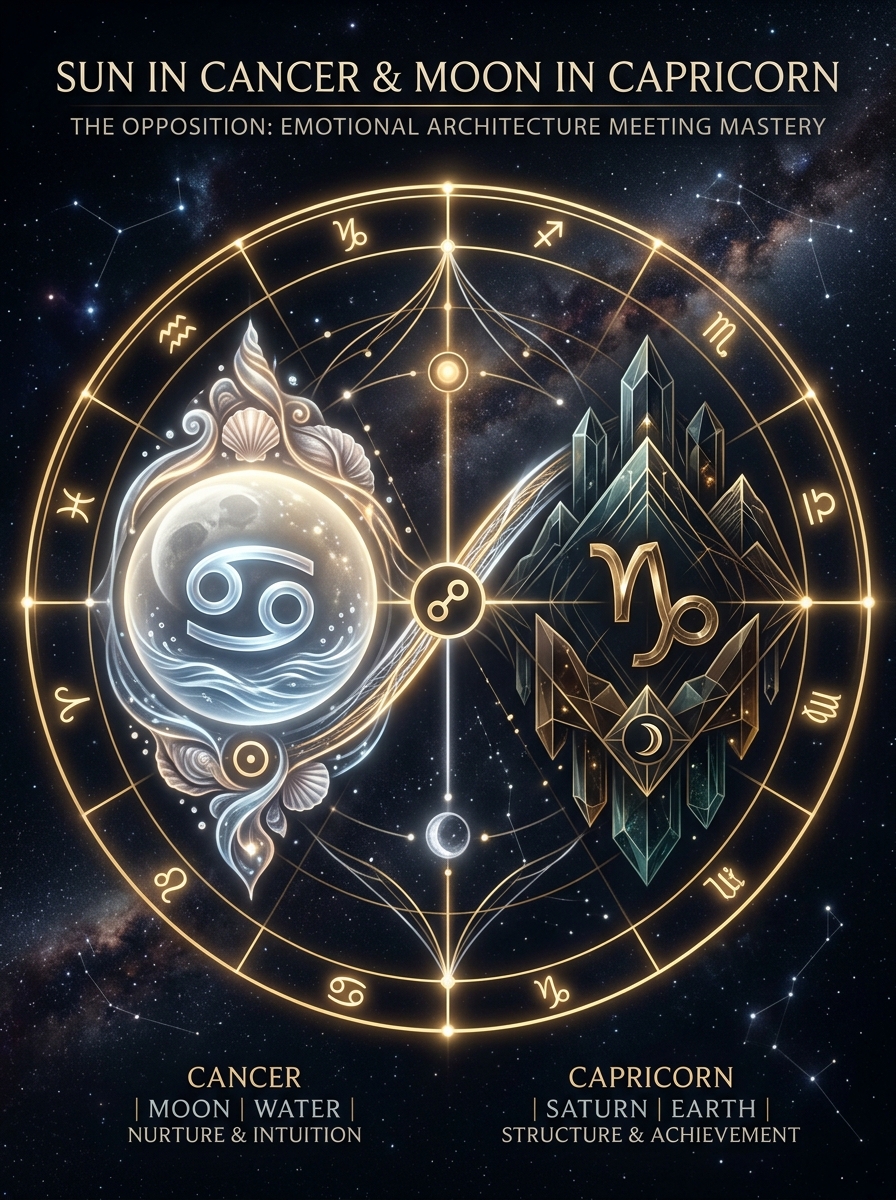
The Cancer-Capricorn Axis: Integrating Home and World
The human psyche is a landscape of opposing forces seeking equilibrium, and few configurations illustrate this dynamic tension as vividly as the combination of a Cancer Sun and a Capricorn Moon. In psychological astrology, particularly within the traditions shaped by Carl Jung, Liz Greene, and Steven Forrest, this placement represents a lifelong engagement with the Cancer-Capricorn polar axis. This axis, which spans the fourth and tenth houses of the natural zodiac, is the axis of security, belonging, and legacy. Cancer, ruled by the Moon, seeks security through emotional connection, maternal warmth, and the preservation of personal roots. Capricorn, ruled by Saturn, seeks security through tangible structures, societal status, and the mastery of the external environment. When these two forces occupy the primary luminaries of a single chart, the individual is charged with the monumental task of bridging the private, subjective world of feelings with the public, objective world of achievement.
This integration is not easily won and often requires decades of conscious psychological development. The Sun in Cancer is inherently receptive, seeking to retreat into the emotional sanctuary of the home or the inner life when threatened. It operates on instinct, feeling, and the tides of memory. Conversely, the Moon in Capricorn receives and processes emotional input through a filter of duty, pragmatism, and self-restraint. Where the Cancer Sun wishes to weep, the Capricorn Moon reminds them of the work that remains unfinished. This creates an internal dialectic where the individual’s core identity (the Sun) is continually challenged and shaped by their emotional survival strategies (the Moon). The journey of this archetype is to realize that these two signs are not enemies, but rather two sides of the same coin: the root and the branch, the foundation and the roof.
The tension of this polarity often manifests as a recurring sense of division. On one hand, the individual feels a profound pull toward the domestic sphere, wishing to nurture loved ones, cultivate a safe nest, and indulge in the cyclical, moody tides of their emotional body. On the other hand, a quiet but relentless voice within demands that they achieve something of lasting significance in the wider world. This is the Saturnian demand for competence and authority. When these two voices compete without resolution, the individual may find themselves trapped in a state of paralysis, feeling that any step toward the world is a betrayal of the home, and any retreat into the home is a failure of their ambition. True integration occurs when they realize that the structures they build in the outer world are the very walls that protect the inner sanctuary.
The Dialectic of the 4th and 10th Houses
To fully comprehend this alignment, we must examine the developmental path associated with the fourth house (associated with Cancer) and the tenth house (associated with Capricorn). The fourth house represents the deepest, most private part of the chart—the imum coeli (IC). It is our psychological soil, containing our family history, our ancestral roots, and the unconscious conditioning of our early childhood. It is where we go to feel safe, hidden from the gaze of the world. The tenth house, by contrast, sits at the highest point of the chart—the medium coeli (MC). It is the house of public visibility, career, reputation, and the legacy we construct in the outer world.
For the individual with a Cancer Sun and Capricorn Moon, life is a constant oscillation between these two poles. In their youth, they may feel torn between the urge to remain within the safe, nurturing cocoon of their family origin and the intense, almost compulsive drive to climb the mountain of public success. Steven Forrest describes the evolutionary path of Cancer as learning to honor the subjective reality of emotions, while Capricorn’s path is about developing spiritual maturity through self-discipline. When these energies are combined, the individual cannot afford to ignore either. If they hide away in the fourth-house sanctuary of domestic life, the Saturnian Moon will nag at them with feelings of unfulfillment and wasted potential. If they dedicate themselves entirely to the tenth-house pursuit of professional status, the Cancerian Sun will wither from emotional malnutrition, leaving them feeling hollow despite their external accomplishments.
This house-axis dynamic also points to the ancestral heritage that these individuals carry. The fourth house speaks to the mother and the maternal line, while the tenth house represents the father and the societal expectations placed upon the individual. In this configuration, there is often a complex blending of maternal sensitivity and paternal expectation. The individual may feel that they must become their own father-figure, structuring their life in a way that protects the vulnerable child within. They must learn to mother their ambition and father their sensitivity. By understanding that the tenth house is built upon the foundation of the fourth, they can begin to treat their emotional health not as an obstacle to their goals, but as the essential fuel that makes their achievement possible. Without a solid, nurturing fourth-house root system, the tenth-house tree will eventually topple under the weight of its own branches.
The Provider-Builder: Nurture as a Catalyst for Ambition
The combination of a Cancer Sun and Capricorn Moon yields the archetype of the "Provider-Builder." This is an individual who does not merely seek power or success for its own sake, but rather as a practical extension of their instinct to care for others. In this personality, nurturing is not a passive, soft quality; it is an active, structural force. The Cancerian Sun provides a deep reservoir of empathy, intuition, and a desire to protect the vulnerable. The Capricorn Moon channels this emotional energy into concrete action, constructing the financial, physical, and organizational frameworks necessary to ensure long-term stability for themselves and those they love.
For the Provider-Builder, love is a verb that is conjugated through responsibility. They are unlikely to offer empty reassurances or superficial displays of affection. Instead, they will show their love by paying the mortgage, organizing the family finances, building a secure home, or working late hours to ensure their children have access to the best education. This is nurture manifested as architecture. The danger, of course, is that they may become so focused on building the fortress that they forget to inhabit the courtyard. They must constantly remind themselves that emotional security cannot be entirely bought or built; it must also be felt and shared in the present moment.
Furthermore, this archetype is deeply concerned with legacy. They do not live merely for the present day; they look forward to the generations that will follow them. The Cancer Sun feels a profound connection to the ancestral past, while the Capricorn Moon feels an obligation to the future. This dual perspective makes them exceptionally planning-oriented. They are the ones who establish family trusts, purchase land that will be passed down through the family, or build businesses with the intention of handing them over to their children. Their ambition is fueled by a desire to be the bedrock upon which their family stands, a reliable source of strength that cannot be shaken by economic or emotional storms.
The Soft Core and the Hard Shell
The physical symbols of Cancer and Capricorn tell us a great deal about the internal structure of this personality. Cancer is represented by the Crab, an animal with a soft, vulnerable interior protected by a hard exoskeleton. Capricorn is represented by the Sea-Goat, a creature with the horns and hooves of a goat for climbing steep peaks, and the tail of a fish for swimming in the deep waters of the unconscious. Both signs understand the necessity of defense mechanisms.
In the Cancer Sun, Capricorn Moon individual, this defense is doubly reinforced. The external persona is often marked by a cool, competent, and stoic reserve—the Capricornian armor. To the casual observer, they may appear unflappable, serious, and perhaps even emotionally distant. They are the ones who remain calm in a crisis, taking charge of logistics while others panic. However, this stoic exterior is designed to protect an incredibly sensitive, tender, and easily bruised Cancerian heart.
This shielding can create a profound sense of isolation. Because they present such a strong, capable front to the world, others often assume they do not need support. They become the "strong one" in their families and social circles, the shoulder upon which everyone else leans. Yet, inside the armor, the Cancerian Sun is longing for the same tenderness and protective care that they so freely distribute to others. The challenge for this archetype is learning how to selectively lower their shield, allowing trusted partners to see the vulnerability beneath the competence. They must learn that asking for help is not a sign of weakness, but a vital act of self-preservation that actually strengthens their long-term resilience.
Early Maturity and the Weight of Saturnian Emotion
One of the most consistent themes in the life of a Capricorn Moon is the experience of early maturity. Ruled by Saturn, the planet of time, structure, and karma, the Moon in this sign suggests that the emotional nature was conditioned very early to accept responsibility. In childhood, these individuals often felt that they could not afford to be simple, carefree children. Whether due to financial hardship, parental illness, emotional instability in the household, or simply a perceived pressure to perform, they internalized the role of the adult at an age when they should have been playing.
This early "adultification" leaves a permanent mark on the psyche. The Capricorn Moon learns to equate safety with competence and control. They quickly discover that expressing raw, chaotic emotions (such as crying, throwing tantrums, or showing fear) is either unsafe or unproductive. Therefore, they learn to repress these reactions, replacing them with a mature, dutiful compliance. When paired with a Cancer Sun, this Saturnian conditioning creates a complex inner conflict. The Cancerian Sun represents the archetypal Child—instinctive, emotional, and deeply attached to the mother. The Capricorn Moon represents the archetypal Senex, or wise old man—disciplined, cold, and focused on duty. This inner child and inner elder must somehow learn to coexist within the same personality.
As they grow older, this dynamic often manifests as a form of reverse aging. In their youth, they may have been incredibly serious, carrying the worries of the world on their shoulders. However, as they master the lessons of Saturn, they often learn to lighten up, discovering a dry, witty sense of humor and a capacity for play that they were denied in childhood. Liz Greene notes that Saturnian types often grow younger as they age, finding the freedom to be simple and spontaneous only after they have fulfilled their duties to the world. For the Cancer Sun, Capricorn Moon, this developmental curve is essential. The integration of the Senex and the Puer (the youth) allows them to remain emotionally vibrant and creative, rather than succumbing to the rigid crystallization that can occur when Saturnian defenses go unchecked.
The Parentified Child
The concept of the parentified child is central to understanding the early development of the Cancer Sun, Capricorn Moon individual. In many cases, these individuals were required to care for their parents, either physically or emotionally, or to act as the stabilizing force in a chaotic home environment. They may have been the mediator in parental conflicts, the caretaker of younger siblings, or the emotional confidant of a lonely parent.
This early role reversal teaches them that their value is tied to what they can provide or how well they can manage crises. As they grow into adulthood, they carry this belief system with them. They feel a chronic, background sense of responsibility for the emotional well-being of everyone around them. If a partner is in a bad mood, the Cancer Sun, Capricorn Moon person immediately assumes it is their job to fix it, or worse, that they are somehow to blame.
Healing this pattern requires a conscious reclamation of the playfulness and spontaneity of the inner child. The individual must recognize that they are no longer required to earn their right to exist through constant labor or emotional stewardship. By working with Jungian active imagination or other depth-psychology modalities, they can begin to dialogue with that young, neglected part of themselves, assuring the inner child that the adult Capricorn Moon is now fully capable of handling the external world, thereby freeing the child to simply feel, play, and rest. They must learn that their worth is inherent, not transactional.
Shadow Aspects: Melancholy, Repression, and Silent Depression
Every astrological configuration has its shadow, and for the Cancer Sun, Capricorn Moon, the shadow is painted in shades of Saturnian grey. The primary risk of this combination is a tendency toward melancholy, emotional repression, and what can only be described as silent depression. Because the Capricorn Moon values self-control and fears vulnerability, it tends to bottle up emotions, storing them in the dark recesses of the subconscious. Meanwhile, the Cancer Sun is highly sensitive to emotional atmospheric pressure, absorbing the pain of the world like a sponge.
When these two dynamics collide, the result is a heavy, dense emotional climate. The individual may experience periods of deep gloom or pessimism, which they try to hide from others out of a sense of duty or pride. They may tell themselves that their feelings are irrational, self-indulgent, or a sign of weakness. This intellectualization of emotion does not make the feelings disappear; instead, it causes them to fester, manifesting as physical fatigue, chronic tension, or a flat, joyless approach to life.
Furthermore, this emotional repression can lead to a state of emotional dryness. The individual may become so adept at ignoring their feelings that they lose touch with them entirely, experiencing a sense of detachment or apathy that drains the color from their life. They may find themselves going through the motions of their daily routine, performing their duties with flawless competence, yet feeling absolutely nothing inside. This is the classic signature of Saturnian depression—not a wild, dramatic sadness, but a slow, cold freezing of the emotional landscape.
The High Cost of Unexpressed Grief
In her seminal work on Saturn, Liz Greene writes extensively about the psychological consequences of denying one's emotional reality. For the Capricorn Moon, grief is often the most difficult emotion to process. Grief requires a surrender of control, a willingness to be broken open by pain, and a temporary abandonment of productivity. All of these things are terrifying to the Saturnian emotional nature.
When the Cancer Sun, Capricorn Moon individual suffers a loss—whether it is the death of a loved one, the end of a relationship, or the failure of a professional goal—their instinct is to keep moving forward. They throw themselves into their work, take care of the funeral arrangements, manage the estate, and reassure everyone else that they are "doing fine." But the unexpressed grief does not vanish. It settles into the body, sometimes showing up as joint pain, digestive issues, or dental problems (all areas ruled by Saturn and Capricorn).
To avoid the debilitating effects of silent depression, these individuals must build structured outlets for their grief. They need to create a "container" (a very Capricornian concept) within which they can safely fall apart. This might take the form of therapy, journaling, creative expression, or simply setting aside dedicated time to be alone and allow their tears to flow. They must learn to trust that their emotional sensitivity is not a flaw in their structural integrity, but rather the very source of their humanity and creative power.
Career and Vocation: Where Business and Family Intersect
In the professional sphere, the Cancer Sun, Capricorn Moon individual is a formidable force. They possess a rare combination of emotional intelligence and business acumen, allowing them to navigate complex human dynamics while keeping a steady eye on the bottom line. They are natural leaders, but their leadership style is patriarchal or matriarchal rather than authoritarian. They view their team, department, or company as an extended family, and they feel a deep, personal responsibility for the welfare of their employees.
These individuals are drawn to careers that involve building, organizing, protecting, or nurturing on a grand scale. They excel in fields such as real estate, finance, history, museum curation, architecture, public administration, and organizational development. Because Cancer rules history, the past, and memory, and Capricorn rules structure, tradition, and time, they are often drawn to professions that preserve the past for the benefit of the future. They make excellent historians, antique dealers, or restorers of historic buildings.
Their approach to business is characterized by a long-term perspective. They are not interested in quick, superficial wins; they want to build institutions that will endure for decades. This makes them highly reliable managers and executives. They are willing to invest the time, effort, and resources required to build a solid foundation, trusting that the results will speak for themselves over time. Their decisions are guided by a deep-seated pragmatism, but also by a strong ethical compass that seeks to protect the interests of the collective.
However, they must guard against their own workaholic tendencies. Because their Capricorn Moon feels safest when working, they are highly susceptible to burnout, often using professional labor as a defense mechanism to avoid dealing with personal relationship issues or painful emotions. They must learn to set clear boundaries between their professional and personal lives, recognizing that their worth is not solely defined by their productivity or their societal status.
Love and Relationships: Loyalty, Duty, and Emotional Trust
In romantic relationships, the Cancer Sun, Capricorn Moon individual is looking for a lifetime commitment. They do not enter into partnerships lightly; they view marriage and long-term relationships as sacred structures that require hard work, loyalty, and mutual respect. If they choose you as a partner, you can be assured that they will stand by you through sickness, health, financial ruin, and prosperity. They are fiercely loyal and protective of their loved ones.
However, winning their trust is a slow process. Because they are so easily hurt beneath their Capricornian shell, they keep their guard up for a long time. They will test a potential partner’s reliability, maturity, and consistency before showing their true feelings. They are not impressed by grand romantic gestures or empty promises; they want to see concrete evidence of your commitment over time.
Once they do open up, they reveal a deeply loving, tender, and domestic side. They are incredibly nurturing partners, always looking out for your physical and emotional well-being. They enjoy creating a comfortable, beautiful home environment and will do everything in their power to make you feel safe and protected. They are also highly sensual, possessing a grounded, earthy sexuality that is deeply connected to their emotional state.
Seeking Safe Harbors in Structured Partnerships
The relational dynamics of this placement often revolve around the search for safety and structure. The Cancer Sun longs for an emotional sanctuary, a warm hearth where they can let down their hair and feel completely accepted. The Capricorn Moon, however, requires structure and clear agreements to feel safe. This can lead to a relationship dynamic that is highly organized, with clearly defined roles and responsibilities.
Sometimes, this archetype can fall into the trap of playing the parent to their partner. Because they are so comfortable taking charge and managing logistics, they may attract partners who are irresponsible, emotionally immature, or dependent. While this satisfies their Cancerian need to nurture and their Capricornian need to control, it eventually leads to resentment. They begin to feel like a mother or father rather than an equal partner, which kills romantic and sexual intimacy.
To maintain a healthy relationship, the Cancer Sun, Capricorn Moon individual must learn to step back and allow their partner to carry their own weight. They need to find a partner who is mature enough to meet them as an equal, someone who can offer them a safe harbor where they can drop their armor and be cared for in return. True intimacy for this placement occurs when they realize that they do not have to perform, provide, or protect in order to be loved.
Paths to Integration: Balancing Sensitivity and Structure
The ultimate goal for the Cancer Sun, Capricorn Moon individual is the conscious integration of their solar sensitivity and their lunar structure. When these two parts of the psyche work in harmony, they create a life that is both deeply meaningful and highly successful. Here are several practical paths to achieving this integration:
- Develop a Structured Relationship with Your Emotions: Instead of repressing your feelings, use your Capricornian discipline to schedule regular times for emotional check-ins. Journaling, therapy, or meditation can provide a safe, structured container for your Cancerian sensitivity to express itself.
- Soften the Shell: Practice vulnerability in small, safe steps. Let a trusted friend or partner know when you are feeling overwhelmed, tired, or sad. You do not have to carry the weight of the world on your shoulders at all times.
- Redefine Success: Shift your definition of success from purely external markers (status, wealth, career achievements) to include internal markers (emotional peace, deep relationships, a nurturing home life). Remember that a beautiful home is just as much of an achievement as a corner office.
- Establish Healthy Boundaries: Learn to say no. Your instinct to provide and protect is beautiful, but it must be balanced with self-care. You cannot pour from an empty cup, and you are not responsible for solving everyone else's problems.
- Connect with the Earth and the Past: Engage in activities that ground you in the physical world and connect you to history. Gardening, cooking family recipes, hiking, or studying genealogy can satisfy both the Cancerian love of roots and the Capricornian affinity for the earth and time.
By embracing both the sensitive crab and the steady mountain goat, you can build a life that is supported by strong foundations and filled with emotional warmth. You are the architect of your own soul, capable of building a sanctuary that can withstand any storm.
Frequently Asked Questions
What is the biggest challenge for a Cancer Sun, Capricorn Moon individual?
The primary challenge is the internal conflict between their deep need for emotional vulnerability (Cancer Sun) and their defense mechanism of emotional self-restraint and control (Capricorn Moon). This can result in emotional repression, melancholy, and a tendency to take on too much responsibility, leading to silent depression. Learning to express vulnerability and ask for help is their greatest developmental task. They must learn that their strength lies not in their ability to endure pain alone, but in their capacity to share their sensitivity with others.
How does this astrological combination handle stress and crisis?
In a crisis, they are exceptionally reliable and calm. The Capricorn Moon takes control immediately, organizing logistics and handling the practical realities of the situation, while the Cancer Sun ensures that the emotional needs of those involved are ultimately recognized. However, their stress handling is often entirely externalized; they may swallow their own anxiety and fear to remain strong for others, only to collapse from exhaustion once the crisis has passed. They need to learn to process their own stress rather than just managing the stress of others.
Which career paths are best suited for the Provider-Builder?
They thrive in careers that require long-term planning, organizational structure, and caretaking. Excellent choices include real estate, historical preservation, museum curation, finance, architecture, corporate leadership, social work administration, and family law. They do well in any position where they can act as a stabilizing, protective force for a community or organization, allowing them to balance their need for professional achievement with their desire to care for others.
How do they show love and affection in romantic relationships?
They express love through duty, loyalty, and practical support. They are the partners who will fix your car, manage the household budget, build you a bookshelf, and ensure your long-term security. While they may not be verbally effusive or highly expressive of their feelings early on, their commitment is deep, steady, and designed to last a lifetime. They show love by building a secure foundation upon which a shared life can be built.
How can a Cancer Sun, Capricorn Moon heal from childhood patterns of parentification?
Healing involves recognizing that their value is not dependent on their utility or their ability to manage family crises. They can work on setting strict boundaries with family members, engaging in therapy to process early childhood grief, and consciously cultivating play, spontaneity, and rest. Recognizing that they are allowed to have needs without being a burden is a crucial step in their healing journey, allowing them to reclaim the childlike joy they were denied in their youth.
Comments
Loading comments…