Azurite Meaning: The Deep Blue Stone of Insight, Truth, and Inner Sight
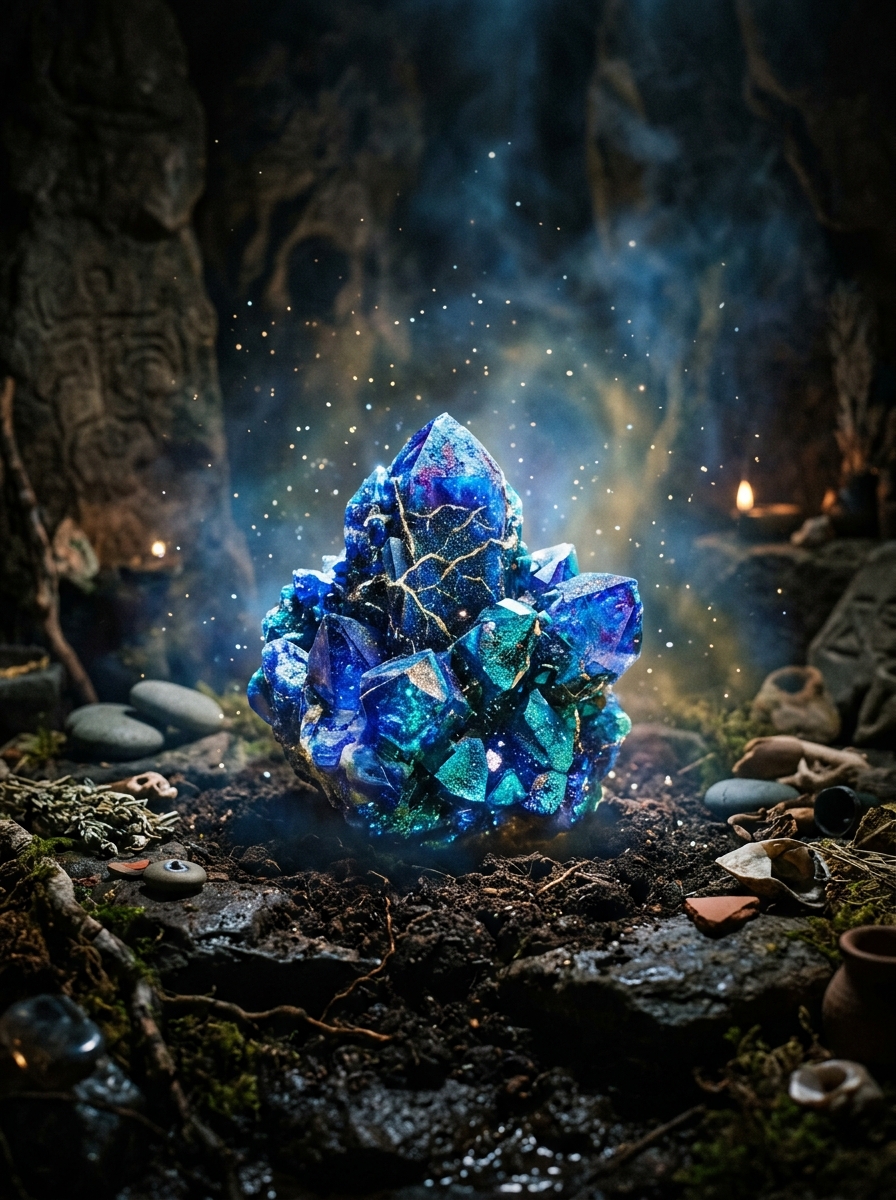
Azurite is the stone of concentrated perception: a deep-blue mineral whose meaning is not vague intuition but clarity under depth — the ability to see what is actually there when emotion, habit, or fear have blurred the outline. In metaphysical work, it is used when someone needs a cleaner inner signal, stronger discernment, or help translating subtle knowing into language. It is a stone of the mind, but not the overactive mind; of vision, but not fantasy.
The Core Dynamic: What Azurite Actually Does
Azurite does not soothe. It sharpens. Its saturated blue is the color of truth, vision, and the inner witness — but the archetype here is insight, not escape. Where other stones open the psyche to receive, azurite forces it to distinguish. It belongs to the realm where symbols become legible, where the hidden structure of a situation reveals itself because sustained attention has worn away the camouflage.
This function is most visible in how azurite treats confusion. Confusion often masquerades as complexity — too many options, too many feelings. Azurite cuts through by asking a single question: What is the pattern you are avoiding? It does not supply answers; it exposes the shape of the question. That makes it uncompromising. It tends to highlight self-deception, mixed motives, and the gap between what you say you want and what you are actually choosing. For anyone mapping the deeper architecture of their life — whether through astrology or self-inquiry — azurite works as a lens that reveals which life arena is under pressure and what truth is trying to emerge there, a function that aligns naturally with the framework of the astrological houses.
Its blue is not airy. Lighter blues suggest openness; azurite’s dense, almost electric tone suggests concentrated perception — the kind that sees through emotional weather. It supports not spontaneous flashes but sustained discernment, the capacity to sit with complexity long enough for its contour to become visible.
How It Works: The Pressure of Honest Perception
The mechanism of azurite is rooted in its composition: a copper carbonate mineral formed under pressure in the earth. Metaphorically, it applies similar pressure to the psyche. It does not amplify emotion; it refines awareness until a repressed truth can no longer hide. That is why its healing reputation centers on mental clarity and emotional truth, not comfort.
In practice, azurite functions as an internal sorting instrument. When the mind is saturated — overthinking, circling the same problem — it helps separate signal from static. The real issue is often not that there are too many answers, but that there is one difficult answer the psyche does not want to admit. Azurite strips away the interpretive fog, much as the Sun sign describes the core self that emerges when distortion is cleared — the journey of individuation requires seeing through the layers of acquired identity, and azurite aids that stripping process (as explored in the Sun sign as the journey of individuation).
Emotionally, azurite supports truthful feeling rather than amplified drama. Its role is to help you name what is actually present before it hardens into defense. Many practitioners note that once a repressed truth is acknowledged — even if painful — the system softens. That is the relief of precision, not sedation. This quality echoes the sextile aspect in astrology: an opening that becomes useful only when you participate consciously. Azurite offers that same kind of latent potential, ready to be activated by honest attention (see the sextile aspect’s activating quality).
Because it works on the level of deep pattern recognition, azurite is especially useful when you are circling a recurring problem. It reveals the underlying structure — the karmic or psychological knot — rather than offering another opinion. For those working with stelliums or dense chart configurations, azurite can help unpack the psychological concentration and identify where energy is stuck (a dynamic treated in stellium analysis).
Where It Lives: The Third Eye–Throat Axis
Azurite is most strongly associated with the third eye chakra and secondarily with the throat chakra. This pairing is not incidental; it defines the stone’s signature move. The third eye perceives — pattern, implication, meaning — while the throat gives perception a form that can be shared. A truth that cannot be spoken remains partial; speech without insight becomes noise. Azurite works at that seam, helping intuition become articulate and language become honest.
The third eye, in metaphysical terms, is not about fantasy or dramatic psychic display. It is the faculty that recognizes the underlying structure of a dream, a synchronicity, a relationship dynamic, or a life theme. Azurite is one of the clearest stones for this center because it supports sustained inner seeing — the kind that does not flinch when the pattern is uncomfortable. It is excellent for meditation, journaling, or silent reflection when the goal is not a vague mystical experience but a more exact understanding of what a symbol is saying.
The throat chakra connection gives azurite its ethical edge. Insight that remains private can become self-protective; insight spoken too quickly can become performative. Azurite supports the difficult act of saying what is true in a clean, non-dramatic way — useful for boundary setting, confession, feedback, or any exchange where ambiguity is causing harm. This pairing of perception and articulation mirrors the relationship between the Emperor and the Sun in tarot: authority and will integrated with clarity, a combination that azurite helps stabilize (a theme developed in The Emperor and the Sun card meanings).
In zodiac terms, azurite is commonly linked with Sagittarius (seeking meaning and philosophical coherence) and Aquarius (valuing perspective and pattern). But its resonance goes beyond sign correspondences. If the zodiac is the cosmic grammar that frames character, as outlined in the mechanics of the zodiac, azurite is the ink that helps you read it correctly — not by adding more information, but by clarifying what is already there.
Practical Application: Tasks That Suit This Stone
Azurite performs best when given a specific job. This is not a background stone for gentle ambiance. Use it when you need to see through a recurring pattern, gain clarity before a conversation, deepen dream recall, or support focused study and divination.
For meditation, hold azurite near the brow or in the non-dominant hand while asking a single, exact question. The question should be about truth, not prediction: “What am I missing?” works; “What will happen?” rarely does. The stone answers in subtle shifts of awareness, not theatrical visions. For divination — whether tarot, journaling, or chart reading — azurite helps isolate the central thread beneath the symbols. If a spread seems crowded, it will often point to the one card that holds the key.
Placement in the home belongs near your writing desk, meditation cushion, or bedside table — settings where thought, memory, and dream can cross-pollinate. Because azurite is energetically stimulating, many people prefer short, intentional sessions rather than all-day wear. On the body, a pendant or brief placement at the brow or throat during quiet reflection works well.
A chart-minded way to think about its use is through the houses: azurite belongs where perception, communication, study, and meaning-making occur. If you are working on a North Node question — where you are being pulled to grow — the stone’s directional clarity can support the process of recognizing that trajectory, though azurite approaches the question through insight rather than fate (see the North Node’s life purpose function). Timing sessions around Mercury transits, new moons, or personal chart periods that emphasize the third house or ninth house can amplify its effect.
Distinction from Similar Stones
Azurite is often confused with other deep-blue stones, but its temperament is unique. Lapis lazuli blends wisdom with sovereignty and ancient gravity; it carries a sense of royal authority and spiritual kingship. Azurite is narrower — focused on perception and the exposure of hidden truth, not on commanding presence. Sodalite supports rational calm and structured thinking; azurite is more penetrating, more likely to reveal the emotional charge beneath the thought process. It is less decorative than lapis and less stabilizing than sodalite; its gift is incisive sight.
Choose azurite when the issue is not “How do I feel better?” but “What is actually true here?” That may sound austere, but in metaphysical work, truth is often the deepest healing agent. The psyche cannot integrate what it cannot first see. Azurite makes the invisible visible, and then asks you to live as if you mean it. It is one of the more intellectually serious stones in crystal work — less about aesthetic spirituality than about consciousness under pressure. Work with it when you need more than reassurance. Work with it when you are ready for the cleaner, braver sentence.
Related
- Amazonite Meaning & Healing Properties: The Stone of Clear Boundaries
- Topaz Meaning & Healing Properties: Clarity, Fire, and Steady Power
- Kyanite Meaning: The Blue Blade of Clarity and Alignment
- Sapphire Meaning & Healing Properties: The Stone of Clear Judgment and Quiet Power
- Amethyst Meaning & Healing Properties: Clear Mind, Quiet Spirit
Comments
Loading comments…