Venus Conjunct Mercury in Synastry: The Spark Where Speech Learns Desire
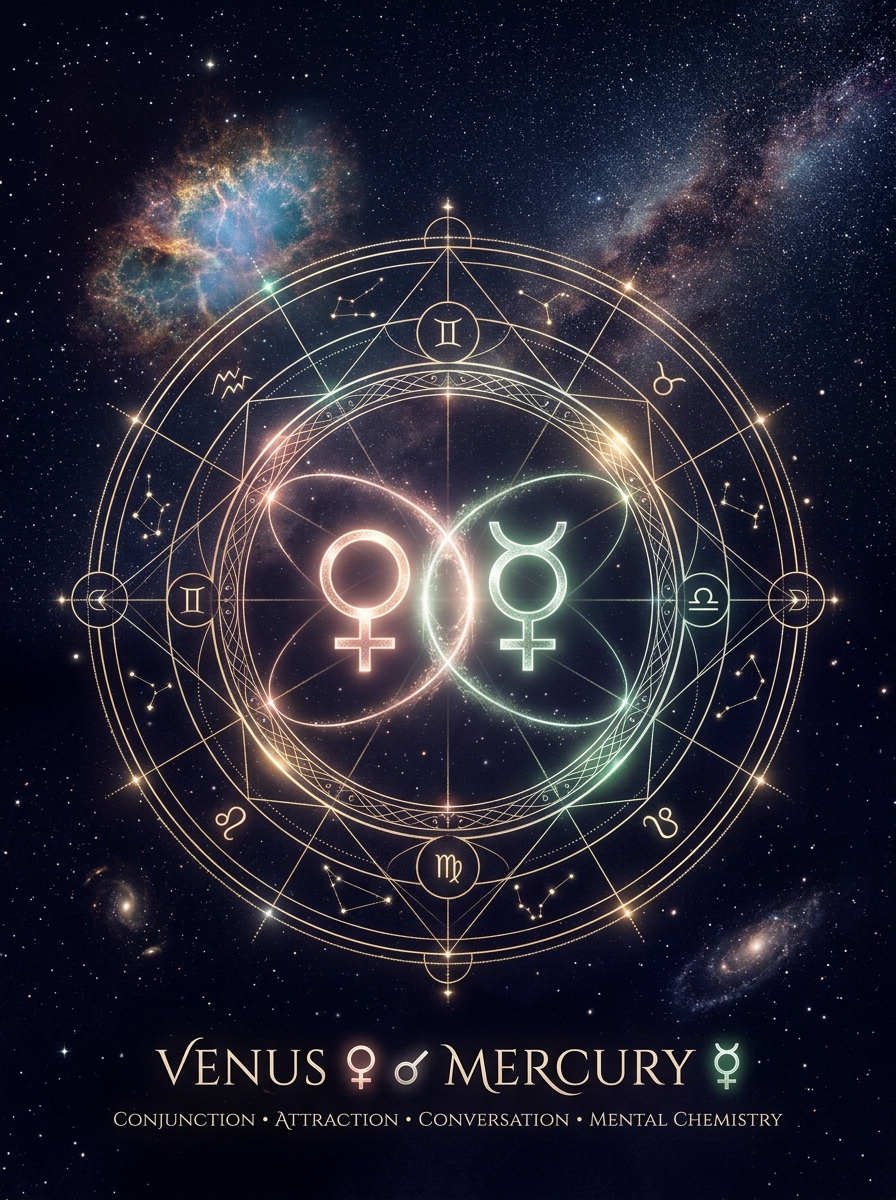
Venus conjunct Mercury in synastry creates a circuit where one person’s love language is the other person’s native tongue. The Venus person’s desire for harmony, beauty, and connection meets the Mercury person’s need to name, exchange, and understand. The result is not simply good conversation—it is a distinct chemistry in which words feel like touch and thoughts become seductive. The attraction is verbal before it is physical, and the bond often begins with the pleasure of being effortlessly understood. But this ease can also become a trap if the couple mistakes eloquence for depth.
The Core Dynamic: Affection That Speaks Itself
At its simplest, the conjunction means the Mercury person says something, and the Venus person likes the way it lands. That liking invites more speech. The loop feeds itself: every well-placed compliment, every shared joke, every insight that feels personally tailored deepens the pull. This is not merely intellectual compatibility—it is a felt sense of being met on the level of style, timing, and aesthetic instinct. The Mercury person feels mentally rewarded by the Venus person’s approval; the Venus person feels relationally flattered by the other’s attention to their preferences. In a chart, this conjunction often appears alongside strong 3rd- or 7th-house themes, and its expression changes dramatically depending on where the planets fall. For the full geography of how overlay shapes contact, synastry house overlays provides the necessary map.
The attraction is embodied in the texture of exchange: how a sentence is phrased, what is left unsaid, how a text message feels in the hand. People may forget the content of a conversation but remember the sensation of being met with grace. This is why Venus conjunct Mercury can be deeply erotic without being overtly sexual—admiration itself becomes intimate. The Mercury person may feel that their mind is being seen as beautiful; the Venus person may feel that their taste is being validated as intelligent. For a broader lens on how aspect patterns shape relationship bonds, synastry aspects shows where this conjunction fits among harder or more catalytic contacts.
How the Conjunction Forms: The Loop of Charm and Recognition
Why does this aspect create such immediate rapport? Psychologically, the loop activates two core needs: the need to be recognized (Mercury) and the need to be cherished (Venus). When one person’s Mercury encounters another’s Venus, recognition and cherishing become entangled. The Mercury person feels that their thoughts matter to someone who values harmony; the Venus person feels that their aesthetic choices are being studied and appreciated. Both receive a kind of validation that feels rare.
In practice, this often shows up as early flirtation through recommendations: “Read this,” “Listen to this,” “You’d hate this, so of course I had to tell you.” Shared taste becomes the currency of intimacy. The couple may develop private phrases, inside jokes, or a shorthand that feels like a domestic language. This process is not superficial—it builds a shared symbolic world that deepens over time. But the loop works only if both people stay authentic. If the Mercury person starts performing intelligence for approval, or the Venus person starts curating taste for harmony, the loop becomes a feedback of inauthenticity. The early dynamic of synastry step by step helps situate this conjunction within the larger story of the relationship chart.
The Mature Expression vs. The Shadow
When Venus conjunct Mercury matures, it produces a relationship that is diplomatically intelligent and aesthetically attuned. The couple often develops a clean, persuasive way of speaking together—they can soften disagreements, choose gifts that feel personal, and present themselves as a unit in social settings. This aspect supports excellent conflict management because Mercury provides articulation and Venus provides tact. Hard truths can be phrased so they are heard. Small grievances are addressed before they fester. In this mode, the conjunction serves as a lubricant for daily partnership.
But the same qualities can turn shadow. Because both planets are relational, the couple may unconsciously agree to a unspoken contract: “If we are speaking well, we must be doing well.” That assumption is dangerous. A relationship can sound harmonious while carrying resentment beneath the floorboards. The Mercury person may over-interpret politeness as depth; the Venus person may charm to avoid revealing an unpopular preference. Then both begin curating themselves for the other’s comfort. The relationship looks light but costs authenticity. This is especially likely when either planet is in Libra, where balance can become polished hesitation.
The shadow also appears as a role division: one person becomes the “nice communicator,” the other the “aesthetic validator.” The Mercury person may feel valued only for what they can explain; the Venus person only for what they can approve. To break this pattern, the couple must risk speech that is not pleasing—to say the one thing that would change the dynamic. For a related dynamic where emotional attunement can support or complicate this, Moon-Venus synastry explores how daily care interacts with verbal charm.
Where It Lands: Love, Work, and Everyday Life
The conjunction’s gifts are not limited to romance. In romantic contexts, it creates a courtship built on conversation. The couple may fall in love through the exchange of ideas, books, music, and humor. Shared taste becomes a foundation of intimacy. But the aspect can also produce a refined form of seduction where admiration itself is the foreplay. The bond is often playful and elegant, with a strong mental chemistry that can outlast physical attraction.
In professional or creative partnerships, Venus conjunct Mercury helps two people collaborate with grace. Ideas are presented persuasively, feedback is given tactfully, and the pair may excel at pitching, negotiating, or presenting themselves as a stylish unit. The aspect is common in long-term partnerships where work and life blend, such as co-founded businesses or artistic duos. For a deeper look at how this aspect interacts with the eros of desire, Venus-Mars synastry shows what happens when this verbal chemistry gains a physical charge.
In everyday life, the conjunction lubricates household coordination, errands, and scheduling. The couple can make plans easily, choose restaurants without friction, and develop a shorthand that saves time. The relationship feels easy to maintain because language itself is a source of pleasure. But this ease can also mask deeper issues if the couple avoids difficult conversations. The test of maturity is whether the two can maintain the same elegance while naming what is hard.
The Signature of Signs and Houses
A conjunction is never generic. The signs and houses tell you what kind of language this is and where it wants to live. In air signs (Gemini, Libra, Aquarius), the bond is witty, mobile, and quick to refresh itself. In earth signs (Taurus, Virgo, Capricorn), it is practical, grounded, and quietly loyal. In water signs (Cancer, Scorpio, Pisces), the speech becomes emotionally encoded—implication carries more weight than direct statement. In fire signs (Aries, Leo, Sagittarius), the exchange is lively, expressive, and sometimes impatient with nuance.
For example, a Venus in Taurus person meeting a Mercury in Gemini person will blend sensuous, grounded appreciation with rapid-fire curiosity—they may argue about comfort versus novelty. A Venus in Leo with Mercury in Scorpio can produce a dynamic where admiration is dramatic but subtext is intense. The style of the conversation is everything. Pages like Mercury in Gemini and Venus in Taurus sharpen the flavor of the contact.
House placement is equally decisive. In the other person’s 1st house, the conjunction makes them feel admired and mentally mirrored. In the 5th, it turns into flirtation and creative banter. In the 7th, it reads as direct partnership chemistry. In the 10th, the pair may present as stylish, articulate, and socially polished. In the 12th, the bond becomes private, intuitive, and hard to fully verbalize. Retrograde Mercury or Venus under stress in the natal chart changes the tone—the connection may be recursive, delayed, or highly self-editing. For a deeper dive into how Mercury’s retrograde motion reshapes communication patterns, Mercury retrograde is a useful companion.
The conjunction’s ultimate gift is immediacy: it tells you that affection can be heard and thought can be loved. But that gift stays alive only when the sweetness of the contact is matched by the courage to say what is not sweet. When that happens, the aspect becomes what it promises at its best—language with a pulse, and desire with a vocabulary.
Related
- Synastry Venus Sextile Mercury: When Desire Learns to Speak
- Mercury Conjunct Venus: When Mind and Desire Share a Pulse
- Synastry Mercury Conjunct Mercury: The Shared Language of the Mind
- Synastry Venus Trine Mercury: When Affection Finds the Right Words
- Synastry Venus Opposite Mercury: The Electric Tension Between Affection and Language
Comments
Loading comments…