Jera Rune Meaning: The Harvest of Time, Effort, and Return
The core dynamic: Jera is not luck
Jera is the Elder Futhark rune of the year’s turn, the harvest, and the exacting logic of cause meeting consequence. Its name is usually glossed as “year” or “harvest,” but that translation only begins to touch its force. Jera does not promise speed, rescue, or sudden reversal. It speaks of time that has ripened, of effort that returns in proportion to what was actually planted, and of the quiet authority of natural sequence. In divination, it often marks the moment when a situation stops being abstract and becomes answerable to reality.
That makes Jera rune meaning fundamentally different from the runes of action, conflict, or immediate breakthrough. It is not the strike of will; it is the field after weather, labor, and patience have done their work. The reward is earned, conditioned, and seasonal. If there has been integrity, Jera tends to bring the kind of fulfillment that cannot be faked. If there has been distortion, it exposes that too, because harvest reveals the truth of the seed.
People sometimes read Jera as a generic prosperity rune, but that flattens it. Good luck can be random; Jera is rarely random. It speaks of timing, cause, and the inevitability of return. If it appears in a reading around money, success, or love, it asks first whether the system itself is healthy. Is the foundation sound? Is the cycle clean? What has been put in motion, and what still needs time?
The grammar of the rune: name, shape, and the logic of return
The Old Norse root behind Jera points to the year as a complete cycle, not merely a calendar unit. This distinction matters. The rune is not about clock time in the abstract; it is about living time, the time that carries consequence through weather, gestation, and return. In that sense, Jera belongs to the intelligence of agriculture, but also to every process that matures through stages: a relationship, a legal matter, a body of work, a grief, a skill, a reputation.
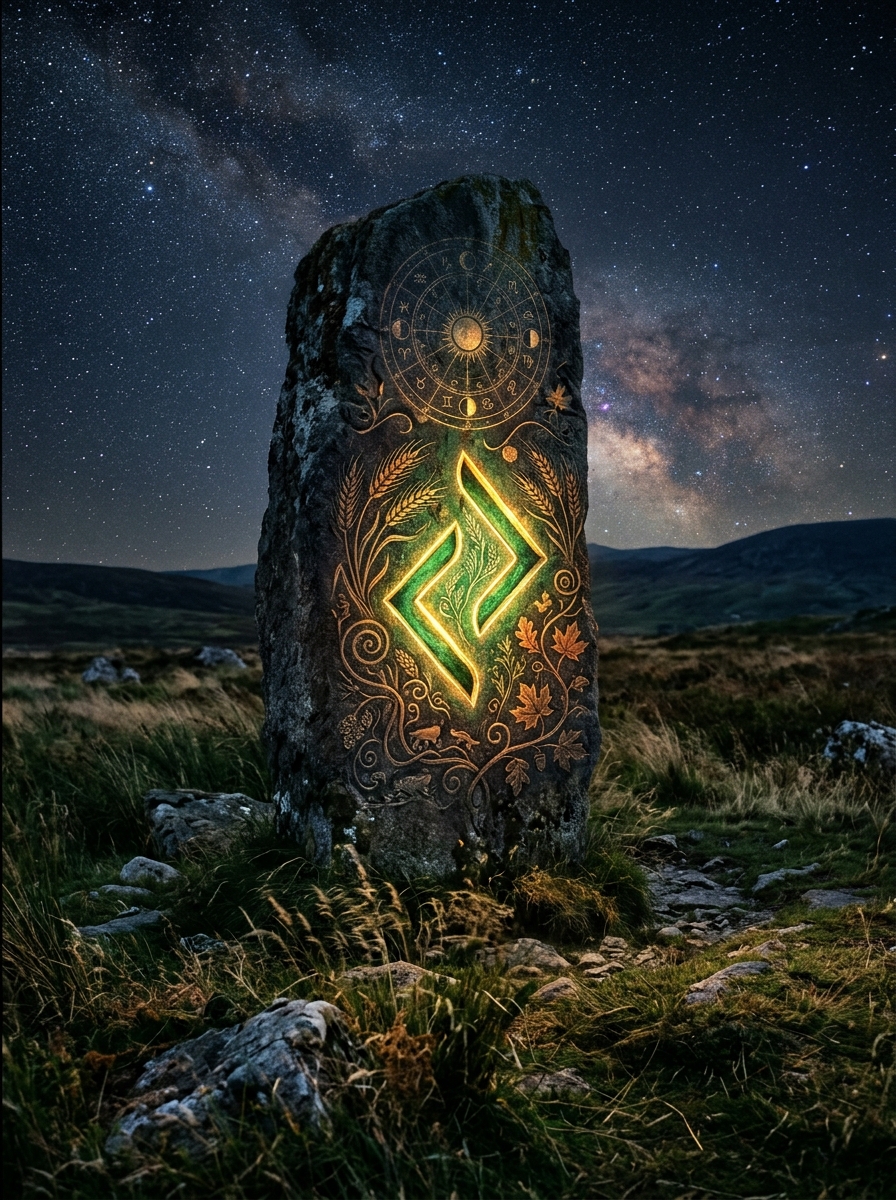
Visually, Jera is often rendered as two angled shapes meeting in a way that suggests rotation or interlocking motion. It is one of the runes whose form feels dynamic even when still. The shape implies circular return without becoming a literal wheel. That is important symbolically: Jera is not endless sameness. It is cyclical movement with memory. The rune’s geometry also hints at exchange. One force meets another, and neither cancels the other out. That is why Jera can feel calm rather than dramatic. It is the rune of processes that work because they are aligned, not because they are forced.
Because the rune names the year, it also implies reciprocity. A year gives, but only through rhythm: sowing, tending, waiting, gathering, resting. Jera therefore carries a measured moral tone. It asks what was done in season and what was neglected. It is less interested in desire than in correspondence.
How Jera manifests in life: one dynamic, many expressions
In any reading, upright Jera indicates a season of favorable ripening, stable return, or a process nearing completion in a way that feels proportionate and just. This is not the kind of “yes” that grants immediate gratification. It is the kind that confirms the conditions are finally coherent enough for results to show themselves. If a project has been well tended, Jera can mean the yield is coming in. If a relationship has been reciprocal, it may deepen into reliability. If a person has been disciplined, the rune may signal a visible payoff.
In relational readings, Jera often points to mutuality, long-term compatibility, or the slow confidence that comes from repeated proof. It is especially meaningful when the question is not “Is this intense?” but “Is this sustainable?” The rune favors bonds that can survive ordinary time, not just peak emotion. It can indicate a relationship entering a more settled rhythm, or two people finally seeing the structure of what they have built together. It can also function as a test. If one person has been taking more than giving, Jera tends to reveal the imbalance through time itself. The cycle will show who shows up and who does not.
For career or money matters, upright Jera is often a sign of harvest, payment, or success that arrives because the groundwork was real. It is excellent for projects that require cultivation: a portfolio, business, scholarship, training, or any enterprise with seasonal rhythm. Jera does not reward panic; it rewards consistency. If you are asking whether to continue, Jera may say yes if the structure is viable and the effort is aligned. If you are asking whether to force an outcome, the rune usually discourages that instinct. Better to refine the system, protect the cycle, and let the return emerge naturally.
In questions of health, Jera can point to gradual recovery, the benefits of routine, or the body’s need for regularity. It is a rune of biological rhythm as much as external timing. The message is often that healing is happening, but at the pace of tissue, sleep, nourishment, and repetition rather than drama. Psychologically, Jera can signify a person learning to trust process after a period of overcontrol or impatience.
Merkstave Jera: when the cycle is out of phase
In reversed or merkstave position, Jera does not become “bad luck” in a simplistic sense. Its shadow is more precise: delay, mismatch, poor timing, or the experience of trying to harvest before the season is ready. The cycle is still operating, but not in one’s favor or not in clean alignment. What should mature may be stunted; what should arrive may be postponed; what should have been reciprocal may prove uneven.
The reversed rune is not mainly asking you to panic. It asks you to examine the relationship between effort and timing. Where are you trying to shortcut the natural order? Where are you refusing to accept that some processes cannot be bullied into completion? This makes merkstave Jera useful in readings about frustration. It can show the pain of wanting a result before the structure can hold it. It can also reveal self-sabotage through inconsistency: starting, stopping, promising, drifting.
In relationships, reversed Jera may point to uneven investment, bad timing, or the discovery that a bond cannot produce mutual return in its current form. It is not always a verdict of ending, but it is often a warning that the relationship cannot be forced into maturity by hope alone. In work, it may signal stalled projects, underprepared launches, or the frustration of not seeing payoff for labor that has not yet reached coherence. The rune’s darker face is not chaos; it is distorted seasonality. Something is out of phase. The correction may require patience, reordering, or letting a false harvest fail so that a real one can begin.
The mythic and psychological depth: evolutionary return
Jera belongs to the deepest symbolic layer of the rune set because it encodes a truth the psyche resists: growth is not linear. Jung would have recognized the rune’s pattern as a symbol of transformation through recurrence. What returns is not identical to what began. It is changed by weather, labor, loss, and ripening. That is why Jera often feels psychologically honest. It does not flatter the ego with instant transcendence. It respects the long work of becoming.
Mythically, the rune stands near the world of agriculture, sacred order, and seasonal law. Its symbolism is compatible with the ancient insight that human life is embedded in larger rhythms: the sun’s arc, the land’s fertility, the body’s cycles, the slow consolidation of destiny. Jera is a rune of right order in time. Not moral perfection, not control, but alignment with the conditions that let life bear fruit.
It is also a rune of memory. A harvest is only possible because something happened earlier that can now be understood in retrospect. This retrospective clarity is one of Jera’s gifts. It shows why a phase mattered, why a hardship was not arbitrary, why a delay was not empty. Even when the rune appears in a difficult context, it can confer meaning by placing events inside a larger arc.
To read Jera well, resist the urge to treat it as a simplistic blessing or warning. Its actual power lies in the quality of return it describes. Upright, it often says the cycle is healthy and the yield is arriving. Reversed, it says the cycle is damaged, premature, or poorly timed. In both cases, the rune asks the same question: what has been sown, how has it been tended, and is the season truly ready? That is why Jera rune meaning is so enduring. It is not a rune of fantasy, but of consequence made visible. It honors patience without passive resignation, and reward without magical thinking. In the language of the runes, it is the point where time stops being abstract and becomes answerable.
Related
- Berkano Rune Meaning: The Birch Gate of Growth, Protection, and Renewal
- Eihwaz Rune Meaning: The Axis of Endurance, Thresholds, and Hidden Change
- Raidho Rune Meaning: The Road, the Rhythm, and the Right Order
- Fehu Rune Meaning: Wealth That Moves, Not Wealth That Sleeps
- Uruz Rune Meaning: The Raw Power of Vital Force
Comments
Loading comments…