The Astrological Midlife Crisis: A Complete Guide to the Outer-Planet Transits of Your Early 40s
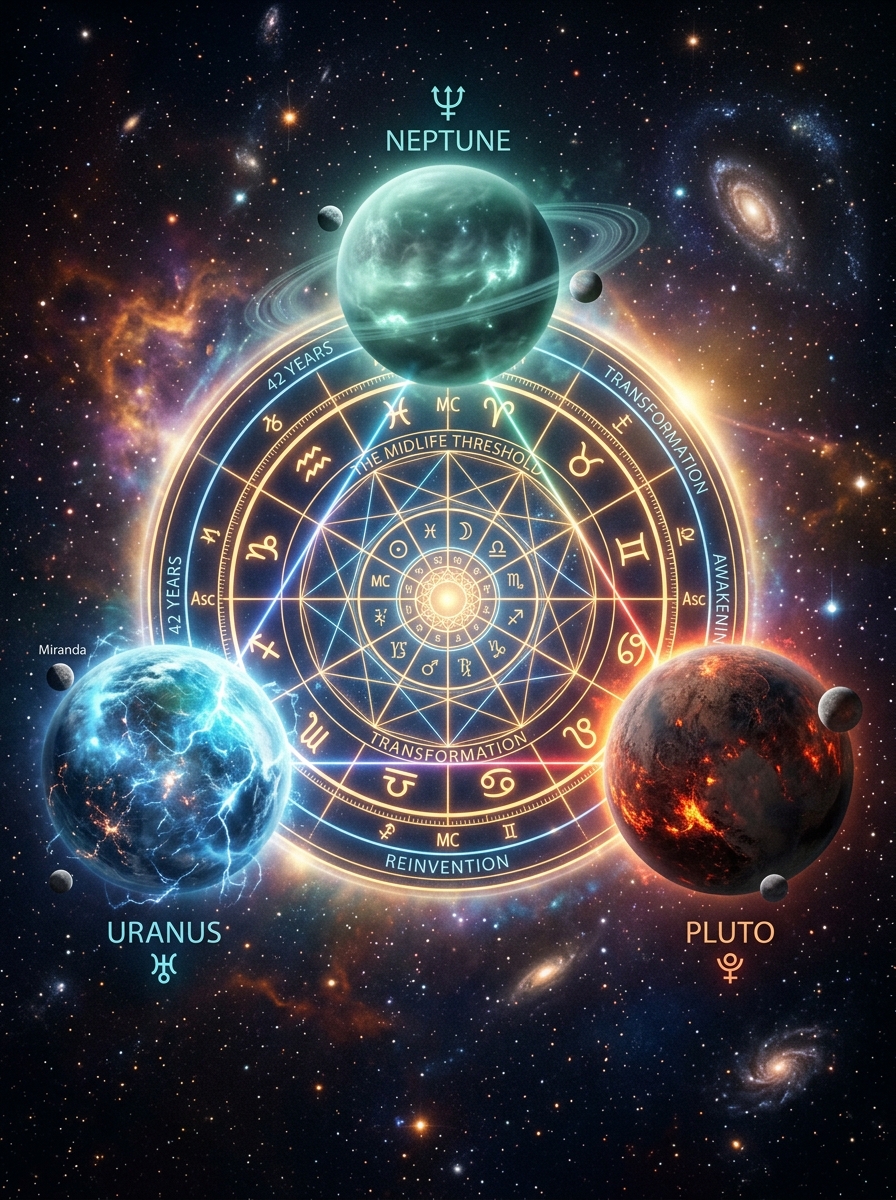
The Midlife Alchemical Crucible: When the Planets Demand a Reckoning
There is a moment — usually somewhere between your fortieth and forty-fifth birthday — when the life you carefully constructed starts to feel like a costume you borrowed and forgot to return. The career that once drove you begins to hollow out. The relationship that seemed perfectly reasonable at twenty-eight suddenly feels like a translation error. A restlessness that has no obvious object sets in, something between claustrophobia and grief, and you cannot quite name what you have lost because, technically, nothing is gone yet.
Western astrology has a precise, structurally elegant explanation for this. It is not a random mood. It is not a psychological weakness. It is the result of four outer planets reaching critical geometric angles to their positions at your birth — all within a window of roughly six to nine years — creating a confluence of pressure that is, by design, supposed to crack you open.
C. G. Jung described the transition between the first and second half of life as one of the most psychologically dangerous passages a human being undertakes. In his view, the persona — that carefully assembled social mask — must be partly dismantled if the deeper Self is ever to emerge. The first half of life is for building: identity, career, family, reputation. The second half is for meaning, depth, and integration. The midlife passage is the hinge. It is, as Jung understood it, an invitation into individuation: the slow, lifelong process of becoming who you actually are beneath the roles you have played.
Evolutionary astrology, developed and refined by practitioners such as Liz Greene and Steven Forrest, maps this Jungian territory onto the movements of the outer planets. What emerges is a portrait of the midlife crisis not as a failure of character or a descent into vanity but as an astronomically timed rite of passage — painful, disorienting, and ultimately indispensable. The planets do not cause the crisis. They time it. They give its chapters a structure. And understanding that structure is the first, most important step toward navigating it consciously rather than reactively.
The Architecture of the Passage
Four transits define the midlife window, and each one operates at a different layer of the psyche:
- Pluto square natal Pluto arrives first, typically between ages 36 and 42, initiating the deep subterranean work.
- Neptune square natal Neptune follows around age 41, dissolving the youthful illusions that kept you moving forward on autopilot.
- Uranus opposite natal Uranus peaks around age 42, delivering the most electric and disruptive jolt — the instinctual cry for authentic freedom.
- Saturn opposite natal Saturn arrives last, around age 44, landing the structural reality check and asking: now that you know who you are, what are you going to build?
Together, these transits form what might be called an alchemical crucible. The raw material going in is the person you were. What emerges — if you do the work — is someone more fully realized, more honestly inhabiting their own life.
Uranus Opposite Natal Uranus (~Age 42): The Lightning Strike of Authentic Self
Of all the transits in the midlife cluster, Uranus opposite natal Uranus is the one most people feel in their bodies before they can explain it intellectually. Uranus moves through the zodiac over a period of approximately 84 years, which means its opposition to the natal position falls with near-mathematical precision at age 42. This is not generational — it is personal, individual, and timed to the half-cycle of your own chart.
Uranus is the planet of awakening, disruption, and radical authenticity. In mythological terms, it is the bolt from the sky that breaks the established order. When it reaches the exact opposition to the degree it occupied at your birth, it is essentially asking: in what ways have you betrayed yourself? In what areas of your life have you been living according to someone else's script — your parents' expectations, your culture's template, a younger version of yourself who made commitments without fully knowing who he or she was?
The Cage You Didn't Know You Built
The crisis of Uranus opposite Uranus is often described as a sudden, almost shocking awareness of constraint. People report feeling trapped in careers they chose twenty years ago without understanding their true nature. They feel confined in relationships that once felt safe but now seem to suppress something vital. They experience what Liz Greene described, in her landmark work Saturn: A New Look at an Old Devil, as the return of the repressed — not in the Freudian sense of specific trauma, but in the broader sense of unlived life pressing back against the walls of the ego's carefully maintained enclosure.
The typical reactive expressions of this transit are the ones that gave the midlife crisis its popular reputation: the sports car, the much younger partner, the abrupt resignation letter. These are not meaningless impulses — they are distorted transmissions of a genuine signal. The signal is real. The problem is acting on it in ways that demolish what is good in your life in a chaotic lunge toward novelty.
The constructive response to Uranus opposite Uranus is discernment. It requires asking: which of my structures are genuinely confining and need to change? And which structures are solid, load-bearing walls I would destroy at great cost? The planet is not telling you to burn everything down. It is telling you that some renovation is necessary, and that you are the only one who can identify exactly what.
Freedom as Integration, Not Escape
Steven Forrest, in his work on evolutionary astrology, frames Uranus transits as invitations to radical honesty. The question is not "how do I get out of this life?" but "how do I bring more of myself into this life?" Sometimes that does mean a career change, a geographical move, or a significant relationship shift. But sometimes it means staying exactly where you are and changing the way you show up — with more honesty, more creative expression, less performance.
The healthiest response to this transit involves giving Uranus a legitimate outlet. New creative projects, resuming an old artistic practice, travel with genuine purpose, mentorship, entrepreneurial experiments — these provide the authentic stimulus the planet is calling for without requiring you to dismantle your entire life in a panic.
Neptune Square Natal Neptune (~Age 41): The Fog That Dissolves False Maps
If Uranus hits like lightning, Neptune arrives like a slow tide. Neptune square natal Neptune, which peaks around age 41, is the transit most associated with the specifically spiritual dimension of the midlife passage. Neptune dissolves. It erodes. It takes what was solid and reveals that it was never as solid as you believed.
Neptune is the planet of transcendence, illusion, spiritual longing, and creative vision. When it reaches its square to the natal position in the early forties, it begins to dissolve the motivational scaffolding that powered the first half of life. The goals that once seemed obviously worth pursuing begin to look like elaborate constructions — not wrong exactly, but somehow insufficient. The ladder was real; the question becomes whether it was leaning against the right wall.
When the Compass Stops Working
The characteristic signature of Neptune square Neptune is a loss of clear direction that cannot be remedied by more information or more effort. People describe it as a fog. Not depression exactly — though depression can accompany it — but a kind of existential haze in which the metrics you formerly used to measure success no longer give satisfying readings. You achieved what you said you wanted, and you feel flat. Or you are still in pursuit of it, and the pursuit no longer compels you the way it once did.
This transit is particularly pronounced for people whose identity has been heavily achievement-oriented or who have organized their sense of purpose around external validation. Neptune, for a period, strips away the feedback loop. The approval no longer lands. The ambition goes strangely quiet. And in that silence, questions arise that cannot be answered with more productivity: What do I actually believe? What am I living for? Is there something larger than my personal narrative that I am meant to serve?
Navigating the Spiritual Void
The Jungian framework is essential here. Jung observed that the second half of life, properly entered, demands a confrontation with what he called the Self — the totality of the psyche, including its unconscious dimensions, its spiritual capacity, and its connection to something beyond the individual ego. Neptune square Neptune is one of the primary astrological signatures of this confrontation. It thins the boundary between the conscious and unconscious, between the personal and the transpersonal.
The danger is spiritual bypassing — using the sudden openness to unconscious material as a license for escapism: alcohol, numbing entertainment, compulsive romantic seeking, or uncritical immersion in spiritual systems that promise quick transcendence without genuine transformation. The constructive path involves allowing the dissolving to happen at the level of ego rigidity while building — slowly, carefully — a more authentic spiritual practice.
Meditation, depth psychotherapy, serious engagement with a contemplative tradition, Jungian shadow work, genuine creative surrender — these are the legitimate Neptunian responses. They do not end the fog immediately, but they give you a way of moving through it with some intelligence rather than simply being lost in it.
Pluto Square Natal Pluto (~Ages 36–42): The Descent Into the Underworld
Pluto is the slowest of the outer planets, and its transit through each sign spans a generation. The Pluto square — when transiting Pluto reaches a 90-degree angle to the natal position — occurs across a wide range of ages depending on your birth year, typically arriving anywhere from the mid-thirties to the early forties. For those born in the 1970s and 1980s, it has arrived on the earlier end of that spectrum, making it sometimes the first of the midlife transits to announce itself.
Pluto operates at the deepest stratum of the psyche. If Uranus is about identity and Neptune is about meaning, Pluto is about power — specifically, the power dynamics you internalized so early that you mistook them for reality itself. It rules what has been buried, what is dying, what must be released before something new can live, and what has been controlling you from beneath the surface of conscious awareness.
Shadow Work as Survival Strategy
Jung's concept of the shadow is indispensable for understanding Pluto square Pluto. The shadow is not simply the "bad" part of the personality. It is everything the ego has rejected, suppressed, or refused to acknowledge — including qualities that are not morally problematic but that were too dangerous or too inconvenient to express in the context of one's upbringing and social environment. Ambition can be shadow. Vulnerability can be shadow. Rage, tenderness, creativity, sexuality — any of these can be shadow depending on what was and was not permitted in a given person's formative environment.
Pluto square Pluto dredges these contents up. It does not do so gently. The characteristic eruptions include intense power struggles in intimate relationships and at work, compulsive behaviors that seem to come from nowhere, bouts of obsessive thinking, confrontations with mortality (one's own or others'), and encounters with loss that cannot be managed through ordinary coping strategies. These are not signs of psychological breakdown. They are signs that the deeper healing process has begun.
Reclaiming Personal Sovereignty
The purpose of this transit, understood evolutionarily, is the reclamation of personal sovereignty. Sovereignty, in this sense, does not mean control over external circumstances. It means the capacity to act from genuine inner authority rather than from fear, conditioning, or the unexamined templates of the past. It means knowing your own power — and your own limitations — with enough clarity that you stop giving either away unconsciously.
Depth psychotherapy during a Pluto square is not optional for people who are experiencing its more intense manifestations. The material that surfaces genuinely requires skilled containment and skilled reflection. But even outside a formal therapeutic context, practices that cultivate honest self-examination — serious journaling, dream work, somatic body practices, twelve-step work if appropriate — create the conditions in which Pluto's intense pressure transforms into genuine growth rather than destruction.
Saturn Opposite Natal Saturn (~Age 44): Building the Life You Actually Mean to Live
The final transit in the midlife sequence arrives with Saturn — the planet of structure, accountability, time, and earned authority — reaching its opposition to the natal position around age 44. By this point, the more volcanic activity of Uranus, Neptune, and Pluto has done its work. The question Saturn poses is not "who are you?" but "given who you now know yourself to be, what are you going to construct?"
Saturn opposite Saturn is a reality check of unusual depth. Saturn, in classical astrology, is the great teacher — the figure who will not let you lie to yourself about consequences. At its opposition, it surveys the structures of your life — professional, relational, financial, physical — and asks which ones are built on a foundation that can actually bear the weight of the second half of life.
The Vocational Reckoning
For many people, this transit marks a decisive vocational shift. Not the impulsive, Uranian leap of a few years earlier, but a more considered, deliberate realignment. The career assessment that Saturn demands is not about passion in the romanticized sense — it is about vocation in the original sense: a calling, something you are genuinely built to contribute. It asks: are you doing work that uses your actual gifts? Work that serves something beyond your own economic survival? Work that you can sustain with integrity for the next twenty or thirty years?
The Saturn opposition also surfaces issues of authority and mentorship. Where Uranus at its opposition was often rebelling against external authority, Saturn at its opposition typically moves toward becoming a legitimate authority — someone who has earned the right to lead, teach, or guide because they have done the necessary inner and outer work. This is a threshold moment for stepping into elder roles, for taking on greater professional responsibility, or for building institutions and projects that will outlast the individual ego.
Time, Mortality, and the Long View
Saturn is the planet of time, and its opposition in the mid-forties inevitably includes a reckoning with mortality — not in the morbid, paralyzing sense, but in the clarifying sense. The recognition that time is not infinite sharpens discernment. It makes it harder to waste years on relationships, projects, or obligations that do not genuinely align with who you are. The Saturn opposition installs what might be called a cosmic editing function: the things that are not truly yours begin to feel genuinely unbearable rather than merely inconvenient.
Used well, this transit produces extraordinary focus. People who move through the midlife crucible consciously and come out the other side often describe a quality of clarity that was simply not available to them before. They know what they want. They know what they are willing to give their time and energy to. They have stopped performing and started living.
Typical Symptoms and Life Metamorphoses
When the Body Speaks First
The midlife transits are not only psychological events. They manifest in the body, in daily behavior, in the texture of ordinary life. Understanding the common presenting symptoms — not as problems to be solved but as signals to be interpreted — is essential for navigating the passage intelligently.
Career burnout is among the most universal symptoms. What looked like ambition at thirty begins to look like compulsion at forty. The drive that kept you competitive and productive starts to feel hollow. This is not laziness or depression (though it can trigger both) — it is Neptune dissolving the fuel source that powered the achievement machine, and Uranus refusing to keep running the old program. It is the system signaling that the motivational architecture needs to be rebuilt on a more authentic foundation.
Relationship strain is equally common. Partnerships that were built during the first half of life often face significant pressure during the midlife passage because one or both partners are changing in fundamental ways. The person your partner fell in love with at twenty-five is genuinely not quite the same person at forty-two. This is not necessarily a crisis of love — it can be a crisis of familiarity, of the need to renegotiate a relationship that was established before both parties fully knew themselves. Many relationships that survive the midlife passage emerge genuinely stronger and more honest. Many that do not survive needed to end.
Geographical restlessness — the sudden, urgent desire to live somewhere entirely different — is a classic Uranian symptom. So is an abrupt attraction to creative pursuits that were abandoned in early adulthood in the name of practicality: the novelist who became a lawyer and starts writing again at forty-three, the musician who became an accountant and buys a guitar, the painter whose canvases have been in storage for two decades.
Spiritual Hunger and the Return of Wonder
The Neptunian dimension of the midlife passage often expresses itself as a sudden and serious spiritual hunger that was not present earlier — or was present but suppressed. People who had no particular interest in metaphysics, contemplative practice, or depth psychology find themselves drawn to astrology, Jungian analysis, Zen, or contemplative Christianity. They begin to sense that there is more to their experience than the material framework they have been operating within, and they want to understand what that "more" actually is.
This spiritual hunger is healthy and should be taken seriously. The danger is in where it leads. The midlife window, with its dissolution of defenses and its heightened sensitivity, can make people vulnerable to charismatic spiritual teachers, high-demand groups, or belief systems that offer certainty at the cost of critical thinking. The gold standard is a spiritual path that deepens self-knowledge rather than bypassing it.
Conscious Integration vs. The Shadow Crisis
The Panic-Driven Response
The midlife crisis has a cultural reputation built largely on its most reactive and unconscious expressions. The clichés exist because there is genuine observational data behind them: people do leave long-term partners for relationships that carry the intoxicating charge of novelty. People do make impulsive financial decisions — luxury purchases, ill-considered business ventures, dramatic career abandonments — that create serious downstream consequences. People do adopt radically different identities — new clothes, new social circles, new bodies through obsessive fitness regimes — in an attempt to escape the self they no longer recognize or want.
These behaviors are not incomprehensible. They are the shadow crisis: the genuine transformational pressure of the outer-planet transits, filtered through unconscious panic rather than conscious intention. The planets are sending a real message. The reactive response mistakes the medium for the message. It treats the form of the old life as the problem rather than the relationship to self that generated that life.
Jung's concept of the shadow is again illuminating here. The shadow crisis is often characterized by what he called shadow projection — locating in external circumstances (the boring job, the suffocating partner, the disappointing city) what is actually an unexamined internal reality. The person who leaves their partner for someone younger is often, at an unconscious level, fleeing themselves. The liberation they seek is real; the direction is misdirected.
The Therapeutic Tools of Conscious Renewal
Conscious integration of the midlife passage is not about suppressing the intensity of what arises. It is about bringing intelligence, reflection, and skilled support to that intensity so that it transforms rather than simply disrupts.
Depth psychotherapy — particularly Jungian analysis or other depth-oriented approaches — is one of the most valuable tools available during this passage. The reason is structural: the transits are bringing unconscious material into contact with conscious life, and that process requires a skilled witness who understands how to work with unconscious material without being overwhelmed by it. A good analyst or therapist can help distinguish between genuine calls for change and panic-driven impulses, can help metabolize the intensity of Pluto without acting it out destructively, and can help hold the Neptunian dissolution with enough stability that it becomes genuine spiritual development rather than simple disorientation.
Astrological consultation — with a psychologically sophisticated practitioner who draws on the Liz Greene tradition of integrating depth psychology with chart interpretation — can provide an extraordinary level of clarity during this passage. Knowing that what you are experiencing has a precise astrological structure, that it has a beginning and an end, that it is purposeful rather than arbitrary, changes the subjective experience of it in significant ways. It does not make the passage easier in the sense of less intense. It makes it navigable.
Other practices that support conscious integration include: serious engagement with Jungian shadow work (through either formal analysis or structured self-inquiry practices), active imagination, dreamwork and dream journaling, somatic body practices that help process the emotional and physical intensity without intellectualizing it, and creative practice that gives the transformational energy somewhere constructive to go.
Choosing Integration Over Implosion
The crucial choice during the midlife passage is the choice between integration and implosion. Implosion means allowing the pressure of the transits to collapse the existing life structure without replacing it with anything more authentic — just the rubble of what was, and a new set of reactive choices that will eventually generate their own version of the same crisis. Integration means allowing the pressure to do its genuine work: dissolving what is no longer true, excavating what was buried, and rebuilding on a more honest foundation.
This choice is rarely made once, dramatically, at a decisive moment. It is made repeatedly, in small decisions, over the course of the entire transit window. Each time you choose therapy over numbing, depth over distraction, honest conversation over avoidance, creative risk over stagnation — you are choosing integration. The planets will exert their pressure regardless of the choice you make. The question is only whether that pressure becomes the catalyst for the second half of your life or the wreckage of the first.
FAQ: Your Questions About the Astrological Midlife Crisis
What is the astrological midlife crisis, exactly?
The astrological midlife crisis is a cluster of four major outer-planet transits — Pluto square Pluto, Neptune square Neptune, Uranus opposite Uranus, and Saturn opposite Saturn — that occur between approximately ages 36 and 45. Each transit operates at a different level of the psyche, and together they create an intense period of psychological, spiritual, and existential transformation. Unlike the popular cultural notion of a midlife crisis as a purely psychological event, the astrological perspective understands it as a precisely timed developmental passage with genuine purpose.
Why does the midlife crisis happen around age 42?
The peak of the midlife transit cluster is typically around age 42, when Uranus reaches the exact opposition to its natal position. Since Uranus takes approximately 84 years to orbit the Sun, the opposition falls precisely at the halfway point. Neptune square Neptune arrives slightly earlier (around 41), and Saturn opposite Saturn arrives slightly later (around 44). Pluto square Pluto varies in age depending on birth year due to Pluto's elliptical orbit, but it generally falls within the same broad window.
What does Uranus opposite Uranus actually feel like?
People commonly describe a sudden, electric awareness of constraint — the sense that a life that once felt chosen is now being lived by default. There can be intense restlessness, creative urgency, an attraction to radical change, and a feeling that the authentic self has been suppressed under layers of obligation and social expectation. It often manifests as the sudden desire to do something completely different: a new career, a new city, a new relationship, or the resurrection of creative passions from early adulthood.
Is it possible to go through the midlife transits without a crisis?
Yes, though it requires a degree of self-awareness and preparation that most people do not have simply because no one warned them this passage was coming. People who have cultivated a depth-psychological orientation to their own experience — whether through therapy, Jungian analysis, contemplative practice, or ongoing astrological self-study — often find the midlife passage intense but not catastrophic. They are less likely to act out the pressure in destructive ways because they have a framework for understanding what is happening and practices that help metabolize the intensity.
How long does the astrological midlife passage last?
The entire cluster of transits spans roughly a decade, from the first stirrings of Pluto square Pluto (which can begin as early as the mid-thirties for some generations) to the completion of Saturn opposite Saturn (around age 44-45). The most concentrated and intense period is typically a two-to-three-year window in the early forties when multiple transits are active simultaneously. Most people feel a significant shift in the quality of their experience somewhere between 45 and 48, as the major transits complete and the reconstruction phase of the second half of life begins.
Should I make major life changes during the midlife transits?
Major life changes — career shifts, relationship endings or beginnings, geographical moves — can absolutely be appropriate responses to the genuine insights that emerge during this passage. The key is distinguishing between changes driven by authentic self-knowledge and changes driven by panic, projection, or the desire to escape from an internal reality by rearranging external circumstances. Working with a skilled depth psychotherapist or psychologically sophisticated astrologer during this period can help you develop the discernment to tell the difference. As a general rule, decisions made from clarity rather than desperation tend to have better long-term outcomes.
Comments
Loading comments…