Pallas in Sagittarius: Strategy at the Edge of Meaning
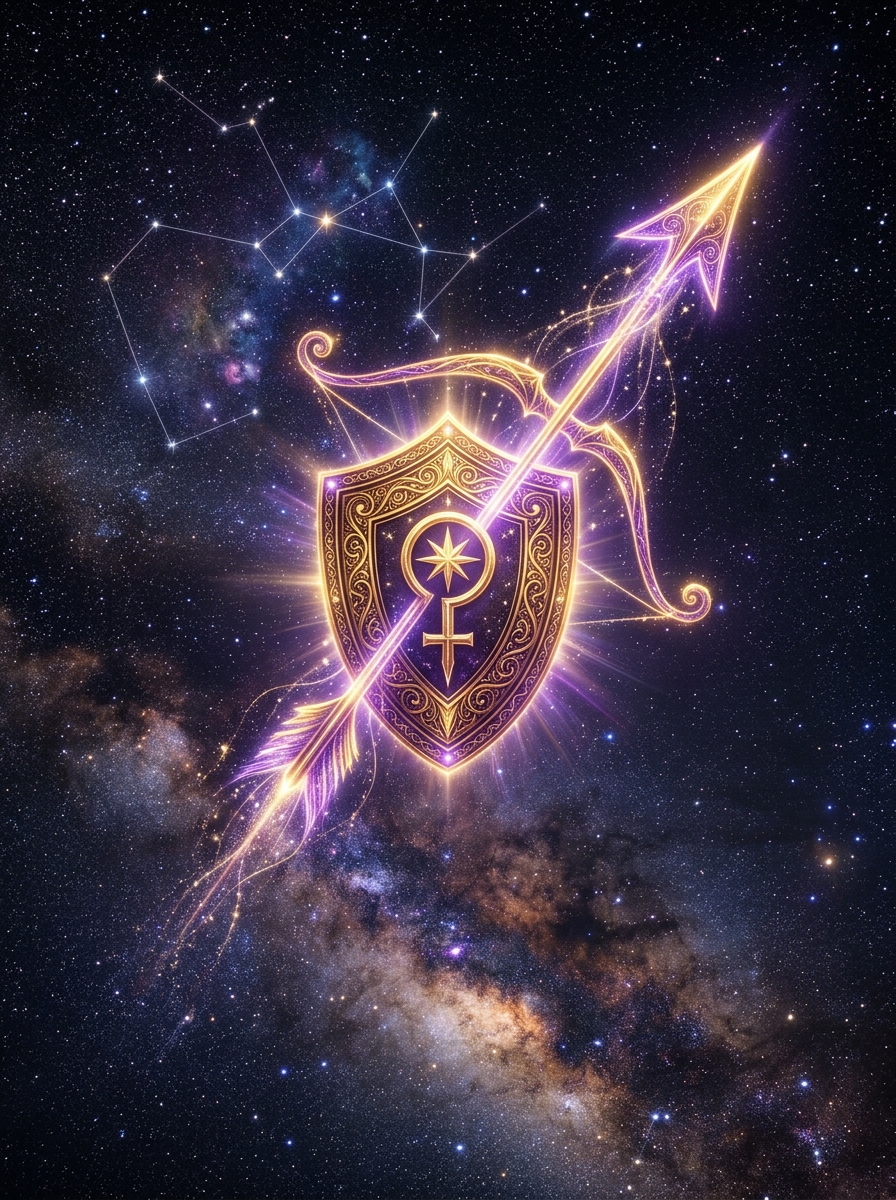
Pallas in Sagittarius is intelligence that organizes by meaning, not efficiency. While most strategic placements ask what works, this one asks what is true, and what does that truth demand of me? The mind here refuses to separate tactical thinking from ethical vision. Every plan, every alliance, every decision is judged by whether it expands understanding, preserves integrity, and opens a horizon worth walking toward.
The Core Dynamic: Strategy as Philosophy
Pallas in astrology governs pattern recognition, craft, and the ability to see a situation whole before acting. In Sagittarius, mutable fire ruled by Jupiter, that capacity becomes routed through belief, conviction, and the search for a principle larger than the self. The result is a strategist who is unimpressed by mere cleverness. If a solution works but shrinks the soul, it fails the test.
This placement sees farther than it sees fine detail. It can spot the governing idea inside a mess of facts and build a map around that idea. The gift is synthesis: one thread, one thesis, one unifying law. The danger is overreach. When the native falls in love with the truth-image more than the actual evidence, strategy becomes sermon. The person may sound brilliant while missing the practical compromise that makes insight usable.
Pallas in Sagittarius is strongest where interpretation matters: education, law, publishing, advocacy, coaching, international work, and any arena where someone must defend a worldview. It pairs naturally with a strong Jupiter in Sagittarius signature, because Jupiter amplifies the appetite for growth and coherence. But Pallas adds something Jupiter alone does not: diagnostic intelligence. Jupiter wants meaning; Pallas wants the architecture of meaning.
How It Thinks: The Architecture of Belief
A Pallas in Sagittarius mind typically works from the top down. It begins with the highest premise — a first principle, a moral axiom, a vision of how things ought to be — and then tests whether the particulars can stand under that sky. This is not laziness but cognitive economy. The placement wants a unifying law before it wants a spreadsheet.
This top-down approach makes the placement excellent at moral reasoning and poor at granular analysis unless supported elsewhere in the chart. When functioning well, it produces elegant decisions that feel inevitable. When functioning poorly, it creates premature certainty, especially if the person has only half-studied the terrain they are declaring upon. The shadow here is dogmatic idealism: the strategist who confuses conviction with verification and cannot tell the difference between a sacred insight and a familiar prejudice.
Unlike Saturn in Sagittarius, which earns truth through discipline and confrontation with limits, Pallas in Sagittarius is less punitive and more interpretive. Saturn in Sagittarius asks what can I afford to believe? Pallas asks what larger principle is trying to emerge through this situation? That makes it faster but also more vulnerable to righteous blind spots. The antidote is exposure: travel, dialogue, genuine disagreement — the willingness to let reality revise the map. A well-integrated Pallas does not need to be right at every moment; it needs to remain answerable to truth.
The shadow deepens when the native uses the belief system as a shield. Instead of treating values as instruments for navigating complexity, they treat them as fixed identities. That is the point where Pallas in Sagittarius tips into the ideologue, the missionary, the polemicist who cannot distinguish between the sacred and the merely familiar. The Jungian shadow here is especially acute: the beautiful worldview becomes a prison, and the person defends it so fiercely that it stops learning. For those with a volatile Sagittarian charge, Lilith in Sagittarius can show where the raw hunger for absolute truth refuses domestication, while Pluto in Sagittarius intensifies the need to tear down dead beliefs and rebuild from the bones. Pallas in Sagittarius sits between them as the intelligent mediator — not merely burning falsehood, but discerning what can replace it.
Integration and Its Conditions
The mature form of this placement does not shout its principles. It articulates them, tests them against lived reality, and revises them without humiliation. That is the hidden achievement: it turns conviction into a method. The native learns that truth is not weakened by contact with complexity; it is clarified by it.
Integration requires movement — not just physical travel, but intellectual and ethical exposure. Read outside your tribe. Study systems that challenge your assumptions. Let your ideals encounter other ideals without rushing to conquest. The point is not relativism. Pallas in Sagittarius does not need to abandon truth; it needs to discover that truth is big enough to survive examination.
This placement also benefits from companions who respect both vision and execution. Someone with this signature is brilliant at naming where the future should go but often less interested in the bureaucratic middle. That is where complementary energy matters. A grounded partner, team, or chart factor can keep the arrow from flying past the target. The dynamic between vision and structure is explored well in Capricorn Sun Sagittarius Rising, where the questing flame meets the architecture of ambition. Similarly, Mercury in Sagittarius shares the love of big ideas but focuses on communication rather than the pattern beneath; the two placements together can amplify both reach and clarity.
The placement also matures when it learns timing. Sagittarius loves to fire the arrow; Pallas can refine when to release it. A truth poorly timed becomes a weapon. The strategist who knows the right moment to speak, and the right frame, is a strategist who has outgrown the need to be right immediately.
Living the Placement: Applications in a Life
Every facet of life becomes a test case for the placement's central dynamic: organizing action around meaning. In relationships, Pallas in Sagittarius is drawn to partners who are intelligent, ethically alive, and hard to pin down. Boredom is the enemy. A relationship must have a shared horizon — an idea, a mission, an adventure, a mutual inquiry — or the psyche starts wandering. Honesty is valued so highly that it can forget tenderness. The native may say the "true" thing without noticing that truth, poorly timed, lands as a judgment. Pallas can refine that instinct by teaching framing, timing, and the difference between illumination and abrasion.
In work, the placement excels wherever one must see the larger pattern and then persuade others to move with it. It suits the consultant, the professor, the editor, the campaign strategist, the multicultural communicator, the expedition planner, the lawyer with a moral spine, the spiritual guide who can keep doctrine from hardening into dead language. The native is often best when there is room to build a philosophy into a system. Entrepreneurship can work, but only if the business has a mission larger than profit; pure commerce feels hollow.
One of the most elegant expressions is teaching — not lecturing, but teaching as transmission of perspective. This placement can clarify what matters without reducing complexity to cliché. It knows how to preserve the living flame of an idea while making it accessible. Because Sagittarius is ruled by Jupiter, there is a natural confidence in the educative process: growth is possible, minds can expand, a person can move beyond their current frame. At best, that confidence is contagious. At worst, it becomes impatience with anyone who is not "getting it" fast enough. Pallas tempers Jupiter's bigness by adding tactical intelligence: meet the person where they are, then move them one truthful step farther.
For the native with a strong Sagittarius Rising or Moon in Sagittarius, the need for conceptual freedom becomes a psychological demand. The rising sign shapes how you present; the Moon shapes what you need emotionally. Pallas in Sagittarius aligns with both but adds a strategic layer: it doesn't just want freedom — it wants freedom that serves a coherent purpose.
Mythic Signature: Athena on the Frontier
Mythologically, Pallas in Sagittarius feels like Athena stepping onto a road that never ends. Pallas Athena is the strategist, the artisan of intelligent order; Sagittarius is the frontier, the pilgrim, the sworn seeker of a truth that outgrows the local village. Together they create a psyche that wants both discipline and liberation, both principle and motion. The native is not content to know what is useful; they want to know what is worthy.
That combination can produce extraordinary moral clarity. It can also produce exile. If the person's ideas run ahead of the culture they live in, they may feel chronically ahead of their time, misunderstood, or too expansive for the room. In that sense, Pallas in Sagittarius has a relationship to dissent. It becomes the one who sees the flaw in the official story and cannot unsee it. This is why the placement often resonates with the broader Sagittarian wound-and-search complex seen in Chiron in Sagittarius, where faith itself has been damaged and must be rebuilt through experience.
The shadow here is the exile who wears the crown of the prophet. The mature version is different: it can articulate a principle, test it, revise it, and still hold conviction. That is the achievement — to be guided without being rigid, to be oriented without being lost. A luminous kind of intelligence: not merely clever, but answerable. Not merely informed, but in service to a truth worth carrying farther.
Comments
Loading comments…