Pallas in Libra: Strategy as the Art of Equilibrium
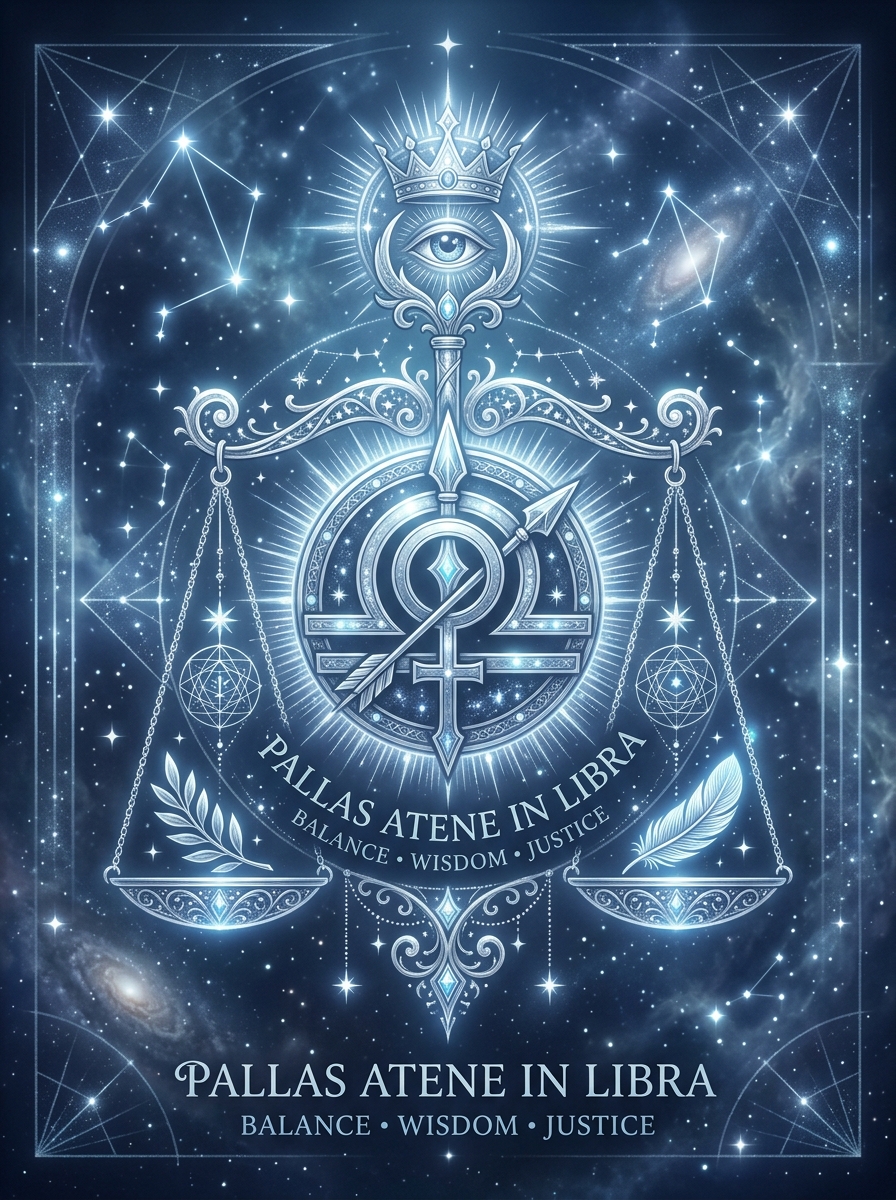
Pallas in Libra thinks in proportions. This placement does not merely want peace; it wants a peace that can survive contact with reality. The core thesis is simple: when Pallas—the asteroid of pattern recognition, tactical intelligence, craft, and principled knowing—moves through Libra, wisdom becomes relational, aesthetic, and judicial. It sees the hidden geometry inside negotiations, alliances, and social dilemmas, then tries to shape a form that is fair without being crude, beautiful without being fake.
The Core Thesis: Strategy as Relational Intelligence
Pallas is not the same as Mercury. Mercury reasons, compares, and transmits. Pallas Athena observes the field, recognizes the structure of a problem, and designs a move that changes the entire board. In Libra, that move is rarely direct force. It is calibration: choosing the word, the gesture, the seat at the table, the timing of the intervention, the exact degree of concession that preserves dignity on all sides. If Mercury in Libra can sound like an elegant debater, Pallas in Libra is the strategist who knows which arguments are worth having at all.
This placement is often mistaken for “being diplomatic,” but diplomacy is only the surface behavior. Underneath, Libra gives Pallas a formal sense of symmetry, proportion, and mutuality. There is a bias toward two-sided thinking, yes, but at its best that bias is not indecision. It is the refusal to reduce human complexity to a blunt verdict before the relevant factors have been weighed. In a chart, this can show up as a mind that instinctively asks: Where is the imbalance? What is the missing clause? Which party has the stronger case, and which has the cleaner motive?
That is why Pallas in Libra can be so strong in law, mediation, design, curation, consulting, and any field where judgment must be both precise and humane. It knows that the right answer is often not the loudest answer. The placement’s native gift is to create a field in which truth can be approached without humiliation. That is a rarer talent than it sounds. It requires not only intelligence but tact, and tact is just ethics with nerve.
Pattern recognition in a human room
The deeper gift of Pallas in Libra is social pattern recognition. It notices the unspoken contract in a friendship, the power imbalance in a team, the style logic in an aesthetic movement, the hidden cost of “keeping the peace” when one person is silently carrying the burden. Where some placements see people, this one sees the choreography between people. It tracks who yields, who absorbs, who frames the terms, and who gets to call the arrangement neutral.
That makes it exceptionally useful in conflict mediation, but also vulnerable to overfitting. A Pallas in Libra native may become so attuned to balance that they begin to treat discomfort itself as evidence of disorder. Yet real justice is not always graceful. Sometimes the cleanest strategy is to let a room get temporarily ugly so a false equilibrium can die. This is one reason the placement’s wisdom deepens when read alongside the broader Libra archetype, especially in the Libra horoscope and in more embodied placements such as Libra Rising, where presentation, tone, and social perception become a lived discipline rather than an abstract ideal.
The Psychological Architecture: Form, Pattern, and the Risk of Over-Aestheticizing
The shadow of Pallas in Libra is not weakness; it is compromised discernment. When the scale is sacred, the mind may start protecting the scale instead of serving justice. Then strategy becomes image management. Harmony becomes a costume. The native can become exquisitely skilled at making everyone feel considered while quietly postponing the one decision that would actually resolve the issue.
This is especially likely when the person has strong Saturnian pressure in the chart, because Libra already fears social rupture and Saturn adds the burden of consequence. In that case, the mind may become overformal, legalistic, or petrified by the possibility of being “unfair.” The irony is that an excessive commitment to fairness can produce distortion. A refusal to privilege one truth over another, when the evidence is unequal, is not balance; it is evasive symmetry.
The emotional pattern here is subtle. Pallas wants competence. Libra wants approval, or at least mutual regard. Put together, they can create a strategist who edits their own brilliance so nobody feels excluded. The problem is not kindness. The problem is when kindness becomes a mechanism for avoiding the loneliness that sometimes accompanies clear judgment. For a related exploration of this wound around reciprocity and self-erasure, see Chiron in Libra. The difference is important: Chiron describes the raw hurt; Pallas describes the adaptive intelligence built around it.
When aesthetics hide the argument
One of the most distinctive pitfalls of Pallas in Libra is over-aestheticizing the issue. Because Libra is Venus-ruled, it can make order feel morally beautiful. The room with the best manners becomes the room that seems most right. The most balanced phrasing can begin to substitute for substance. A person may become so good at framing that they obscure the actual stakes.
This is where Pallas must remember that strategy is not decoration. A well-composed argument is not automatically a true one. In fact, this placement sometimes has to learn to trust the sentence that feels less pretty because it is more exact. That lesson becomes sharper under pressure from placements like Mars in Libra, where the will itself must negotiate with the desire to maintain civility. Together, these Libra signatures show how often the sign’s finest intelligence lives in tension with its fear of disruption.
Maturation: From Appeasement to Principled Relation
A mature Pallas in Libra does not avoid conflict; it civilizes it without neutering it. It can name the fault line without turning the room into a battlefield. It knows that fairness is not sameness, that mutuality is not fusion, and that elegant language only matters if it serves a real standard of justice. In practice, this looks like choosing the right forum, the right frame, and the right moment—not to soften truth, but to make it received.
This is the placement of the person who can turn negotiation into an art form, but also the person who must beware of becoming addicted to the art form itself. The endgame is not perfect balance. The endgame is right relation. That distinction matters. Perfect balance is static. Right relation is alive.
The role of myth and image
Pallas Athena is the goddess of intelligent force: not the hot impulse of battle, but the craft that wins the contest before swords are drawn. In Libra, her armor is not only symbolic; it is social form. She is the one who understands that alliances are artifacts, that tone is a technology, and that justice needs style if it is going to move through human beings instead of over them.
What this placement reveres is not power for its own sake, but legitimate power. Libra asks whether power is proportionate, relational, and consent-based. Pallas asks whether it works. Together, they form a mind that is both normative and strategic: it wants principles, but principles must be usable. This is why Pallas in Libra often excels at arbitration, law, branding, contract writing, design direction, and any role where the invisible architecture matters as much as the visible outcome.
There is also a distinctly Venusian intelligence here. Unlike more martial forms of strategy, Pallas in Libra understands that beauty can lower resistance, and that a graceful structure invites cooperation. This is not superficiality. A well-designed environment, a clean brief, a balanced proposal, or a carefully timed apology can alter the emotional weather of an entire interaction. The placement’s genius is to know that aesthetics are not frosting; they are part of the mechanism.
That said, the Venusian influence can also seduce the native into confusing elegance with truth. A beautiful solution may still be inequitable. A harmonious couple may still be unstable. A polished public stance may hide a rotten private arrangement. The mature expression of Pallas in Libra learns to distinguish refinement from reality. It sees that style is powerful precisely because it shapes perception, and therefore must answer to something harder than taste.
In a Life: Where This Intelligence Shows
At its best, Pallas in Libra wins by making others feel intellectually respected. It persuades without cornering. It builds coalitions by making the terms legible. It knows that people will cooperate more willingly when they can see themselves in the structure being proposed. This is why the placement can be so effective in client work, advocacy, teaching, and any arena where agreement must be negotiated rather than imposed.
But the highest expression of Libra strategy is not agreement at any cost. It is principled relationship. That means the native must occasionally choose asymmetry: one person speaks more, one person yields less, one truth gets priority because it has been ignored too long. Pallas in Libra can do this, but only when it has matured past the fantasy that all conflict is a design flaw. Some conflict is the proof that the design is finally honest.
This placement is especially powerful when integrated with other Libra signatures in a chart. A person with Sun in Libra may live the social ethic from the center of identity, while someone with Moon in Libra feels it as emotional necessity. Pallas in Libra, by contrast, operates as an analytic intelligence: it does not merely want harmony, it wants to understand what kind of harmony is actually sustainable. That is a different kind of sophistication, one that can remain calm while asking harder questions.
For the same reason, this placement often resonates with people who are learning how to balance autonomy and partnership in a more adult way. If you want to see that tension expressed in a relational axis, Aries–Libra nodal themes are especially relevant. Aries pushes for self-definition; Libra demands responsiveness. Pallas in Libra sits in the middle and says: define yourself clearly enough that your agreements mean something.
Final Measure: Right Relation Over Perfect Balance
If you are studying this placement in a natal chart, look for where the person’s social intelligence becomes discernment rather than performance. Ask whether the native is able to hold two realities without collapsing into paralysis. Notice whether they can select the fair move even when it is aesthetically inconvenient. And consider how this Pallas signature interacts with other chart factors that shape the public self, such as Libra Sun with Aries Rising or Sun in Libra, Moon in Aquarius, both of which reveal how balance changes when paired with fire or air.
In the end, Pallas in Libra is wisdom that understands the consequences of form. It reads the room like a text, the contract like a moral diagram, the relationship like a living system. Its gift is not indecision. Its gift is the ability to see that justice, if it is to last, must be beautiful enough for people to choose it willingly.
Comments
Loading comments…