Neptune in Gemini: The Alchemy of Word and Dream
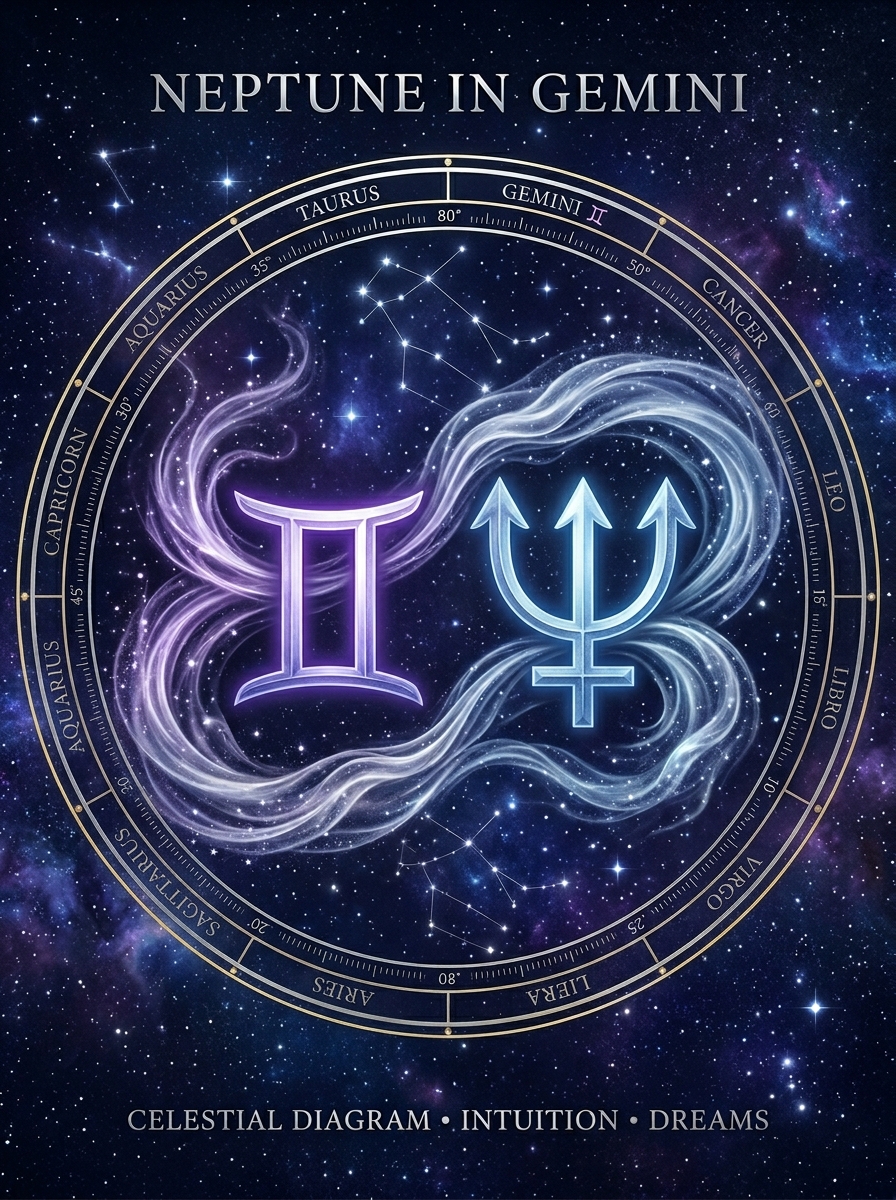
The Archetypal Synthesis: Neptune's Water Dissolving Gemini's Air
When the vast, boundaryless ocean of Neptune pours into the breezy, light-footed, and analytical atmosphere of Gemini, an extraordinary astrological alchemy occurs. Neptune represents the principle of dissolution, the longing for the infinite, the collective unconscious, and the mystical yearning to return to the primordial source. It is the cosmic fog that blurs distinctions, the spiritual waters that wash away the ego's rigid structures, and the source of all artistic inspiration, dream states, and divine confusion. Gemini, ruled by Mercury, is the archetype of the trickster, the messenger, the collector of facts, the weaver of networks, and the architect of language. Gemini categorizes, labels, compares, and contrasts, building intellectual bridges across the chasms of duality.
When these two forces combine, the sharp edges of Gemini's intellect are softened, and sometimes entirely dissolved, by Neptune’s misty depths. As Liz Greene has noted in her psychological investigations of the outer planets, Neptune's presence in a Mercury-ruled sign challenges the native to move beyond mere intellectual gymnastics and intellectualized defenses, forcing the mind to become a vessel for the transpersonal. This is not an easy marriage. Air and Water do not readily mix; instead, they create steam, mist, and condensation. The clarity of logic is replaced by the nuance of symbol, metaphor, and myth. Under this signature, the intellect is asked to surrender its need for absolute certainty, learning instead to float in the currents of ambiguity and mystical experience. The mind becomes less like a logical computer and more like an open window looking out over a misty shore.
The Liquefaction of Logic
In the realm of the mind, Neptune in Gemini demands the surrender of literalism. The classical Cartesian division between subject and object, so dear to Gemini’s analytical nature, begins to leak. Facts lose their rigid contours and become fluid, showing themselves to be mere waves on the surface of a deeper, collective stream of consciousness. For the individual with this placement, or during transits of this signature, the pursuit of objective truth yields to the appreciation of subjective resonance. One no longer asks, "Is this statement factually correct?" but rather, "What psychological or spiritual truth does this symbol evoke?"
This liquefaction of logic can manifest as intellectual disorientation, a sense of mental scattering, or an inability to focus on dry, linear data. Yet, it is precisely this mental dissolution that allows for the birth of genuine poetic genius. When the boundaries of language are breached, the mind can touch the unspoken, translating the wordless yearnings of the soul into contemporary vernacular. The Gemini need to communicate is not extinguished; rather, it is drafted into the service of Neptune’s sanctuary, transforming speech into a sacred art form and writing into a channel for the divine. The linear path of logical deduction is replaced by the lateral movements of intuition, allowing the seeker to perceive connections between seemingly unrelated ideas, synthesizing science, magic, art, and philosophy into a cohesive, fluid vision of reality. We begin to understand that truth is not a solid stone to be dissected, but a river that must be felt.
The Sacred Duality of Mercury
Steven Forrest often emphasizes that Gemini represents the path of the Witness—the part of the psyche that observes, gathers information, and remains open to all possibilities. Under Neptune's influence, this witness-consciousness is elevated to a spiritual practice. The dualism of Gemini—represented by the mythological twins Castor and Pollux, one mortal and one divine—becomes the central mystery of the incarnation. Neptune in Gemini highlights the tension between our earthly, linear language and the silent, unified reality of the spiritual self.
Through this placement, we discover that language is both a cage and a key. It is a cage because no word can ever fully capture the infinite expanse of the divine; it is a key because, through poetry, myth, and sacred symbols, we can point beyond the margins of the page toward that which cannot be named. The Mercurial drive to classify is subverted, revealing that every category is temporary, and every boundary between the self and the other is an illusion. The mind becomes a porous membrane, sensing the interconnectedness of all ideas, all stories, and all souls. In this state, the dualities of good and evil, light and dark, self and world are not seen as absolute divisions, but as complementary expressions of a singular, underlying unity that Neptune seeks to restore. By embracing this duality without rushing to resolve it, the mind becomes an instrument of profound spiritual synthesis, capable of holding multiple, paradoxical truths simultaneously.
The Historical Generation of 1887–1902 and the Dematerialization of Communication
To understand the concrete manifestations of Neptune in Gemini, we must look to the generation born during its last transit through the sign, which spanned from 1887 to 1902. This was a period of astonishing acceleration in the dematerialization of human communication and physical reality. The industrial era’s heavy iron and coal began to give way to invisible networks, waves, and signals. Gemini’s dominion over transit, paths, and messages merged with Neptune’s affinity for the invisible, the ethereal, and the omnipresent.
During this transit, the physical distance between human minds was collapsed by the rapid expansion of the telegraph, the telephone, and the early developments of wireless telegraphy. The voice, which had previously been bound to the physical body of the speaker, was suddenly severed from its fleshly origin. It was cast into the ether, traveling along copper wires or pulsing through the airwaves as invisible energy. This was the literal dematerialization of the Mercurial word—language stripped of its physical mass and transformed into pure, Neptunian vibration. The generation born under this influence grew up in a world where the boundaries of space and time were dissolving, fundamentally altering their psychological relationship to presence, proximity, and reality.
Telephony and the Disembodied Voice
The widespread adoption of the telephone during the late 19th and early 20th centuries fundamentally altered the human experience of presence. To speak to someone miles away, hearing their whispers directly in one's ear while their body remained distant, was a deeply Neptunian experience. It blurred the boundary between presence and absence, near and far. It lent a ghostly, almost mediumistic quality to daily communication. The telephone operator became a modern high priestess, connecting invisible threads across vast distances, weaving a web of voices that hung in the air like spirits.
This disembodied communication mirrored the psychological shifts of the era. If a voice could exist without a body, then perhaps the mind itself was not confined to the physical brain. The generation of 1887–1902 grew up with the understanding that human connection was no longer limited by physical proximity. This fostered a collective imagination that was highly sensitive to telepathy, remote influence, and the concept of a shared mental sphere, paving the way for the electronic village that would fully manifest in the late twentieth century. It created a deep sense of wonder, but also an underlying anxiety: if the voice could be separated from the throat, what else of our humanity could be digitized and cast into the air?
Wireless Telegraphy and the Ethereal Messenger
At the same time, Guglielmo Marconi’s experiments with wireless telegraphy in the late 1890s demonstrated that messages could travel through the void without any physical medium whatsoever. This was the ultimate synthesis of Neptune in Gemini: the air itself became pregnant with hidden information, teeming with silent messages waiting to be decoded by those with the proper instruments. The collective mind of humanity was beginning to realize that it was suspended in an ocean of invisible data.
The metaphysical implications of this technology were profound. The atmosphere was no longer empty space; it was a medium of connection, filled with silent voices and unseen light. This physical discovery perfectly aligned with the mystical understanding of the ether as a repository of memory and spirit. The Mercurial messenger had shed its physical sandals and wings, transforming into an electromagnetic wave that could circle the globe in an instant, dissolving the isolation of distant communities and knitting the consciousness of humanity into a single, highly sensitive net. It changed how we perceived the cosmos, shifting our view from a mechanical collection of separate objects to an interconnected web of waves and frequencies.
The Mystical Renaissance: Theosophy, the Hermetic Order of the Golden Dawn, and the Magic of Symbols
The Neptunian passage through Gemini coincided with a magnificent revival of interest in the occult, the mystical, and the esoteric across the Western world. As the rationalist, materialist paradigms of the Victorian era began to fracture under the weight of scientific discoveries that revealed the unseen nature of reality, the collective psyche turned inward. It sought a language that could bridge the gap between scientific inquiry and spiritual experience. This era saw the flourishing of the Theosophical Society and the founding of the Hermetic Order of the Golden Dawn in 1888, organizations that sought to classify, systematize, and communicate the hidden laws of the universe.
The Golden Dawn, in particular, was a quintessential Neptune in Gemini creation. It took the vast, chaotic, and fluid waters of Western occultism—including Hermeticism, Kabbalah, alchemy, astrology, and tarot—and subjected them to the meticulous, structured categorization of Gemini. The order constructed an elaborate hierarchy of grades, correspondences, and rituals, mapping the spiritual journey with academic precision. They treated the unseen worlds not as a vague, emotional mist, but as an intricate library of symbols that could be studied, spoken, and mastered. In this way, Gemini's intellectual discipline served to anchor and ground Neptune's vast spiritual aspirations, ensuring that the mystical voyage did not end in madness or delusion, but in a systematic expansion of consciousness.
Arthur Edward Waite, Crowley, and Tarot's Visual Language
Key figures of this generation, born under or deeply influenced by this astrological signature, revolutionized how humanity interacts with symbols. Arthur Edward Waite, along with the artist Pamela Colman Smith, created the Rider-Waite-Smith tarot deck, published in 1909. This deck revolutionized the tarot by introducing rich, illustrative scenes for the Minor Arcana, turning the cards into a highly accessible, visual vocabulary. The tarot became a Mercurial deck of cards that functioned as a direct portal to the Neptunian collective unconscious, a visual language that bypassed the limitations of literal words and allowed the seeker to converse directly with the soul. The deck did not explain the mysteries in rigid texts; it painted them in symbols, allowing the eye of the beholder to drink in the meaning directly.
Aleister Crowley, born in 1875, was another monumental figure whose life's work involved the codification and communication of the occult. His writings, marked by a brilliant, razor-sharp intellect coupled with a profound surrender to mystical states, perfectly mirror the tension between Gemini's analytical drive and Neptune's longing for dissolution. Crowley's creation of the Thoth Tarot, and his extensive writings on magick, served to deconstruct traditional religious dogmas while simultaneously building a complex, highly intellectualized system of spiritual attainment. He sought to make magick a science, utilizing language, symbol, and mathematics to describe the indescribable heights of mystical ecstasy, illustrating how Neptune's spiritual waters can be navigated using the map of Mercurial analysis. Through these creators, the ancient symbols of the West were modernized and made accessible, offering the contemporary mind a structured way to engage with the deep unconscious.
The Talking Cure: Deciphering the Neptunian Unconscious Through Mercurial Speech
As Neptune dissolved the boundaries of the external world through wireless communication, it also dissolved the boundaries of the internal world through the birth of psychoanalysis. Sigmund Freud, working in Vienna during this transit, published The Interpretation of Dreams in late 1899. Freud’s revolutionary insight was that the symptoms of psychological distress, which had previously been viewed as purely physical or meaningless neurological anomalies, were actually symbolic messages from a hidden depth of the psyche—the unconscious.
The method Freud developed was famously dubbed "the talking cure." This phrase is a perfect summary of the Neptune-Gemini dynamic. The vast, murky, and chaotic waters of the Neptunian unconscious—filled with repressed desires, forgotten traumas, and primal fantasies—were to be healed and integrated through the Mercurial act of free association and speech. By putting the dream into words, the patient brought the dissolved parts of the self back into the structured world of human relationship and conscious understanding. The analyst acted as a translator, decoding the symbolic, non-linear language of the night into the rational, everyday language of the day. Through speech, the unseen monsters of the deep were brought to the surface and dissolved in the light of awareness.
Freud, Jung, and the Symbolic Bridge
Carl Gustav Jung, who initially partnered with Freud before developing his own school of analytical psychology, expanded this work into the realm of the transpersonal. Jung recognized that the unconscious was not merely a repository for personal trash, but a collective treasury of archetypes—universal patterns of energy that speak to us through symbols, myths, and dreams. Jung’s work was dedicated to building a bridge between the rational ego (Mercury) and the vast depths of the collective soul (Neptune). He understood that the intellect alone could not cure the soul; instead, the intellect must learn to interpret the symbolic language of the unconscious.
In his exploration of dreams, Jung emphasized that the unconscious does not speak the language of literal logic; it speaks the language of symbol. To understand a dream, one must learn its unique syntax, translating its images into conscious insight without destroying their poetic, evocative power. This therapeutic process is a living practice of Neptune in Gemini: it requires us to listen to the whispers of the ocean while standing firmly on the dry land of rational reflection. By engaging in this dialogue, the individual is able to integrate the split-off, unconscious elements of their personality, moving toward a state of wholeness and spiritual alignment that Jung termed individuation. This process showed that the mind was not a static machine, but a dynamic, self-regulating landscape that could heal itself when given the proper symbolic vocabulary.
Silent Cinema: The Projection of Collective Dreams into Moving Images
One of the most spectacular cultural phenomena to emerge from the Neptune in Gemini transit was the birth of cinema. The late 1880s and the 1890s saw the invention of the Kinetoscope, the Cinématographe, and the gradual emergence of projected moving images. Cinema is a purely Neptunian medium: it relies on light, shadows, illusion, and projection. It takes place in a darkened room, a modern equivalent of the dream state, where the individual ego is temporarily suspended, and the audience shares a collective hallucination.
Yet, during this specific transit, this Neptunian magic was married to Gemini’s love for narrative, sequence, and technical ingenuity. The early cinema was silent, relying on visual pantomime, symbolic gestures, and written title cards to tell stories. It was a language of pure imagery, a universal tongue that could be understood by anyone, regardless of their native speech. The silent screen projected the collective dreams, anxieties, and fantasies of the era, turning the collective unconscious into a public spectacle. It allowed the masses to participate in a shared, visual myth-making process, dissolving the barriers between different cultures and languages. The movie theater became the new church of the industrial era, where people gathered not to hear sermons, but to watch their own dreams come to life on a screen of light.
Celluloid Fantasies and the Universal Screen
The pioneers of early film, such as Georges Méliès, used the medium to create fantastical illusions, trick photography, and dreamscapes that defied the laws of physics. Méliès’s A Trip to the Moon (1902), released at the tail end of the Neptune in Gemini transit, is a monument to this spirit. It combined technical, mechanical precision with the wildest, most whimsical fantasy. The film demonstrated that the camera was not just a tool for recording reality, but a magic wand capable of constructing entirely new worlds of imagination.
The screen became a mirror for the collective soul. In the flickering light of the projector, audiences saw their own hidden longings and terrors writ large. The boundaries between the viewer and the viewed were dissolved, creating a new form of empathy and collective experience. Cinema dematerialized theater, transforming physical actors and wooden stages into two-dimensional ghosts of light and shadow, forever captured on celluloid, destined to repeat their stories across time and space. It was the ultimate democratization of the dream, allowing millions of people from different backgrounds to sit together in the dark and feel the same emotions, illustrating the power of visual language to unite a fragmented world.
The Next Transit (2052–2066): Re-evaluating Truth and Language in a Post-AI World
Astrology is a science of cycles, and to understand the future, we must project the archetypal patterns forward. Neptune will return to the sign of Gemini in the mid-21st century, specifically from 2052 to 2066. While the late 19th-century transit brought the dematerialization of the voice and the rise of silent film, the mid-21st-century transit will occur in a world thoroughly saturated by artificial intelligence, synthetic media, and the complete digitalization of human interaction.
This future transit will bring a profound crisis—and a potential rebirth—concerning the nature of truth, language, and meaning. As AI systems become capable of generating flawless, human-like speech, text, and video, the traditional Gemini faith in the written and spoken word will be thoroughly shaken. The Neptunian waters will flood the digital landscape, making it increasingly difficult to distinguish between authentic human expression and synthetic generation, between historical fact and algorithmic illusion. The very medium of our communication will become a source of profound ambiguity, forcing us to look deeper for the essence of truth. We will be forced to ask: when words are infinite and cheap, what is the value of speech?
The Dissolution of Meaning in the Age of Synthetic Intelligence
During the 2052–2066 transit, humanity will have to grapple with the realization that language is no longer the exclusive domain of conscious beings. When machines can write poetry, generate philosophy, and simulate intimate conversation, the Mercurial function of language will undergo a radical transformation. Words will lose their utility as simple carriers of objective data, as the digital sphere becomes an endless, swirling ocean of hyper-realistic simulations and deepfakes. The danger is a collective slide into solipsism, paranoia, and the total dissolution of shared reality.
This intellectual disorientation will mirror the challenges faced by the late Victorian generation, but on a global, digital scale. If any text, voice, or video can be synthesized, then the physical senses can no longer be trusted to verify reality. The Gemini drive to collect and verify information will hit a wall of Neptunian illusion. To survive this transit without losing our minds, we must learn to look beyond the surface of the message, developing a capacity for energetic and intuitive discernment that can sense the presence of life behind the word. We must learn to listen not only to what is said, but to the silence out of which the word arises, searching for the human spark in a world of mechanical mirrors.
The Reclamation of Intuitive Resonance
However, the higher potential of this transit lies in the reclamation of the sacred, intuitive dimensions of communication. Forced to abandon our reliance on literal text, humanity may learn to listen to the deeper, Neptunian currents that underlie all interaction—the resonance of presence, the unspoken energy between souls, and the intuitive recognition of truth that goes beyond syntax. We will be challenged to develop a new form of literacy, one that reads not just the words on the screen, but the spiritual source from which they flow.
In this post-AI landscape, the value of communication will shift from the efficiency of the transmission to the depth of the connection. We may see a revival of oral traditions, face-to-face gatherings, and analog forms of expression that cannot be easily simulated or manipulated. The transit will ask us to recognize that true understanding is not merely an intellectual agreement upon facts, but a spiritual resonance that occurs when two minds touch. By dissolving our attachment to the outer form of language, Neptune in Gemini can open the way to a direct, telepathic communion of the heart. We will discover that the most important things we say are often the ones we cannot put into words.
Frequently Asked Questions
What does it mean to have Neptune in Gemini in a natal chart?
Individuals born with Neptune in Gemini in their natal chart possess a mind that is deeply sensitive to the collective currents of their time. They are natural channels for the myths, dreams, and anxieties of their society, often expressing these themes through writing, teaching, art, or technology. On a personal level, this placement can manifest as a highly active, imaginative intellect that struggles with the boundaries of linear logic. These individuals may experience periods of mental confusion, scattered focus, or disillusionment with traditional education, but they also possess a rare capacity for poetic expression, intuitive learning, and the ability to speak to the soul rather than just the intellect. They are often drawn to fields that combine analytical thought with spiritual or imaginative pursuits, such as psychological astrology, esoteric study, creative writing, or the development of new communication media.
How does Neptune in Gemini affect daily communication during a transit?
During a Neptune in Gemini transit, the collective atmosphere becomes filled with a sense of intellectual curiosity mixed with spiritual longing. Daily communication may become more fluid, intuitive, and symbolic, but also more prone to misunderstandings, rumors, and illusions. The boundaries between fact and fiction become blurred, requiring a high degree of discernment. It is a period where poetry, storytelling, and creative writing flourish, as people seek to express deeper, non-linear truths. It is also an excellent time for studying esoteric subjects, dream analysis, and psychology, as the rational mind is more receptive to the whispers of the unconscious. However, it is important to guard against mental scatteredness, deception, and the tendency to believe what is pleasing rather than what is true.
What is the relationship between Neptune in Gemini and the history of psychology?
The transit of Neptune in Gemini between 1887 and 1902 directly coincided with the birth of psychoanalysis and modern depth psychology. This period saw the development of "the talking cure" by Sigmund Freud and the early structural work of Carl Jung. The placement represents the alchemical process of using Mercurial tools—speech, analysis, association, and language—to investigate, decode, and heal the Neptunian depths of the human unconscious. It established the understanding that our conscious minds are constantly influenced by a vast, unseen ocean of archetypes, dreams, and symbolic languages. Through this transit, psychology became the bridge between the rational intellect and the mystical soul.
How will the future transit of Neptune in Gemini (2052–2066) differ from the past transit?
While the 1887–1902 transit focused on the invention of technologies that extended the human voice and image across space (such as the telephone and early cinema), the 2052–2066 transit will take place in a post-artificial intelligence world. The challenge of the future transit will not be how to transmit messages, but how to determine what is real in an environment dominated by synthetic language, deepfakes, and algorithmic projections. It will demand a transition from intellectual literacy to intuitive literacy, forcing humanity to find truth beyond the digital code and to reconnect with the authentic, spiritual essence of human connection. The future transit will challenge us to define what makes our communication uniquely human and to reclaim the sacred dimension of language.
Who are some key historical figures that represent the Neptune in Gemini archetype?
The generation born during the late 19th-century transit produced many writers, thinkers, and artists who transformed how we interact with language, psychology, and symbols. Figures like Arthur Edward Waite and Pamela Colman Smith revolutionized the visual language of tarot, while Aleister Crowley systematized esoteric magic using both intellect and intuition. In literature, writers of this generation explored stream-of-consciousness techniques and the fluid boundaries of identity and memory, mirroring the dissolution of Gemini's linear structures. In psychology, the work of Freud and Jung during this period laid the foundation for using spoken language to map and explore the vast, watery realms of the unconscious mind.
How does this placement influence our understanding of creative writing?
Neptune in Gemini changes the writer’s pen from a tool of recording facts into an instrument of mystical channeling. In creative writing, this placement encourages the writer to let go of rigid outlines and allow the narrative to flow organically from the unconscious. It fosters stream-of-consciousness writing, rich metaphorical layers, and stories that operate on multiple levels of meaning simultaneously. The writer under this influence does not simply write a story; they capture a dream, using the Mercurial tools of grammar and syntax to construct a vessel that can carry the reader into the deep, Neptunian waters of empathy, imagination, and spiritual insight.
Comments
Loading comments…