Mercury Square Venus: When Thought Courts the Heart and Sparks Fly
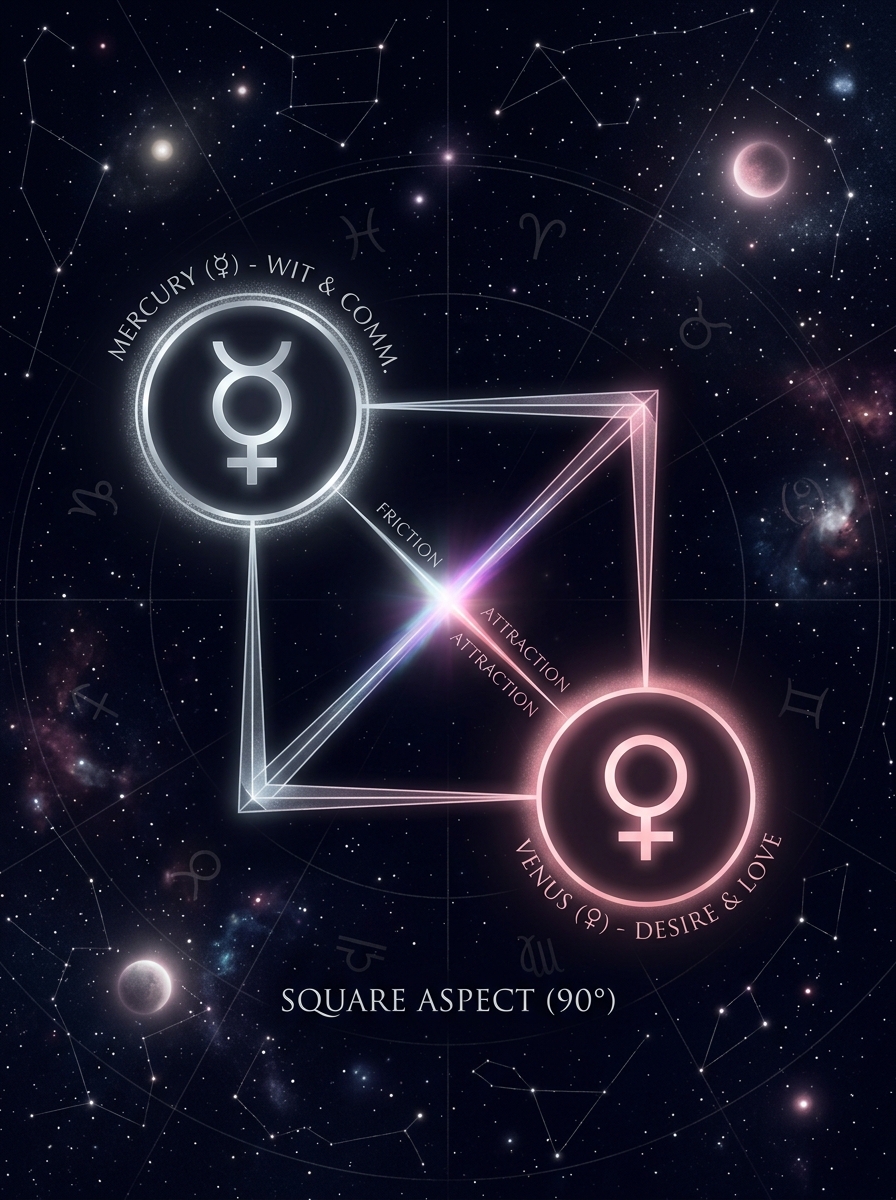
The Core Dynamic: A Mind That Cannot Speak Without Editing the Feeling
Mercury square Venus does not produce a simple contradiction. It produces a style of consciousness: intelligent, socially attuned, verbally gifted, and perpetually unconvinced that any single phrasing is quite good enough. The person hears nuance everywhere, including in their own voice, and that sensitivity becomes both gift and disturbance. Mercury wants precision, clarity, and the accurate naming of things. Venus wants harmony, beauty, and the preservation of emotional connection. When they are in square—a 90-degree tension that is the signature of the square aspect as a developmental pressure point—neither instinct fully trusts the other. The result is a live wire: a mind that evaluates every statement for its relational impact before releasing it, and a heart that wonders whether anything it desires can be stated plainly.
This is not indecision in the trivial sense. It is a deep-seated negotiation between truth and likeability, between the impulse to say exactly what you mean and the fear that doing so will make you less wanted. The person may seem witty, agreeable, or aesthetically polished on the surface, while privately wrestling with a recurring split: “What is true?” versus “What will land well?” At its best, this aspect creates someone who can refine language until it sparkles and can sense what a room needs emotionally. At its worst, it produces diplomacy that smothers honesty, cleverness that becomes evasive, or a craving for affection so strong that it quietly distorts judgment. The whole lesson of the square is built into that friction: not choosing one planet over the other, but building a bridge between articulation and affection.
What the Square Is Asking For
A square is not a simple contradiction. It is a catalyst. For the native, the pressure to reconcile Mercury and Venus often surfaces as a hyper-awareness of tone. They notice what was implied, what was softened, what was left out. They can hear the emotional weather inside ordinary conversation. That sensitivity is not decorative; it is the psychological engine of the aspect. It also explains why social interaction can feel high-stakes, even when nothing dramatic is happening. Over time, the habitual self-correction can become a second personality—one that speaks fluently but never feels fully authentic.
The core question the aspect poses is this: Can you say the necessary thing well without falsifying it? Can you hold both the truth and the relationship in the same sentence? That question does not have an easy answer, but the journey toward it is where the square earns its value.
Psychological Roots: The Formation of the Aesthetic Conscience
Mercury square Venus often originates in early environments where emotional safety was tied to being agreeable, charming, or verbally skillful. The child learns that being pleasant reduces conflict, that saying something beautifully makes it easier to be heard, or that wit can soften a difficult truth. This is not a lie; it is a survival strategy. The mind adopts charm as an adaptive intelligence—a way to navigate a world where bluntness costs affection. But the strategy calcifies. By adulthood, the person may no longer know which of their statements are chosen for accuracy and which are chosen for reception.
This is where the aspect develops what we might call an aesthetic conscience: an internal critic that evaluates every utterance for style. Bad phrasing feels morally suspect, as though an ugly expression somehow contaminates the idea. The person may feel that if the sentence is not elegant, the self is not elegant; if the word is awkward, the feeling was inappropriate. That fusion of self-worth with verbal performance is the shadow. It can lead to exquisite taste—but also to conversational performance anxiety, where every interaction becomes a silent audition.
The psychological task is to unhook self-worth from how things are said. For those with Mercury in Libra or Venus in Gemini, the social intelligence can be dazzling, because both placements love exchange and relational finesse. But the square still insists on a deeper task: not merely being likable, but becoming honest without becoming brutal, and agreeable without becoming false.
How It Matures vs. How It Goes Shadow
The aspect matures when the person stops trying to say everything beautifully and starts saying the necessary thing well. Integration is not dramatic. It looks like pausing before apologizing. It looks like speaking plainly without over-explaining. It looks like noticing when charm is serving connection and when it is serving fear. Over time, the native learns that truth need not be abrasive and beauty need not be evasive. The messenger and the lover learn to negotiate in the same room.
The Shadow: People-Pleasing and the Fear of Being Aesthetically Wrong
The deepest friction is not communication but valuation. Venus governs what is worth loving, keeping, or desiring. Mercury governs how we distinguish, compare, and name. In square, the person may distrust their own preferences. They ask others what they think too soon, or defer to consensus because internal certainty feels fragile. Praise can feel intoxicating but also unstable—the psyche knows how easily flattery smooths over conflict. Criticism may sting less because it is harsh and more because it threatens the person’s sense of being lovable.
This is why the aspect can manifest as indecision that looks trivial from the outside and existential from within. The person may bargain with authenticity—not lying in a crude sense, but modulating. They trim the sharp edge, delay the hard sentence, lace criticism with sugar, or turn a need into a joke. Sometimes this is kindness. Sometimes it is fear. The body often knows the difference before the intellect does. For a comparison of how revision and reconsideration work in the psyche, the retrograde process—as described in the cycle of Mercury retrograde—offers a useful parallel: both signatures involve the instability of first drafts. But Mercury square Venus is not merely about mental rework; it is about the emotional cost of refinement.
When the shadow is in charge, the person may harden into irony, coyness, or a polished emotional distance. Or they may become overly sweet—so agreeable that they disappear. The immature expression avoids the friction; the mature expression metabolizes it.
How It Plays Out in a Life: Love, Work, and the Art of the Necessary Sentence
The dynamic does not stay theoretical. It surfaces in every arena where language carries emotional weight.
In Relationships: The Mind That Courts the Heart
In romance, the native often falls in love with wit, voice, and conversational chemistry before trusting the deeper bond. They may need intellectual rapport to feel attraction, or attraction becomes tangled with the wish to be admired for being clever or refined. The square adds an edge: the need to negotiate between what feels sweet and what feels true. People with this aspect can be extremely appealing, yet the more they want love, the more likely they are to over-curate themselves. They may say yes too quickly, soften a boundary until it disappears, or agree to an arrangement because they want the exchange to remain pleasant. The lesson is not to become harsher. It is to tolerate a moment of aesthetic discomfort in service of authenticity. When Mercury in the 7th House is involved, the relational focus intensifies, making the tension between self-expression and partnership even more acute.
In Work and Creative Expression
The aspect is especially potent in writing, design, negotiation, counseling, sales, performance—any field where language must carry emotional weight. A person with this square often has a refined instinct for what is “too much,” “not enough,” or “almost right.” They may not always trust that instinct, but it is there. In creativity, the Venusian side wants beauty; the Mercurial side wants variation. That can produce creative restlessness—brilliant at brainstorming, editing, styling, or composing, but never fully satisfied. The person can see ten possible versions and mourn the one they did not choose. In art, this can become a signature style of layered sophistication. In daily life, it can become chronic second-guessing. Compare the Mercury in the 5th House profile, where the playful mind performs without self-consciousness; this square adds the performer who also worries about reception. The difference matters. Mercury-Venus square does not merely create creative talent; it creates a feedback loop between taste and self-evaluation.
In professional settings, the native may become an acute negotiator—able to persuade by making an idea attractive. That is a real gift. Venus in the 10th House can channel this into public grace and professional charm. But the shadow is over-accommodation: saying yes to keep the meeting pleasant, agreeing to a bad deal because confrontation feels ugly. The mature version learns to state a boundary with the same elegance they once reserved for compliments.
The Alchemy: From Appeasing to Artistry
The final gift of Mercury square Venus is not harmony in the easy sense. It is cultivated discernment. This aspect trains a person to make choices with both intelligence and taste, to speak with tact without falsifying reality, and to create forms of connection that are neither cold nor sentimental. That is a real achievement.
When the square is part of a larger configuration, such as a T-square, the tension becomes even more urgent—the psyche is trying to create a third thing, a voice that can think, feel, and choose without splitting itself. The person may spend years trying to say things in a way that preserves every bond. But the deepest reward comes when they realize that bonds survive better when reality is allowed into the room. The wise version of the aspect is a voice that can carry both lucidity and grace: unsentimental, alive, and finally free of the need to be liked into silence.
Comments
Loading comments…