Mercury Opposition Venus: The Divided Tongue and the Beautiful Argument
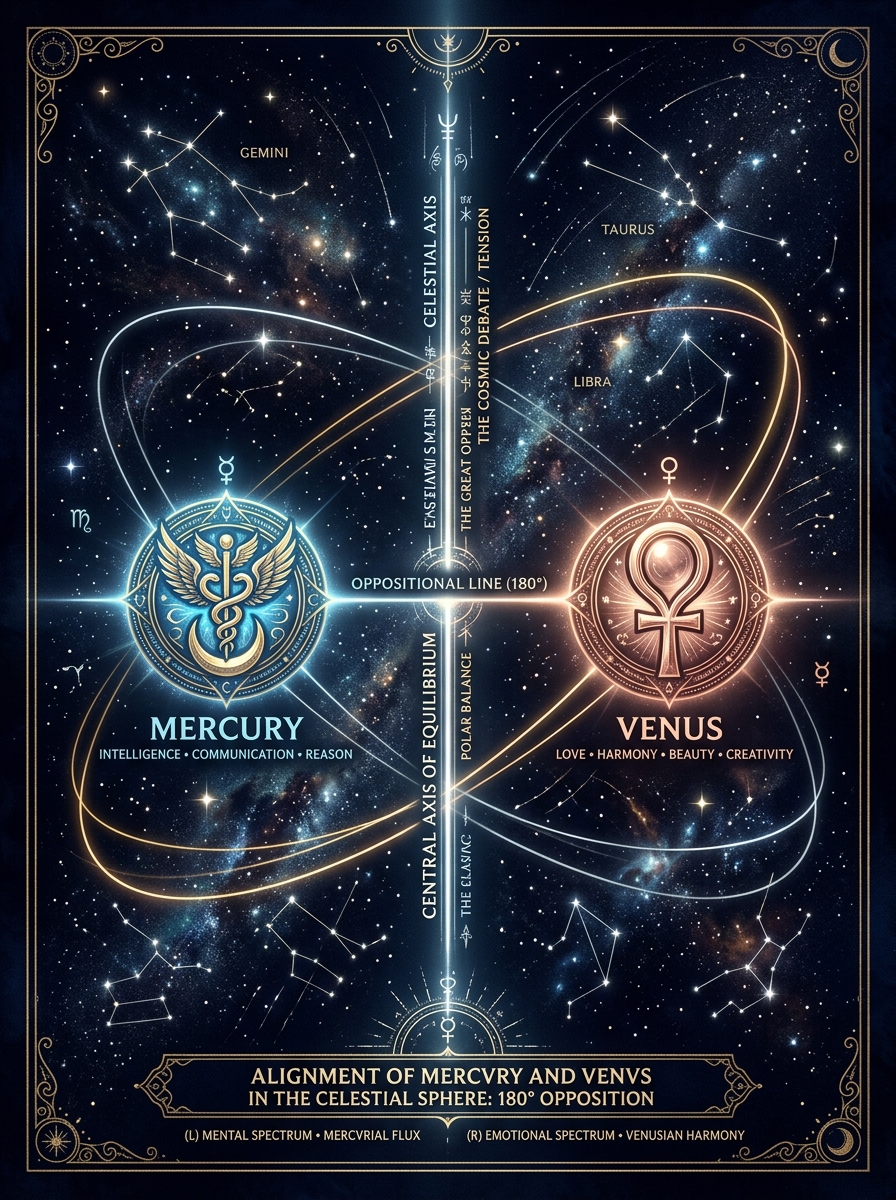
The core dynamic: two worlds with different grammars
Mercury opposition Venus creates a native who experiences thought and affection as rival jurisdictions. Mercury names, compares, revises, and insists on accuracy; Venus harmonizes, enjoys, consents, and prefers the air to remain pleasant. In opposition the two planets face each other across the chart, each most aware of itself through the other. That means the person often thinks while feeling watched by desire, or feels while the mind edits the sensation in real time. The result is not simple conflict—it is a lifelong education in how language changes love and how love changes language.
This aspect does not force a choice between truth and kindness. It places the native in the charged space where both are present and neither can be dismissed. The opposition aspect teaches through polarity: the psyche learns not by picking one pole but by discovering what lives in the interval between them.
The perceptual split
The central tension is easy to state and hard to live. Mercury wants accurate expression; Venus wants pleasing expression. That does not mean one is honest and the other false. It means the chart holder may experience honesty as disruptive and kindness as evasive—or kindness as necessary and honesty as dangerous. Many with this aspect oscillate between intellectual candor and diplomatic self-correction, sometimes in the same sentence.
A thought arrives; immediately a second voice says it is too sharp, too needy, too blunt, too revealing. The person may polish everything they say until it gleams, or, in a backlash, speak with startling directness and later regret the damage. The task is not to silence either planet. It is to learn what each is protecting.
Psychological roots: the mind that polices desire
Why does this opposition produce such acute self-awareness? Because Mercury is the planet of perception, and Venus is the planet of value. When they oppose, every perception is immediately tagged with a value judgment: Is this beautiful? Is this appropriate? Will this cost me affection? Mercury cannot simply observe; it must negotiate with Venus’s craving for harmony. Conversely, Venus cannot simply relax into pleasure; Mercury keeps asking, “Does this make sense? Is it real?”
This creates an inner editor that operates even in casual conversation. The native may be exquisitely sensitive to tone, subtext, and social consequence. They hear the inflection beneath a sentence, sense when a compliment is sincere, detect the small lies that smooth over discomfort. That hyperawareness can be exhausting, but it also cultivates a kind of psychological intelligence—the ability to read a room, to know what someone needs to hear, and to recognize when rapport is being faked.
How signs set the stage
The signs tell you the style of the disagreement. Mercury in Taurus opposing Venus in Scorpio may create a mind that clings to concrete language while desire plunges into emotional depth—the person may want to talk about money and routine while secretly longing for psychological fusion. Mercury in Aries opposing Venus in Libra intensifies the push-pull between blunt assertion and relational tact; the speaker may blurt out a truth, then immediately soften it with charm.
House placement is equally decisive. If Mercury is in the 4th house and Venus in the 10th, the person may feel torn between private honesty and public polish. If Mercury is in the 8th house, the mind probes beneath appearances, while Venus prefers what can be enjoyed without emotional dismemberment. The Mercury in the 8th house page explores this dynamic further: the native may need to speak the unspeakable, but Venus recoils from the rawness.
Integration and shadow: how the split matures
Unintegrated, Mercury opposition Venus tends toward two poles. The first is strategic charm: the native learns exactly what others want to hear and delivers it, then resents themselves for tailoring the message. The second is cold criticism disguised as honesty: the mind justifies sharp remarks as “just being direct” while Venus’s need for connection goes unmet. Both patterns are attempts to control distance—the first by pleasing, the second by pushing away.
Integration looks different. It is not a middle ground but a new capacity: the ability to speak truth in a way that lands without wounding. This begins when the native stops using prettiness to avoid conflict and stops using bluntness to punish. Mercury learns to report accurately while remembering the person; Venus learns to value the speaker even when the message is difficult. The mature expression is discernment with feeling in it.
The role of Venusian and Mercurial dignity
A well-placed Venus—say, in Taurus or Libra—can soften the opposition into social intelligence and aesthetic finesse. The native may have a natural sense of timing and proportion, knowing when to speak and when to let silence do the work. A well-placed Mercury—in Gemini, Virgo, or Aquarius—can turn the opposition into lucid self-observation and verbal agility. The person becomes a gifted mediator, able to paraphrase between people who want facts and people who want feeling.
Stressed versions go darker. A struggling Mercury becomes sarcastic, evasive, or overexplanatory. A struggling Venus becomes approval-seeking, image-managed, or seductively indirect. The difference between the two is the difference between a mind that fears saying the wrong thing and a heart that fears wanting the wrong thing. In some charts, the mind polices desire. In others, desire sweet-talks the mind. The mature version is when neither dominates by force.
How it plays out in a life: love, work, and the art of the right sentence
Because the core dynamic is already established in the previous sections, we need only apply it—not re-derive it.
In love, the native’s challenge is to stop disguising affection as commentary. A person with this aspect may say “I love the way you think” when they mean “I love you,” or they may dissect a partner’s taste instead of simply enjoying it. The breakthrough is learning to ask for closeness without intellectualizing it.
In work, the same tension appears. The native may over-polish presentations until the force is lost, or speak so plainly that they alienate collaborators. The gift is mediation: they can translate between the quantitative and the qualitative, between the data analyst and the creative director. This is especially true when Mercury is in the 7th house, where thought comes alive through partnership. The Mercury in the 7th house article describes how the mind becomes relational, needing the other to find its own voice.
In self-respect, the native must stop treating their own needs as negotiable. Venus wants to be loved; Mercury wants to be understood. Both are legitimate. The person who matures this aspect learns that directness does not cancel beauty and that beauty does not nullify truth. They become someone who can tell a difficult fact without withdrawing warmth—a rare social art.
Aesthetic intelligence as a signature
This aspect also shapes taste. Venus governs what pleases; Mercury categorizes and critiques. In opposition, the native may be exquisitely discerning but never fully settled. They love beauty and dissect it. They may buy, write, or decorate with intelligence, then second-guess whether the choice was authentic or merely clever. That habit can deepen discernment, but it can also inhibit delight.
The highest expression is not to resolve the tension but to use it. The person develops a signature style that is both intelligent and sensuous, precise and warm. They know that a phrase can be true and still kind, that a room can be elegant and still livable. For signs like Venus in Gemini, the intellectual flirtation becomes an art form; for Venus in Taurus, the sensuality is grounded. Each combination yields a different dialect of the same core split.
The hidden gift: translator between truth and grace
The ultimate achievement of Mercury opposite Venus is translation. These people can carry meaning without brutality and beauty without vagueness. They become skilled mediators between people who want “the facts” and people who want “the feeling.” In the best cases, they can say what is difficult in a way that remains humane.
This gift often matures over time. The native stops fighting the opposition and starts listening to what each planet is protecting. Mercury protects the integrity of perception; Venus protects the integrity of relationship. When both are honored, the native develops a voice that can hold a human being without reducing them to a problem or a project. They are not here to choose between wit and warmth. They are here to fuse them.
For a deeper look at the polarity itself, the opposition logic page explains why the other voice—inside or outside—often contains the missing piece. And for those with Mercury in the 10th house, the public voice becomes both polished and principled, a model of how to speak with consequence.
At its best, Mercury opposite Venus produces someone who can tell the truth beautifully and love without becoming theatrically vague. That is not a small achievement. It is the making of a voice that carries both precision and grace—a voice that knows relationship is not preserved by silence, but by the right sentence at the right time, spoken with a fully awake heart.
Related
- Mercury Conjunct Venus: When Mind and Desire Share a Pulse
- Synastry Venus Opposite Mercury: The Electric Tension Between Affection and Language
- Mercury Sextile Venus: The Mind That Knows How to Charm
- Mercury Square Venus: When Thought Courts the Heart and Sparks Fly
- Moon Opposition Mercury: The Split Between Feeling and Thought
Comments
Loading comments…