Mercury Opposes Mars: The Mind at War with Its Own Fire
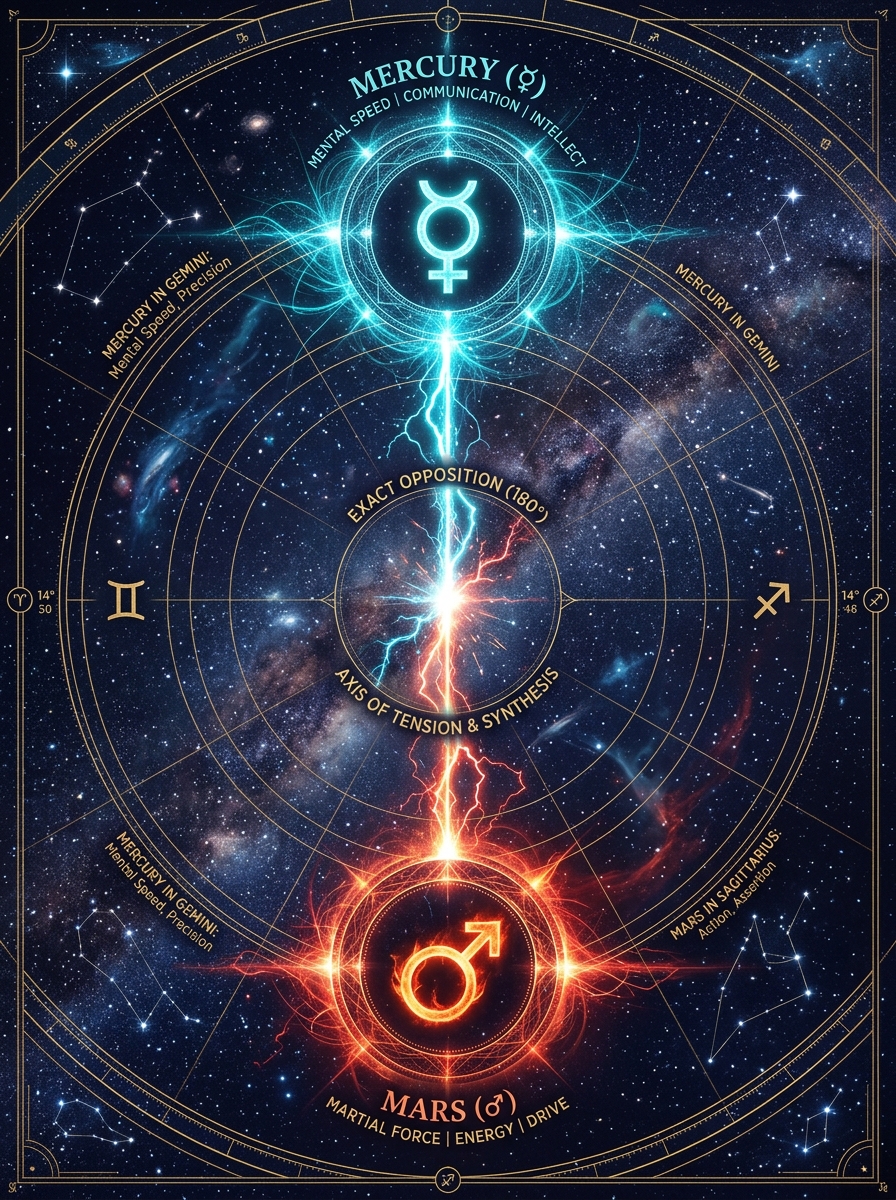
The Core Dynamic: A Mind That Thinks Under Fire
Mercury opposition Mars is the natal signature of a consciousness that cannot separate thought from combat. The archetypal tension is precise: Mercury names, compares, and discriminates; Mars strikes, cuts through, and wins. In opposition, these two planets face each other across the chart, each becoming the other’s witness and adversary. The result is an internal weather system where every idea arrives with an impulse, and every impulse demands articulation before it is fully formed.
This is not a placement of “bad communication.” It is a placement of pressure between mental perception and martial instinct. The person experiences a split between the part that wants to consider and the part that wants to act. Because the opposition is a mirror aspect, each side sees the other clearly but not kindly. Arguments begin as private events — thought heating into impulse, impulse demanding a verbal outlet. The native often learns early that speech has consequences: a careless remark provokes retaliation, a needed truth arrives with too much force, silence feels like self-betrayal. For a fuller understanding of how any opposition functions as a field of encounter rather than a defect, see the general discussion of the opposition aspect.
The psyche becomes alert to tone, timing, and subtext because the line between saying something and escalating it is thin. That alertness can produce a brilliant tactical intelligence. It can also produce chronic over-preparation, where one mentally rehearses arguments the way a swordsman sharpens a blade. The mind is never at rest. It is always scanning for the next point of friction.
How It Forms: The Body and the Early Wound
This opposition rarely stays abstract. It shows up in the mouth, the shoulders, the hands, the pace of the day. Mars brings muscular immediacy to Mercury’s processing. The body is not merely carrying the message; it is part of the message. Clenched jaws, a racing pulse, the need to pace while thinking, or the sense that one must “do something” while others are still discussing — these are common embodiments. The native may have grown up in an environment where words and anger were entangled: a household where a raised voice meant a threat, or where silence was used as a weapon. Alternatively, the opposition can emerge from a temperament that simply moves faster than the social average.
Psychologically, the core formation is an internalized debate between the witness (Mercury) and the warrior (Mars). The mind learns to think under pressure, but the cost is that it forgets how to think without pressure. Early experiences often involve being interrupted, corrected, or dismissed, leading the native to compensate by speaking faster, louder, or more precisely. The result is a speech style that is incisive but also defensive. For those with Mercury in Aries — a sign that doubles down on the martial quality of thought — this dynamic intensifies, turning every conversation into a potential contest. See Mercury in Aries for the overlap between mental fire and verbal will.
At its root, this opposition is about survival through articulation. The mind believes that if it can say the right thing fast enough, it will be safe. That belief is both a strength and a trap. The person may become exceptionally good at crisis communication, negotiation, or any arena where adrenaline rises and words must land. But the nervous system never fully relaxes. The body stays on alert.
Two Paths: Strategic Courage or Reactive Combat
The same energy that produces a sharp tongue can produce a sharp mind. The difference lies in whether the person uses the opposition as a tool of discernment or a trigger for escalation. Both paths are always available.
The Constructive Expression
A well-integrated Mercury-Mars opposition becomes strategic courage: the ability to think under pressure without losing nerve, and to act without losing language. These are people who can make a case, defend a position, advocate for the vulnerable, or cut through euphemism with precision. They are often gifted at seeing what others will not say. In mythology, Mercury is the messenger and Mars is the fighter; together they create the messenger who can survive hostile terrain. That is why this aspect appears in attorneys, activists, researchers, journalists, and entrepreneurs who must make decisions publicly and quickly.
There is also a creative gift. Mars gives Mercury nerve; Mercury gives Mars shape. The result can be writing with bite, speech with rhythm, humor with teeth, or artistic work that carries an unmistakable charge. When the chart emphasizes expressive houses, the opposition can become theatrical — a person who uses conflict as performance, wit, or creative daring. For example, Mercury in the 5th House turns the mental and martial energy into a stage for play, romance, or artistic risk. See Mercury in the 5th House for how that house amplifies the performative side of this aspect.
The Shadow Expression
The shadow of this opposition is not simply anger. It is reactivity masquerading as truth. The native may feel compelled to answer immediately, correct instantly, or sharpen every conversation into a contest. The ego becomes addicted to friction because friction generates aliveness. In that state, even a neutral remark can be heard as a challenge. The mind rushes toward combat before it has fully understood the terrain.
One of the hardest lessons is that being right too quickly can be a kind of blindness. Mars wants victory; Mercury wants precision; together they can accidentally steamroll nuance. The native discovers, repeatedly, that an argument won in substance is lost in relationship. This is not a moral failure so much as an issue of tempo. The psyche has to learn that meaning matures. Sometimes the most accurate response is not the fastest one.
This is where Mercury retrograde becomes essential medicine. The retrograde cycle demands revision, re-hearing, and reconsideration — exactly the opposite of the native’s instinct to strike fast. Learning to pause, to let the first impulse pass, is the developmental task of this aspect. For the broader logic of how retrogradation forces reflection, see the guide to Mercury Retrograde. Without that discipline, the opposition can degenerate into mental exhaust, insomnia, and a nervous system that forgets what ease feels like.
Where the Dynamic Plays Out in a Life
Once the core dynamic is understood — the mind under fire, the two paths — we can see its concrete fingerprints across love, work, and creativity without re-explaining the entire mechanism.
In Relationships
This aspect often creates a pattern of provocation and repair. The native values candor so much that tact looks like dishonesty. They may resent being told to “calm down” because the instruction itself feels condescending — as though the other person is trying to disarm the mind by restraining the will. Verbal sparring becomes a love language; competition becomes intimacy. If the chart also highlights the 7th house, the opposition can play out as a recurring dynamic where partners stimulate each other through friction. For a deep dive into how Mars in the 7th House intensifies this relational combat, see Mars in the 7th House. The gift is that these people do not tolerate dead communication for long. They can expose what is evasive, inflated, or intellectually lazy. The risk is confusing intensity with authenticity.
In Work
Professionally, this opposition thrives in environments that reward quick diagnosis and decisive wording: editing, law, sales, emergency response, strategy, technical troubleshooting. The native does not merely analyze a problem; she wants to solve it before the window closes. The downside is impatience with process. Meetings drag; delays feel personal; bureaucracy feels like psychic sandpaper. When handled poorly, this becomes combative micromanagement or self-sabotage through haste. When handled well, it produces a rare capacity to cut through confusion and mobilize action. The person becomes the one who says the hard thing in the meeting, names the missing variable, or speaks for a reality others prefer to avoid.
In Creativity
Creatively, the opposition can fuel work that has edge and rhythm. Writers with this aspect often have a voice that demands attention — not through volume, but through precision and timing. The humor is dry, the imagery is sharp, the pace is fast. For those whose chart emphasizes the 5th house, the creative output becomes a stage for conflict, wit, and daring. See Mercury in the 5th House for how that house can turn the opposition into a source of theatrical or artistic power.
The Internal Battlefield
Some people with this aspect do not fight others; they fight themselves. The inner dialogue becomes a courtroom. Mercury keeps producing evidence; Mars keeps demanding a verdict. This can generate mental exhaust, jaw tension, headaches, or a sense of being haunted by what one should have said. If the chart ties Mercury or Mars to the 12th house, the battle is less visible but more corrosive. The person may appear composed while privately enduring a relentless internal sparring match. For the quieter, submerged forms of this conflict, see Mercury in the 12th House and the patterns of silence and inner combat it reveals.
Ripening Over Time
This opposition is never “resolved” by becoming less intense. It ripens through craft. The person learns which battles are worth the expenditure, which truths benefit from heat, and which decisions require the body to slow down before the tongue moves. With maturity, Mercury opposition Mars becomes one of the most effective signatures for disciplined advocacy and agile problem-solving, because the native has had to learn exactly where their own friction lives.
The deeper purpose is not to abolish conflict but to civilize it without neutering it. This aspect asks for a person who can tolerate heat without becoming heat, who can use language as an instrument rather than a flare gun. When integrated, Mercury and Mars become a single instrument: the mind that can move, the will that can speak, the sentence that knows when to strike and when to wait.
Related
- Synastry Mars Opposition Mercury: The Spark That Argues, Seduces, and Reveals
- Mercury Square Mars: The Mind Under Pressure, the Tongue as a Blade
- Sun Opposition Mercury: The Split Between What You Know and What You Are
- Moon Opposition Mercury: The Split Between Feeling and Thought
- Mercury Opposition Saturn: The Mind at the Edge of the Wall
Comments
Loading comments…