Mars in the Seventh House: The Warrior at the Threshold of Partnership
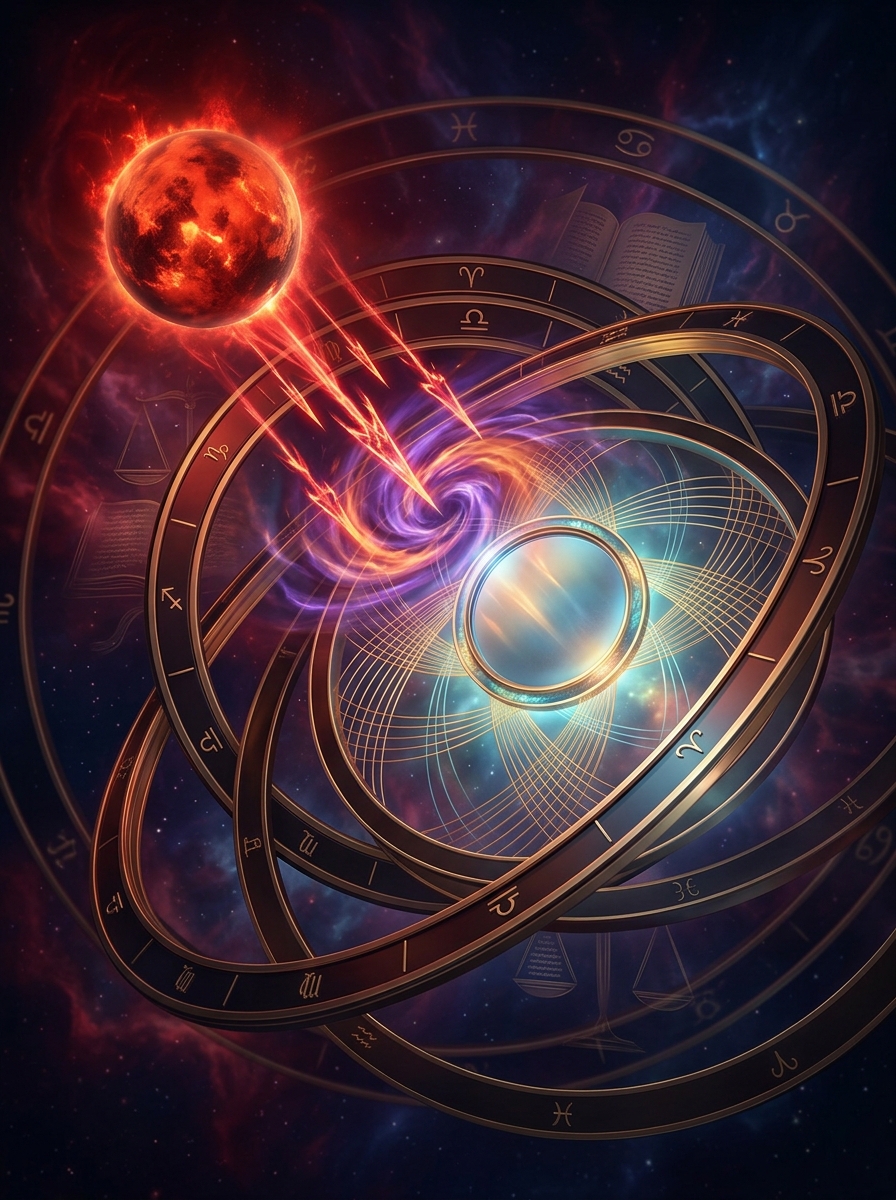
Mars in the Seventh House places the god of assertion where life demands response, negotiation, and the difficult art of meeting another person as an equal. The core pattern is simple but never easy: desire does not remain private. It enters the field of partnership, where it becomes visible as attraction, rivalry, impatience, sexual charge, and the urge to act decisively in relation. This is not passive love. It is love with a blade in it.
The Core Dynamic: The Warrior at the Mirror
The Seventh House governs committed one-to-one relationships: marriage, business alliances, legal contracts, and the social mirror that reveals who we become in contact. When Mars lands here, the native discovers that relationship is not a refuge from conflict but the very stage where conflict becomes conscious. The psyche seeks an other who can match force, reflect heat, and withstand directness. Attraction feels immediate because Mars recognizes vitality fast; it knows who has backbone, who can spar, who will not dissolve under pressure.
This placement is often misunderstood as “bad for relationships,” when in fact it is better described as uncompromising. The deeper question is not whether conflict appears, but what kind of person conflict reveals. Mars here can draw in partners who are active, combative, athletic, entrepreneurial, or simply hard to ignore. Sometimes the native is magnetized to people who possess the very aggression they have not yet owned. Sometimes the native becomes the one who provokes, initiates, challenges, or pursues the relationship with unnerving intensity. Either way, partnership is animated, not tranquil. For a foundational understanding of this house, see The Seventh House itself.
Psychological Roots: The Unfinished Work of Mars
Why does the psyche repeatedly attract partners who ignite the martial charge? Because the Seventh House is an axis of projection. Mars here often represents a quality the native has not fully integrated. A person who grew up suppressing anger may marry someone who expresses it freely; a person who never learned to assert their own desires may find themselves pursued by someone who knows exactly what they want. The relationship becomes a living laboratory for the disowned Mars within.
This is not mere coincidence; it is the psyche’s attempt to complete itself through the other. The shadow of relational aggression shows up in two directions. Some people meet their own intensity only through partners, calling the other “too much” while unconsciously supplying the charge. Others identify with Mars so strongly that they expect relationships to survive on stamina alone. Neither stance works for long. The work is to let Mars become conscious as clean assertion rather than compulsive reaction. When the natal Mars is retrograde, this internal process is even more pronounced—the person’s own fire often turns inward first, making the external partner even more necessary as a mirror. For that complex signature, see Mars Retrograde.
Shadow and Maturity: The Two Faces of Relational Fire
The first shadow of Mars in the Seventh House is strategic combat disguised as romance. The native may test a partner by disagreeing, withhold vulnerability until the other proves strength, or keep score in arguments long after the immediate issue is over. In some charts, the relationship becomes the stage where old battles with a parent, ex, or rival are replayed with new faces. The person seems to be fighting about dishes, money, time, or tone; underneath, they are fighting for sovereignty, dignity, and the right not to be absorbed. This pattern often echoes deeper wounds around trust and recognition—a dynamic that can be explored through Chiron in the Seventh House, where the healing of relational wounds begins.
The mature expression of Mars here is something else entirely: the courage to stay distinct while in close contact. This placement can teach a person how to want without devouring, disagree without demeaning, and choose a partner without surrendering the self. In the healthiest bonds, the couple learns to argue without annihilating each other, to want without dominating, to choose one another again after friction has burned through illusion. The relationship becomes a training ground for directness, not a duel of wills. This capacity for clean assertion is what makes Mars in the Seventh House one of the strongest signatures for collaborative leadership and legal advocacy—where decisive motion and clear contracts matter as much as emotional resonance. For a contrasting archetype that deepens the theme of power in partnership, see Pluto in the Seventh House.
Living Expression: Love, Work, and Contract
In romantic life, Mars in the Seventh House tends to produce partnerships that begin with friction because friction itself is charged. The erotic spark is inseparable from resistance. The native needs a partner who can say no without collapse and yes without pretense. Weak boundaries invite contempt; strong boundaries invite respect. This dynamic often responds powerfully in synastry—when someone else’s Mars lands on the native’s personal planets, the attraction is immediate and unmistakable. For a detailed look at how desire and affection interact across two charts, see Venus and Mars Synastry.
In the professional and legal arena, Mars here gives a natural aptitude for negotiation, contract law, and any field where active opposition must be met with strategic force. The native does not flinch from hard conversations; they often excel at mediation or advocacy because they can hold their ground without personalizing the conflict. Business partnerships under this placement thrive on explicit agreements, shared goals, and a clear division of labor. When the chart also activates the public sphere, the drive for action through partnership can become a career signature—see Mars in the Tenth House.
The sign on Mars refines the style of relational pursuit. Cardinal signs (Aries, Cancer, Libra, Capricorn) bring immediate initiation: the native moves toward partners boldly and may need to manage a tendency to rush. Fixed signs (Taurus, Leo, Scorpio, Aquarius) bring stubborn stamina—once committed, change is resisted, and desire deepens slowly. Mutable signs (Gemini, Virgo, Sagittarius, Pisces) make the struggle verbal and adaptive; arguments become a form of intellectual intimacy. For a focused look at how this plays out in a specific sign, consider Mars in Scorpio, which intensifies the themes of loyalty, jealousy, and transformative desire.
The Mature Gift: Relating Without Self-Erasure
The highest expression of Mars in the Seventh House is not winning against the other. It is acquiring the courage to remain distinct while in close contact. This placement can produce an adult who knows that love requires action: showing up, telling the truth, initiating repair, defending the agreement, and refusing passivity when the relationship is starving. It can also produce the rare ability to meet opposition without panic.
If partnership has felt like combat, the lesson is not to abandon desire. It is to refine it. If the relationship has been too polite, Mars brings necessary heat. If you have been waiting to be chosen, this placement asks you to choose. If you have been choosing too aggressively, it asks you to listen for the difference between assertion and attack. The seventh-house mirror does not flatter. It reveals. And under the pressure of that revelation, Mars learns the most difficult skill of all: how to stay lit without burning the bridge.
Related
- Mars in the Eighth House: Desire at the Threshold
- Mars in the 7th House: The Warrior in the Mirror and the Alchemy of Relationship
- Mars in the Fifth House: The Incandescent Will of Play, Romance, and Creative Risk
- Mars in the Twelfth House: The Warrior Behind the Veil
- Mars in the Sixth House: The Warrior at Work
Comments
Loading comments…