Mars in the First House: The Face of Will
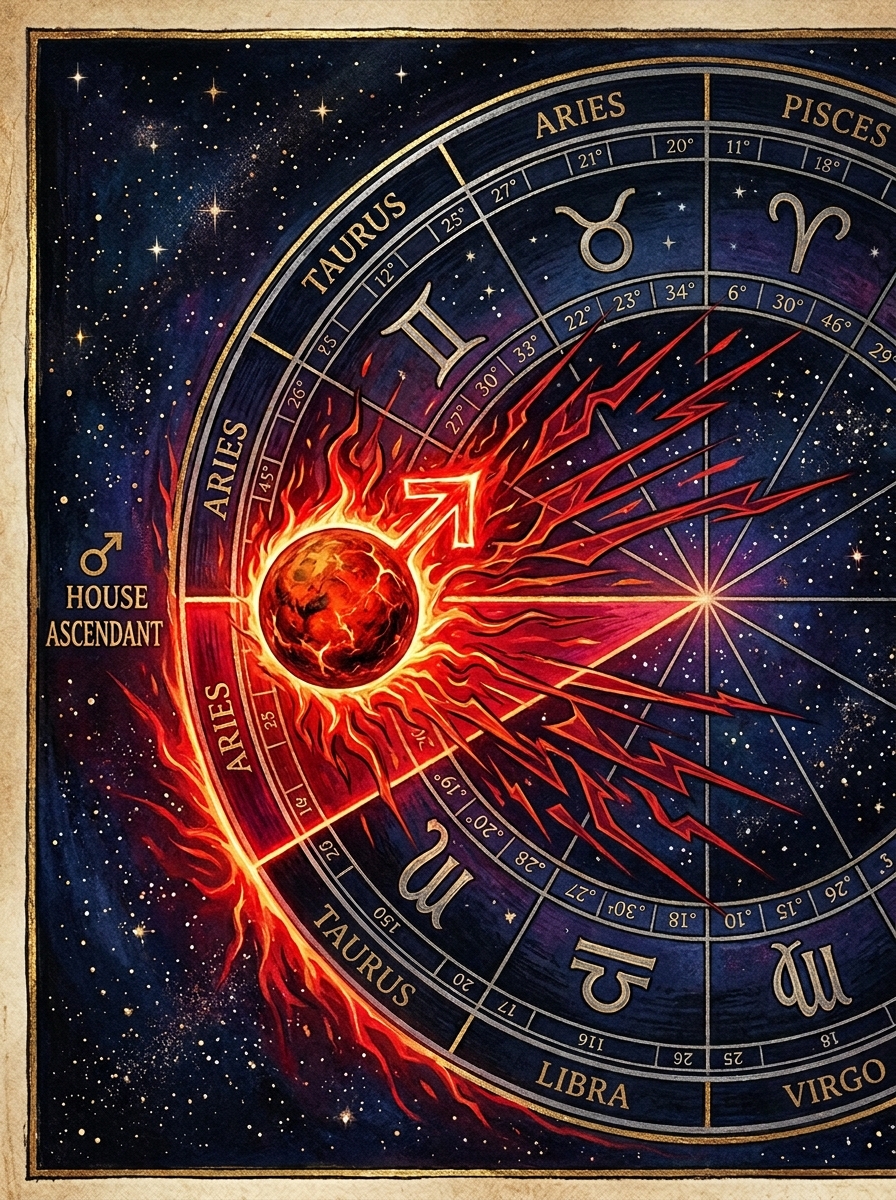
Will made visible
Mars in the First House is not a placement of quiet potential. It is the chart signature of a person whose desire steps into the room before their name does. The self announces itself through speed, heat, and a readiness to move. Others sense momentum the way they sense a draft from an open door — something has shifted, something is about to happen. This is Mars at the level of persona: identity forged in the act of beginning.
The First House is the lens of immediate embodiment — how the world meets you and how you reflexively meet it. With Mars stationed there, that lens becomes a blade. The person’s presence can feel catalytic, even challenging, not because they intend aggression but because their will refuses to wait backstage. A crisp handshake, a direct gaze, a slight forward lean — the body has already spoken. This is less a mask than a spark striking flint. The native does not become assertive; they are the assertion before they have time to choose it.
This is why Mars in the First House is often misunderstood as mere aggression. What it actually produces is instinctive assertion — a posture of readiness that others may read as combativeness even when the native feels neutral. Silence itself can feel tactical. The person cannot stay neutral for long; their system is primed for ignition. For a deeper understanding of how the house context shapes planetary expression, see The First House in Astrology.
How the warrior learns to stand
The root of this placement is rarely abstract. Many with Mars in the First House learned early that passivity felt unsafe, erased, or humiliating. Perhaps initiative earned them approval — a parent’s attention, a teacher’s praise — or perhaps hesitation got them hurt. Either way, the psyche fused self-worth with movement. To stop was to disappear. To wait was to lose.
This creates a lifelong pressure to stay ahead of hesitation. The body becomes the primary instrument of identity. A quick stride, an impatient gesture, a face that shows irritation or enthusiasm before the mind has translated it — these are not mannerisms; they are survival reflexes. The person may be athletic, but the deeper truth is somatic: the gap between impulse and action is nearly nonexistent. When anger rises, the jaw tightens. When desire stirs, the body leans forward before words arrive.
The cost of this fusion is a certain fragility beneath the bravado. Because identity depends on initiating, delay can feel like humiliation. Vulnerability registers as weakness. The person may become their own alarm system, flooding with adrenaline at the smallest frustration. This is where the placement touches the Moon in the First House — where emotional transparency meets martial reflex — or Saturn in the First House, which asks for structure to contain the fire without smothering it.
Shadow and maturation
The shadow of Mars in the First House is not simply anger. It is identification with anger as a survival style. Under stress, the person may preemptively escalate — sensing threat and striking before they have evidence. They may mistake tension for readiness, loudness for authority, dominance for self-respect. The warrior archetype has swallowed the softer parts of the self, leaving a narrowed, armored persona.
Anger itself serves a protective function. It keeps the native from feeling the faster, more vulnerable emotions underneath: fear, shame, longing. Many outbursts are intelligible when you hear what they protect. The work is not to extinguish the warrior but to educate it. A mature Mars in the First House learns to distinguish between battle and boundary. It discovers that not every resistance is an enemy, and that restraint can be a form of strength rather than surrender.
When integrated, this placement produces clean embodiment. The person knows how to say no without building a fortress. They can move toward what they want without apologizing for having direction. Their force becomes trustworthy because it is less reactive and more deliberate. This is a different kind of power than the one offered by Mars in the 7th House, which learns through mirrors and opponents; here the lesson is self-definition, not negotiation.
The sign, retrograde, and chart context
A first-house Mars is never generic. The sign choreographs the style of force; the house guarantees its visibility. In Mars in Aries, the placement is at its purest — raw ignition, fearless initiation. In Mars in Leo, it becomes performative: courage tied to self-display and creative sovereignty. In water signs — Cancer, Scorpio, Pisces — the will moves through emotion, often indirectly until provoked. The core dynamic remains, but the vocabulary shifts.
Mars retrograde in the First House internalizes the battle. The person may appear restrained, private, even passive, while the inner pressure is immense. Their assertiveness develops through revision — they may spend years learning to trust their own impulse without turning it into self-attack. For more on this, see Mars Retrograde.
The chart’s overall emphasis also matters. If Mars is strong in the 8th or 10th house, the first-house placement becomes part of a larger warrior pattern. If the chart contains hard aspects to Mars — squares from Saturn or Pluto — the theme of power and survival intensifies. The planetary archetype itself is covered in Mars in Astrology, but here the question is more primitive: who am I when I enter the world, and what happens to my desire the moment I am seen?
In a life: love, work, and daily expression
Because the core dynamic is visible desire, it colors every domain without needing separate explanations. In love, Mars in the First House means the person chases what they want with uncommon candor. They may be the initiator, the one who makes the first move, the one whose appetite is legible before the date begins. They can also struggle to receive — if all value is attached to pursuit, being pursued can feel disorienting. Patience and surrender are learned, not native.
At work, this placement thrives in roles that require quick decision, crisis response, or entrepreneurial initiative. The native is often intolerant of stagnation and may become restless in bureaucratic environments. They lead by example, not by conference. The risk is burnout from chronic overdrive; the gift is the ability to move when others freeze.
In daily life, the Mars-first person often has a clear, direct conflict style. They prefer clarity over diplomacy, and they will name a problem before others are ready to hear it. This can make them difficult, but also trustworthy: you always know where you stand. The same fire that causes friction also creates breakthroughs.
The highest expression is a person who carries fire without burning their own face — someone who can meet life head-on, act with courage, and still stay soft enough to feel. That is the integration of Mars in the First House: will that has learned to choose its battles, and a presence that others can trust because it has stopped confusing power with panic.
Related
- Mars in the Seventh House: The Warrior at the Threshold of Partnership
- Mars in the 1st House: The Archetypal Warrior and the Evolution of Self
- Mars in the Twelfth House: The Warrior Behind the Veil
- Mars in the Sixth House: The Warrior at Work
- Mars in the Fifth House: The Incandescent Will of Play, Romance, and Creative Risk
Comments
Loading comments…