Mars in Aquarius: The Promethean Fire and the Alchemy of Fixed Air
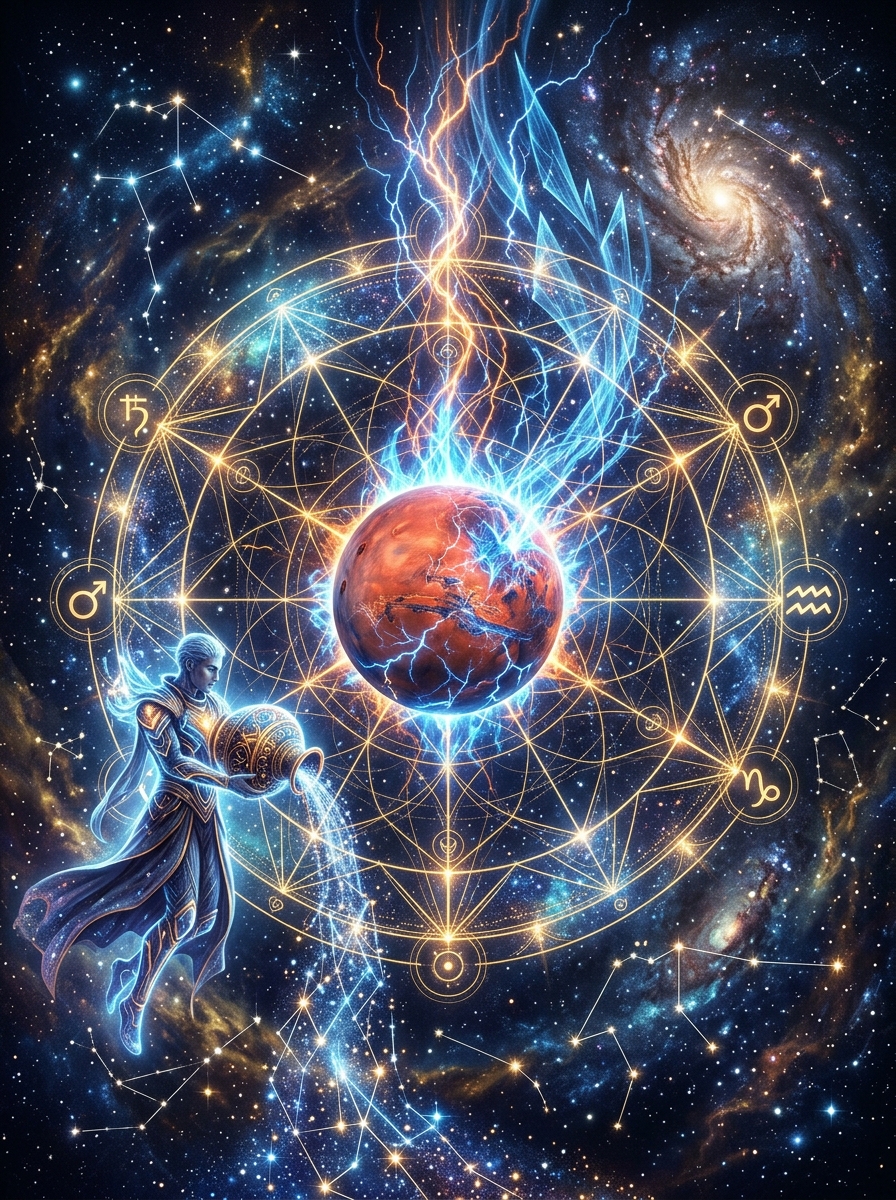
The Alchemy of Mars in Fixed Air: Saturn, Uranus, and the Promethean Archetype
The Promethean Fire and the Saturnian Vessel
In the grand architecture of natal astrology, the placement of Mars in Aquarius represents a highly complex, alchemical synthesis: the introduction of the red planet's raw, instinctual fire into the cold, structured, and intellectualized realm of fixed air. Mars is the planetary archetype of kinetic energy, assertion, survival drive, and individual willpower. It is the cosmic sword, the psychological function that cuts through obstacles, establishes personal boundaries, and declares "I am." When this hot, immediate, and subjective energy is forced to express itself through the sign of the Water Bearer, it undergoes a profound sublimation. The impulsive fire of Mars is cooled, pressurized, and redirected. It is no longer about immediate personal survival or simple ego gratification. Instead, the warrior's drive is harnessed to serve a larger, collective vision. The individual does not fight for the self; they fight for the system, the community, and the future.
This placement is archetypally represented by Prometheus, the mythological Titan who stole fire from the heavens to gift it to humanity, thereby initiating the dawn of technology, civilization, and collective progress. The Mars in Aquarius native possesses this Promethean drive. They are motivated by an intrinsic urge to challenge arbitrary authority, disrupt stagnant dogmas, and implement innovative solutions for the benefit of the group. However, as the myth warns, the theft of fire carries consequences. The raw power of Mars must be contained and structured, or it risks burning down the very systems it seeks to improve. In Jungian psychology, Carl Jung emphasized that the raw psychic energy of the libido requires a strong psychological vessel—a container—to prevent it from dissolving into chaotic inflation or destructive outbursts. For Mars in Aquarius, this containment is traditionally provided by Saturn, the classical ruler of Aquarius. Saturn imposes discipline, structure, realism, and a deep respect for natural laws, ensuring that the revolutionary fire is channeled into sustainable, real-world reform.
The Double Rulership: The Dialectic of Structure and Revolution
Aquarius is uniquely positioned in the zodiac as a sign ruled by two distinct, and often conflicting, planetary masters: traditional Saturn and modern Uranus. This double rulership creates an ongoing inner dialectic for the Mars in Aquarius individual, shaping how they initiate action, manage their drive, and assert their will in the world. Saturn, the lord of structure, boundaries, time, and karma, demands that action be strategic, organized, and realistic. It forces the native to understand the rules of the existing system, to respect the slow passage of time, and to build their initiatives on solid, logical foundations. Under Saturn's influence, Mars does not rush recklessly into battle; it plans, coordinates, and designs structures that can withstand the test of time.
Conversely, Uranus, the modern co-ruler of Aquarius, is the archetype of sudden insight, rebellion, revolution, and the collapse of outdated paradigms. It infuses Mars with an electric, unpredictable, and highly innovative energy. When Uranus is activated in the psyche, the Mars in Aquarius native acts with sudden, lightning-fast clarity. They introduce radical concepts, shock the establishment, and refuse to conform to societal expectations. This tension between Saturnian discipline and Uranian revolution is the defining feature of their drive. They are systemic rebels. They do not seek to destroy structure entirely, as a more chaotic placement might; rather, they use their Saturnian understanding of systems to dismantle them from within, replacing them with more progressive, Uranian alternatives. This makes them highly effective strategists who can bring about long-lasting social change, navigating the boundary between the rules of today and the visions of tomorrow.
Furthermore, the fixed nature of Aquarius introduces an element of stubbornness and durability to this martial expression. Unlike cardinal signs, which initiate and then redirect their focus, fixed air persists. Once Mars in Aquarius determines a course of action that aligns with their intellectual principles, they stick to it with absolute determination. This can make them incredibly resilient in the face of prolonged resistance, but it also carries the risk of ideological entrenchment, where the native refuses to adapt their methods even when the real-world evidence suggests they should. Liz Greene, in her deep psychological analysis of the outer planets, suggests that this co-rulership requires a conscious integration of the ego's drive with the collective unconscious, transforming personal ambition into a dedicated service to the evolution of the species.
In practice, the individual with this placement must cultivate a high degree of self-awareness to recognize when they are acting out of genuine Uranian inspiration versus when they are merely repeating Saturnian patterns of resistance. They must balance the urge to break rules with the understanding that rules often provide the necessary stability for human society to function. By integrating these co-rulers, they can execute their actions with both precision and flexibility, achieving a balance of form and freedom.
Intellectualized Action and the Drive for a Cause
Action as a Principle
A key psychological characteristic of Mars in Aquarius is the sublimation of personal ego into collective ideals. While a native with Mars in Aries or Leo asserts their will with a direct, subjective "I want," the individual with Mars in Aquarius operates from a conceptual framework. Their actions must be aligned with a set of principles, a logical theory, or a humanitarian cause. If they cannot find a rational or ethical justification for an action, they experience a profound paralysis of will. The raw, animalistic impulse to act is filtered through the higher mind, turning physical drive into an intellectual project.
This intellectualization of action makes them powerful advocates for social change, community projects, and technological innovation. They are energized by the prospect of creating a fairer, more efficient, and more progressive world. Their motivation is fueled by the group, the network, and the collective vision. When working toward a shared goal, they display remarkable endurance, objectivity, and dedication. They are the community organizers who can coordinate complex logistics without getting bogged down in personal drama, the activists who maintain focus on the long-term objective despite temporary setbacks, and the innovators who push the boundaries of what is possible because they believe in the future.
However, this detachment from personal ego can also manifest as a significant psychological shadow. Liz Greene has noted that individuals with strong Aquarian placements can become so focused on their grand, idealized visions for humanity that they lose touch with the simple, messy, and emotional realities of individual human beings. They may fight passionately for global justice while ignoring the emotional needs of their partners, or work tirelessly for a community cause while remaining cold and distant toward those in their immediate circle. The martial drive, when entirely intellectualized, can become dry and dogmatic. The challenge for Mars in Aquarius is to realize that the collective is composed of individual souls, and that true reform must include personal empathy and warmth.
Navigating Institutional Resistance
When acting within traditional corporate or bureaucratic frameworks, Mars in Aquarius often encounters friction. Traditional organizations are built on hierarchical authority, whereas Mars in Aquarius inherently values flat structures, meritocracy, and open-source collaboration. When they perceive that a rule exists solely to preserve the status of a leader rather than to serve the collective objective, they will bypass it or challenge it directly.
This challenge is not typically delivered as a loud confrontation, but rather as a systemic circumventing. They will build alternative channels of communication, form coalitions among their peers, or design automated workarounds that render the outdated rule obsolete. They assert their independence not by screaming for it, but by quietly implementing more efficient, modern systems that force the hierarchy to adapt or become irrelevant. In this way, they function as quiet subversives, using the power of innovation to democratize their environments.
Moreover, in leadership roles, they act as facilitators rather than dictators. They seek to empower their team members, encouraging independent thinking and collaborative decision-making. They believe that the best solutions emerge from a diversity of perspectives rather than a single commanding voice. This approach can make them highly respected leaders, but it can also lead to frustration among team members who prefer clear, top-down direction. Mars in Aquarius must learn to provide structure when necessary, balancing their preference for democratic consensus with the practical need for decisive leadership.
The Alchemical Coldness of Anger and Conflict
The Detached Mind in Confrontation
The manifestation of anger in Mars in Aquarius is marked by an alchemical cooling process. When confronted with conflict, direct hostility, or personal attacks, their immediate reaction is not to explode, cry, or strike back. Instead, they emotionally detach, retreating into the high-altitude atmosphere of the intellect. They view anger as a primitive, illogical emotion that clouds judgment and disrupts systemic efficiency. Consequently, they analyze the conflict with clinical objectivity, treating the confrontation as a psychological puzzle or a logical fallacy to be dissected.
In an argument, a Mars in Aquarius native will often remain frustratingly calm, speaking in measured, logical tones and using precise, intellectual arguments to point out the inconsistency of their opponent's position. To the other person, this response can feel incredibly provocative, resembling an icy wall of superiority or absolute indifference. The native is not necessarily empty of feeling, but their Saturnian defense mechanism immediately goes to work to contain the hot, martial energy, transforming it into intellectual distance. They believe that by refusing to engage on an emotional level, they maintain control of the situation. They prefer to debate rather than fight, attempting to resolve disputes through rational dialogue and structural adjustments.
Yet, this Saturnian containment has its limits. The anger does not disappear; it is simply stored within the unconscious, building pressure like an electric charge in a capacitor. If the conflict remains unresolved, and the other party continues to violate boundaries or act with perceived irrationality, the Uranian co-rulership will eventually trigger a sudden, radical rupture. Without warning, the Mars in Aquarius native will reach their absolute limit and cut the cord. This is the classic Aquarian door slam. The break is final, absolute, and accompanied by a chilling emotional coldness. There is no drama, no shouting, and no possibility of negotiation—just a clean, permanent separation. To prevent these sudden, destructive ruptures, the native must learn to access and express their anger in its earlier, warmer stages, recognizing that emotional confrontation, though messy, is a vital component of human relationship.
The Anatomy of the Silent Treatment
Before the final Uranian rupture occurs, Mars in Aquarius often employs a Saturnian cooling mechanism known as the intellectual silent treatment. When hurt or angry, they do not scream; instead, they withdraw their attention, treating the offender as if they have ceased to exist in their conceptual universe. They construct an invisible, impenetrable barrier of polite formality, refusing to engage in any communication that is not strictly necessary or logical.
This response is not merely passive-aggression; it is a defensive boundary. By removing the emotional oxygen from the relationship, they attempt to force the other person to operate on their detached, logical terms. They dissect the dynamic from a distance, deciding whether the relationship is worth the energy required to maintain it. However, this silent dissection can be highly damaging to relationships, as it denies the partner the opportunity to connect, repair, and express their own feelings. The Mars in Aquarius native must realize that true boundary-setting involves direct, verbal communication, rather than silent emotional exile.
Furthermore, this suppression of direct anger often leads to the projection of the martial shadow onto the external world. Jungian theory notes that whatever we refuse to acknowledge in ourselves is projected onto others. For Mars in Aquarius, their denied anger and assertiveness are often projected onto their partners, friends, or colleagues. They may repeatedly find themselves attracting highly angry, irrational, or aggressive individuals, wondering why they are surrounded by such conflict. In reality, these individuals are acting out the repressed martial energy that the native is too detached to express. To break this cycle, the Mars in Aquarius individual must retrieve their shadow, acknowledging their own capacity for anger and learning to express it in a healthy, direct manner.
Cerebral Sexuality and Free Partnerships
The Primacy of the Mind in Desire
In the realms of intimacy, romance, and sexual expression, Mars in Aquarius operates with a highly cerebral signature. For this placement, the mind is the primary erogenous zone. Physical attraction is rarely sufficient to spark deep desire; there must be a compelling intellectual connection, a meeting of minds, and a shared appreciation for the unconventional. They are attracted to individuals who are unique, independent, intellectually stimulating, and who dare to stand outside the norm. Witty banter, philosophical debates, and the exchange of radical ideas are the essential precursors to physical intimacy.
Because they approach desire through the intellect, Mars in Aquarius individuals are naturally drawn to alternative relationship structures and experimental dynamics. They reject traditional societal expectations surrounding romance, marriage, and ownership of the partner. They value ethical freedom, mutual independence, and intellectual honesty above all else. Whether exploring open relationships, polyamory, long-distance arrangements, or simply maintaining highly independent social circles and hobbies separate from their partner, they require breathing room. They believe that love and desire can only thrive in an atmosphere of complete freedom, where both partners choose to be together daily without the pressure of conventional obligation.
In their physical expression, they are open-minded, curious, and experimental. They view the bedroom as a laboratory for exploration, free from traditional taboos and cultural conditioning. However, their highly cerebral approach can also create a barrier to deep, instinctual intimacy. Because they are constantly observing, analyzing, and conceptualizing their experiences, they may struggle to let go of control and surrender to the raw, animalistic, and non-logical flow of physical passion. They can become spectators in their own intimate lives, watching the experience rather than fully inhabiting their bodies. Steven Forrest suggests that for Mars in Aquarius, the path to sexual fulfillment involves learning to quiet the analytical mind, descending from the head into the sensory reality of the body, and accepting the vulnerability of raw, unpolished feeling.
The Dialectics of Platonic Attraction
A fascinating feature of Mars in Aquarius is the thin line they walk between friendship and romantic desire. In their psychological framework, friendship is the highest form of relationship. They often choose partners from their existing social networks or community circles, prioritizing companionship, shared ideals, and intellectual alignment over raw physical chemistry. For them, a lover who is not also their best friend is a contradiction in terms.
This focus on platonic values can sometimes lead to confusion in their romantic endeavors. They may struggle to transition from the safety of friendly camaraderie to the intensity of romantic pursuit, or they may find themselves attracting partners who feel that the connection lacks passion or emotional depth. They must learn that acknowledging and expressing direct, romantic desire does not destroy the equality of a friendship, but can elevate it into a richer, more integrated union.
Additionally, under the influence of Uranus, their erotic fantasies are often highly experimental and tech-forward. They may be drawn to virtual intimacy, online roleplay, or the use of advanced technology and toys in their sexual practices. They view sexuality as a realm of discovery, constantly seeking to push the boundaries of conventional intimacy. This curiosity makes them highly open-minded lovers, but they must ensure that their pursuit of novelty does not become a way to avoid the simple, quiet intimacy of presence and touch. They must balance their Uranian curiosity with a Saturnian grounding in the physical reality of their partner's body.
Alternative Physicality and Collective Movement
Rejection of Conventional Competition
The physical energy of Mars in Aquarius does not flow easily into traditional, highly competitive sports that emphasize brute force, individual dominance, or rigid, repetitive training. They are unlikely to find joy in the aggressive contact of football, the solitary grind of bodybuilding, or the corporate conformity of golf. Instead, their physical drive is activated by activities that involve a collective element, expressive movement, or unconventional, alternative disciplines.
They are drawn to group fitness dynamics, community-based martial arts, yoga collectives, and outdoor adventure sports that foster a sense of shared adventure rather than cutthroat competition. Activities such as rock climbing, ultimate frisbee, skateboarding, snowboarding, or experimental dance allow them to express their physical energy in a way that feels unique and liberating. They appreciate disciplines that require high mental focus, coordination, and the integration of mind and body. Aikido, for example, is a martial art that perfectly mirrors the Aquarian archetype: it is non-aggressive, focusing on redirecting an attacker's force to restore harmony rather than using violence to crush them.
In team sports, the Mars in Aquarius native is the ultimate strategist and playmaker. They are not interested in individual glory or hogging the spotlight. Instead, they derive satisfaction from the seamless coordination of the group, finding the optimal pathways for collective success. They play with their minds as much as their bodies, constantly analyzing the spatial dynamics and tactical patterns of the game. For them, physical movement is a way to discharge the high-voltage mental energy that accumulates in their daily lives, serving as a dynamic, somatic release that restores equilibrium to their overactive nervous systems.
The Kinesthetic Mind and Flow States
To truly thrive physically, Mars in Aquarius must engage their intellect during physical exercise. They are often drawn to somatic practices that require intense mental presence and coordinate complex motor patterns. Disciplines such as Feldenkrais, Pilates, or Capoeira appeal to their need for physical movement that has an underlying logical structure and a history of community integration.
When they enter a physical flow state, it is characterized by a feeling of mental expansion rather than physical exhaustion. They do not seek to push their bodies to the point of collapse through sheer willpower; instead, they seek to harmonize the body's movements with the mind's intentions. By viewing their physical vehicle as an intelligent, interconnected system rather than a machine to be driven, they achieve a state of relaxed alertness that supports their mental endeavors and overall well-being.
Moreover, they often incorporate technology and data tracking into their physical routines. They are the individuals who analyze their sleep cycles, track their heart rate variability, and use apps to design optimal workout schedules. They view their bodies as systems to be understood and optimized through logical, science-based methods. This data-driven approach appeals to their Saturnian co-ruler, which values structural efficiency and empirical evidence. However, they must be careful not to rely so heavily on metrics that they lose the ability to intuitively feel what their body needs, balancing data with somatic awareness.
Shadow Integration: From Dogmatism to Personal Connection
The Pitfalls of Ideological Rigidity
The primary evolutionary and psychological task for the individual with Mars in Aquarius is the integration of their shadow traits, which center around emotional detachment, intellectual pride, and ideological rigidity. Because they act from a foundation of high principles and logical systems, they are highly susceptible to a subtle form of self-righteousness. They can easily fall into the trap of believing that their particular vision for the future, or their logical analysis of a situation, is the absolute truth. When others disagree, or act from a place of emotional subjectivity, the Mars in Aquarius native can react with dismissive arrogance, intellectual bullying, or cold exclusion.
This dogmatism is a defense mechanism against the vulnerability of the personal ego and the unpredictable nature of human emotion. It is easier to fight for a grand, abstract ideology than to navigate the messy, sensitive, and often illogical dynamics of a personal relationship. In the Jungian framework, the opposite sign of Aquarius is Leo, which represents the heart, personal warmth, individual creativity, and the courage to be subjective. To integrate their shadow, Mars in Aquarius must embrace this Leo polarity. They must learn to descend from the cold tower of collective theory and engage with the warmth of personal connection.
Integrating the shadow means acknowledging that logic has its limits and that subjective, emotional experiences are valid and real. It means learning to express personal warmth, vulnerability, and affection directly, without filtering these feelings through an intellectual grid. When Mars in Aquarius individuals can balance their Promethean drive for collective reform with a genuine, heart-centered appreciation for the individuals in their lives, they become truly integrated. They transform from detached, dogmatic ideologues into compassionate, inspiring, and highly effective leaders who can change the world not by cold design, but by warming the hearts of those around them.
Integrating the Solar Leo Spark: Active Pride and Heart-Centered Will
To fully integrate their opposite polarity, Mars in Aquarius must learn to value the power of personal, creative self-expression. In Leo, Mars is proud, dramatic, and expressive, seeking to shine individually and command attention. For Mars in Aquarius, this can feel uncomfortable, as they prefer to hide within the anonymity of the group or the objectivity of a cause. However, without the Leo spark, their efforts can feel sterile, lacking the personal heat needed to inspire others.
Integrating the Leo spark means allowing themselves to be seen as individuals, to take personal credit for their innovations, and to express their desires with passion and pride. It means recognizing that their individual voice matters, and that they cannot create a better future by erasing their own subjective needs. When they combine the objective, progressive vision of Aquarius with the warm, expressive courage of Leo, they become charismatic leaders who can move others to action, transforming theoretical ideals into living, breathing realities.
In the Rider-Waite-Smith tarot, the Justice card represents the mental clarity and boundary-setting associated with Libra and the air element, but the Strength card is associated with Leo, representing the quiet, heart-centered fortitude required to tame the wild beast of the ego. For Mars in Aquarius, integration requires both cards: the intellectual sword of Justice and the warm, compassionate embrace of Strength. When they can stand in both archetypes, they no longer need to project their martial energy or withdraw into cold detachment, but can act as complete, integrated individuals.
Frequently Asked Questions
How does Mars in Aquarius handle sudden breakups or relationship ruptures?
When a relationship ends, Mars in Aquarius individuals often exhibit a shocking degree of detachment and finality. Influenced by their modern co-ruler Uranus, they are prone to the "Aquarian door slam," where they suddenly and completely cut all emotional and physical ties with an associate or partner. This rupture usually occurs after a long period of internal Saturnian cooling, during which they have intellectually analyzed the relationship's viability and decided it no longer aligns with their path. Once the decision is made, they can detach instantly, viewing the separation as a logical necessity. To the partner, this can feel incredibly cold and sudden, as the Mars in Aquarius native rarely displays the typical emotional grief or anger associated with endings, choosing instead to move forward into the future without looking back.
What is the primary difference between Mars in Aquarius and Mars in Aries?
The primary difference lies in the source and direction of their drive. Mars in Aries is a cardinal fire placement, representing direct, instinctual, and self-focused action. It is motivated by immediate desires, competitive instincts, and the urge to conquer. Mars in Aries acts first and thinks later, expressing anger immediately and directly. In contrast, Mars in Aquarius is a fixed air placement, where drive is intellectualized and directed toward collective, systemic goals. They act based on principles and theories rather than instinct, prioritizing the group's needs over personal ego. Furthermore, their anger is cooled and analyzed, rarely showing the hot-blooded passion or immediate confrontation characteristic of Mars in Aries.
Why does Mars in Aquarius struggle with emotional vulnerability in intimacy?
Mars in Aquarius struggles with vulnerability because emotion is inherently non-logical, unpredictable, and difficult to systematize. They feel safest in the realm of the intellect, where concepts can be analyzed and organized. Emotional vulnerability requires a surrender of this mental control and an acceptance of messiness, weakness, and dependency—qualities that trigger their Saturnian fear of loss of control and their Uranian urge for absolute independence. To protect themselves, they may intellectualize their feelings, talk about intimacy rather than experiencing it, or maintain a safe emotional distance from their partners. Overcoming this requires a conscious effort to drop into the body and value emotional connection as much as intellectual alignment.
How can individuals with this placement constructively channel their anger?
To channel their anger constructively, Mars in Aquarius individuals must first acknowledge that anger is a valid physical and emotional response, not a logical error. Instead of immediately intellectualizing or suppressing the feeling, they need to allow themselves to feel the physical charge in their bodies. They can benefit from practices that bridge the mind-body gap, such as conscious breathing, somatic therapy, or expressive movement. When communicating anger, they should practice using "I feel" statements rather than presenting a clinical indictment of the other person's flaws. By expressing their dissatisfaction earlier and more directly, they can prevent the accumulation of resentment that leads to sudden, destructive Uranian ruptures.
What are the best career paths for those with Mars in Aquarius?
Mars in Aquarius individuals thrive in careers that allow them to combine their analytical minds with a drive for progress, innovation, and social benefit. They excel in technology, software engineering, science, and research, where they can design new systems and solve complex problems. They are also highly suited for roles in community organizing, social activism, non-profit leadership, and humanitarian work, where their energy is fueled by a collective cause. Additionally, fields that value independent strategy, mediation, and unconventional thinking—such as strategic consulting, alternative education, and progressive design—provide excellent outlets for their unique martial drive.
How do Saturn and Uranus uniquely shape the native's daily routines?
The co-rulers Saturn and Uranus create a daily rhythm that oscillates between extreme structure and sudden, creative deviation. Under Saturn's influence, the native values routines, systems, and structured planning, often tracking their habits with mathematical precision. However, Uranus introduces a constant craving for novelty and cognitive stimulation, prompting sudden departures from their plans to pursue a new insight or experimental approach. To navigate this, the native must learn to build flexible structures—Saturnian containers that allow room for Uranian innovation and unexpected inspiration, balancing stability with freedom.
Comments
Loading comments…