Justice and The Hanged Man Tarot Combination: Balancing Truth and Sacred Surrender
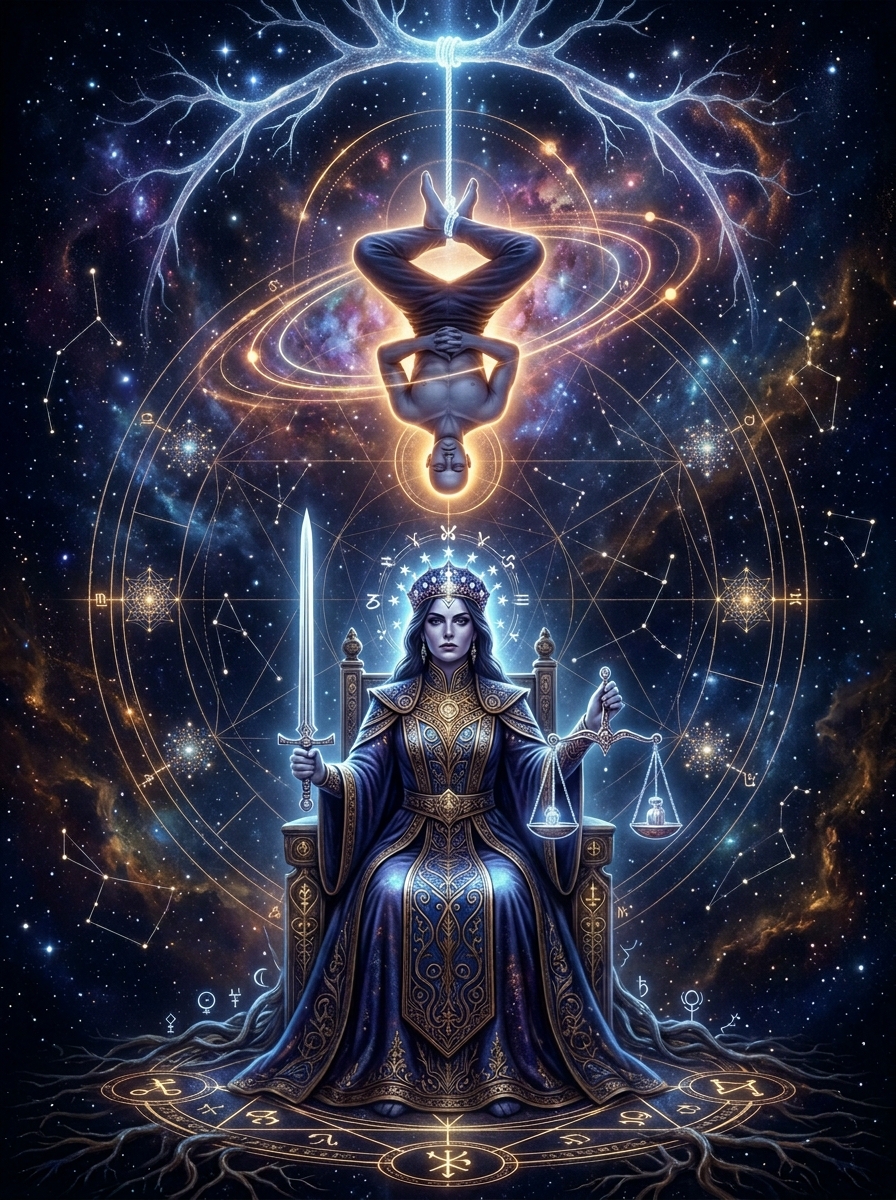
The Archetypal Dynamics of Justice and the Hanged Man
When the card of Justice and the Hanged Man appear side-by-side in a Tarot layout, they initiate a profound dialogue between two seemingly incompatible modes of being: the active, objective pursuit of truth, and the passive, internal path of mystical surrender. Archetypally, this pairing represents a crucial evolutionary juncture in the journey of human consciousness. Justice, traditionally aligned with the astrological sign of Libra, represents the solar, masculine principle of discernment, structure, law, and objective truth. It is the ego’s attempt to bring order to the chaos of experience, to weigh actions against a universal standard of fairness, and to execute decisions with clean, analytical precision. The Hanged Man, by contrast, is associated with Neptune and the fluid element of Water, representing the lunar, feminine path of ego dissolution, voluntary sacrifice, and the suspension of linear time.
In the language of Jungian psychology, this combination maps directly onto the dramatic encounter between the Ego and the Self. The Ego, operating through the archetype of Justice, desires to analyze, categorize, judge, and act. It seeks to resolve situations by applying logic, establishing boundaries, and making conscious choices. However, when the Hanged Man enters the space, the Ego’s forward momentum is brought to a sudden, absolute halt. The Hanged Man demands that we yield our personal will to a larger, collective or divine process. This is not a state of passive defeat, but rather a vital expression of enantiodromia—the psychological phenomenon wherein an excess of one force inevitably triggers its opposite to restore balance. Here, the highly active, logical, and external focus of Justice must invert itself, turning inward to discover a deeper level of truth that cannot be parsed by rational mechanisms alone.
This archetypal collision often manifests when a seeker has exhausted all analytical possibilities. You may have collected all relevant facts, constructed logical arguments, and weighed every option with absolute impartiality, yet the path forward remains entirely blocked. The Hanged Man arrives to explain that the problem cannot be resolved on the same level of consciousness that created it. By suspending our active efforts and hanging upside down, we are forced to let go of our standard reference points, allowing a new, spiritual perspective to emerge. The combination therefore challenges us to integrate the Venusian search for harmony and relationship (Libra) with the Neptunian desire for transcendence and unity (The Hanged Man), bridging the gap between earthly ethics and cosmic law.
From an esoteric and numerological perspective, Justice (traditionally numbered VIII or XI) and the Hanged Man (XII) represent a significant step in the Major Arcana's initiatory sequence. As we transition from the societal laws, karmic adjustments, and intellectual balances of Justice into the deep, initiatory waters of the Hanged Man, we are asked to move from outward morality to inward transformation. Justice demands that we pay our debts and balance our scales; the Hanged Man shows us that sometimes the ultimate payment is the release of our own rigid expectations. Together, they illustrate that true justice is not a static human construct, but a dynamic, cosmic flow that occasionally requires us to sacrifice our immediate desires for the long-term evolution of our souls.
The Sword and the Scale: The Symbolic Territory of Justice
To fully comprehend how these two cards interact, we must first map the symbolic territory of Justice. In the classic Rider-Waite-Smith depiction, Justice is shown as an authoritative figure seated between two stone pillars, which represent the dualities of the manifest world—mercy and severity, light and shadow. She wears a red robe with a green mantle, symbolizing the active passion of the heart balanced by the cool neutrality of nature. In her right hand, she holds a double-edged sword upright, signifying that clear judgment is an active, ongoing effort that requires strength and vigilance. In her left hand, she holds a balance scale, representing the objective evaluation of evidence, the weighing of karma, and the search for equilibrium.
The sword of Justice is the ultimate symbol of mental discernment and intellectual clarity. Because it is double-edged, it cuts through illusions and falsehoods while simultaneously holding the judge accountable to the same standards. It belongs to the element of Air, representing the realm of thought, communication, and social contracts. This sword does not strike out of anger or emotional reaction; it cuts with dispassionate precision, separating what is true from what is convenient, and what is essential from what is superfluous. It demands that we look at our lives without sentimentality, stripping away our personal biases to see the raw reality of our choices.
The Psychology of Objective Discernment
From a psychological perspective, as detailed by Liz Greene in her archetypal studies of the Tarot, Justice represents the ego's ability to create boundaries, make conscious choices, and accept responsibility for their consequences. To make a judgment is to define what is "me" and what is "not me," establishing an ethical framework that guides our interactions with the world. Without this capacity for objective discernment, we risk being swept away by our emotional projections, blaming others for our difficulties rather than recognizing our own role in the creation of our circumstances.
In evolutionary astrology, as taught by Steven Forrest, the sign of Libra represents the soul's desire to achieve harmony through relationship. However, Forrest emphasizes that true harmony cannot exist without absolute honesty and balance. The scales must remain level. If we tip the scales by hiding our truths, compromising our integrity, or avoiding conflict to keep a false peace, we violate the law of Justice. The psychological work of this card is therefore one of rigorous self-audit. It asks us to look closely at our lives and identify where we are out of balance, where we are avoiding necessary decisions, and where we have allowed our fear of conflict to distort our clarity. It is the challenging process of cutting through our own defense mechanisms to stand naked before our own conscience.
Moreover, this psychological discernment requires a level of emotional detachment that can be difficult to achieve. We are naturally inclined to defend our own actions and interpret events in a way that favors our ego. To truly align with Justice, we must be willing to step outside of our personal narrative and view our lives from a detached, objective perspective. We must look at our relationships, our career choices, and our personal behavior with the same cool, critical eye that we would use to evaluate a stranger. This level of self-honesty is painful, but it is the only way to develop the psychological maturity required to make choices that lead to genuine, long-term balance.
The Sacred Suspension: The Inverted World of the Hanged Man
If Justice is the card of upright alignment and logical structure, the Hanged Man represents a radical departure from the ordinary world. The figure is suspended upside down from a living wooden cross, which represents the tree of life and the organic nature of spiritual growth. His right leg is crossed behind his left, forming a numeral four or a cross, while his arms are folded behind his back, forming a triangle. This geometry represents the spirit (triangle) submerged in or suspended by matter (cross). Yet, despite his physical confinement, his face is serene, showing no signs of suffering or struggle. A brilliant golden nimbus of light glows around his head, indicating that this state of suspension is the source of spiritual awakening and enlightenment.
The Hanged Man is the archetype of the mystical initiate. He evokes the myth of the Norse god Odin, who voluntarily hung from the world tree Yggdrasil for nine days and nights, sacrificing his eye to gain the wisdom of the runes. He represents the mythological descent into the underworld, the necessary incubation period before rebirth, and the willingness to let go of physical control to gain spiritual mastery. The Hanged Man does not fight his confinement; he understands that struggle in this state is counterproductive. Instead, he surrenders to the pause, letting the blood rush to his head and allowing his perception of reality to turn completely upside down.
Wu Wei and the Art of Non-Doing
Psychologically, the Hanged Man represents the transition from the active, goal-driven mindset of the ego to the receptive, contemplative state of the Self. This transition is closely linked to the Daoist philosophy of wu wei, which is often translated as "non-doing" or "effortless action." Wu wei is not lazy complacency or passive avoidance; rather, it is the conscious decision to stop fighting the natural flow of events. When we find ourselves suspended by circumstances, unable to move forward despite our best efforts, the Hanged Man reminds us that the most powerful action we can take is to stop trying to force an outcome.
Liz Greene notes that the Neptunian nature of the Hanged Man represents the psychological urge to dissolve the ego's boundaries and merge with a larger cosmic order. When our lives are going according to plan, the ego feels secure and powerful. However, when our plans are suddenly interrupted, we are forced to confront our lack of ultimate control. If we resist this interruption, we experience it as frustration, victimization, and suffering. But if we accept the pause, if we willingly yield our personal plans to the timing of the universe, the suspension becomes a fertile ground for inner transformation. We begin to see that our blockages are not punishments, but protective interventions designed to redirect our path.
Furthermore, wu wei teaches us that the ego's desire to control every aspect of our lives is an illusion. We are part of a vast, interconnected universe that operates on its own schedule and according to its own laws. When we try to force our will onto the world, we create resistance, conflict, and exhaustion. By surrendering to the Hanged Man's suspension, we learn to release our grip on outcomes and trust that the universe will bring the right results at the right time. We stop swimming against the current and allow ourselves to be carried by the natural flow of life, finding that this surrender brings a deep sense of peace and relief.
The Dialectical Collision: When the Sword Meets the Rope
When Justice and the Hanged Man meet in a reading, their collision creates a profound tension. The sharp, active sword of Justice is held suspended by the yielding rope of the Hanged Man. The seeker is caught between the urge to decide and the necessity to wait. This combination indicates that while you may have a clear, logical understanding of your situation (Justice), you are currently forbidden from acting on that knowledge (The Hanged Man). The universe has imposed a temporary freeze, demanding that you sit with your truths rather than executing them.
This combination often appears during legal stalemates, paused career moves, or relationship impasses. You may know exactly what needs to be cut away, which decision is fair, or how to resolve a conflict. Yet, no matter how hard you push, the doors remain closed. The Hanged Man steps in to explain that your intellectual conclusions, though correct, are not yet integrated with your spiritual alignment. You are being asked to suspend the sword, to stop trying to force the scales to balance, and to allow the situation to evolve naturally. It is a lesson in the difference between human logic and divine timing.
The Alchemical Conjunction of Air and Water
In the Western esoteric tradition, particularly within the frameworks of alchemical tarot, this pairing represents the union of Air (Justice) and Water (The Hanged Man). Air is dry, hot, intellectual, and separating; Water is cold, wet, emotional, and unifying. When these two elements meet, they undergo a process of mutual transformation. The sharp, rigid edges of intellectual logic (Air) are softened and dissolved by the emotional depth and spiritual receptivity of Water. Conversely, the watery, potentially confusing depths of the unconscious are structured and clarified by the analytical light of the mind.
Without the Hanged Man, Justice can easily degenerate into a cold, clinical, and unforgiving legalism. It can lead to a state of moral self-righteousness where rules are enforced without empathy or consideration for the complexities of the human heart. Without Justice, the Hanged Man can devolve into aimless wandering, escapism, and a victim mentality. The Hanged Man needs the objective clarity of Justice to ensure that his spiritual insights are grounded in ethical reality. Together, they create a state of "conscious surrender"—a position where we yield our control not out of weakness, but because we have analyzed the situation objectively and recognized that surrender is the most constructive action possible.
This alchemical union also represents the integration of our rational thoughts with our intuitive feelings. In our daily lives, we often experience a conflict between what our mind tells us is logical (Air) and what our heart or gut tells us is true (Water). Justice and the Hanged Man suggest that true wisdom can only be found when these two functions are in harmony. We must use our intellect to analyze the facts, but we must also be willing to suspend our logical conclusions and listen to the quiet voice of our intuition. When we allow these two aspects of our consciousness to merge, we develop a deeper, more holistic understanding of our situation, allowing us to make decisions that are both intellectually sound and spiritually aligned.
The Crossed Shadow: Rigidity and Martyrdom
Every card combination holds a shadow potential, and when Justice and the Hanged Man cross paths, their shadow manifestations can form a tight psychological loop. This shadow is characterized by a combination of intellectual self-righteousness and passive-aggressive victimhood. When a seeker is caught in this dynamic, they use the analytical tools of Justice to justify their stagnation, while using the posture of the Hanged Man to claim they are sacrificing themselves for a noble cause.
The shadow of Justice is rigidity, judgmentalism, and the belief that one is uniquely aligned with truth and fairness. It is the refusal to see other perspectives, leading to an intellectual stubbornness that blocks growth. The shadow of the Hanged Man is the martyr complex. It is the tendency to hold onto suffering to gain moral leverage over others, avoiding personal responsibility by claiming to be helpless. When these two shadows combine, they create a toxic loop: the individual believes they are suffering because they are "too honest" or "too good" for their environment, using their intellectual convictions as a shield to avoid making necessary changes or taking real risks.
Breaking the Loop of Self-Righteous Sacrifice
To break free from this shadow loop, the seeker must turn the double-edged sword of Justice inward, using it to dissect their own hidden motives. You must ask yourself: Am I truly waiting for spiritual clarity, or am I using this pause to avoid making a difficult choice? Am I sacrificing my needs for a genuinely higher purpose, or am I using my suffering to manipulate the people around me? The Hanged Man’s suspension must never be used as a comfortable hiding place for procrastination or fear of failure.
This self-inquiry aligns with Jung’s process of individuation, which demands that we withdraw our projections from the external world. In the shadow of this combination, we often project the "unjust authority" onto others, blaming our environment, our partners, or society for our lack of progress. The sword of Justice must be used to cut through these externalizations, showing us how we are actively participating in our own confinement. Only when we take complete responsibility for our state of suspension can the Hanged Man’s inverted view become a source of genuine illumination rather than an intellectual prison of our own design.
Breaking this loop also requires us to let go of our attachment to being right. Our ego gains a tremendous amount of satisfaction from feeling morally superior to others, but this superiority is a major obstacle to true spiritual growth. To move forward, we must be willing to sacrifice our self-righteousness, acknowledging that we are human, flawed, and complicit in the problems we face. We must use the scales of Justice to evaluate our own behavior with absolute honesty, and then use the Hanged Man's spirit of surrender to let go of our grievances, forgive ourselves and others, and allow the energy to move once again.
Practical Interpretations
When we translate these archetypal principles into daily life, the combination of Justice and the Hanged Man offers highly specific, practical guidance for navigating relationships, careers, finances, health, and spiritual practice.
Love and Relationships
In relationship readings, this combination indicates a period of mandatory evaluation and emotional pause. If you are currently in a partnership, you may feel that you have reached an insurmountable block. The issues you face cannot be resolved through argument, negotiation, or forcing your partner to change. Justice indicates that you see the imbalances clearly, but the Hanged Man demands that you pause and look at the relationship from your partner's point of view before taking action. It suggests that a temporary period of distance or silence may be necessary to gain the perspective needed to make a fair, long-term decision.
Furthermore, this combination warns against trying to force a resolution during this time. You may feel a strong urge to issue an ultimatum, demand a commitment, or break off the relationship in a fit of frustration. However, the Hanged Man suggests that any action taken now will be premature and likely to cause unnecessary harm. Instead, use this period of suspension to work on your own emotional alignment. Look at how your own patterns and expectations are contributing to the relationship's dynamic. By changing your own internal state, you may find that the external situation resolves itself in a way you could not have predicted.
For single seekers, this combination suggests that before you can attract a balanced, harmonious partnership (Justice), you must undergo a period of voluntary introspection and self-discovery (The Hanged Man). You need to examine your relationship history, cut away old emotional patterns that no longer serve you, and allow your understanding of partnership to change. This is a time to focus on your internal alignment, ensuring you are not looking for a relationship to rescue you from your own unresolved issues.
Career and Professional Life
In career readings, this combination frequently signals delays, suspended contracts, or pending decisions from higher-ups. You may have applied for a new position, proposed a project, or negotiated a deal, only to find that everything has come to a sudden halt. Justice indicates that your performance, credentials, or proposals are currently being evaluated and weighed. The Hanged Man warns that any attempt to force the process, demand immediate answers, or push through obstacles will result in failure.
The advice here is to align yourself with the pause. Use this professional suspension to review your strategies, refine your skills, and make sure all your documentation is completely accurate. The Hanged Man suggests that the current delay is serving a protective purpose, perhaps giving you the time to spot a critical error in your plans or preventing you from signing a disadvantageous contract. Trust the timing of the pause and wait for the scales to tip naturally.
This combination also suggests that you may need to look at your professional goals from a completely new angle. If you have been pursuing a specific career path out of a sense of obligation, ambition, or a desire for status (Justice), the Hanged Man may be blocking your progress to force you to reconsider. Ask yourself: Does this career path truly align with my soul's purpose? Am I sacrificing my well-being for a job that doesn't fulfill me? Use this period of stagnation to reflect on your true values and align your work with your internal sense of integrity.
Finances and Resources
Regarding financial matters, Justice and the Hanged Man indicate frozen resources, delayed payments, or legal investigations into your finances. You may be waiting for a court settlement, an insurance claim, a tax return, or a loan approval. Under this influence, you must budget conservatively and avoid any high-risk investments or impulsive spending.
This combination demands absolute transparency and ethical integrity in all financial transactions. Do not attempt to cut corners, cheat on your taxes, or take shortcuts, as the scales of Justice will inevitably bring consequences under the Hanged Man. View this temporary financial restriction as an opportunity to re-evaluate your relationship with material security, learning to find stability within your own values rather than relying solely on external accumulation.
Health and Well-being
In health-focused readings, this combination is a clear call to slow down and rest. The Hanged Man represents physical immobility, suggesting that your body is demanding a break. If you have been ignoring physical warning signs, overworking, or living out of alignment with your body's needs, Justice will bring the consequences in the form of forced rest—such as a minor injury, illness, or fatigue that leaves you unable to continue your normal routine.
This is a time for holistic recovery and alignment. Examine how your daily habits, diet, and mental stress levels are affecting your physical state. The Hanged Man encourages alternative therapies, meditation, and practices that shift your physical orientation, such as gentle yoga or inversion therapy. Respect your body's limitations and surrender to the healing process rather than trying to force your way through exhaustion.
The Spiritual Journey: Navigating the Dark Night of the Reason
On the spiritual path, Justice and the Hanged Man mark a major threshold of transformation. This is the transition from intellectual, concept-based spirituality to direct mystical experience—a period often described as the "Dark Night of the Reason." You may have studied esoteric philosophies, read the texts, and mastered the concepts of spiritual growth (Justice). Now, however, you are being asked to live those truths, which requires the temporary dissolution of the intellectual mind (The Hanged Man).
This combination invites you to move beyond the search for logical answers. You are being initiated into the mysteries of the unseen, where you must learn to trust the silent flow of the universe. It asks you to sit in quiet contemplation, to embrace the unknown, and to recognize that even when you feel suspended and lost, you are aligned with a deeper, divine order. True spiritual justice is not a matter of intellectual calculation, but a felt harmony that emerges when the busy ego finally surrenders to the silent wisdom of the Self.
This spiritual initiation requires a profound level of trust. It is easy to trust when everything is going well and we can see the path ahead of us. It is much harder to trust when we are suspended upside down in the dark, unable to move and unable to see the destination. Yet, this is precisely where true faith is forged. By surrendering our need for intellectual certainty and letting go of our demand for immediate answers, we open ourselves to a direct, experiential relationship with the divine. We realize that the universe is not a chaotic, indifferent place, but a beautifully ordered cosmos that is constantly working to bring us into alignment with our highest good.
Frequently Asked Questions
What does it mean when Justice and the Hanged Man appear together in a love reading?
In a love reading, this combination suggests that your relationship has reached a stalemate that cannot be resolved through direct action or verbal debate. Justice shows that both partners are aware of the imbalances or ethical issues at play, but the Hanged Man advises against making immediate decisions, such as breaking up or forcing a commitment. Instead, you are encouraged to take a step back, suspend your egoic demands, and look at the relationship from your partner’s perspective. A period of conscious pause or temporary separation is often required to gain the emotional clarity needed to make a fair, long-term decision that respects both individuals.
Does this combination indicate a legal loss or delay?
This combination rarely indicates an outright loss, but it is a strong indicator of major delays, postponements, and pauses in legal matters. Justice represents the court system, contracts, and legal verdicts, while the Hanged Man represents suspension, waiting, and a shift in perspective. If you are currently involved in a lawsuit, a contract negotiation, or a divorce process, this pairing suggests that the proceedings will be put on hold or require deep re-evaluation. Use this time to review your arguments, ensure your documentation is flawless, and practice patience, as forcing the issue will only create further complications.
How do Jungian concepts explain this pair?
From a Jungian perspective, Justice and the Hanged Man represent the essential dialogue between the Ego and the Self. The Ego (Justice) seeks to analyze, judge, and control the external world through logic and willpower. The Hanged Man represents the Self's demand for ego-surrender, requiring us to yield our personal plans to a deeper, unconscious process of individuation. This transition is an example of enantiodromia, where the highly active, intellectual energy of Justice must invert into the passive, receptive contemplation of the Hanged Man to restore balance to the psyche and allow true wisdom to surface.
What action should I take when these cards show up in a reading?
The primary guidance of this combination is to stop taking direct, external action. While Justice requires you to maintain your commitment to truth and integrity, the Hanged Man insists that the path to resolution lies in pausing, surrendering your need for control, and letting your perspective shift. You should cease arguing your position, stop trying to force immediate outcomes, and allow the situation to settle. Use this period of suspension for meditation, introspection, and self-audit, waiting for genuine inner clarity to emerge before making any further moves.
How does Crowley's Thoth Tarot interpret these cards differently?
In Aleister Crowley’s Thoth Tarot, Justice is called Adjustment (Arcanum VIII) and the Hanged Man remains The Hanged Man (Arcanum XII). Crowley emphasized the mathematical and scientific nature of Adjustment, viewing it as the continuous, active maintenance of equilibrium throughout the cosmos. The Hanged Man is associated with the formula of the Sacrifice and the element of Water, representing the baptism of the spirit and the release of personal will to the divine. In the Thoth system, this combination emphasizes the alchemical union of cosmic balance (Adjustment) and personal surrender (The Hanged Man), indicating that spiritual alignment requires the complete dissolution of the personal ego in the waters of universal consciousness.
Comments
Loading comments…