Understanding Numerology Challenge 8: Power, Saturnian Limits, and Material Alchemy
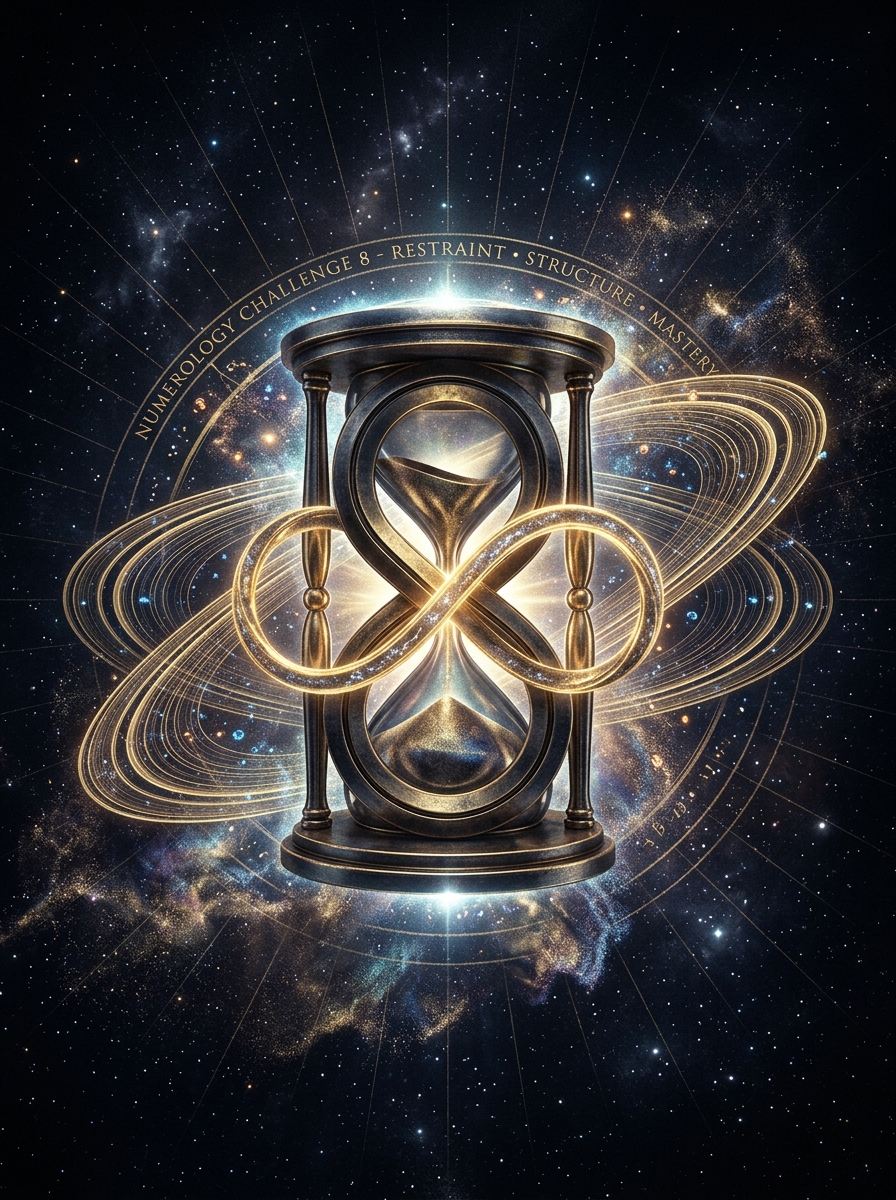
The Initiatory Meaning of Numerology Challenge 8
In the Pythagorean tradition of numerology, numbers are not merely quantitative markers used to measure the material world; they are living, qualitative archetypes that outline the evolutionary journey of the human soul. Within this philosophical framework, the challenge numbers in a chart represent the specific friction points, developmental bottlenecks, and karmic lessons that an individual must confront to achieve wholeness. The Numerology Challenge 8 is perhaps the most demanding of these initiations, as it directly addresses the integration of spirit and matter, the dynamics of personal power, and the transmutation of control. When the universe presents you with an 8 Challenge, it is inviting you into a crucible where your relationship with authority, wealth, and systemic structure will be systematically tested, dismantled, and rebuilt upon a foundation of absolute integrity.
To understand the initiatory path of the Challenge 8, one must first recognize that the number 8 represents the threshold between the temporal and the eternal. It is the number of manifestation, organization, and execution, but it is also the number of cosmic balance. In a challenge position, the 8 indicates that the flow of these energies is initially disrupted. The individual does not enter this life with a natural, harmonious grasp of how to wield authority or how to interact with the material world. Instead, they are born into a narrative defined by extremes. They may experience early life environments where power was abused, where financial instability created a chronic sense of unsafety, or where rigid, unyielding structures stifled their developing sense of self. These formative conditions set the stage for the core psychological conflict of the 8: the struggle to find a middle path between total powerlessness and tyrannical control.
This initiatory path requires a profound shift in consciousness. The individual must realize that the external obstacles they encounter—be they demanding employers, financial setbacks, or systemic roadblocks—are not random acts of a hostile universe, but rather mirror reflections of their own unresolved inner dynamics. The 8 Challenge demands that we move beyond the infantile desire for absolute control over our external environment and instead cultivate inner sovereignty. This shift requires us to examine our relationship with ambition, success, and societal status. Are we pursuing power to protect ourselves from vulnerability, or are we developing mastery to serve a higher, collective purpose? The initiation of the 8 is completed only when the individual learns to stand anchored in their own center, recognizing that true power is not exercised over others, but is rather a state of alignment with the natural laws of creation.
The Pythagorean Architecture of the Eight
To appreciate the deeper mechanics of the Challenge 8, we must look to the geometric and philosophical foundations established by Pythagoras and his successors. The Pythagoreans viewed the number 8, or the Ogdoad, as the first actual cube, representing three-dimensional stability, earth-bound reality, and the ultimate consolidation of form. It is also the number of justice, because it can be divided into equal halves of four, which in turn can be divided into equal halves of two, and further into ones—symbolizing a perfect, harmonious balance. In Pythagorean cosmology, the 8 is the octave, the interval that brings the musical scale back to its starting point but at a higher frequency. This musical metaphor is crucial for understanding the Challenge 8: it represents the task of elevating the crude, heavy vibrations of material survival into the refined, resonant frequencies of spiritual mastery.
When the 8 functions as a challenge, this geometric stability is experienced as a cage, and the harmonious division of the number is felt as a polarizing tension. The initiate feels torn between the vertical axis of spiritual aspiration and the horizontal axis of material demand. In the Pythagorean mystery schools, students were taught that the physical universe is a dense manifestation of divine geometry. Therefore, to master the physical plane, one must understand the mathematical laws that govern it. The Challenge 8 indicates that the soul has previously neglected this study or has misused the laws of manifestation. Consequently, the individual must now learn to respect the structural integrity of the material world. They cannot bypass the rules of form through spiritual escapism, nor can they dominate the physical plane through brute force. They must learn the art of sacred architecture, building their lives with precision, patience, and absolute alignment with cosmic order.
The Blocked Flow of the Lemniscate and Subtle Energy Tension
The visual glyph of the number 8 is the lemniscate—the infinity symbol rotated ninety degrees. In Western esotericism, the lemniscate represents the eternal, continuous flow of life force, looping endlessly between the spiritual realms above and the material manifestation below. It is the symbol of perfect reciprocity, showing that what is gathered in the unseen realms must be poured out into the physical, and what is harvested in the physical must be offered back to the spiritual. In a healthy, balanced state, this energetic loop sustains the individual, providing a constant flow of vitality, creativity, and abundance. However, when the 8 is positioned as a challenge, this fluid motion is interrupted. The lemniscate becomes pinched at its center, preventing the natural exchange of energy and creating areas of severe congestion and stagnation.
      SPIRIT
     /      \
    (   UP   )
     \      /
      \    /
       \  /
        \/  <-- The Blocked Center (Crucible of Will)
        /\
       /  \
      /    \
     (  DOWN )
      \    /
      MATTER
This energetic block typically manifests as a profound polarization within the individual's psyche. On one hand, there may be an obsessive focus on the lower loop of the lemniscate—the realm of physical accumulation, financial security, and status. The individual clings to material assets, believing that their safety and worth are entirely dependent on their bank account or professional title. This hoarding of energy creates a dense, heavy aura, blocking the descent of spiritual inspiration and leaving the individual feeling spiritually bankrupt and chronically anxious. On the other hand, the individual may reject the lower loop entirely, adopting an attitude of spiritual superiority that masks a deep fear of material failure. They may view money as inherently corrupting, avoiding career advancement and financial responsibility. This intellectualized rejection of the physical plane creates a fragmented energy field, leaving the individual ungrounded, ineffective, and unable to manifest their higher ideals.
To resolve this subtle energy tension, the individual must consciously clear the blockage at the center of the lemniscate, which corresponds to the solar plexus chakra—the seat of personal will, power, and digestion. In the esoteric anatomy of the human body, the solar plexus is where we assimilate both food and experience. When the 8 Challenge is active, this center is often tight, guarded, or overactive. The individual may experience physical symptoms such as digestive issues, chronic tension in the diaphragm, or a constant state of fight-or-flight. Healing this energetic bottleneck requires learning to surrender the ego's demand for control. The individual must practice allowing energy to flow through them rather than trying to capture and hold it. By recognizing that they are a conduit for divine abundance rather than its ultimate source, they can relax the solar plexus, reopen the central channel of the lemniscate, and allow the natural circulation of spiritual and material wealth to resume.
The Archetype of Chronos and the Weight of Saturnian Structure
In esoteric astrology and numerology, the number 8 is intimately linked to the planet Saturn and its mythological personification, Chronos—the god of time, boundary, and limitation. While Jupiter expands and offers grace, Saturn contracts, demanding discipline, structure, and accountability. To experience the Challenge 8 is to walk path of the Saturnian initiate. The individual is placed under the direct tutelage of Chronos, who holds the hourglass and the scythe, reminding us that every action has a consequence and that true maturity cannot be rushed. Under this influence, the individual often feels the weight of life as a heavy, crushing burden. They may encounter structural limitations, institutional barriers, or long periods of delay where their best efforts seem to yield no visible results.
This Saturnian energy is not malicious; rather, it is corrective. As Liz Greene notes in her seminal work on Saturn, this archetype acts as the "Dweller on the Threshold," confronting us with our deepest fears and insecurities so that we may develop genuine inner strength. In the context of the 8 Challenge, Saturn strips away the superficial structures we rely on for security. If we build our identity on external status, Saturn will orchestrate circumstances that challenge that status. If we rely on manipulation or shortcuts to achieve our goals, Saturn will demand that we pay our debts and face the reality of our choices. The weight of this structure can feel oppressive, leading to feelings of pessimism, depression, or resentment. However, if the initiate submits to the discipline of Chronos—accepting the necessity of hard work, delayed gratification, and ethical responsibility—the Saturnian lead is slowly transmuted into spiritual gold.
Saturnian Initiation: The Trial of Time
The trial of time is perhaps the most difficult aspect of the Saturnian initiation for the Challenge 8 individual. In a contemporary American culture that values instant gratification, rapid success, and superficial metrics of achievement, the slow, deliberate pace of Saturn can feel like torture. The individual may watch peers advance quickly while they remain stuck in positions that require intense effort for minimal recognition. This trial is designed to test the individual’s commitment to their path. It forces them to ask whether they are pursuing their goals out of a superficial desire for praise, or out of a deep, soul-level calling.
During this trial of time, the initiate must cultivate what Liz Greene describes as the capacity to sit with discomfort and uncertainty without collapsing into despair. They must learn to build structures that are durable and resilient, rather than quick fixes that will crumble under pressure. This means paying attention to details, honoring commitments, and building professional relationships based on mutual respect and integrity rather than transactional utility. The Saturnian initiation teaches us that time is not our enemy, but our most valuable ally. It is the medium through which character is forged. When the individual ceases to fight the boundaries of time and instead uses them to focus and refine their energy, they transition from a victim of circumstance to a master of their destiny.
Confronting the Shadow of the Sovereign and Ego Hypercompensation
The psychological dimension of the Challenge 8 is deeply illuminated by Carl Jung’s work on archetypes, particularly the relationship between the Ego, the Shadow, and the archetype of the King or Sovereign. The Sovereign is the archetype of order, fertility, and benevolent leadership; when active and balanced in the psyche, it provides a sense of direction, protects the vulnerable, and establishes a stable environment where others can thrive. However, when the Sovereign archetype is corrupted or unintegrated, it splits into its shadow forms: the Tyrant and the Weakling. For the individual navigating a Challenge 8, this split is a central theme of their psychological life, leading to patterns of ego hypercompensation that can damage both their personal relationships and their professional aspirations.
                  THE BENEVOLENT SOVEREIGN
                    (Integrated Mastery)
                        /          \
                       /            \
                      /              \
            THE TYRANT   <--------->   THE WEAKLING
      (Active Shadow: Control)     (Passive Shadow: Impotence)
The shadow of the Tyrant emerges when the individual, driven by a deep, unconscious fear of powerlessness, seeks to dominate every situation. This is ego hypercompensation in its purest form. Because they feel fragile or vulnerable internally, they project an image of invulnerability and absolute authority externally. They may become micromanagers, demanding absolute obedience from employees or family members, and reacting with anger or defensiveness to any perceived challenge to their authority. They view the world through a lens of raw power dynamics: you are either the hammer or the anvil, the controller or the controlled. This psychological posture isolates the individual, cutting them off from genuine connection and creating a self-fulfilling prophecy of betrayal and conflict, as those around them eventually rebel against their heavy-handed rule.
The Tyrant Archetype: Ego and Control Dynamics
Underneath the imposing facade of the Tyrant lies a terrified child who believes that to let down their guard is to invite destruction. In Jungian terms, this is a state of inflation, where the ego has identified with the collective archetype of power, losing touch with its human limits. The Challenge 8 individual must do the difficult work of shadow integration, which involves recognizing the fear that drives their controlling behavior. They must look back at their history to see where their sense of personal agency was compromised and understand that their current drive for dominance is a defense mechanism designed to prevent that pain from ever recurring.
Integrating the Tyrant requires learning to tolerate vulnerability. The individual must understand that true authority does not require constant assertion or defense; it is a quiet, self-contained presence. When they can allow themselves to be vulnerable, they break the cycle of hypercompensation. They no longer need to control others because they have established control over their own reactions. This allows the Tyrant to step down, making way for the Benevolent Sovereign—a leader who does not rule through fear, but who inspires through integrity, wisdom, and a genuine commitment to the welfare of the collective.
Resigned Inertia and the Abyss of Chronic Impotence
While the active shadow of the 8 Challenge manifests as the Tyrant, the passive shadow manifests as the Weakling, characterized by resigned inertia and a chronic sense of impotence. This is the opposite pole of the power dynamic. Instead of trying to control everything, the individual gives up control entirely, collapsing into a state of learned helplessness. They look at the structures of society, the demands of the economy, or the authority figures in their lives and conclude that they are powerless to change their circumstances. They may complain about their lack of resources or opportunities, yet they refuse to take concrete actions to improve their situation, preferring the passive comfort of victimhood to the risky responsibility of action.
This state of chronic impotence is often fueled by a profound fear of failure. The 8 Challenge represents a high-stakes arena where the potential for public failure, financial ruin, or professional rejection is very real. For the individual who lacks confidence in their inner resources, the pressure can feel so intense that they choose to withdraw from the game entirely. By convincing themselves that they cannot succeed, they protect themselves from the pain of trying and failing. However, this withdrawal comes at a terrible cost. It breeds a deep, toxic resentment toward those who are successful, leading the individual to adopt a cynical, bitter attitude toward wealth and power, which they dismiss as corrupt or unattainable.
To climb out of this abyss of inertia, the initiate must realize that their powerlessness is an illusion—a defensive strategy designed to avoid the discomfort of responsibility. They must begin to take small, disciplined actions to reclaim their agency. This involves setting realistic goals, breaking them down into manageable steps, and executing them with consistency. It requires them to face the fear of failure directly, recognizing that mistakes are not indictments of their worth, but essential learning experiences on the path to mastery. By taking responsibility for their own lives, they break the spell of chronic impotence, moving out of the shadow of the Weakling and beginning the process of building a life of authentic power and self-direction.
Projections of Authority and the Quest for the Archetypal Father
A key psychological theme for anyone working through the Challenge 8 is the projection of authority onto the external world. In Jungian psychology, the father archetype represents law, order, structure, logic, and the external world of society and career. In early childhood, this archetype is naturally projected onto the biological father. If the father was absent, abusive, overly critical, or weak, the child’s integration of this archetype is disrupted. As an adult, the Challenge 8 individual carries this unintegrated father projection into the world, constantly searching for the "Archetypal Father" in bosses, mentors, governmental institutions, or partners, while simultaneously rebelling against them.
This projection creates a highly unstable relationship with authority. The individual may alternate between idealizing authority figures—believing that they hold the key to their security and success—and devaluing them when they fail to meet these impossible, archetypal expectations. They may find themselves trapped in repetitive cycles of conflict with employers, feeling micromanaged or unappreciated, or they may become passive followers, surrendering their own judgment to a charismatic leader. These patterns are signs that the individual is still looking outside themselves for the permission to be powerful, seeking a blessing from an external father that can only be generated from within.
The Externalized Father: Reclaiming Personal Agency
The resolution of this conflict lies in what Jungians call the internalization of the father archetype. The individual must withdraw their projections from bosses and systems, realizing that no external entity can give them the validation or authority they crave. This process requires them to face the grief of whatever was lacking in their early relationship with their father, acknowledging the wound without allowing it to dictate their adult behavior.
   EXTERNALIZED PROJECTION                      INTERNALIZED INTEGRITY
   [Boss/System] <=== (Father Archetype)        [Self] <--- [Integrated Father]
   (Expectation of validation/fear)             (Internal law, structure, & self-sovereignty)
To internalize the father archetype, the individual must develop their own internal masculine principles: discipline, structural thinking, boundary-setting, and protective strength. They must become their own authority, establishing their own set of values and living by them regardless of external approval. When they do this, their relationship with authority figures transforms. They no longer see bosses as parental figures to be feared or pleased, but as peers with whom they can engage in professional, adult relationships. They reclaim their personal agency, standing firm in their own power while respecting the structures that govern the collective.
The Court of Matter: Financial Ruin as Soul Alchemy
For the Challenge 8 individual, the material world is not a neutral stage, but a courtroom where the soul’s integrity is put on trial. Money, debt, investments, and professional standing are the physical materials through which this trial is conducted. It is common for those with an 8 Challenge to experience significant financial upheavals, including bankruptcies, sudden job losses, failed business ventures, or crippling debt. These events are rarely simple bad luck; rather, they are alchemical interventions designed to break the ego’s identification with material form.
In alchemy, the first stage of the Great Work is the nigredo, or the blackening—a period of decay, dissolution, and confrontation with the shadow. Financial ruin acts as a powerful nigredo. When the external structures of wealth and status are stripped away, the individual is forced to confront the naked reality of who they are without their titles and assets. This is a terrifying experience for the ego, which equates loss of material security with death. However, it is precisely in this state of emptiness that true soul alchemy can occur. The individual is forced to discover their intrinsic value, recognizing that their worth is not determined by their net worth, but by the strength of their character, their capacity for resilience, and their alignment with truth.
The Alchemical Crucible of Debt and Scarcity
Debt is a particularly potent alchemical crucible in the modern world. For the Challenge 8 individual, debt is often the physical manifestation of an energetic imbalance—an attempt to claim material power or lifestyle before they have built the internal foundation to sustain it. It represents a borrowing from the future to escape the discipline of the present. When the weight of debt becomes overwhelming, it forces a radical reckoning. The individual must look at the psychological drivers behind their spending and borrowing habits: Were they trying to buy respect? Were they compensating for feelings of inadequacy?
Navigating the alchemical crucible of debt requires entering a phase of radical honesty and financial discipline. The individual must stop running from the numbers and instead face their financial reality with courage and precision. They must learn to live within their means, accepting the Saturnian lessons of frugleness, planning, and systematic repayment. This process is not merely about balancing a ledger; it is a spiritual practice. As they systematically pay down their debts and build a stable, honest relationship with money, they are clearing their karmic ledger as well, converting the lead of financial anxiety into the gold of true financial self-mastery.
The Scales of Cosmic Justice and Tarot Arcana VIII
The ultimate resolution of the Challenge 8 is found in the archetype of Justice, which is represented by Major Arcanum VIII (8) in the Rider-Waite-Smith tarot system (and as Adjustment in Crowley's Thoth deck). In the RWS system, the figure of Justice sits between two pillars, holding a sword in her right hand and a pair of scales in her left. This imagery provides a profound blueprint for the integration of the 8 Challenge. The scales represent the need for absolute balance, objectivity, and the weighing of cause and effect (karma). The sword represents the cold, sharp edge of truth and decision-making, which cuts through illusions and separates the essential from the non-essential.
                     [ JUSTICE / VIII ]
                       /            \
                      /              \
            THE SCALES                THE SWORD
       (Cosmic Karma & Balance)     (Discernment & Truth)
For the Challenge 8 individual, the archetype of Justice is a reminder that the universe operates on a system of absolute, mathematical reciprocity. Every thought, word, and deed is a seed planted in the field of reality, and the harvest is inevitable. If they act with selfishness, manipulation, or deceit, the scales will eventually tilt, bringing corrective consequences into their lives. The 8 Challenge teaches us that we cannot escape this cosmic law. True success is not measured by what we can get away with, but by how closely our actions align with the principles of universal truth. When the individual embraces this perspective, they stop fighting the rules of the game and instead become stewards of justice, using their power and resources to restore balance and fairness to their corner of the world.
Frequently Asked Questions
How does the Challenge 8 manifest in career choice and professional obstacles?
The Challenge 8 often manifests in the professional arena as a series of intense power struggles, structural limitations, or financial setbacks. Individuals with this placement may find themselves repeatedly clashing with authoritative bosses, feeling that their talents are overlooked or actively suppressed. They may also experience a pattern of starting successful businesses or projects, only to have them collapse due to mismanagement, sudden economic shifts, or conflicts with partners. Professionally, they are being asked to master the Saturnian virtues of patience, organization, and ethical leadership. Instead of seeking shortcuts or trying to bypass established systems, they must learn to work within structures, build solid foundations, and earn their authority through consistent, high-quality work.
What is the difference between an 8 Life Path and a Challenge 8?
While an 8 Life Path indicates that the central theme of an individual's life journey involves the acquisition and use of power, material success, and organizational ability, a Challenge 8 indicates a specific, deeply rooted obstacle in expressing these energies. Someone with an 8 Life Path has the natural potential and drive to operate in the material world, though they must still learn to balance it. Someone with a Challenge 8, however, experiences a fundamental friction or block in this area. They may cycle between periods of intense financial anxiety and reckless spending, or they may feel completely paralyzed when it comes to taking professional risks. The Challenge 8 represents a psychological wound around power and resources that must be healed before the positive potential of the 8 archetype can be fully realized.
How can I release the physical tension associated with Challenge 8?
Because the Challenge 8 is closely linked to the solar plexus chakra and the Saturnian principle of contraction, it often manifests physically as chronic tension in the core of the body, particularly the diaphragm, stomach, and lower back. To release this tension, individuals should focus on somatic practices that encourage grounding, deep breathing, and the surrender of control. Deep abdominal breathing (pranayama), progressive muscle relaxation, and yoga poses that open the hips and solar plexus (such as Cobra or Warrior poses) can be highly effective. Additionally, spending time in nature—literally grounding oneself by walking barefoot on the earth—helps disperse the excess mental and emotional energy that accumulates from chronic stress and control-oriented thinking.
What role does karma play in the financial struggles of a Challenge 8?
In Western esoteric systems, the number 8 is deeply connected to the law of karma, or the principle of cause and effect. In the context of a Challenge 8, financial struggles are often the manifestation of karmic lessons related to the use of power and resources in past cycles (either earlier in this life or in ancestral/soul lineages). If an individual has previously used wealth to manipulate others, or conversely, if they have abdicated their power and lived in resentment of the wealthy, these attitudes must be balanced. Financial difficulties serve as a mirror, showing the individual where their relationship with the physical plane is based on fear, greed, or insecurity. By treating financial management as a spiritual discipline and acting with absolute integrity, they balance the scales of karma and open the door to sustainable abundance.
Comments
Loading comments…