Hexagram 47, Oppression: The Intelligence of Constraint
The Core Dynamic: Success Under Constraint
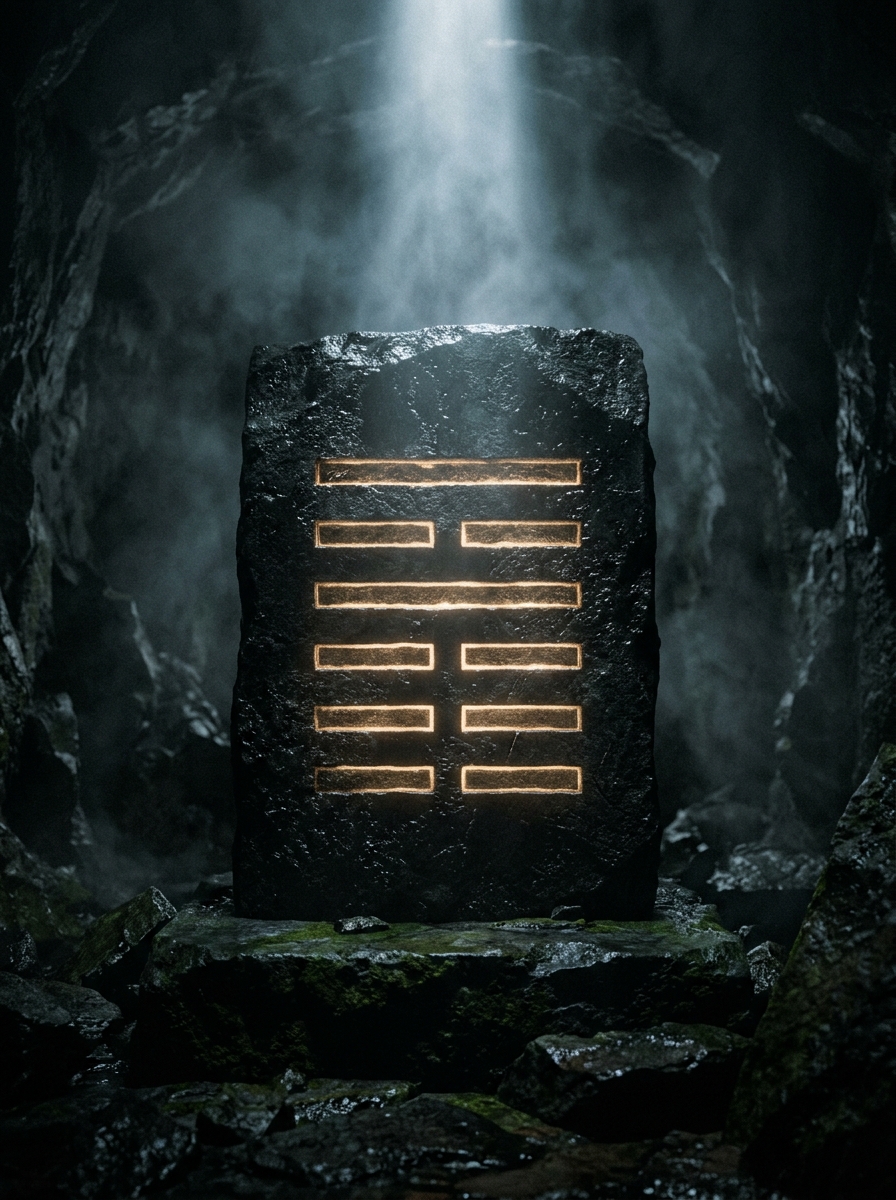
Hexagram 47, Oppression names a condition in which outer pressure meets inner resource that cannot yet be spent. The I Ching calls it a paradox: “Oppression. Success. Perseverance.” No bad omen, no promise of escape — rather an assurance that a person can remain inwardly aligned while the world refuses to cooperate. This is not hardship in general but the specific experience of being hemmed in from above and below: the surface of life narrows, and the depths below churn with what cannot be safely released.
The English word “oppression” carries a political weight, but the hexagram’s field is more intimate. It describes a situation where willpower alone cannot break through. The usual tools — speech, money, reputation, charm — lose their leverage. What remains is the question of character. Can you hold your center when every external channel is blocked? The judgment’s “success” refers not to expansion but to moral coherence under pressure: the ability to preserve truth when the world no longer rewards it.
The image that carries this meaning is Lake over Water — the trigram of the Lake above, the Abysmal Water below. Water on water suggests depth upon depth, yet the lake is contained, its surface small. Below, the abyss is bottomless. The pressure comes from both directions: the weight of circumstances above compressing the psyche, and the rising tide of unresolved feeling below. There is no stable platform. The hexagram teaches that in such a season, forcing a breakthrough often backfires; the wise response is to conserve, to concentrate, to let the pressure itself reveal what is essential.
This is why Oppression belongs to the same family as Hexagram 39, Obstruction and Hexagram 29, the Abysmal — but its accent is different. Obstruction flows; there is still movement, however blocked. The Abysmal repeats, a series of falls. Oppression, by contrast, feels static. The walls are not moving, but neither are they falling. The soul is asked to wait in a tight space, not until the walls dissolve, but until the self becomes unbreakable.
The Psychological Landscape: When the World Refuses to Mirror You
Oppression arises when the outer environment ceases to reflect the inner truth back to the ego. In Jungian terms, the persona — the face we present to the world — meets a context that refuses to accept it. Speech falls flat. Intentions are misread. Reputation offers no protection. This can feel like abandonment, but the I Ching sees it as a stripping away of dependencies: the psyche is being weaned off applause, consensus, and visible progress.
The emotional signature of 47 is a specific kind of humiliation — not the shame of failure, but the frustration of being unable to make reality answer. You know what is true, but you cannot prove it. You have the resources, but they cannot be deployed. The hexagram describes a season of "between no and not yet": the old avenues are closed, and the new ones have not opened. In that interval, the soul must learn a different economy — not exchange, but witness; not expansion, but concentration.
The abyss below the lake is the unconscious, the depth of what is felt but not yet expressible. When oppressive pressure descends, this depth becomes turbulent. Dreams may intensify, anxiety may spike, and the body may contract. The danger is to mistake this inner churning as a sign to collapse or to perform. The oracle advises the opposite: to sit with the depth without drowning, to let the lake contain it. The discipline of containment is not repression; it is the capacity to hold complexity without acting it out.
This is why silence becomes the primary gesture. In Oppression, words too often become a substitute for truth — an attempt to manufacture relief by explanation when trust has already thinned. The judgment’s warning — “When words are not believed, one is misfortunate” — is not a command to stop speaking altogether. It is a call to align language so tightly with substance that words no longer need to persuade. Let action, not rhetoric, be the carrier of meaning.
The Two Paths: Great Person and Small Person Under Pressure
The I Ching distinguishes two responses to Oppression, and the difference defines the hexagram’s teaching. The great person does not panic, does not beg, and does not convert pressure into melodrama. They remain dependable to what is essential. The small person, under the same condition, spins into manipulation, complaint, or self-pity — trying to escape the constraint by altering the outer appearance instead of deepening the inner ground.
Perseverance in this hexagram is not stubbornness. It is the discipline of staying aligned without becoming rigid. There is a real danger here: some people endure oppressive conditions by confusing dignity with martyrdom, staying too long in a situation that is simply toxic. The oracle is subtler. It asks: Can you remain honest when no one seems impressed? Can you keep your word when the reward is delayed? Can you refuse to contaminate your own center just to relieve pressure? This is perseverance as active waiting — the spine of an intact purpose.
The great person knows something the small person misses: that constraint is not meaningless. It reveals shape. In times of abundance, one mistakes motion for meaning; in compression, only essentials survive. That is why 47 often appears to people undergoing a trial of spirit — a phase in which the outer field is too narrow for flourish but wide enough for truth. The suffering is real, but it is not sterile. It forges a quality of presence that cannot be faked.
The Danger of Over-Explaining
The line about words is the most psychologically precise in the hexagram. When trust is already thin, explanation becomes friction. The more you talk, the more you dig the hole. Oppression advises a counterintuitive move: speak less, act exactly. If you must speak, let the words be few, clean, and incontrovertible. The intelligence of constraint knows that trust cannot be argued into existence — it must be embodied over time. Silence here is not avoidance; it is concentration.
How Oppression Plays Out in a Life
Because Hexagram 47 describes a structural condition rather than a specific domain, it surfaces across love, work, and spirit — but always with the same signature: a mismatch between inner truth and outer response.
In love, Oppression often appears when communication is bound by old distrust or unequal power. One partner feels hemmed in by unspoken agreements or emotional exhaustion. The common mistake is to try to talk the blockage open. The hexagram suggests a different approach: rebuild credibility through behavior rather than speech. Small, consistent acts of honesty — even when they are uncomfortable — have more weight than any declaration.
In work, 47 can indicate a role that has become too small, too controlled, or too indifferent to the soul. The lesson is not necessarily to quit immediately — sometimes the confinement is the very pressure that clarifies vocation. But the oracle warns against using the situation to dramatize victimhood. Instead, protect your dignity, conserve your energy, and watch for the moment when the outer field shifts. That shift may come slowly; the I Ching trusts that the great person will recognize it.
In spiritual life, Oppression is a crucible. It strips away practices that depend on comfort, inspiration, or community. What remains is the raw question: Do you still trust the path when it yields nothing visible? This is the abyss — the place where faith becomes either authentic or hollow. The hexagram offers no consolation except the knowledge that this passage, too, is part of the rhythm. The lake may be small, but the water below is endless.
The Hidden Gift of Compression
Hexagram 47 does not offer a promise of liberation. It offers something rarer: the possibility of becoming unforgeable. When the pressure lifts — and it will — what remains will be the core that could not be bent. That is the success the judgment speaks of. Not escape, but essence.
The I Ching never romanticizes suffering. It names it, maps it, and shows the way through without false hope. Oppression asks only that you hold your center while the world refuses to hold you. That is enough. The intelligence of constraint is the intelligence of the soul that knows its own weight.
Related
- I Ching Hexagram 12: Standstill, and the Intelligence of Contraction
- Hexagram 62: Small Exceeding and the Art of Flying Low
- Hexagram 28, Great Excess: When the Beam Begins to Bow
- Hexagram 34, Great Power: Force Under Discipline
- Hexagram 23: The House Peels Away from Its Own Bones
- I Ching Hexagram 38: Opposition — The Fire at the Waterline
Comments
Loading comments…