I Ching Hexagram 5: The Discipline of Waiting
The Core Dynamic: Waiting as Strategic Tension
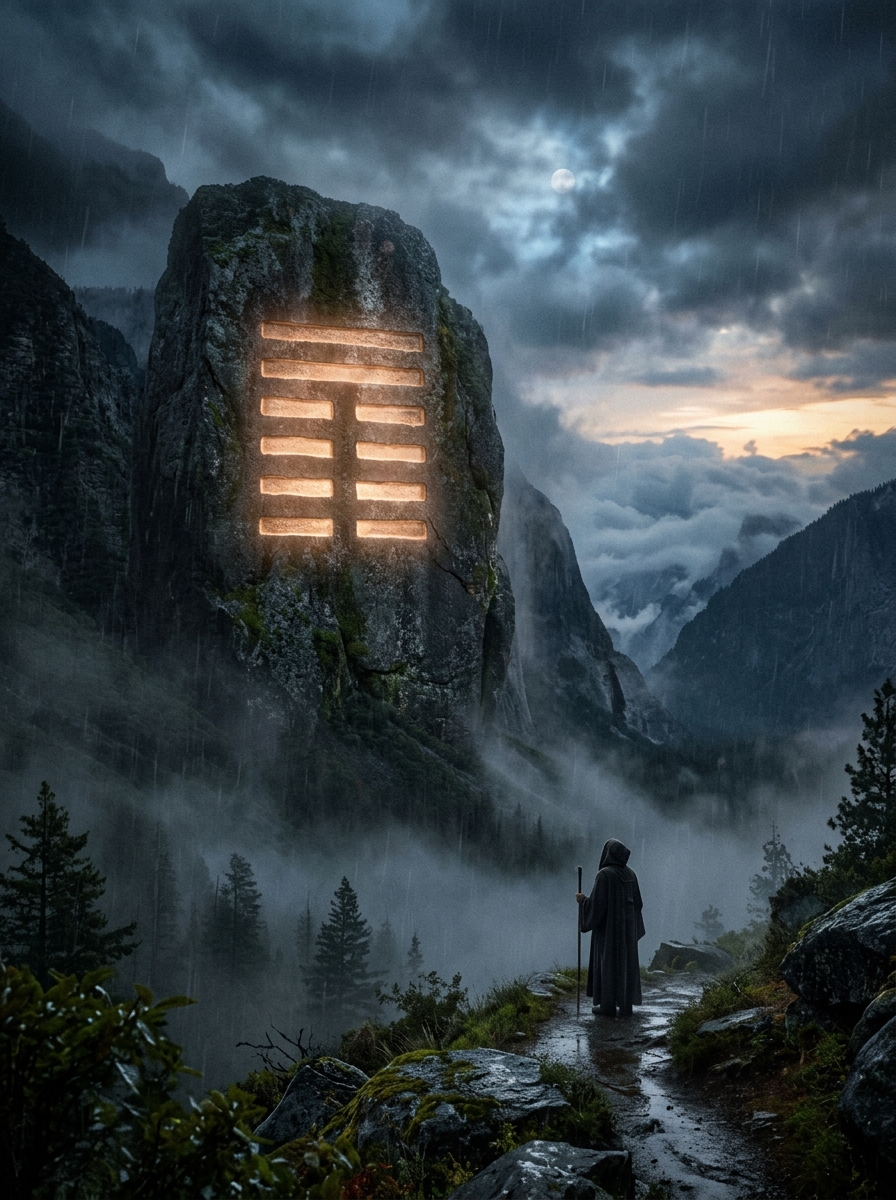
Hexagram 5, Waiting (Xu) is not a gentle exhortation to patience. It is a diagram of suspended force. The ancient image — clouds rising into a clear sky while rain has not yet fallen — captures a precise condition: the moisture is present, the atmospheric pressure is building, but the release has not been authorized by circumstance. The hexagram’s structure of Water below and Heaven above makes this tension legible. The lower trigram, K’an, is the abyss, the dangerous deep, the current that wants to flow. The upper trigram, Ch’ien, is pure creative initiative, the power that could break through at any moment — but does not. The two are locked in a standoff that is not deadlock but gestation.
This is the central insight that the rest of the oracle elaborates: waiting in the I Ching is a state of charged readiness, not emptiness. The field is not barren; it is gathering. The danger in the lower trigram (K’an is also the Abysmal, the pit, the trap) signals that premature action would fall into that pit precisely because you have not yet read the terrain. Meanwhile, the Heaven trigram recalls Hexagram 1, The Creative — raw yang force — but here it remains overhead, withholding its thunder. The message is that timing belongs to a larger order than your personal urgency. You are not being told to do nothing; you are being shown that the moment for doing has not crystallized.
The Judgment and the Test of Sincerity
The Judgment of Hexagram 5 reads, in paraphrase: “Waiting. If you are sincere, you have light and success. Cross the great river with endurance.” The emphasis on sincerity is the oracle’s practical heart. In the I Ching, sincerity (cheng) is not honesty in the modern sense — it is a psychospiritual coherence that aligns intention, perception, and action. You are not splitting yourself between what you know and what you wish. That coherence generates the “light” the Judgment names. Light here means clarity, the ability to see the situation without the distortion of fear or desire.
Without sincerity, waiting becomes one of its degraded forms: resentful passivity, performative patience, or foggy indecision. With sincerity, the delay itself becomes luminous. You are not waiting for something; you are waiting in something — a weather system that has its own intelligence. The Judgment’s injunction to cross the great river with endurance is not a promise that you will cross tomorrow. It is a condition: the crossing is possible, but only if you can sustain your integrity through the interval. The “great river” is any threshold that demands commitment — a relationship deepened, a career pivot, a spiritual death-and-rebirth. Hexagram 5 says you must arrive at that river fully present, not half-wishing you were already on the other side.
This is why the oracle appears so often in readings that involve suspense: before a medical result, before a contract signs, before a love declaration lands. The underlying answer may be favorable, but the route is indirect. The sincerity test asks whether you can remain upright while the atmosphere is charged.
The Changing Lines: Stages of Delay
Waiting is not a single posture; it has six inner phases, each a different relationship to time. The changing lines of Hexagram 5 map how delay behaves under different pressures. This is what makes the hexagram psychologically precise — it refuses to prescribe a bland “just wait.”
-
Early lines (the first two positions) describe caution near the threshold. The first line speaks of waiting at the border — you are close to the crossing, but the water is dangerous. You feel the impulse to act, but the line warns that acting now draws calamity from the Abysmal (K’an). The second line shifts to waiting on the bank, where gossip and social currents complicate the delay. Here the advice is to keep distance from petty provocations; your endurance is being tested by other people’s impatience.
-
The middle lines (positions three and four) introduce relational entanglement. The third line warns of waiting in mud — a situation where you have sunk into a half-commitment that cannot advance or retreat cleanly. The fourth line is more promising: waiting at the well, where resources are present but need clean access. This line often appears when you have done your preparation but are blocked by another person’s timing or a systemic bottleneck.
-
The top line (sixth position) carries the most severe warning. It images waiting while stuck in a pit — a violent or futile struggle that results from ignoring the signals of the earlier lines. This is one of the great cautions in the I Ching: to move in a season that is not yours invites injury that could have been avoided. The top line is not a prophecy of doom; it is a reminder that waiting becomes wise when it saves you from the cost of false timing. The person who forces an opening often creates the very obstruction they feared.
These line meanings allow the diviner to locate exactly where the pressure sits: in external conditions, in another person’s unreadiness, in your own restlessness, or in a systems delay that has no personal agent.
The Shadow: When Waiting Goes Wrong
The shadow of Hexagram 5 is not procrastination but anxious improvisation — the nervous mind that cannot tolerate suspended time. When sincerity fails, waiting splinters into three toxic forms. The first is resentful passivity: you comply externally but inwardly punish the universe for withholding what you feel entitled to. This breeds bitterness and saps the very readiness the situation requires. The second is performative patience: you display calm to earn approval, but the display is hollow. Others sense the falseness, and your credibility erodes. The third is vacant indecision: a fog of inaction that has no directing intention behind it — you are waiting not because you are gathering, but because you have lost the thread.
In relationships, this hexagram often appears when a confession is emotionally true but temporally wrong — the other person cannot receive it yet, and forcing it will deform the connection. In career, it signals that an opportunity exists but has not cleared its bureaucratic or seasonal hurdles. Meddling now — sending the aggressive follow-up, demanding a premature decision — reverses the momentum. In spiritual practice, forced insight breaks the natural maturation of understanding. The shadow is always the same: you mistake the delay for an enemy, and you fight it with the wrong weapons.
The top line’s warning — the pit, unnecessary bloodshed — is the endpoint of this shadow path. It is not abstract. It can mean overexplaining, overcommitting, pushing an emotional resolution before the other party can meet it, or insisting on a yes when only a maybe is available. Hexagram 5 teaches that the most advanced skill is sometimes to do nothing that will need to be undone.
The Gift: Refinement Through the Interval
The real gift of this hexagram is not the delay itself but the discernment it cultivates. To inhabit the interval without collapsing into fantasy or rage is an art. The person who learns it stops wasting force on false starts. They stop projecting certainty where none exists. They stop mistaking their own anxiety for a sign that action is required.
There is dignity here. Waiting does not reduce you; it refines you. It strips away compulsive motion and reveals whether your confidence rests on genuine alignment or on desperation. If you can remain steady through the rains’ withholding, you emerge with a durable relationship to time itself. That is one of the oldest teachings of the I Ching, and it connects Hexagram 5 to its neighbors: after the difficulty of Hexagram 3 (Difficulty at the Beginning) and before the union of Hexagram 8 (Union, Holding Together), this is the interval of formation. The sky is gathering. The question is whether you can stand beneath it without breaking formation — because when the rain finally falls, it will fall for those who have kept their ground clean.
Related
- I Ching Hexagram 12: Standstill, and the Intelligence of Contraction
- I Ching Hexagram 64: Before Completion — The Edge of the Threshold
- I Ching Hexagram 61: Inner Truth and the Pressure of What Cannot Be Faked
- I Ching Hexagram 63: The Knife-Edge of After Completion
- Hexagram 53, Development: The Slow Architecture of Growth
Comments
Loading comments…