The Emperor and The Hierophant: Law, Lineage, and the Shape of Authority
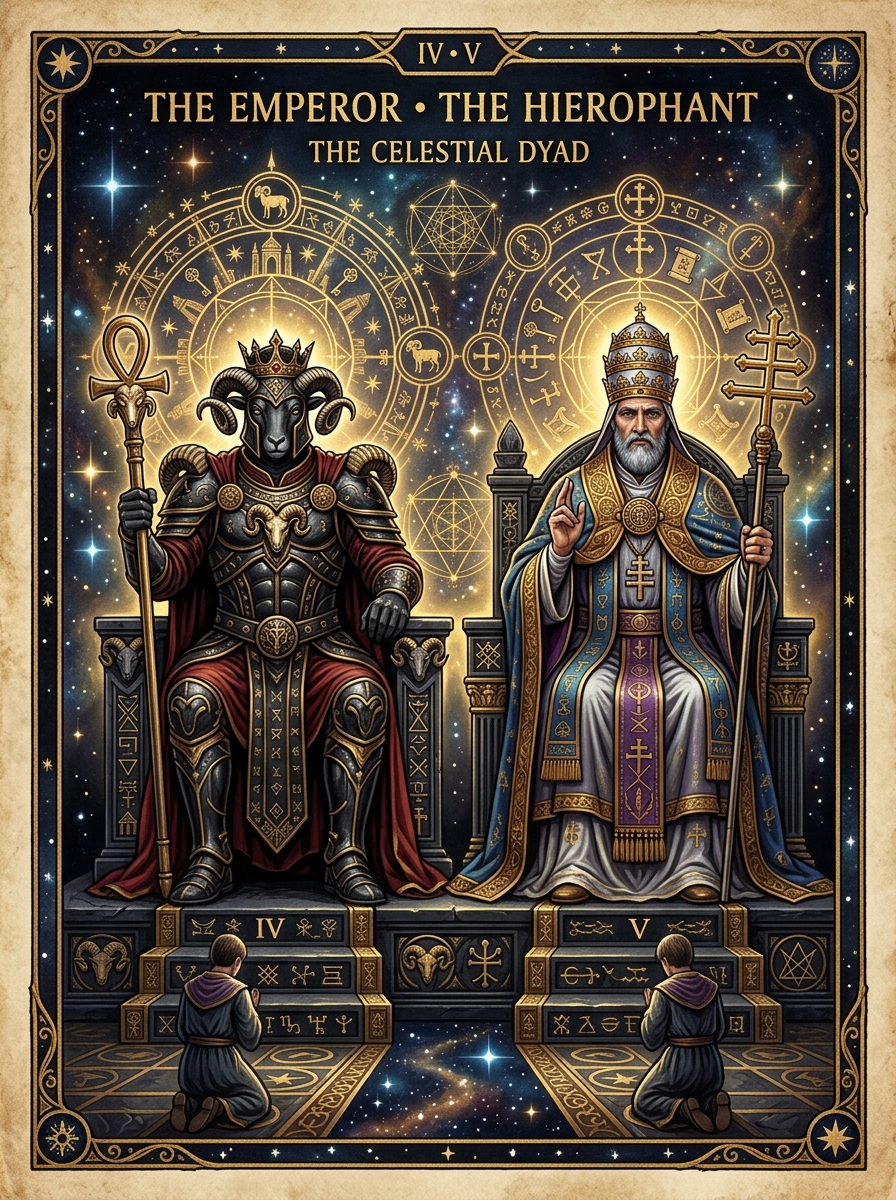
The Core Dynamic: Power That Must Answer to a Higher Law
When The Emperor and The Hierophant appear together, the reading is not about charisma or intuition. It is about authority that has been formalized, sanctioned, and made legible to a group. The Emperor governs by command — boundaries, hierarchy, visible order. The Hierophant governs by tradition — ritual, doctrine, the transmission of inherited meaning. One says, “This is how it is done.” The other says, “This is how it has always been authorized.” Between them they describe a life shaped by systems, vows, institutions, and codes that predate personal preference.
The numerological sequence matters. IV and V run consecutively: the stabilised seat of power (the Emperor’s square throne) leads directly into the arena of teaching and institutional blessing (the Hierophant’s crossed keys). The Emperor’s raw order is not enough; the Hierophant adds liturgy, orthodoxy, and collective memory. This is why the pairing feels both grounding and restrictive. It offers a container — but the container may be centuries old and full of inherited assumptions that no one has questioned.
At its healthiest, this combination describes authority that has earned its right to rule. It is public, accountable, and rooted in something larger than ego. At its shadow, it describes a regime that has mistaken its own customs for truth and now enforces them reflexively. The central question for the querent is whether the structure they are inside — a marriage, a career path, a spiritual tradition, a family code — still carries living truth or has become a mausoleum of good intentions.
The Psychological Architecture: Father Law and the Problem of Obedience
Jungian psychology would recognise The Emperor and The Hierophant as two faces of the father complex: the part of the psyche that internalises authority, approval, law, and the voice that says what is permitted. The Emperor represents the ego’s need for structure — the fortress that keeps chaos at bay. The Hierophant represents the superego’s need for meaning — the story that justifies the fortress. Together they form the inner architecture of a person who has learned to survive by being “good,” respectable, and controlled.
This is not inherently pathological. A functioning adult needs a lawful inner structure to move through the world. But the pairing appears most often when that structure has become over-identified with a single narrative: religious orthodoxy, family honor, academic credentialing, professional legitimacy. The querent may be asking, “Am I living my life, or performing a role?” The cards do not answer that question directly. They force it into the open by showing how much of the self has been mortgaged to an external code.
The shadow emerges when obedience replaces discernment. The Emperor’s discipline becomes rigidity; the Hierophant’s tradition becomes dogma. The psyche may begin to rebel through symptoms — anxiety, emptiness, covert acts of defiance, sudden attraction to forbidden paths. For those who feel this tension, the shadow work tarot spread can help map what has been exiled to keep the structure intact.
But the pairing is not always a diagnosis of oppression. It can also mark a rite of passage into mature authority — the moment when a person internalises real wisdom rather than merely complying with external rules. In that case, the Hierophant’s transmission is alive: a teacher, a craft, a lineage worth serving. The Emperor’s command is earned: a role that requires stewardship, not domination. The difference lies in whether the structure still has the capacity to learn.
How the Dynamic Matures — and How It Goes Shadow
The mature face of this pairing is rightful authority. It shows up when someone occupies a position of power with genuine accountability: a judge who understands the gravity of law, a CEO who builds systems that serve people rather than crushing them, a priest who opens doors rather than closing minds, a parent who sets limits out of love rather than control. The Emperor and Hierophant together can bless any undertaking that requires durability and ethical form — a marriage, a business partnership, a public office, a long-term creative project with institutional backing.
The shadow face is authority that has forgotten its source. The Emperor becomes a tyrant who mistakes his own rules for reality. The Hierophant becomes a gatekeeper who defends tradition for its own sake, unwilling to revise a doctrine that no longer serves life. In a love reading, this shadow shows up as a relationship held together by roles, status, or family pressure rather than genuine intimacy — the model couple that is dead inside. In a career context, it appears as bureaucracy that suffocates initiative, or a mentor who demands loyalty while offering nothing but repetition.
The critical distinction is whether the structure is living or fossilised. A living structure can be questioned, amended, and exited with integrity. A fossilised structure punishes questioning, enforces conformity, and confuses its own survival with the good. The cards themselves do not judge — they merely show what kind of container the querent is inside. The work is to assess whether that container still deserves allegiance.
For those wrestling with a choice between institutional legitimacy and personal vocation, the Magician and The Emperor combination offers a different lens: one where applied skill creates its own structure rather than fitting into an existing one. But this pair is less about invention and more about stewardship — the question is not “can I build something new?” but “is this old thing still worthy of my loyalty?”
What It Looks Like in a Life: Applications of the Dynamic
Because the core dynamic is already established, we can now touch love, work, and relationships briefly — not re-explaining, but showing how the same principle expresses in different domains.
In love, the pairing almost always speaks to commitment that is publicly recognised: engagement, marriage, family approval, shared values that are explicit and enforceable. It can appear when two people are building a bond with backbone — agreements, fidelity, a sense of “we know what this is.” That is the healthy current. The shadow appears when love becomes duty: the relationship held together by roles, religion, or social pressure rather than genuine desire. The partners may be performing marriage while starving intimacy. The Hierophant and The Lovers pairing contrasts this by placing choice and moral framework in tension; here, the framework itself has become the relationship’s spine.
In career, the combination is one of the strongest signals for institutional authority: promotion, certification, licensing, tenure, or a role with oversight. It often appears when the querent is joining a large organisation, seeking a mentor, or being tested by a gatekeeper. The healthy expression is a position earned through competence and integrity. The shadow is a hierarchical system that rewards obedience over insight, where the air is thick with unwritten rules and no one dares innovate. The career tarot spread can help distinguish whether the structure is supporting growth or merely demanding compliance.
In spiritual or psychological contexts, the pairing points to a person who has internalised a strong moral code — possibly religious, possibly familial, possibly academic. The question is whether that code is a genuine source of meaning or a borrowed script that has never been examined. The High Priestess and The Hierophant shows how silence and doctrine can coexist; this pair, by contrast, asks whether the doctrine has room for silence at all.
The Final Question: Does the Structure Serve Life?
The Emperor and The Hierophant together do not ask for rejection of structure. They ask for discernment — the hard work of evaluating whether the laws and traditions that shape a life are conduits of truth or obstacles to it. Every reader who pulls this combination should sit with a single question: if I stripped away all the titles, roles, and inherited scripts, would the essential shape of my life still stand?
If yes, the cards affirm a foundation built on real authority. If no, they reveal a structure that may need to be revised, left, or mourned. This is not a romantic call to burn everything down. It is a stoic call to honor what is worthy and release what is not. The Emperor and the Hierophant are the tarot’s most focused statement on the ethics of power — not whose power, but what kind.
For a deeper look at how authority interacts with vitality, the Emperor and The Sun pairing adds confidence and joy to the theme. For a more generative counterpoint, The Empress and The Emperor shows what happens when power is paired with care rather than doctrine. And for the foundational symbolism of each card, the individual meanings of The Emperor and The Hierophant complete the picture.
In the end, this combination is about legitimised power. It can be a coronation, a marriage, a promotion, a vocation, or a moral inheritance. It can also be a warning that authority has become so entrenched it no longer knows how to learn. The cards do not ask you to reject structure. They ask you to determine whether the structure still carries truth.
Comments
Loading comments…