The Emperor and the Chariot: Sovereign Will in Motion
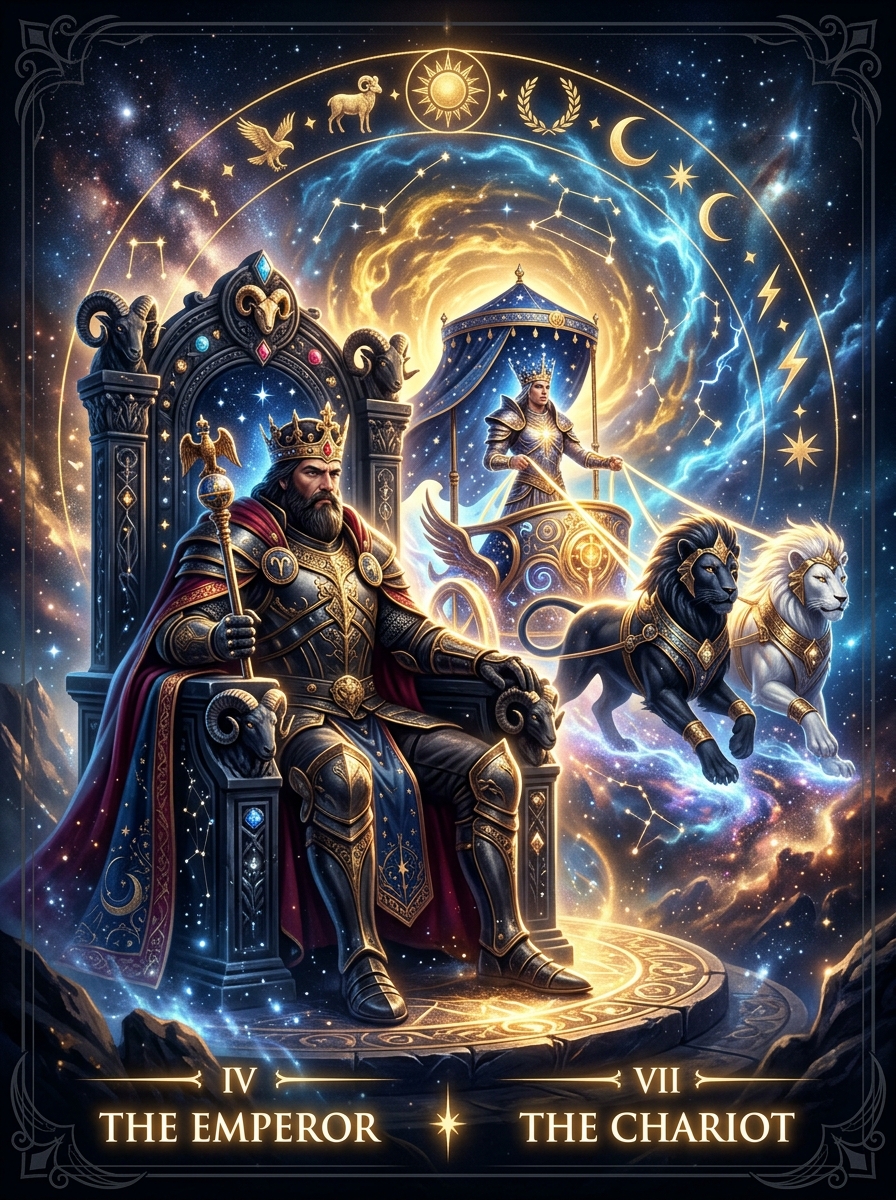
The Emperor and The Chariot together do not simply add structure to momentum. They fuse two modes of power that ordinarily repel each other. The Emperor sits on his cube-throne, an architect of permanence, a lawgiver who builds walls and writes codes. The Charioteer stands in his vehicle, harness contradictions, drives through obstacles toward a visible prize. One holds ground; one crosses it. When they appear in the same spread, the question is no longer whether you have power, but whether your power can move without shattering the vessel that contains it. This pairing describes a person or situation where discipline becomes trajectory — where the ability to command meets the ability to advance. It is the signature of directed force, not brute force, and it asks for a kind of interior governance most people never attempt.
The architecture of sovereign will
At its psychological core, this combination addresses the relationship between the father principle and the warrior principle. The Emperor represents the internalized authority that sets boundaries, defines rules, and refuses chaos. The Chariot represents the activated will that takes those rules into contested terrain. One without the other falters. Too much Emperor and you get rigidity — plans that never leave the fortress, relationships smothered by protocol, careers stalled by perfectionism. Too much Chariot and you get reckless drive — ambition without a moral compass, love that burns out because it had no container, success that collapses under its own speed.
The integration these cards demand is not compromise but synthesis. The Charioteer’s sphinxes or horses — opposing forces of instinct, emotion, and circumstance — cannot be driven by sheer aggression. They require a steady hand, a clear destination, and an inner order that the Emperor provides. This is why the pair feels more adult than the simpler power cards like The Magician or Strength. It does not promise effortless manifestation or gentle taming. It promises that if you have done the work of building a coherent self — laws you actually obey, boundaries you hold, commitments you honor — then you can mobilize that self without falling apart. For a related frame on how structure becomes ethical, the pairing of The Emperor and Justice shows how authority can be grounded in principle rather than whim.
The number logic
Four and Seven — the Emperor’s 4 and the Chariot’s 7 — reinforce this. Four is the square, the foundation, the material world set in order. Seven is the journey through opposition, the test, the victory that comes only after struggle. In combination, the numbers say: first build the vessel (4), then sail it into the gale (7). You cannot skip the building. You also cannot stay anchored. The pairing is a call to finish the blueprint and then leave the architect’s table.
Paths of mastery and shadow
Like any potent archetypal marriage, this one has a healthy current and a sick one. The difference lies in whether the Emperor’s authority is owned or imposed, and whether the Chariot’s drive is directed or compulsive.
In its mastery expression, the pairing produces a person who can hold tension without leaking. They set a course; they enforce the conditions that make that course possible; they absorb resistance without collapsing into aggression or despair. This is the leader who both plans and executes, the partner who defines the relationship’s terms and then shows up consistently, the professional who works within systems while pushing them forward. The inner dynamic feels like a king who also drives his own chariot — no gap between decision and action. The The Chariot and Strength combination touches a similar note: willpower must be tempered by wisdom of the heart, but here the emphasis falls on the governing structure that makes that tempering stable.
In its shadow expression, the pairing hardens into control without awareness. The Emperor becomes a tyrant who mistakes rigidity for strength, and the Chariot becomes a war machine that cannot stop. The result is burnout, relationship breakdowns, and a professional life that runs on adrenaline and resentment. The person may feel they must dominate every situation or be devoured by it. This is not the sovereign in motion; it is the prisoner of his own armor. The shadow work begins when you recognize that the need to be in command has become a reflex, not a choice. For those wrestling with this pattern, a shadow work tarot spread can illuminate whether the issue is fear of chaos, fear of failure, or fear of relinquishing control.
When the pairing slides into crisis
If The Emperor and The Chariot appear reversed, or if they coincide with disruptive cards like The Tower or The Devil, the dynamic often signals a collapse of the integration. Reversed, the Emperor can mean a father figure absent or tyrannical; the Chariot can mean directionless ambition or a victory that costs too much. Together, they may describe a person who alternates between rigid control and explosive release — the bureaucrat who snaps, the executive who burns out, the lover who demands order then breaks it. The path back is to re-own the Emperor’s law internally rather than project it onto circumstances, and to re-channel the Chariot’s drive into a purpose bigger than winning. For more on how momentum meets its own limits, the pairing of The Chariot and The Tower explores willpower colliding with structural collapse.
Living the pairing: love, work, and the proving ground
This combination rarely appears in a reading about passive waiting. It appears when the querent is already in motion or must become so. How that motion expresses itself depends on the domain, but the underlying dynamic — structured will moving toward a defined goal — remains constant.
In relationships
The pairing signals a bond that is intentional rather than accidental. The partners are not drifting; they are building. The Emperor contributes clarity of boundaries, roles, and expectations. The Chariot contributes momentum — a shared project, a move, a formal commitment, a challenge they face together. The risk is that love becomes managerial: one person governs, the other executes. Healthy couples using this energy will negotiate the terms openly and revisit them as circumstances change. The The Empress and The Emperor pairing shows a more fertile integration where care and structure intertwine; here, the tone is drier, more focused on direction than nurture. When the pairing appears in a troubled relationship, it often indicates a power struggle disguised as progress — both partners trying to drive, neither willing to define the route.
In career and ambition
This is one of the clearest indicators of disciplined advancement. The querent is entering a phase where ideas must become systems, and systems must produce results. Promotions, launches, management roles, and entrepreneurial scaling all fall under this pairing. The key insight: do not confuse motion with progress. The Chariot moves, but without the Emperor’s strategic frame, motion becomes busywork. The Emperor plans, but without the Chariot’s execution, plans gather dust. The cards favor the person who can consolidate — trim the excess, set the pace, clarify the chain of command. For a close cousin in the creative realm, The Magician and The Emperor shows raw skill being shaped into structured reality; here, the emphasis shifts from creation to deployment under pressure.
In personal development
At the soul level, this pairing asks the querent to become the sovereign of their own life — not a dictator, but a ruler who governs with purpose and rides out into the unknown without losing center. The inner work is to identify the laws you actually live by (not the ones you wish you lived by) and then test them in action. A Career Tarot Spread or a Decision Tarot Spread can help map the terrain, but the real test happens off the table.
The deeper directive
What The Emperor and The Chariot ultimately ask is not “Are you strong enough?” but “Are you coherent enough?” The force you carry must be governed by an intelligence that does not flinch, a center that does not disperse when resistance hits. This is mastery, not domination — the ability to travel through uncertainty without needing to eliminate it. The Charioteer does not control the road; he controls the chariot. The Emperor does not control the future; he controls the principles that shape his response to it.
In timing, this combination rarely says “wait.” It says “define and proceed.” If you are at a crossroads, pick the path that has structural support — the relationship with clear terms, the job with a real mandate, the creative project with a deadline and a budget. If you are already in motion, check whether the motion has direction or is just velocity. The The Chariot and The World pairing speaks to victorious completion; this earlier stage is about the disciplined journey itself. The The Emperor and The Sun pairing brings vitality to authority; here, the sun is not yet high — the work is still hard.
The real victory of this combination is not the conquest. It is that the sovereign remains sovereign all the way to the destination. That is the distinction between will that fragments and will that arrives.
Related
- The Magician and The Emperor: Will Made Law
- The Emperor and The Hierophant: Law, Lineage, and the Shape of Authority
- The Lovers and The Chariot: Desire, Discipline, and the One Life You Choose
- The Chariot and Temperance Tarot Combination: Victory Tempered by Wisdom
- The Fool and The Chariot: Wild Beginnings, Directed Force
Comments
Loading comments…