Dream About a Whale: What the Deep Is Trying to Say
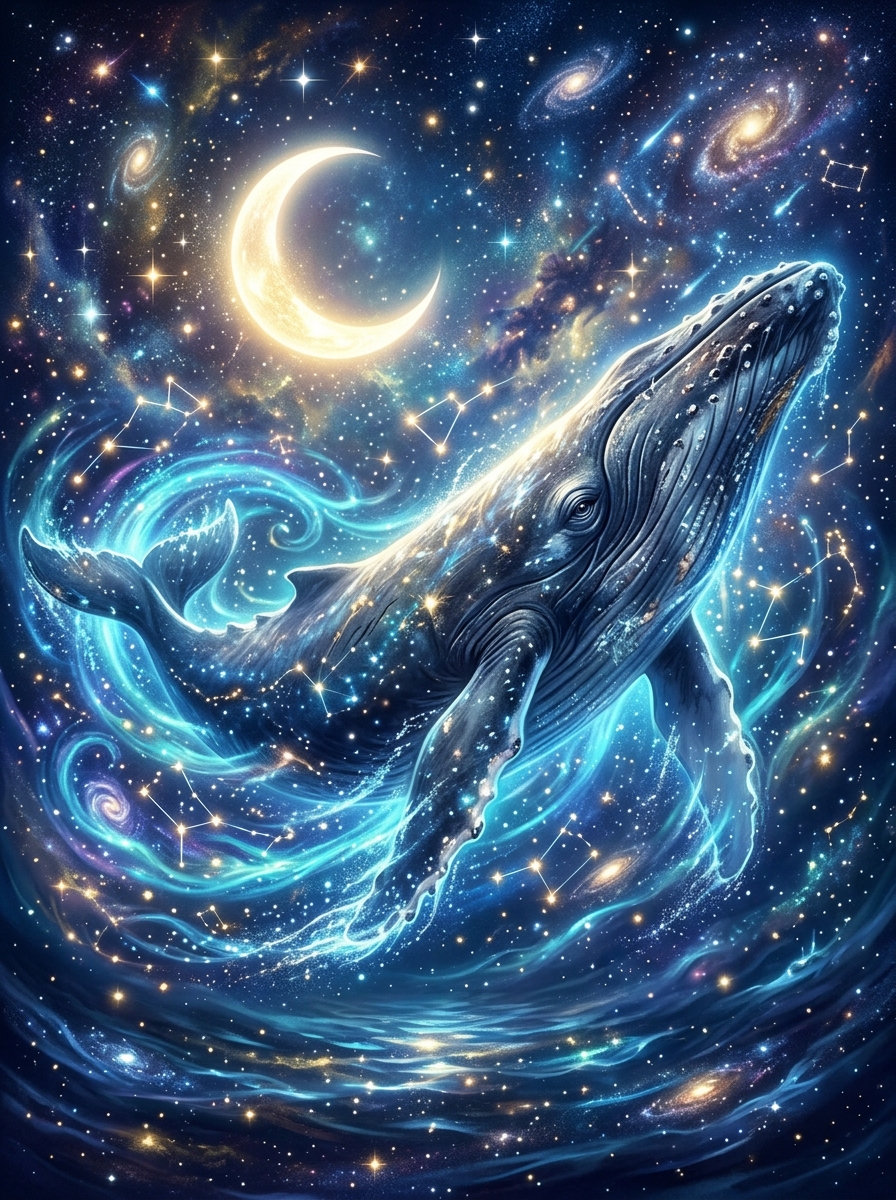
A whale in a dream is never a casual image. It arrives with mass, depth, and a gravity that changes the emotional climate of sleep itself. Unlike a fish or a dolphin—surface swimmers that signal fragments of daily life—a whale belongs to the deep. It moves through an ocean that in dream language stands for the totality of feeling, the unconscious, the ancestral murk. When a whale appears, the psyche is saying: something enormous is stirring below your ordinary awareness.
The Whale’s Essential Meaning
Dreams about whales are not about “big emotions” in a generic sense. They are about emotions that have become too saturated, too old, or too consequential to fit into ordinary speech. The whale embodies scale—not just size but also pressure, time, and the weight of what has been submerged. Jungian psychology would call it an archetypal image of the Self, the organizing center of the psyche that dwarfs the ego. But you do not need jargon to feel it: a whale dream leaves a residue of awe, solemnity, or unease because it touches something that cannot be reduced to a simple explanation.
The ocean context is essential. If the dream shows you standing on a shore watching a whale breach, the message is about something external surfacing—a truth, a memory, a life change rising into view. If you are underwater with the whale, you are already inside that emotional reality. The dream is showing you that the issue is not “out there” but already part of your submerged life. The whale does not need to do anything dramatic to carry meaning. Its mere presence shifts the frame.
The Action Tells the Story
What the whale does in the dream determines which facet of the archetype is active. A breaching whale—one that explodes upward—usually signals repression breaking open. Something that has been building for a long time now insists on being seen. This can feel revelatory or alarming, depending on how ready you are to face it. A whale that simply swims nearby, calm and unhurried, points to a vast force in your life that is moving according to its own rhythm. You are not meant to control it; you are meant to witness it with respect. The dream may be asking for humility, not intervention.
A whale that threatens or swallows you tilts the meaning toward overwhelm. This is the Jonah pattern: a symbolic descent into darkness before renewal. The feeling of being consumed—by grief, by a relationship, by a career turning point—is not a sign of failure. It is the psyche’s way of insisting that you stop minimizing the scale of what you’re carrying. Even a terrifying whale dream can be a kind of reverence in its early, raw form.
When you swim alongside a whale willingly, the dream often indicates alignment with your deeper self. The whale here is not a threat but a companion. It can symbolize a period of life in which you are trusting your intuition, letting go of hyper-vigilance, and moving at a pace that your unconscious approves. The emotional tone—friendly, ominous, neutral—is your best guide. The same action can mean very different things depending on whether you feel exhilarated or terrified.
Psychological Roots and Functions
Why does the psyche choose a whale rather than a shark, a storm, or a mountain? Because the whale is a mammal that lives in the ocean yet must surface to breathe. It inhabits two worlds: the deep and the air. That dual nature mirrors the dreamer’s own situation. You have a submerged life—intuitions, grief, ancestral patterns, bodily knowing—that needs to be acknowledged without being fully dragged into the rational light. The whale is the bridge: it can descend and rise.
From a depth-psychological perspective, whale dreams often appear during transitions that are emotionally dense: pregnancy, mourning, leaving a long-term role, or recognizing a desire you have been denying for years. They also surface when the dreamer has been overusing analysis and underusing receptivity. The dream compensates by offering an image that cannot be handled by cleverness. It demands a different kind of attention—still, patient, embodied.
Whale dreams can also carry ancestral weight. Because whales migrate, communicate across vast distances, and nurture their young for extended periods, they sometimes symbolize inherited emotional life. A dream may be pointing to family patterns that have been passed down unconsciously—loyalty, silence, survival strategies, a sense of belonging to something older than your personal biography. In that sense, the whale is not merely “your emotion.” It is a collective thread running through your lineage. If you want to explore how we distinguish such archetypal symbols from ordinary wish fulfillment, our editorial framework explains the approach we use across all these readings.
How the Dream Plays Out in a Life
Because the whale dream is about scale, it manifests differently in different domains while always pointing to the same underlying dynamic: something in your life has become too large to manage with your current strategies.
In a relationship context, a whale may appear when the depth of your feeling for someone has outpaced your ability to express it—or when a partnership is carrying unspoken grief or legacy from both families. The dream is not telling you to fix the other person. It is telling you to stop pretending the relationship is small.
In work or vocation, a whale dream often surfaces when your purpose exceeds your current role. You may be in a job that fits your résumé but not your calling. The whale does not say “quit.” It says: acknowledge the gap. Let yourself feel the dissatisfaction instead of numbing it. That honesty will shift the ground.
During major transitions—moving, becoming a parent, losing someone—a whale dream can mark the emotional weight of the change. It is not predicting disaster. It is showing you that you are in the middle of something real, something that will shape you. The dream’s comfort or terror reflects your current capacity to hold that weight. Over time, as you metabolize the transition, the same whale may reappear in calmer seas, signaling that you have grown into its scale.
Reading Your Whale Dream Without Flattening It
The most reliable interpretation begins with one question: What emotional effect did the dream leave on waking? Awe, fear, peace, curiosity—each points to a different relationship with the material. Then move to context. What part of your life feels bigger than your ordinary language? Where are you circling but not entering? The whale is one of those symbols that rewards precision: a small detail—color, species, whether it is singing or silent—can change the entire reading.
If your dream involved a blue whale, the theme of enormity intensifies. This animal is the largest that ever lived; it dwarfs all perspective. A blue whale often appears when the dreamer is facing something that feels archetypal: a loss that reorders your life, a destiny that is not optional. A humpback whale, known for its songs, brings in the dimension of voice. If it is singing, the dream may be about longing to be heard across a great distance—or about the beauty of something that has no practical use but matters anyway. A dead or stranded whale shifts the tone to blocked feeling, ecological grief, or the collapse of something once immense. The dream may be asking where vitality has become unsustainable, or where a vast emotional life has been left without proper support.
For readers who want to deepen their symbolic vocabulary, our approach to dream interpretation can help you notice what belongs to the image itself and what belongs to your own life. The whale dream, at its clearest, is the psyche’s way of saying: there is more here than you can see from the shore. Do not try to shrink it. Meet it with stillness.
Comments
Loading comments…