Dream About a Lion: Power, Fear, and the Moment You Can’t Ignore
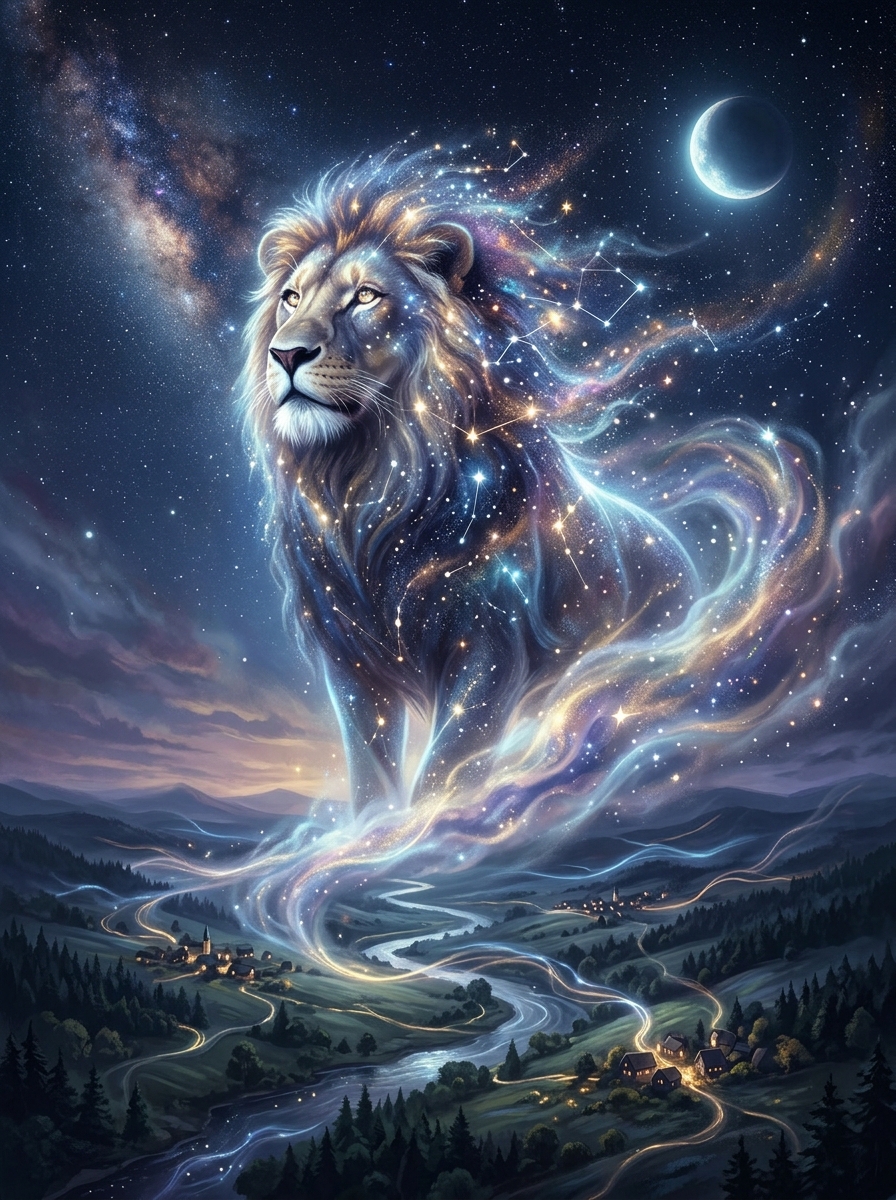
A dream about a lion is almost never decorative. It arrives when power — your own, another’s, or the kind that cannot be reasoned with — has crossed a threshold in your waking life. The core question is not what the lion symbolizes in general, but what role it played in your dream. Behavior overrides abstraction: a watching lion differs from one that charges, guards, sleeps, or follows. This is the first discipline of reading dream imagery, and it prevents the symbol from collapsing into a one-size-fits-all token. For a broader framework on how symbols gather meaning across dreamwork, tarot, and astrology, the interpretive approach we use at Aurora Arcana is built around that same principle of contextual precision.
The Lion as a Threshold Symbol
The lion shows up at a tipping point. Psychologically, it often marks the moment when instinct, authority, courage, pride, or threat has become too large to keep at the edge of awareness. The psyche does not waste a lion on trivial matters. If the dream felt charged but not terrifying, it may be testing whether you are ready to own a larger role: leadership, visibility, sexual confidence, or a decision that requires backbone. If you were afraid, the question shifts. What power in your waking life feels bigger than your ability to contain it? A common mistake is to treat every lion dream as a call to dominate. Sometimes the dream is correcting the opposite problem — you have been shrinking your own force until it returns as menace.
The lion also acts as an archetype of sovereignty. Not status for its own sake, but the capacity to occupy your own ground. In Jungian terms, it can be a shadow figure if you have disowned aggression, ambition, or pride. But it can also be a guardian of the Self — the part of the psyche that knows what is worth protecting and what is beneath your consent. The dream asks you to distinguish between these two registers before you reach for an interpretation.
Where the Power Resides: Internal vs. External
The first distinction to draw is whether the lion represents something inside you or something outside you. In some dreams, the lion is plainly external: a boss, partner, parent, rival, or institution with real force behind it. In others, the lion is internal: a newly awakened boundary, a drive you have previously softened, or a confidence you have dismissed as arrogance. The same image can serve both functions depending on the dreamer’s context.
When the lion feels external, the dream often points to a situation in which you feel overpowered or overshadowed. The dream is not predicting conflict; it is registering that a power dynamic has become salient. The psyche chooses the lion because the issue carries momentum, authority, and teeth. When the lion feels internal, the dream may be surfacing a part of you that has been waiting for permission to act. This is where the shadow work begins: what have you been keeping caged? A tame lion in a dream can indicate controlled anger or constrained vitality. A wild lion says the force is alive and untamed. The difference between the two tells you whether containment is wisdom or starvation.
The Instinctual Self
Psychologically, the lion often stands for instinct with rank. It is not the nervous animal in the bushes; it is the animal that knows it can win. Dreams about lions frequently arrive when someone has been over-accommodating, over-rational, or too eager to explain away a gut response. The lion refuses that. It asks for dignity, appetite, and directness. This does not mean every lion dream is a license to roar. Sometimes the dream is revealing that your natural authority has been dulled by politeness or fear of being seen as aggressive. The corrective dose may be as subtle as speaking your truth without apology in a meeting, or as bold as ending a relationship where your power has been chronically undermined.
The Emotional Register: Fear, Awe, or Protection
The emotional tone of the dream changes the interpretation more than the image itself. A peaceful lion indicates protected strength; a panic dream signals tension around control. The mind does not use the same animal to describe those two states.
If the Lion Is Attacking
An attacking lion often reflects a force you experience as too strong, too close, or too punitive. This might be external criticism, a conflict you have delayed, or a harsh inner voice that has learned to roar. If you fought the lion, the dream may be about how you meet conflict: head-on, defensively, or with too much heat. If you ran, the dream may reveal avoidance, but not cowardice. Flight in dream logic can mean your nervous system has not yet found a tolerable strategy for a problem that feels oversized. The useful question is not “why did I run?” but “what in my life currently feels impossible to argue with?”
If the Lion Is Protecting You
A lion that stands between you and something else may represent protection, not danger. This is one of the most overlooked variations. The dream may be showing that a boundary has finally emerged in your psyche — a refusal, a no, a line you can defend. Protection can feel frightening when you are unaccustomed to it because it requires occupying space. People often mistake their own boundaries for aggression before they learn the difference. If the lion is calm but alert, the dream implies readiness. If it is resting near you, there may be an instinctive part of you that already knows the situation is survivable, even if your conscious mind has not caught up. In that sense, the lion can function as a dream-bodyguard, embodying the capacity to withstand pressure without collapsing into appeasement.
Variations That Shift the Emphasis
Not every dream about a lion concerns brute force. Variations matter because they shift the emphasis from power itself to how power is carried, inherited, or transformed. The dream’s exact form tells you what kind of power the psyche is trying to name.
Cub, Lioness, White Lion
A lion cub often symbolizes emerging strength, early confidence, or a vulnerable version of courage. It can point to a talent or leadership quality that is still developing and therefore easy to underestimate. If you felt tenderness toward the cub, the dream may be asking for protection around a new identity. If the cub was feral, you may be witnessing a powerful instinct before it has learned restraint.
A lioness changes the emphasis again. She is not the image of public sovereignty so much as watchfulness, hunting skill, and protective force. A lioness dream may speak to fierce care, maternal authority, strategic patience, or the kind of strength that does not announce itself until it is already in motion. If the dream featured a lioness with cubs, the issue may be guardianship: what in your life needs defending before it can mature.
A white lion carries an intensified or rarified feel. In dream symbolism, whiteness can suggest unusual clarity, spiritualized power, or a power image stripped of ordinary aggression. But it can also indicate projection — the psyche dressing an intense force in purity so it feels safer to approach. In either case, the dream is asking you to meet power without reducing it to something merely decorative.
Mythic and Domestic Settings
A lion in a house, bedroom, or familiar place brings the archetype into private life. This can point to family authority, boundaries inside intimate relationships, or the feeling that power has entered spaces where you usually expect comfort. A lion in the bedroom often leans toward intimacy, sex, and vulnerability — not necessarily romance, but the exposure that comes when defenses are down. A lion in the wild preserves its natural meaning most strongly: untamed force, instinct, nobility, danger, and vitality. A lion in a zoo suggests power under observation — something magnificent but constrained, or something you can see clearly without fully meeting it. If you felt compassion for the caged lion, the dream may be about a strong aspect of yourself that has been civilized into silence.
What the Dream Demands Now
A lion dream usually leaves a residue: adrenaline, awe, unease, or a strange sense of being summoned. That residue is part of the message. These dreams often appear when a person is approaching a threshold where passivity is no longer neutral. Something in you knows it is time to act with more authority, or to recognize that someone else already is.
The most useful question is practical and psychological at once: where in your life do you need more courage, and where do you need less? The lion can expose both defects — timidity when strength is required, and aggression when restraint is required. A dream about a lion is rarely a simple endorsement of force. It is more exacting than that. It asks whether your power is earned, integrated, and properly aimed.
In love, a lion dream may surface a need to set clearer boundaries or to stop shrinking to make someone else feel big. In work, it may signal that a leadership moment has arrived and your hesitation is costing you. In relationships more broadly, it may ask you to recognize where you have surrendered your ground to a dominant other. These are all applications of the same core dynamic: the lion tests what kind of power you can recognize without flinching.
If the dream felt auspicious, you may be stepping into a larger version of yourself. If it felt threatening, you may be confronting a fear of power itself — either yours or someone else’s. If it felt sacred, the psyche may be showing you the animal form of dignity: not politeness, not performance, but presence. For readers who like to think across symbol systems, the interpretive method we use at Aurora Arcana treats the dream as the primary text — an encounter, not a slogan. The lion did not arrive to flatter you. It arrived to ask what you are willing to stand for.
Comments
Loading comments…