Venus Opposite Jupiter: The Heart That Wants More
The architecture of appetite
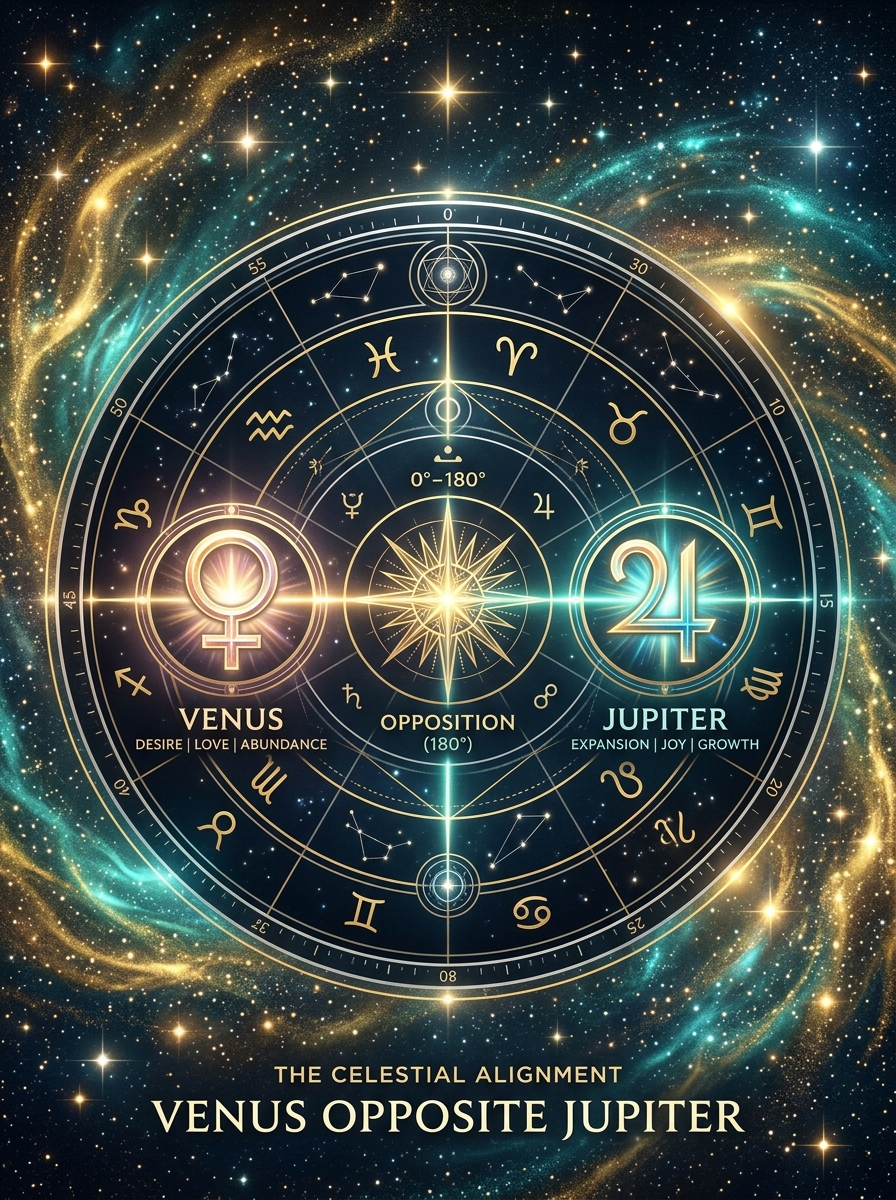
Venus opposite Jupiter is not a conflict between pleasure and principle. It is a confrontation between two kinds of largeness. Venus wants what feels good, harmonious, and relationally fitting—a beautiful object, a balanced exchange, a love that is sweet without being heavy. Jupiter wants what feels meaningful, expansive, and worth believing in—a horizon, a philosophy, a sense that life has more room than the present moment suggests. In opposition they face each other across the chart like two generous monarchs who cannot agree on the budget. Neither is wrong; both are convinced that abundance alone will resolve the tension.
What this produces in a person is a hunger that is not greedy in a crude sense, but restless. The soul here often develops by swinging between Venusian refinement and Jupiterian enlargement until it learns that beauty without measure becomes brittle, and optimism without taste becomes waste. The underlying structure of the aspect—the mirror, the friction, the need for integration—belongs to opposition dynamics generally, and the astrological opposition provides the grammar for how such a polarity grows into consciousness.
A double longing that cannot be flattened
The most common misreading is to call this aspect a love of luxury. That misses the psychological architecture. A person with this opposition does not simply want more things; they want more life. Venus asks for what feels appropriate and pleasing; Jupiter asks for what feels significant and unbounded. Together they create a person who may be magnetic, generous, and socially fluent, but who is also haunted by the suspicion that goodness should be larger than the container available.
That double longing often shows up as a charm that is real, not performed. These people make others feel welcomed into a larger emotional weather system. They can be gracious hosts, fair-minded lovers, and unusually generous friends. But the same openness can become a blind spot. Jupiter magnifies whatever it touches, and in opposition to Venus the desire for pleasure can outrun proportion. Spending too freely, loving too optimistically, eating or entertaining beyond measure, idealizing a partner and then feeling bewildered when ordinary human limits appear—these are not signs of a broken character. They are the natural overflow of a psyche that confuses abundance with excess because both feel spiritually persuasive.
The roots of the restlessness
To understand how this aspect forms a life, one must go beneath the behavior to the motivation. The opposition creates a psychic loop: Venus finds something beautiful, and Jupiter immediately asks, Is that all? Not from disdain, but from a sincere belief that more must be possible. The native may have high expectations paired with genuine magnanimity. They want love to be generous, playful, uplifting—and they may unconsciously insist that the relationship validate a grand self-image. When it cannot, disappointment is oddly dramatic because the original hunger was so large.
This restlessness is not a flaw; it is the engine of the aspect. The person is pushed to grow beyond the small satisfactions that content others. But the engine can run hot. The shadow side is not simply "too much fun"—it is the tendency to use pleasure as a solvent for discomfort. When conflict threatens, they may smooth it over with a gift, a joke, a big-hearted gesture that postpones the harder conversation. When loneliness appears, they may shop, flirt, host, or consume. When self-doubt rises, they may inflate the story of what they deserve. Jupiter becomes a booster rocket for Venusian avoidance: Sure, I can afford it. Of course it will work out. Why should I settle?
That is where discernment becomes the true spiritual task. The aspect can attract abundance, but it must learn the difference between a blessing and a binge. It may look graceful from the outside while quietly leaking energy through excess. The issue is rarely deprivation; it is calibration.
The expression in life: love, money, and the shape of generosity
Because the opposition creates a pattern that repeats across domains, it is more useful to see the common thread than to list separate life areas. Wherever Venus and Jupiter touch—relationships, finances, taste, social life—the same dynamic plays out: desire for fullness meets the necessity of limits. The skill is learning which limits are worth honoring and which are simply invitations to expand intelligently.
In love, the aspect can fall hard for beauty, promise, and possibility. Romance must feel meaningful, not merely pleasant. The danger is that Jupiter keeps enlarging the projection until the partner becomes emblematic of hope, destiny, the self's untapped future. When reality corrects the fantasy, the native may feel betrayed—yet they are also unusually forgiving, especially when they have learned to respect imperfection as part of human scale. For a deeper look at how Jupiter operates in partnership contexts, Jupiter in the seventh house explores the tension between expansion and commitment directly.
In money, the native often spends as if comfort were a renewable resource. They may earn well—charm and instincts for value are strong—but earnings and expenditures both swell quickly. Financial wisdom matters more than financial instinct. The Jupiter in the second house page details how this planet can inflate self-worth and resources alike, and the same warning applies here: abundance without discipline becomes a leaky vessel.
Taste is another arena. The person has a broad palate and an instinct for what feels lush, generous, and alive. They dislike cramped environments, stingy aesthetics, joyless rules. Their style leans toward richness—deep colors, layered textures, lively spaces. When disciplined, this becomes a signature. When undisciplined, it becomes clutter and aesthetic sprawl. The Venus side, when well-placed, can anchor this generosity in form. Venus in the 10th house shows how that grace can find professional expression; the opposition simply adds the hunger for scale.
The sign inflection
The opposition never speaks naked; sign and house add crucial color. In fire signs, the dynamic acts openly, exuberantly, even dramatically—think of Jupiter in Sagittarius or Venus in Leo, where the desire for expansion becomes a quest. In earth signs, the issue grounds in spending, comfort, and material plenty—Jupiter in Taurus shows a patient, sensory version of the tension. In air signs, the opposition turns social: flirtation, ideas about love, multiplication of connections—Jupiter in Libra offers a graceful, justice-oriented version of the expansive benefic. In water signs, the emotional flooding can make the native tender, sentimental, or prone to oceanic projection—Venus in Pisces illustrates the devotional side that can dissolve boundaries entirely.
The maturation: from excess to magnanimity
The mature form of Venus opposite Jupiter is not restraint for its own sake. It is scale brought under conscious direction. The person learns how to let joy be large without becoming inflated, and how to let generosity be real without becoming financially or emotionally reckless. The goal is not to make the appetite disappear; it is to educate it.
This education usually arrives through repeated contact with limits. A budget fails. A relationship cannot sustain the fantasy. A social life becomes too crowded to nourish anyone. A beautifully phrased promise meets the rough grain of the real. These are not punishments; they are calibrations. The aspect improves when the person stops trying to prove that more is always better and starts asking what, exactly, is worth enlarging.
In psychological terms, Venus carries the capacity to value, and Jupiter carries the capacity to believe. Together they can produce faith in beauty, trust in reciprocity, and a robust social conscience. But faith without discrimination becomes naive, and beauty without boundaries becomes hunger in disguise. Integration means learning to choose what deserves enlargement.
The deeper integration is not austerity but intelligent abundance. The person may still love lavishly, spend generously, and seek delight with conviction. The difference is that their largeness becomes intentional rather than compulsive. They stop using excess as reassurance. They begin to trust that the right amount can be enough—that the appetite itself, when honored with discernment, becomes a compass rather than a current.
Jupiter transits often make this natal opposition especially vivid, activating periods of expansion, risk, and choice where the old pattern of overextension may resurface as an invitation to mature. And the general doctrine of how oppositions generate consciousness through tension—the mirror and the shadow—is laid out in the opposition aspect page. What remains is the daily work: to love life so much that you refuse to waste it, and to trust that fullness is a path, not a destination.
Related
- Venus Conjunct Jupiter: The Joy That Grows Too Large to Hide
- Venus Square Jupiter: When Pleasure Outgrows the Frame
- Sun Opposition Jupiter: The Grand Self and the Problem of Too Much Life
- Moon Opposite Jupiter: The Hungry Heart and the Blessing That Overflows
- Jupiter Opposition Saturn: The Tension Between Faith and Form
Comments
Loading comments…