Saturn in Pisces: The Alchemical Vessel of the Soul
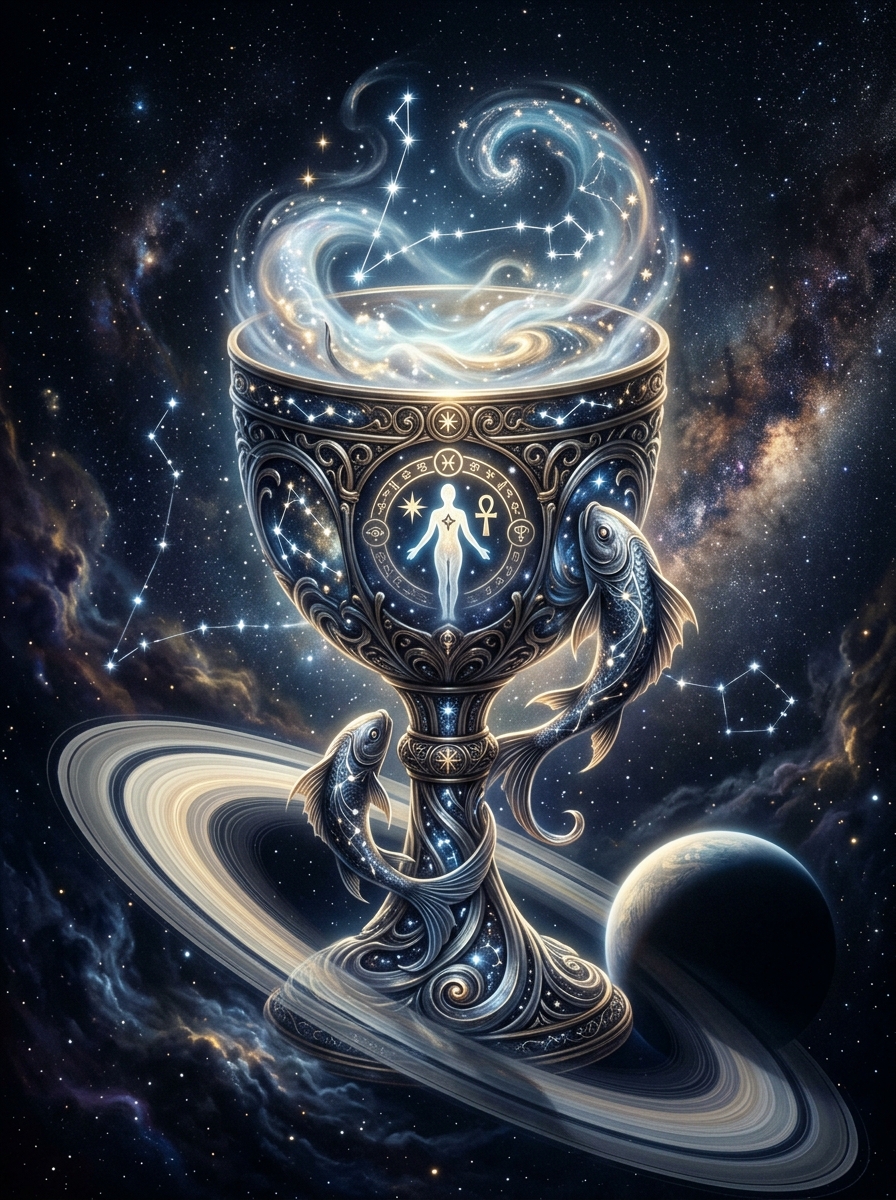
1. The Archetypal Tension: Boundaries Meeting the Boundless
The Saturnian Boundary and the Piscean Ocean
To understand Saturn in Pisces is to contemplate one of the most profound and challenging polarities in the entire astrological pantheon. Here, the archetype of structure, limitation, and concrete reality—Saturn, the Grim Reaper, the Lord of Karma and Time—is submerged into the boundless, fluid, and infinite waters of Pisces. Ruled by Jupiter and Neptune, Pisces represents the final stage of the zodiacal journey, where all individual boundaries dissolve back into the collective unconscious, the primal ocean of unity and spiritual oneness. When Saturn is placed in this watery sign, the individual is tasked with a monumental evolutionary challenge: they must build a structured vessel in a realm where no structures naturally exist. It is the metaphysical equivalent of trying to build a fortress out of fog, or drawing boundaries on the surface of the ocean.
In classical astrology, Saturn represents crystallization, form, and the physical reality of three-dimensional space. It is the principle of the boundary—the line that separates "me" from "not me," the ego defense mechanisms that protect the individual identity from being swallowed by the outer world. In ancient times, Saturn was viewed as a harsh, malefic force, representing blockages, suffering, and the limitations of physical existence. However, modern psychological astrology has reframed Saturn as a vital agent of growth. It is through facing our limitations, taking responsibility, and enduring the slow process of maturation that we build a stable sense of self. Conversely, Pisces represents the complete absence of boundaries. It is the mystical longing to return to the womb of the universe, to experience transcendence, and to dissolve the painful isolation of individual existence. When these two opposing forces meet, a natural psychological tension arises. The individual with Saturn in Pisces feels a deep, often unconscious anxiety regarding the dissolution of their identity. There is a fear of being overwhelmed by the ocean of collective suffering, collective emotions, and psychic noise.
This placement demands that we look at the work of Carl Jung, particularly his concepts of ego-dissolution and the integration of the collective unconscious. Jung warned that without a strong, well-structured ego, the psyche risks being flooded by archetypal forces, leading to psychological inflation or psychosis. Saturn in Pisces is the astrological signature of this exact struggle. The individual must learn to develop a strong, realistic sense of self while remaining open to the spiritual and mystical dimensions of life. If they lean too far into Saturn, they build rigid, armored walls of skepticism, cold intellectualism, and fear-based denial of the unseen. They reject their intuition and lived emotional truths because they cannot categorize or measure them. If they lean too far into Pisces, they lose themselves in fantasy, escapism, addiction, or spiritual bypass, unable to function in the material world.
From the perspective of psychological astrology, as articulated by Liz Greene, Saturn represents the shadow—the place where we feel most vulnerable, inadequate, and fearful, but also the gateway to our greatest psychological maturity. With Saturn in Pisces, the vulnerability lies in the realm of feelings, intuition, and spiritual connection. The individual may harbor a deep-seated fear of their own emotional depth or a paralyzing guilt that they cannot logically explain. This "existential guilt" is a hallmark of the placement. Because Pisces senses the suffering of the entire world, the Saturnian side of the personality interprets this sensitivity as a personal duty. The individual feels responsible for the pain of others, leading to an overwhelming sense of inadequacy. The path to maturity requires recognizing that one cannot carry the weight of the cosmos on their shoulders, and that true spiritual responsibility begins with the self.
Steven Forrest, in his work on evolutionary astrology, views Saturn as the planet of teacher-energy and great work. In the sign of the fishes, the great work is spiritual and emotional discipline. The soul has chosen a path where it must learn to master the fluid realms of intuition, dreams, and art. This is not a lifetime for passive contemplation or lazy mysticism. It is a lifetime for active, disciplined engagement with the sacred. The individual must become an anchor for the divine, translating the formless inspirations of the Piscean ocean into concrete, Saturnian structures that can serve, heal, and inspire others in the material world. This requires a willingness to face the silence, to endure the dry periods of spiritual seeking, and to treat the invisible world with the same respect and rigor that a scientist applies to the laboratory.
2. The Contemplative Container: Cultivating Spiritual Discipline
From Escapism to Sacred Routine
For the individual with Saturn in Pisces, the temptation to escape the harsh realities of material existence is a constant gravitational pull. The material world, with its loud noises, sharp corners, and demanding structures, can feel incredibly hostile to a sensitive Piscean soul. When the pressure of Saturnian reality becomes too intense, the natural defense mechanism is to retreat. This retreat can take many forms: excessive daydreaming, spiritual bypassing, losing oneself in media, or turning to substances that promise temporary relief from the burden of individuality. However, Saturn is an uncompromising taskmaster. It demands that we face our fears and build functional structures in the physical world. Therefore, the key to navigating Saturn in Pisces is not to escape, but to create a "contemplative container"—a structured space where the spiritual and creative dimensions of life can be safely explored and integrated.
To understand this container, we can use the metaphor of an aqueduct. Uncontrolled water is destructive; it floods the land, washes away crops, and stagnates into swamps. But when that same water is channeled through a stone aqueduct, it becomes a life-giving resource that can hydrate cities and power mills. Saturn represents the stone aqueduct, while Pisces represents the wild, flowing water. Without the Saturnian container, Piscean energy dissipates into unproductive fantasies and emotional confusion. The individual must establish a daily routine that grounds their sensitivity. This means committing to a structured spiritual or creative practice, not just when inspiration strikes, but as a matter of daily discipline. This routine serves as a psychological anchor, protecting the individual from being swept away by the shifting currents of their environment.
This discipline must be approached with a contemporary American sensibility—mystical, yet highly practical. It is the integration of the sacred into the mundane. A daily meditation practice, a structured journaling habit, or a dedicated hour of creative writing are all ways of building this alchemical container. It is not about reaching a state of perfection, but about the commitment to showing up. As Liz Greene notes, Saturn teaches us through repetition, delay, and effort. The spiritual life is not a series of sudden, effortless enlightenments; it is a slow, steady building of consciousness, brick by brick. By setting aside a specific time and place for contemplative work, the individual signals to their subconscious that they are ready to receive and organize intuitive material.
The symbolism of the Rider-Waite-Smith tarot deck offers beautiful illustrations of this dynamic. Consider Major Arcana IX, The Hermit. The Hermit stands alone on a cold, snowy peak, holding a single lantern containing a six-pointed star. This is the archetype of Saturn in Pisces: the voluntary withdrawal from the noise of the world, not out of fear, but to cultivate inner light. The snow represents the cold, crystallized structures of Saturn, while the lantern represents the Piscean spiritual truth that must be guarded and carried through the dark. Similarly, Major Arcana XIV, Temperance, shows an angel pouring liquid between two cups. This is the art of containment, balance, and moderation. The angel does not let the water spill or evaporate; they transfer it carefully, representing the disciplined management of emotional and spiritual energies.
By committing to a sacred routine, the Saturn in Pisces individual transforms their relationship to the unseen. They no longer view spirituality as a chaotic force that threatens to dissolve their sanity, nor do they view the material world as a prison. Instead, they realize that the material world is the canvas upon which the spiritual must be painted. They learn to treat their daily chores, their professional duties, and their relationships as forms of spiritual practice. In doing so, they anchor the infinite within the finite, creating a life that is both deeply rooted in reality and open to the heavens.
3. Psychological Depth and the Alchemical Vessel
The Vas Bene Clausum and Ego Integrity
In the classical texts of Hermetic alchemy, great emphasis is placed on the vas bene clausum—the well-sealed vessel. The alchemists understood that the transformation of base metal into spiritual gold required a container that could withstand the intense heat of the furnace without cracking. If the vessel was poorly sealed, the volatile spirits would escape, and the alchemical work would fail. In modern Jungian psychology, this alchemical vessel is understood as a metaphor for the human ego. The ego must be strong, flexible, and well-integrated to contain the potent, often volatile contents of the personal and collective unconscious. For those born with Saturn in Pisces, the creation and maintenance of this psychological vessel is their primary life task.
Because Pisces is a mutable water sign, its natural state is one of permeation and merging. Individuals with this placement possess highly porous psychological boundaries. They absorb the moods, anxieties, and unexpressed traumas of those around them like a psychic sponge. Without a solid Saturnian container, this constant influx of external energy leads to psychological exhaustion and a fragmented sense of identity. The individual may feel as though they do not know where they end and another person begins. They may suffer from unexplained emotional swings, picking up on the collective dread of their environment and mistaking it for their own personal pathology.
To build the vas bene clausum, the individual must undergo a process of rigorous psychological differentiation. They must learn to analyze their emotional states with objective, Saturnian clarity. When a wave of sadness, fear, or guilt washes over them, they must ask: "Is this emotion mine, or am I carrying it for someone else? Is this anxiety a response to my immediate reality, or am I tapping into the collective unconscious?" This analytical approach, championed by Jungian analysts, helps to reinforce the boundaries of the ego. It does not shut out the unconscious, but it ensures that the ego remains the conscious director of the personality, rather than being dragged under by the currents of the unconscious mind.
Liz Greene writes extensively about the defensive armor that Saturn can build when it feels threatened. In Pisces, this armor often takes the form of a rigid, defensive skepticism. The individual, terrified of their own sensitivity and the chaotic nature of the unconscious, may adopt a hyper-rationalist stance. They may reject all things spiritual, intuitive, or mystical, clinging to a sterile materialism as a way of keeping the terrifying ocean at bay. However, this is a false vessel; it is brittle and prone to shattering under the weight of life's inevitable crises. True ego integrity is not rigid; it is resilient, like a well-crafted ship that can flex with the waves while keeping the water out.
Furthermore, a weak vessel can lead to the psychological phenomenon of inflation. When the boundary between the ego and the collective unconscious dissolves, the ego can become flooded by archetypal images. The individual may begin to believe they have a unique, savior-like mission, or that they possess special spiritual insights that place them above the rules of ordinary life. This is the shadow side of Pisces—a lack of discrimination and realism. Saturn's role is to act as a reality check, requiring that every spiritual intuition be tested against the physical laws of cause and effect. It demands that we ground our visions in everyday service and practical ethics, ensuring that our spiritual path remains constructive rather than destructive.
4. Transmuting the Martyr Complex: Guilt, Savior Dynamics, and the Art of Saying No
Setting Compassionate Boundaries
One of the most insidious psychological traps for the Saturn in Pisces placement is the martyr complex. Because Pisces is inherently connected to the collective pool of human suffering, these individuals feel a profound, soul-deep empathy for anyone who is hurting. Saturn, the archetype of duty, obligation, and guilt, takes this empathy and turns it into a heavy moral imperative. The individual believes, consciously or unconsciously, that they are personally responsible for saving others. They become the classic "rescuer," entering into relationship dynamics where they constantly sacrifice their own physical, emotional, and financial well-being to prop up someone else. This Savior Dynamic is not only exhausting, but it also prevents both the martyr and the person they are trying to save from achieving true maturity.
Under psychological scrutiny, the savior complex is revealed to be a defense mechanism against existential helplessness. It is easier to focus on fixing someone else's chaotic life than it is to face the structured, difficult work of organizing one's own. By focusing on the partner, the friend, or the family member in crisis, the Saturn in Pisces individual avoids the Saturnian task of self-actualization. Furthermore, this dynamic carries a subtle form of spiritual pride. The savior assumes that they know what is best for the other person, robbing that individual of the opportunity to learn from their own struggles, make their own mistakes, and face their own Saturnian consequences.
To understand this dynamic more deeply, we can look at Karpman's Drama Triangle, which consists of three roles: the Victim, the Rescuer, and the Persecutor. The Saturn in Pisces individual typically enters the triangle as the Rescuer. They identify a "Victim" whom they believe needs saving. They pour their energy, time, and resources into the rescue effort. However, because the Rescuer's boundaries are porous, they eventually become overwhelmed and exhausted. When the Victim fails to recover or demands even more support, the Rescuer feels exploited and shifts into the role of the Victim themselves, feeling unappreciated and abused. Alternatively, they may snap and become the Persecutor, lashing out at the person they were trying to help. This cycle is destructive and can only be broken by refusing to play the game in the first place.
To transmute this complex, the individual must learn the difficult art of saying "no." In the vocabulary of Saturn in Pisces, "no" is not a word of rejection or cruelty; it is a sacred boundary that protects the integrity of both parties. Setting a boundary is an act of profound compassion. It acknowledges that everyone has their own unique path, their own karma to resolve, and their own strength to discover. When we refuse to rescue someone, we are signaling our belief in their capacity to save themselves. It forces them to look inward for their own Saturnian structure, rather than relying on an external crutch.
Healing this dynamic also requires addressing the deep-seated existential guilt that haunts the placement. Saturn in Pisces individuals often feel a vague, persistent sense of sin or debt, as if their very existence is something they must constantly apologize for or pay off through suffering. They must learn to dismantle this punitive inner judge. They must realize that their value is not determined by how much pain they can absorb or how many people they can rescue. They are allowed to exist, to be happy, and to have limits. Practical boundary-setting involves developing clear, verbal communication strategies. The individual must learn to state their limits clearly and without apology. For example, instead of saying, "I'm so sorry, I wish I could help you, but I'm just so busy and tired," which leaves the door open for manipulation and guilt-tripping, they must learn to say, "I cannot help you with this project, but I trust you will find a way to handle it." This clean, direct communication is the hallmark of a mature Saturn.
5. Saturn in Pisces in the Workplace: Structured Empathy and Artistic Form
Careers in Deep Therapy and Concrete Creation
When Saturn in Pisces is successfully integrated, it yields a powerful professional skillset: structured empathy. This is the ability to connect deeply with the human experience, to navigate the complex emotional and psychological waters of others, while maintaining a firm, professional, and ethical frame. Rather than being overwhelmed by the workplace, these individuals can thrive in environments that require both deep compassion and rigorous organization. They are the natural bridge builders between the worlds of spirit and matter, feeling and logic, art and structure.
One of the most natural expressions of this placement is in the fields of deep psychotherapy, Jungian analysis, and systemic family counseling. A therapist with Saturn in Pisces possesses the rare ability to sit with a client's deepest pain, trauma, and shadow material without flinching or running away. Their Piscean sensitivity allows them to read between the lines, to sense what is left unsaid, and to hold space for the client's unconscious processes. At the same time, their Saturnian maturity provides a safe, reliable, and consistent therapeutic frame. They understand the necessity of boundaries, session limits, ethical guidelines, and professional distance. They do not merge with the client; instead, they serve as a stable anchor, allowing the client to explore their own internal depths safely.
Another major domain for this placement is structured art and creative production. In the arts, Pisces provides the raw, fluid inspiration—the dreams, the colors, the melodies, the poetic visions. But raw inspiration is not enough to create a masterpiece; it requires the discipline, technique, and structure of Saturn. Saturn in Pisces individuals excel at taking these ethereal visions and crystallizing them into physical form. We see this in fields like:
- Film Editing: The editor must take hours of chaotic, fluid footage (Pisces) and cut it into a structured, rhythmic, and logical narrative (Saturn). They must have the discipline to discard beautiful but unnecessary scenes for the sake of the overall story structure.
- Musical Composition: The composer translates emotional currents and abstract sounds into the rigorous mathematical language of sheet music, timing, and arrangement. They create the structural rules within which the emotional melody can fly.
- Architecture: The architect designs physical structures that not only serve a practical purpose but also evoke a sense of space, light, and spiritual contemplation. They build the physical container that shapes the human experience of the environment.
In the caregiving professions, such as nursing, hospice care, and social work, Saturn in Pisces individuals can design and run systems that protect the most vulnerable members of society. They do not just feel sorry for the homeless or the sick; they build shelter systems, organize food banks, and draft healthcare policies. They understand that to truly help those in need, empathy must be backed by structural execution. They bring order to chaos, ensuring that resources are distributed efficiently and that care is delivered consistently. They are the quiet administrators of mercy, working behind the scenes to build a more compassionate world. They are also drawn to environmental roles, particularly those protecting the oceans, water supplies, or marine life, where they apply legal and physical protections to the watery domains of the earth.
6. Vulnerabilities, Asceticism, and Physical Correspondences
The Body as the Ultimate Boundary
In the somatic map of astrology, Pisces rules the feet and the lymphatic and immune systems, while Saturn represents restriction, crystallization, skeletal structure, and the skin (the physical boundary of the body). When Saturn is placed in Pisces, the physical body becomes the ultimate arena for learning lessons about boundaries and limits. The individual cannot ignore their physical health without immediate consequences. Their sensitivity is not just psychological; it is deeply biological. Their bodies act as sensitive barometers, registering environmental toxins, emotional stress, and psychological boundary violations before their conscious mind is even aware of them.
One of the primary physical vulnerabilities for Saturn in Pisces is the immune system. The immune system is the body's boundary defense, responsible for distinguishing between "self" and "other" (pathogens). When the individual fails to set psychological boundaries in their life, their immune system often mirrors this confusion. They may suffer from autoimmune conditions, where the body attacks itself, or chronic fatigue and lymphatic congestion, representing an overload of toxins—both physical and emotional—that the body cannot filter out. To support their health, they must treat their physical boundaries with the utmost respect, ensuring they get enough rest, clean water, and time away from chaotic environments.
Pisces also rules the feet, which represent our connection to the earth. In Saturn in Pisces, there can be structural issues with the feet, such as flat arches, weak ankles, or chronic pain. Metaphorically, this points to a difficulty in grounding oneself in the material plane. The individual may literally feel as though they do not have a firm footing on the earth. Grounding practices are essential for this placement. This includes simple, physical activities like walking barefoot on the grass, foot massages, yoga, and mindful walking meditations. By consciously connecting their feet to the earth, they send a signal to their nervous system that it is safe to be present in the physical body.
Psychologically, the vulnerabilities of this placement can manifest in two extreme reactions to the fear of dissolution: punitive asceticism and addictive escapism. Punitive asceticism is the shadow of Saturn. Terrified of their emotional and spiritual desires, the individual may adopt a harsh, dogmatic self-discipline. They may deny themselves pleasure, engage in extreme fasting, or adopt rigid religious practices in an attempt to control their chaotic nature. This is a form of spiritual self-flagellation that only increases their isolation.
On the other hand, addictive escapism is the shadow of Pisces. When the pressure of the world becomes unbearable, the individual may surrender completely, escaping through drugs, alcohol, food, or digital addictions. This is the complete collapse of the Saturnian boundary. The path of balance lies in recognizing that the body is not a prison to be escaped, nor is it a machine to be ruthlessly controlled. It is a sacred temple that requires gentle care, structural support, and conscious maintenance. By honoring the limits of their physical vessel, the Saturn in Pisces individual creates a stable foundation from which their spirit can safely soar.
FAQ
What does it mean to have Saturn in Pisces in the natal chart?
Having Saturn in Pisces in your natal chart means that your lessons of maturity, discipline, and responsibility are focused on the realms of emotion, spirituality, and intuition. You are tasked with taking fluid, abstract concepts and giving them concrete form in the physical world. This placement often brings a tension between the desire to escape the realities of life (Pisces) and the need to face responsibility and build structure (Saturn). The ultimate goal is to develop a disciplined spiritual path and healthy boundaries without closing off your natural compassion and sensitivity.
How can Saturn in Pisces build healthy boundaries?
Saturn in Pisces builds healthy boundaries by shifting from emotional reaction to psychological differentiation. This means learning to distinguish your own emotions from the feelings of those around you. Practically, this involves saying "no" when you are overwhelmed, setting clear time limits on your availability to others, and avoiding the temptation to rescue people from their own life lessons. A boundary is not a wall to lock others out, but a filter that allows you to connect with compassion while preserving your own vital energy and mental clarity.
What is the "martyr complex" associated with this placement?
The martyr complex arises when the boundaryless compassion of Pisces is combined with the heavy sense of duty and guilt of Saturn. You may feel personally responsible for solving everyone else's problems and absorbing the suffering of the world. This leads to savior dynamics, where you sacrifice your own needs to help others, often resulting in resentment and burnout. Healing this complex requires recognizing that you cannot carry the weight of the collective unconscious, and that true spiritual growth involves allowing others the dignity of facing their own challenges.
Which career paths are best suited for Saturn in Pisces?
The most fulfilling careers for Saturn in Pisces are those that combine deep empathy with structural rigor. This includes professions like psychotherapy, Jungian analysis, social work, and institutional caregiving, where you can hold a structured, professional frame while helping others navigate deep emotional territory. It also includes creative fields such as film editing, music composition, and architecture, where you translate abstract, fluid inspirations into concrete, highly organized physical forms.
How does this placement handle spiritual practices?
Unlike placements that seek sudden, transcendent experiences, Saturn in Pisces requires a grounded, disciplined approach to the sacred. Spirituality must be integrated into daily life through consistent routines, such as daily meditation, journaling, or creative rituals. This placement warns against spiritual bypassing—using spirituality to escape physical reality. Instead, the focus is on creating a reliable contemplative container that allows you to safely process intuitive insights and anchor them in your everyday activities.
Can Saturn in Pisces indicate physical health issues?
Yes, this placement can manifest physically in areas ruled by Pisces and Saturn. The most common vulnerability is the immune and lymphatic systems, which can reflect psychological boundary issues through autoimmune symptoms or chronic fatigue. Additionally, the feet are sensitive areas, pointing to a need for physical grounding. Practices like walking barefoot, supportive footwear, and lymphatic drainage can help integrate these somatic lessons, making the body a stable anchor for the spirit.
Comments
Loading comments…