Uranus in Cancer: Redefining Emotional Security, Ancestral Lineages, and the Modern Family
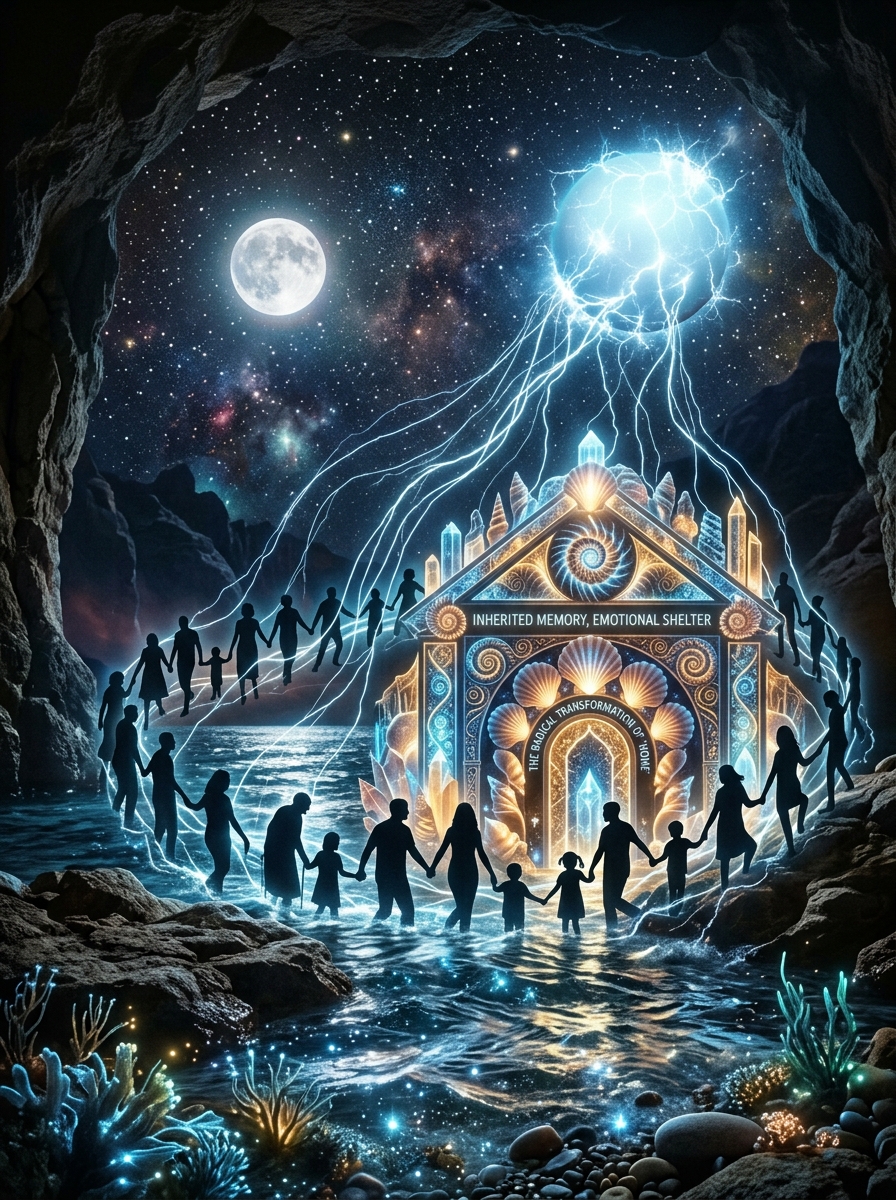
Astrology, when approached through the lens of depth psychology, serves as a map of the collective unconscious, charting the slow, tectonic shifts of human evolution. Among the outer planets, Uranus acts as the cosmic lightning rod—the principle of sudden awakening, revolution, individuation, and the shattering of obsolete forms. When this Promethean archetype enters the watery, cardinal realm of Cancer, a sign deeply associated with the protective womb, ancestral heritage, emotional security, and the domestic sphere, a profound alchemical tension arises. The electric, sky-dwelling sky-god meets the deep, silent tides of the ocean. This transit demands a radical restructuring of how we define home, safety, and family, forcing us to reconcile our primal need for belonging with an equally powerful urge for absolute personal freedom.
In the Western esoteric tradition, particularly through the psychological systems of Carl Jung and the astrological frameworks of Liz Greene, Steven Forrest, and Steven Forrest, Uranus in Cancer represents the breakdown of the maternal container to release the individual spirit. It is the archetype of the home-breaker and the lineage-redeemer. By exploring both its generational footprint and its personal manifestation in the natal chart, we can begin to decode how this placement challenges us to dismantle ancestral inheritance in pursuit of authentic emotional self-determination. The journey of Uranus in Cancer is one of breaking the unconscious bond to the biological clan to discover a universal, psychological connection to the human family.
The Generational Mark of Uranus in Cancer (1949–1956)
To understand the macrocosmic scale of Uranus in Cancer, one must look to the cohort born between approximately 1949 and 1956. This generation arrived in the immediate wake of World War II, a period characterized by a desperate collective search for safety, normalization, and domestic stabilization. The response to the trauma of global conflict was the rapid construction of the idealized suburban nuclear family. Yet, the souls born during this window carried Uranus in the sign of the mother, the hearth, and the homeland. Consequently, they became the very agents who would dismantle the rigid, conformist domestic structures of their childhoods.
The Post-War Nuclear Family and the Baby Boom Cohort
The post-war era sought to institutionalize safety through strict adherence to traditional gender roles and family hierarchies. Cancer represents the protective shell, and the early 1950s built a very thick, literal shell in the form of suburban enclaves, consumer-driven domestic conveniences, and an insistence on outward emotional harmony. This was a direct reaction to the economic devastation of the Great Depression and the horrific loss of life during the war. The parents of the baby boomers wanted nothing more than to insulate their children from the unpredictability of the outer world. They built a fortress of domesticity, hoping that stability inside the home would keep the chaos of history at bay.
However, Uranus represents the disruptive evolutionary impulse that refuses to allow any shell to remain static, no matter how well-meaning its construction. As the baby boom cohort reached adolescence and young adulthood in the late 1960s and early 1970s, the explosive energy of Uranus in Cancer manifested as a sweeping cultural revolution. The traditional nuclear family was not merely questioned; it was structurally challenged. This generation catalyzed the second-wave feminist movement, arguing that the personal is political and dismantling the domestic confinement of women. They questioned the patriarchal authority inherent in the traditional household, paving the way for alternative relationship models, communal living experiments, and a broader redefinition of what constitutes a family unit. The Uranian urge for liberation found its primary target in the Cancerian kitchen, the nursery, and the marriage contract.
Under this transit, the very definition of security shifted from an external, material contract (having a house in the suburbs with a white picket fence) to an internal, psychological state. The youth of this era realized that the outer safety of the post-war household was often bought at the cost of emotional repression and psychological fragmentation. They chose to break the shell rather than suffocate within it, instigating the sexual revolution, exploring Eastern spiritualities, and experimenting with communes, cooperative houses, and intentional communities that challenged the exclusivity of the nuclear family.
The Emergence of Child-Centered Psychological Nurturing
Beyond structural changes, Uranus in Cancer revolutionized the internal psychology of the home. Prior generations often viewed parenting through the lens of obedience, discipline, and behavioral conditioning—a Saturnian approach to raising children. The Uranus in Cancer cohort, influenced by the psychological pioneers of their time, shifted the paradigm toward emotional validation and child-centered nurturing.
This generation championed the integration of depth psychology into everyday parenting. They recognized that the emotional atmosphere of early childhood shapes the adult psyche, a concept deeply aligned with Jungian thought. Rather than demanding that the child conform to the family mold, they sought to nurture the child's unique individuality. This was a radical Uranian departure from the ancestral patterns of the past, introducing the concept of the parent as a facilitator of the child’s self-actualization rather than an authoritarian ruler of their destiny.
The introduction of books like Dr. Benjamin Spock's child-care manuals, which advocated for trust in parental instinct and physical affection, matched the intuitive, watery nature of Cancer, while Uranus demanded that these methods break from the cold, detached guidelines of early 20th-century behaviorism. This child-centered revolution changed the school systems, toy industries, and domestic architectures of the Western world, placing the child's emotional and psychological well-being at the absolute center of family life. Parents of this generation began to talk to their children about their feelings, introducing a vocabulary of emotional intelligence that had been virtually non-existent in previous generations.
Personal Natal Chart Dynamics and House Placements
While the generational signature shapes the cultural landscape, the individual natal placement of Uranus in Cancer reveals how this evolutionary tension plays out within a specific life. In the personal chart, Uranus in Cancer indicates where the individual experiences a persistent conflict between the urge for emotional closeness and the fear of containment. It points to a sector of life where traditional comfort zones must be continually disrupted to allow for psychological growth.
Uranian Disruptions in Angular Houses: The First, Fourth, Seventh, and Tenth Houses
The manifestation of Uranus in Cancer is particularly acute when it occupies the angular houses, where it directly impacts the pillars of self, home, relationship, and career.
Uranus in Cancer in the First House
Individuals with this placement project an aura of unpredictable sensitivity. They are deeply intuitive and receptive, yet they fiercely guard their personal independence. They may present a maternal or protective facade, only to suddenly retreat or assert their absolute autonomy when they feel others are getting too close. Their path of self-discovery involves learning to honor their fluctuating emotional states without allowing them to destabilize their core identity. They are often perceived as eccentric caregivers or pioneers who bring a sharp, electrical intellect to emotional and psychological domains. The key to their integration is recognizing that being sensitive does not mean being weak or dependent; they can be both highly empathetic and fiercely self-directed.
Uranus in Cancer in the Fourth House
This is the natural home of Cancer, making the presence of Uranus here especially potent and volatile. The fourth house represents the home, the roots, the mother, and the private self. With Uranus here, the early domestic life is rarely stable. There may have been frequent moves, sudden disruptions in the family structure, or an emotionally erratic maternal figure who was physically present but emotionally unavailable or unpredictable. As adults, these individuals often struggle to settle down in a traditional sense. They must build a home that is flexible, technologically modern, or unconventional, realizing that their true security lies within their own psychic resilience rather than in brick-and-mortar structures. They are the ultimate "home innovators," frequently redesigning their spaces or living in communities that defy standard domestic definitions.
Uranus in Cancer in the Seventh House
Here, the tension of Uranus is projected onto partnerships. The individual seeks Cancerian nurturing and emotional safety in close relationships, but they attract partners who are Uranian—eccentric, emotionally unavailable, or fiercely independent. Alternatively, the individual may suddenly break off relationships the moment they feel too cozy or suffocated. They want the warmth of the hearth but fear the cage of marriage. The lesson of this placement is to create partnerships that allow for both deep, empathetic intimacy and plenty of breathing room. The relationship must be structured on mutual respect for independence, allowing each partner to have their own separate emotional and physical spaces without triggering fears of abandonment.
Uranus in Cancer in the Tenth House
In the house of career and public reputation, this placement manifests as a desire to revolutionize professions related to caregiving, psychology, real estate, or domestic arts. These individuals cannot tolerate rigid hierarchies or traditional corporate structures. They often seek careers that allow them to work from home or in fluid, non-traditional environments. They are seen as innovators who bring emotional intelligence and psychological depth to the public sphere. They might be founders of alternative healing clinics, advocates for workplace emotional wellness, or architects of green, community-oriented housing. Their public calling is to shake up traditional ideas of authority by introducing maternal care, psychological insight, and fluid adaptation into rigid institutional environments.
Unconventional Expressions in Other Houses
Beyond the angular houses, Uranus in Cancer disrupts other areas of life, forcing a complete reassessment of security and connection.
Uranus in Cancer in the Second House
Here, the sense of financial security is subject to sudden changes. These individuals cannot rely on traditional jobs or standard investment plans. They must find unique, independent ways to support themselves, often through careers centered on nurturing, counseling, or creative expression. Their relationship with money is emotional and unpredictable. They must learn that their self-worth is not tied to material accumulation, but rather to their ability to adapt and innovate in times of financial disruption.
Uranus in Cancer in the Eighth House
The eighth house governs shared resources, sexuality, and deep psychological transformation. In this house, Uranus in Cancer demands a revolution in how the individual experiences intimacy and vulnerability. They may experience sudden psychological crises that force them to confront inherited beliefs about sex, death, and shared money. They are called to develop a highly original, intuitive approach to psychological healing, often breaking through old taboos to find absolute emotional liberation.
Uranus in Cancer in the Eleventh House
In the house of friendships and groups, this placement indicates an individual who forms sudden, intense bonds with groups of like-minded people, often creating a surrogate family structure. They are drawn to eccentric, progressive, or humanitarian circles that focus on emotional support and social reform. They are the builders of intentional communities, striving to create a larger societal family that honors the individuality of each member.
Aspects with Personal Planets: Sun, Moon, and Mercury
The configuration of Uranus in Cancer with the personal planets determines how easily the individual can access and integrate this revolutionary energy. Aspects act as dynamic channels of psychic force, shaping the personality's core alignment.
The Sun-Uranus and Moon-Uranus Dynamic: Individuation vs. Security
When Uranus in Cancer aspects the personal planets, it infuses the basic ego, emotional nature, and intellect with its electric, disruptive qualities.
Sun Aspecting Uranus in Cancer
When the Sun is in dynamic aspect (conjunction, square, or opposition) to Uranus in Cancer, the individual’s core identity is inextricably bound to the process of individuation from the family matrix. They feel a creative mandate to be different, to stand out from their lineage. They are often the black sheep of the family, carrying a sharp awareness of the limitations of their upbringing. They cannot simply inherit their identity; they must construct it from scratch. In harmonious aspect (sextile or trine), this energy manifests as an innate ability to express unique, innovative forms of leadership and creative self-expression that still remain sensitive to the emotional needs of others. They are able to lead teams and organizations by building a supportive, family-like atmosphere that simultaneously encourages individual expression and autonomy.
Moon Aspecting Uranus in Cancer
This is a highly sensitive and emotionally volatile combination. The Moon rules Cancer, and its connection to Uranus generates an intense, electric emotional current. These individuals experience sudden, rapid shifts in mood. They may feel a deep craving for intimacy, followed immediately by an overwhelming urge to run away. The mother-child relationship is often marked by inconsistency; the mother may have been loving but erratic, or preoccupied with her own search for freedom. The child learns to anticipate sudden emotional withdrawals, leading to an adult pattern of preemptively breaking emotional connections before they can be abandoned. Integrating this aspect requires learning to ground the nervous system, practicing mindfulness, and recognizing that emotional vulnerability does not mean a loss of freedom.
Mercury Aspecting Uranus in Cancer
Here, the intellect is highly intuitive, processing information in non-linear, flashes of insight. The mind is constantly searching for original ways to communicate concepts of emotional dynamics, psychology, and history. These individuals possess a unique ability to put complex feelings into words, often using metaphor and narrative to bridge the gap between logical thought and raw emotional experience. Their communication style is conversational yet intellectually sharp, capable of disrupting polite social conventions to speak painful emotional truths. They make excellent psychological writers, therapists, and evolutionary thinkers. Their challenge is to avoid intellectualizing their feelings, as the rapid-fire mental energy of Mercury-Uranus can sometimes be used as a defense mechanism to avoid experiencing the raw, watery depth of Cancerian emotion.
Venus and Mars Aspecting Uranus in Cancer
To fully round out the aspect dynamics, we must look at Venus and Mars. When Venus aspects Uranus in Cancer, the aesthetic taste and relational values are highly unconventional. The individual may love unusual art, historical relics reimagined with modern technology, or unique home decor. In relationships, they require a high degree of intellectual compatibility and personal freedom, often rejecting traditional courtship rituals. When Mars aspects Uranus in Cancer, the drive for action is erratic and fueled by emotional sensitivity. These individuals act as defenders of the vulnerable, fighting fiercely for children, family, or the home. However, their actions can be unpredictable, occasionally leading to sudden conflicts within the domestic sphere.
Historical Collective Transit: Television, Shifting Gender Roles, and the Counterculture
Astrological transits reflect the unfolding story of human consciousness. The transit of Uranus through Cancer between 1949 and 1956 coincided with monumental shifts in the Western world, particularly in the United States, altering the fabric of daily life and redefining the collective psyche.
Media, Technology, and the Redefinition of the American Home
Cancer rules the private sphere, and the entry of Uranus—the planet of technology and electrical communication—into Cancer brought a literal electronic device into the heart of the home: the television. The rapid adoption of TV during the early 1950s forever changed the domestic landscape. It restructured the physical layout of the living room, drawing the family away from the traditional hearth or dinner table and centering them around a screen transmitting images from the wider world. This was a classic Uranian disruption: the outer world suddenly penetrated the inner sanctum of the home, accelerating the globalization of consciousness and exposing children to ideas and cultures far removed from their immediate family environment.
This technological invasion of the domestic sphere did not stop at television. The post-war economic boom saw the mass production of household appliances designed to liberate the homemaker from domestic drudgery. Washing machines, vacuum cleaners, and frozen dinners were marketed as liberating technologies. While these innovations did free up time, they also began to dissolve the traditional role of the mother as the sole engine of domestic maintenance. This shift, combined with the growing economic necessity and desire for women to enter the workforce, began to destabilize traditional gender expectations, laying the groundwork for the radical social movements that would erupt in the decades to follow.
Furthermore, this era marked the beginning of modern suburban architecture. The suburban development of Levittown, constructed to house returning veterans and their young families, symbolized the mass production of the home. By turning the building of homes into a factory-like assembly line, the collective sought to manufacture security. Yet, Uranus in Cancer ensured that this manufactured security would be short-lived. The children raised in these standardized, suburban boxes would grow up to lead the countercultural movements of the late 1960s, rejecting the material conformity of their parents and seeking spiritual, emotional, and social liberation.
The cold war and atomic bomb anxiety of this period also highlighted the Uranian threat of sudden disruption. The threat of nuclear annihilation hung over the Cancerian home, forcing a deep psychological realization that physical structures could not guarantee safety. This collective dread fostered an underlying sense of impermanence, prompting the younger generation to seek a deeper, internal sense of emotional security that did not rely on the physical stability of their external environments.
Jungian Individuation and Family Lineage
In the realm of psychological astrology, particularly as articulated by Liz Greene and Howard Sasportas, Uranus is a primary agent of Jungian individuation. Individuation is the process by which a person becomes their true, undivided self, distinct from the collective and from their parental conditioning. When Uranus is placed in Cancer, this psychological task is focused directly on the maternal line, the family tree, and the ancestral inheritance.
Breaking the Chains of Ancestral Trauma and Biological Guilt
Every family system carries an accumulation of unexpressed grief, unfulfilled desires, and unresolved traumas—what Jungians refer to as the ancestral shadow. Cancer is the sign of the lineage, the memory bank of the family soul. When Uranus operates here, it acts as a structural disruptor, exposing the hidden dynamics and secrets that have bound the family for generations.
Individuals with Uranus in Cancer are often selected by the unconscious dynamics of their family system to break these cycles. This is not an easy task; it requires confronting deep biological guilt. To step outside the family consensus, to refuse to repeat the mistakes of the parents, feels like a betrayal of the bloodline. The family system naturally resists change, seeking to pull the individual back into the established patterns of suffering. If the mother was unhappy, the child feels a subconscious obligation to be unhappy too, as a form of distorted loyalty. Uranus in Cancer cuts through this web of biological guilt with a sword of intellectual clarity.
       [Ancestral Lineage (Cancer)]
                    |
          (Repetitive Cycles)
                    |
      v=== [Uranian Intervention] ===v
      |                              |
[Biological Guilt]        [Individuation & Freedom]
(Conformity & Trauma)      (Lineage Redemption)
The Jungian process of individuation requires the individual to transition from a state of "participation mystique"—a primitive, unconscious identification with the family group—to a state of conscious, differentiated selfhood. For the Uranus in Cancer individual, this means recognizing that their emotional reactions and fears are often not their own, but rather the inherited debris of their ancestors. By bringing these unconscious patterns into the light of awareness, they free themselves from the obligation to act out the unlived lives of their parents.
By refusing to carry the unresolved emotional debt of their parents, the Uranian individual breaks the chain of repetition. They realize that true love and loyalty to their ancestors do not require them to repeat their ancestors' suffering. Instead, by healing themselves and establishing authentic lives, they redeem the entire lineage. They become the point in the family tree where the trauma stops, allowing future generations to inherit a cleaner, more liberated psychological space.
Shadow Work, Integration, and the Creation of Chosen Families
Every astrological archetype has its shadow expression. For Uranus in Cancer, the shadow manifests as chronic emotional instability, a defense mechanism of sudden withdrawal, and an underlying fear of intimacy. Because Uranus seeks freedom and Cancer seeks safety, the individual may find themselves trapped in a repetitive cycle of building a secure emotional foundation, only to sabotage it and run away when the vulnerability becomes too intense.
Navigating Domestic Instability and Fear of Intimacy
The primary shadow of Uranus in Cancer is the tendency to mistake isolation for independence. In their effort to avoid being controlled or engulfed by others, these individuals may adopt a stance of emotional aloofness, refusing to let anyone get close enough to see their vulnerability. They may experience recurring ruptures in their living situations, moving abruptly or ending relationships and partnerships at the first sign of emotional conflict.
This pattern is often rooted in a childhood where closeness was associated with danger, control, or unpredictable emotional outbursts. To protect themselves, the child developed a Uranian defense mechanism: "If I don't attach myself to anything or anyone, I can't be hurt when it is taken away." In adulthood, this manifests as avoidant attachment styles, counter-dependence, and a deep-seated suspicion of domestic stability. They may create crisis after crisis in their homes and relationships to avoid the quiet, slow work of emotional integration.
Integration requires a conscious reconciliation of these two opposing urges. The individual must realize that true emotional autonomy does not require isolation. By developing a strong sense of inner security—an internal "home" that cannot be disrupted by external events—they can begin to engage in deep, committed relationships without the fear of losing their individuality. They must learn to ground their nervous system, allowing themselves to feel the watery depths of Cancerian emotion without triggering the Uranian "fight or flight" response. This often involves somatic therapy and nervous system regulation, helping the body understand that vulnerability is safe.
This integration often leads to the creation of "chosen families." Recognizing that biological ties can sometimes be too fraught with old conditioning, the integrated Uranus in Cancer individual builds support networks based on shared values, intellectual affinity, and mutual respect for personal space. These modern networks of care combine the emotional warmth and protective nurturing of Cancer with the egalitarianism, freedom, and innovation of Uranus. In these chosen circles, the individual can experience the safety of belonging without the threat of emotional containment.
Frequently Asked Questions
What does it mean to have Uranus in Cancer in your natal chart?
Having Uranus in Cancer in your natal chart suggests that your path of emotional development and your experience of home and family are marked by a need for innovation and independence. You are tasked with balancing the deep, emotional nurturing of Cancer with the liberating, progressive energy of Uranus. This often manifests as an unconventional approach to family life, a need for emotional autonomy, and a calling to break free from restrictive ancestral patterns.
How does the generational transit of Uranus in Cancer affect society?
As a generational transit, Uranus in Cancer (such as the cohort born between 1949 and 1956) brings revolutionary changes to domestic life, parenting styles, and gender roles on a collective scale. It challenges the traditional nuclear family structure, introduces alternative living arrangements, and promotes child-centered, psychologically informed nurturing. It also correlates with technological innovations that directly impact the domestic sphere, such as television and household automation.
What are the main challenges of Uranus in Cancer?
The main challenges involve navigating emotional instability, a fear of intimacy, and a tendency to abruptly rupture relationships or living situations when they feel too restrictive. There can be a deep-seated conflict between the urge for absolute freedom and the primal need for emotional safety, leading to cycles of closeness followed by sudden withdrawal.
How does Uranus in Cancer relate to Jungian psychology?
In Jungian terms, Uranus in Cancer is a powerful catalyst for individuation from the family matrix and ancestral lineage. It pushes the individual to examine and break free from inherited family scripts, unconscious patterns, and ancestral traumas. This placement encourages the development of a unique personal identity that is psychologically independent of biological expectations.
What is a "chosen family" in the context of Uranus in Cancer?
A "chosen family" is a network of close relationships built on mutual respect, shared intellectual or spiritual values, and emotional support, rather than biological ties. For those with Uranus in Cancer, chosen families offer a way to experience the warmth, care, and security of a family structure while preserving the personal freedom and individuality that Uranus demands.
Can Uranus in Cancer influence physical health?
Yes, in the realm of medical astrology and somatic psychology, the intense emotional electricity of Uranus in Cancer can impact the body. Cancer rules the stomach, chest, and digestive system, while Uranus rules the nervous system. When emotional stress and the conflict between freedom and security are not consciously integrated, they can manifest as psychosomatic digestive issues, stomach ulcers, or tension in the chest. Learning to regulate the nervous system is crucial for physical well-being.
Comments
Loading comments…