Tarot Card of the Year: Integrating Numerology, Major Arcana, and Archetypal Psychology
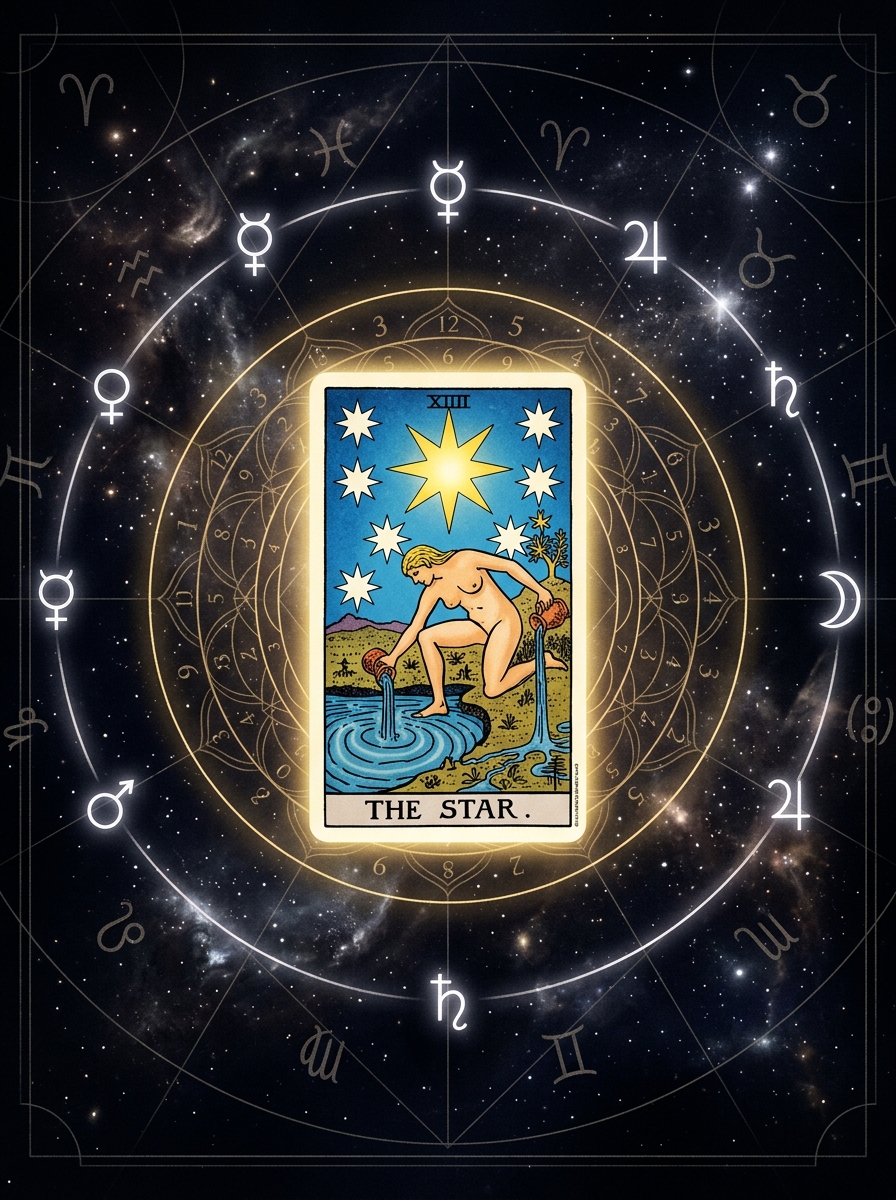
Time as Quality: Chronos, Kairos, and the Synthesis of Symbol Systems
In contemporary Western society, time is almost exclusively measured through the lens of Chronos—the quantitative, linear progression of seconds, minutes, hours, and calendar days. Chronos is the clock-time that governs our schedules, structures our productivity, and measures our aging. It is mechanical, uniform, and indifferent to human experience. However, classical philosophy and the Western esoteric tradition present an alternative understanding of time: Kairos. Kairos represents qualitative time—the opportune moment, the season of life, the psychological flavor of a particular epoch, or the "right time" for a specific action to occur. While Chronos asks "what time is it?", Kairos asks "what is this moment ripe for?" Historically, cultures understood that time was not merely a blank canvas of duration but a series of shifting currents, each with its own unique potential and spiritual atmosphere.
To navigate the qualitative cycles of our lives, ancient and modern practitioners alike have turned to symbolic languages that map the unseen currents of human development. Two of the most enduring systems for organizing these currents are numerology and the tarot. Numerology provides the mathematical architecture of time, viewing numbers not merely as quantities for calculation, but as qualitative symbols that represent specific evolutionary phases. From the singularity of the number one to the integrative completion of the number nine, numerology outlines a structured, nine-year cycle of human growth. Each number in this sequence represents a progressive step in the evolution of consciousness, reflecting how initial potential transitions into structure, expansion, conflict, integration, and eventual release.
Tarot, particularly the Major Arcana, provides the narrative, mythological, and visual flesh to these numerical bones. The twenty-two cards of the Major Arcana depict the "Fool’s Journey," a symbolic representation of the psyche's path toward individuation. When we map the numerological personal year cycle (numbers one through nine) to the corresponding Major Arcana cards, we create a synthesis of structure and narrative. This synthesis allows us to identify our personal Tarot Card of the Year—an archetypal mirror that reflects the primary spiritual, psychological, and practical themes we will encounter over a twelve-month period. By examining the visual allegories of the cards, we can contextualize our experiences, understanding where we are in our personal evolutionary journey.
This integration is not predictive or fatalistic. In alignment with Jungian psychology, we do not view the Tarot Card of the Year as a tool for fortune-telling or forecasting concrete events. Instead, the card operates as a synchronistic mirror. Carl Jung defined synchronicity as an acausal connecting principle, where inner psychological states and outer physical events are linked by meaning rather than direct cause and effect. By calculating and contemplating our year card, we bring the unconscious patterns of our current developmental phase into conscious awareness. As the psychological astrologer Liz Greene notes, archetypes represent the foundational blueprints of human experience; they do not dictate our actions, but rather define the psychological atmosphere in which we operate. In this sense, working with your year card is akin to understanding the seasonal weather of your psyche. Knowing that you are in a winter phase (such as a Hermit year) prevents you from expecting the immediate, outward harvest of a summer phase (such as an Empress year). Understanding your year card is about learning to cooperate with the qualitative currents of your life, rather than swimming against them.
The Mathematical Alchemy: How to Calculate Your Personal Tarot Card
Calculating your Tarot Card of the Year is a straightforward process rooted in Pythagorean numerology. The calculation is based on your birth day, birth month, and the specific calendar year you wish to analyze. Because the calendar year represents a collective shift in energetic frequency, combining it with your static birth data reveals how the collective cycle intersects with your individual timeline.
To find your Personal Year number, you sum the individual digits of your birth month, birth day, and the target year, and then reduce the sum to a single digit between 1 and 9. This single digit then corresponds to one of the first nine cards of the Major Arcana. Let us walk through two detailed examples to illustrate this mathematical alchemy.
Calculation Example 1: Born on October 12, Calculating for the Year 2026
First, identify the numerical values of the birth components:
- Birth Month: October is the 10th month.
- Birth Day: 12.
- Target Year: 2026.
Now, we add these components together. There are two standard ways to calculate this in numerology, both of which yield the same result:
Method A: Reducing each component first.
- Birth Month: 10 reduces to 1 + 0 = 1.
- Birth Day: 12 reduces to 1 + 2 = 3.
- Target Year: 2026 reduces to 2 + 0 + 2 + 6 = 10, which further reduces to 1 + 0 = 1.
- Add the reduced components: 1 (month) + 3 (day) + 1 (year) = 5.
Method B: Summing the raw numbers first.
- Sum: 10 (month) + 12 (day) + 2026 (year) = 2048.
- Reduce the sum: 2 + 0 + 4 + 8 = 14.
- Reduce again to a single digit: 1 + 4 = 5.
In both instances, the calculation yields a Personal Year of 5. In the tarot, the fifth card of the Major Arcana is The Hierophant. Thus, for an individual born on October 12, the year 2026 is governed by the archetype of The Hierophant.
Calculation Example 2: Born on May 7, Calculating for the Year 2027
First, identify the numerical values:
- Birth Month: May is the 5th month.
- Birth Day: 7.
- Target Year: 2027.
Apply the same addition and reduction methods:
Method A: Reducing each component first.
- Birth Month: 5 (already a single digit).
- Birth Day: 7 (already a single digit).
- Target Year: 2027 reduces to 2 + 0 + 2 + 7 = 11, which further reduces to 1 + 1 = 2.
- Add the reduced components: 5 (month) + 7 (day) + 2 (year) = 14.
- Reduce to a single digit: 1 + 4 = 5.
Method B: Summing the raw numbers first.
- Sum: 5 (month) + 7 (day) + 2027 (year) = 2039.
- Reduce the sum: 2 + 0 + 3 + 9 = 14.
- Reduce again to a single digit: 1 + 4 = 5.
Once again, the calculation results in a Personal Year of 5, mapping to The Hierophant for the year 2027.
By reducing the final sum to a single digit, we align our calendar cycle with the primary numerological matrix of 1 through 9. Each number represents a distinct stage in a developmental arc, allowing us to conceptualize our life not as a random series of events, but as a progressive spiral of psychological evolution. This systematic approach allows us to find predictability in the qualitative changes of our lives, showing that each developmental challenge we face is merely a preparation for the next stage of our growth.
The Archetypal Journey: Year Cards 1 through 5
The first five cards of the Major Arcana trace the movement from the initial spark of individual consciousness to the establishment of external structures and beliefs. Understanding these years requires a deep look at their psychological invitations, developmental challenges, and shadow aspects.
The Magician: Personal Year 1
The Magician represents the initiation of a new nine-year cycle. Having completed the introspective and clearing work of the previous Year 9, you stand at the starting line of a fresh personal era. The Magician represents conscious focus, manifestation, willpower, and the alignment of your personal desires with active execution. In this year, the universe invites you to take the initiative, step into your personal power, and direct your willpower toward concrete goals.
Psychologically, this period corresponds to the emergence of the active ego. It is a time for planting seeds and initiating projects, even if you do not yet see how they will fully blossom. Arthur Edward Waite described the Magician as representing the divine impulse passing through the human plane; in practical terms, this means you are the channel through which new ideas take form. The primary challenge of a Magician year is overcoming inertia or the fear of starting anew. The shadow of this archetype manifests as manipulation, scattered focus, or the "trickster" dynamic—where you attempt to force outcomes through sheer mental willpower without genuine alignment, or start multiple projects only to abandon them when the initial excitement fades.
The High Priestess: Personal Year 2
If the Magician year was about active outward movement, the High Priestess year demands a shift to the receptive, inward dimension. The number two represents polarity, partnership, reflection, and gestation. The High Priestess sits at the threshold of the conscious and the unconscious, guarded by the pillars of duality. This is a year of internal development, patience, and intuitive listening rather than aggressive action.
During this cycle, you are asked to allow things to develop beneath the surface. It is a time for quiet observation, dream analysis, and building a deeper relationship with your inner voice. In the framework of Jungian psychology, the High Priestess represents the anima, the keeper of the mysteries of the unconscious. Trying to force external progress during a High Priestess year often leads to frustration and blocks. Instead, focus on learning, waiting for the right timing, and cultivating self-trust. The shadow of this card manifests as passive-aggression, emotional withdrawal, secrecy, and a refusal to participate in life, leading to isolation or a sense of paralysis.
The Empress: Personal Year 3
The Empress year represents a burst of creative expression, abundance, and growth. Following the internal gestation of the High Priestess, the seeds planted during the Magician year begin to break through the soil. The Empress is the archetype of the Great Mother, ruling over fertility, nature, sensory experience, and creative output.
This is a highly social and expressive year. It is ideal for creative writing, artistic endeavors, building community, and focusing on physical self-care and comfort. The Empress encourages you to connect with your senses, spend time in nature, and nurture the relationships and projects that bring you joy. In a psychological sense, it represents the integration of our creative imagination with the material world. The primary developmental task is to allow yourself to receive abundance and express your feelings openly. The shadow of the Empress can manifest as over-indulgence, creative blockages, codependency, or smothering behavior, where your desire to nurture others morphs into control or self-neglect.
The Emperor: Personal Year 4
The Emperor represents structure, stability, authority, discipline, and the construction of solid foundations. After the expansive, organic growth of the Empress, the Emperor arrives to bring order, logic, and structure. The number four is associated with the square—the symbol of stability, boundary, and material organization.
In an Emperor year, you are called to step into your personal authority, establish clear boundaries, and organize your life. This is a period for focusing on career structures, financial planning, physical health routines, and long-term security. It is about creating the container in which your creative visions can permanently reside. Psychologically, the Emperor corresponds to the organizing principles of the ego and the healthy integration of the animus. The developmental challenge is to build order without becoming rigid. The shadow of the Emperor shows up as tyranny, control issues, dogmatic behavior, or a fear of vulnerability, leading to a life governed by cold logic and emotional suppression.
The Hierophant: Personal Year 5
The Hierophant governs the search for meaning, philosophical study, mentorship, and the exploration of belief systems. The number five represents a point of transition, adjustment, and the quest for a higher purpose beyond basic material security.
During a Hierophant year, your focus shifts toward education, tradition, and spiritual or intellectual frameworks. You may find yourself drawn to formal study, seeking out a mentor, or taking on a teaching role yourself. The Hierophant serves as a bridge between the divine and the human, representing the established systems of thought that help us make sense of our existence. Culturally, it is about understanding the rules and wisdom of the past before deciding how to apply them to your own life. The developmental challenge is to identify what you truly believe versus what you have been conditioned to believe. The shadow of the Hierophant is dogmatism, spiritual pride, hypocrisy, and blind conformity to external authorities, which prevents genuine individual exploration.
The Archetypal Journey: Year Cards 6 through 9
The remaining four cards of the Major Arcana shift the focus from individual establishment toward relational ethics, external drive, structural choices, and ultimate integration.
The Lovers: Personal Year 6
The Lovers year centers on relationships, values, ethical choices, and alignment with personal truth. The number six represents harmony, balance, and the integration of opposites. While many associate this card strictly with romance, its psychological meaning runs much deeper.
In a Lovers year, you are confronted with choices that force you to define your core values. It is a time for evaluating your relationships—not just with partners, but with friends, family, and yourself. Jungian analysis views the Lovers as the integration of the internal masculine and feminine principles, or the projection of these principles onto others. You are asked to look past superficial attractions and make choices based on deep psychological alignment and integrity. The primary challenge is taking responsibility for your choices and standing by your values. The shadow of the Lovers manifests as indecisiveness, codependency, people-pleasing at the expense of your truth, or moral compromise to avoid conflict.
The Chariot: Personal Year 7
The Chariot represents direction, willpower, determination, and overcoming obstacles. The number seven is associated with introspection, spiritual testing, and inner mastery. In the Chariot, the individual takes the self-knowledge and values consolidated during the Lovers year and projects them outward into the world with focused intent.
This is a year of active drive and movement. It invites you to overcome self-doubt, master your emotions, and steer your life toward a defined goal. The Chariot requires you to hold contrasting forces together—represented by the dual sphinxes or horses pulling the vehicle—and guide them through willpower. It is an excellent year for career advancement, travel, and personal breakthroughs. Psychologically, it represents the consolidation of the ego's power. The shadow of the Chariot involves over-ambition, ruthless determination, emotional suppression, and burnout, where you push forward at the expense of your physical and emotional well-being.
Strength vs. Justice: Personal Year 8
The calculation for Year 8 introduces an intriguing historical divergence within the tarot tradition. In historical decks, such as the Tarot de Marseille, Justice is designated as card VIII and Strength as card XI. However, when Arthur Edward Waite designed the Rider-Waite-Smith deck in 1909, he transposed these cards, placing Strength at number VIII and Justice at number XI. He did this to align the cards with the astrological signs of Leo (Strength) and Libra (Justice) within the Golden Dawn system. Depending on the deck and system you utilize, your Year 8 will align with one of these two powerful archetypes.
If you work with the Strength archetype, the year focuses on internal courage, patience, and the integration of your instinctual nature. Strength is depicted as a figure gently but firmly closing or opening a lion's mouth, symbolizing the mastery of wild impulses through love and compassion rather than brute force. Psychologically, this represents shadow integration—confronting your anger, desire, and fear with kindness and self-acceptance. The shadow of Strength is weakness, yielding to destructive impulses, or using force to dominate others.
If you work with the Justice archetype, the year centers on karma, objectivity, truth, and accountability. Justice holds the sword and the scales, demanding that you weigh your actions and make balanced, honest assessments of your life. It is a time for legal matters, structural adjustments, and facing the consequences of past choices. The shadow of Justice is self-righteousness, harsh judgment, denial of truth, and a victim mentality that refuses to accept accountability.
The Hermit: Personal Year 9
The Hermit represents the final stage of the nine-year cycle. Having built, structured, chosen, and fought through the previous years, the Hermit year is a period of reflection, introspection, and closure. The Hermit retreats from the noise of the external world, holding a lantern to illuminate the inner path.
This year invites you to step back, complete outstanding projects, and let go of what no longer serves your growth. It is a time for solitude, meditation, and seeking internal wisdom rather than external validation. The Hermit does not seek new beginnings; instead, it focuses on harvesting the lessons of the past nine years to prepare the soil for the next cycle. In Jungian psychology, the Hermit represents the archetype of the Wise Old Man and the process of individuation—finding your unique light in the darkness. The shadow of the Hermit is isolation, alienation, depression, and a stubborn refusal to share your wisdom or eventually return to community.
Integrating the Archetype: Practical Esoteric Methods for Self-Reflection
To derive true value from your Tarot Card of the Year, you must move beyond passive intellectual understanding and actively integrate its themes into your daily life. Esoteric practice is practical; it requires engaging the imagination, the body, and the psyche in a structured dialogue with the symbol.
One of the most effective methods for integrating the year card is the Jungian practice of Active Imagination. Rather than simply looking at the card, you place yourself inside the image. Close your eyes, visualize the card's landscape, and strike up a conversation with the figures depicted.
To structure this process, you can utilize specific prompts for each year card:
- The Magician (Year 1): "Speak to the Magician. Ask him: 'What tools are on my table that I am ignoring, and where must I direct my focus to initiate this new cycle?'"
- The High Priestess (Year 2): "Stand before the veil. Ask the High Priestess: 'What truth am I hiding from myself, and what must I allow to rest in silence?'"
- The Empress (Year 3): "Sit in the Empress's garden. Ask her: 'How can I open my life to greater abundance, and what creative project is ready to be born?'"
- The Emperor (Year 4): "Approach the stone throne. Ask the Emperor: 'Where in my life must I build firmer structures, and where have I allowed my boundaries to crumble?'"
- The Hierophant (Year 5): "Sit in the hall of study. Ask the Hierophant: 'What old belief system has outlived its usefulness, and what teaching am I ready to receive?'"
- The Lovers (Year 6): "Stand between the choosing paths. Ask the figures: 'What core value am I being asked to honor, and what dynamic requires integration?'"
- The Chariot (Year 7): "Hold the reins of the chariot. Ask the driver: 'What opposing forces in my life must I coordinate, and where is my willpower being tested?'"
- Strength / Justice (Year 8): "Touch the lion's mane or stand before the scales. Ask: 'Where do I need to apply compassionate courage, or what debt of accountability must I settle?'"
- The Hermit (Year 9): "Walk beside the Hermit's lantern. Ask him: 'What must I release to complete this cycle, and what wisdom have I gathered?'"
Journaling prompts tailored to your year card can also help unpack these themes. Consider dedicating a section of your journal to your year card and writing on these questions monthly:
- How am I currently embodying the light attributes of this archetype?
- In what ways is the shadow of this card showing up in my reactions or behaviors?
- What resistance do I feel toward the lessons of this card right now?
- How can I align my daily habits with the core theme of this archetype?
Additionally, you can use visual meditations. Place a physical copy of your year card on your desk or personal altar. Spend five minutes each morning quietly observing the imagery. Note which colors, symbols, or figures draw your attention on any given day. A symbol that felt comforting last week might feel irritating today, signaling a shift in your internal landscape. By keeping the card in your physical environment, you anchor its archetypal energy in your conscious awareness, creating a constant touchstone for your decisions and reflections throughout the year.
The Psychological Dimension: Navigating Light and Shadow
A common pitfall in working with tarot and numerology is falling into fatalistic interpretations. When a reader calculates their year card, they may worry that a card like the Hermit means they will be lonely, or that the Chariot guarantees easy success. To avoid these traps, we must approach the cards as psychological mirrors containing both light and shadow attributes.
Every archetype is dualistic. The light attributes represent the integrated, constructive expressions of the energy, while the shadow attributes represent the repressed, exaggerated, or unconscious expressions. For example, during a Magician year, the light aspect brings focused creativity and the drive to start new endeavors. The shadow, however, can manifest as deceptive behavior or a scattered mind that starts twenty projects but completes none, leaving a trail of chaotic, unfinished tasks.
+------------------+-----------------------------+------------------------------------+
| Year Card        | Light Attribute             | Shadow Attribute                   |
+------------------+-----------------------------+------------------------------------+
| The Magician     | Focused execution, agency   | Scattered focus, manipulation      |
| The High Priestess| Intuition, quiet gestation | Passivity, emotional withdrawal    |
| The Empress      | Creative expression, growth | Smothering, creative blockage      |
| The Emperor      | Healthy structure, logic    | Rigidity, authoritarian control    |
| The Hierophant   | Intellectual pursuit, wisdom| Dogmatism, empty conformity        |
| The Lovers       | Clear values, alignment     | Indecision, codependency           |
| The Chariot      | Determination, momentum     | Aggression, emotional burnout      |
| Strength         | Compassionate integration   | Emotional volatility, weakness     |
| Justice          | Objective accountability    | Self-righteousness, victim mindset |
| The Hermit       | Deep introspection, wisdom  | Alienation, depressive isolation   |
+------------------+-----------------------------+------------------------------------+
According to Jungian theory, when we refuse to consciously engage with the challenges of our year card, we project them onto our environment. If you refuse to take responsibility for your life during a Justice year, you may perceive the people around you as unjust and punitive. If you resist the call to structure your life during an Emperor year, you may experience external institutions or authority figures as overly controlling. Embracing your year card means taking ownership of both its light and shadow, using the archetype to navigate the complexities of your inner world. This shadow work is essential for psychological growth; by recognizing the shadow aspects of our card, we prevent them from operating in our unconscious lives and causing self-sabotage.
Frequently Asked Questions: Navigating the Nuances of Tarot Numerology
What is the difference between a Numerological Personal Year and a Tarot Year Card?
A Numerological Personal Year is a system focused on the vibrational quality of numbers. It provides a structural blueprint of a cycle, focusing on numerical transitions (e.g., how a year 4 of building leads to a year 5 of change). A Tarot Year Card takes that numerical structure and translates it into visual, narrative, and archetypal imagery. The Year Card allows you to engage with the cycle through myth, symbolism, and psychological projection. While numerology offers the map, the tarot offers the landscape, making the themes of the year more accessible to the imagination.
Why is there a debate between Strength and Justice for Year 8, and which should I follow?
The debate stems from Arthur Edward Waite's decision to switch the positions of Strength (originally VIII in historical Marseille decks) and Justice (originally XI). If you prefer the Rider-Waite-Smith system, your Year 8 will be Strength, focusing on inner courage and instinctual integration. If you prefer the Marseille system or classical numerology that maps 8 to karmic order, your Year 8 will be Justice, focusing on balance, truth, and accountability. There is no single "correct" approach. We recommend exploring both archetypes, as they both offer profound insights into the themes of power, balance, and alignment that characterize the number eight.
Can I calculate my Year Card using double digits instead of reducing to a single digit?
Some practitioners calculate their Year Card by adding the birth data and year without reducing to a single digit, mapping the resulting double-digit number to the corresponding Major Arcana card (e.g., if the sum is 19, they map it to The Sun). While this is a valid technique in some tarot circles, the primary method outlined here reduces the number to a single digit (1 through 9). This single-digit reduction maintains the foundational link to Pythagorean numerology cycles and ensures that the cycle flows systematically from the initiation of the Magician to the completion of the Hermit.
What if my Year Card represents themes that I find difficult or unpleasant?
It is natural to feel resistance toward certain archetypes, particularly those that demand reflection (The Hermit) or discipline (The Emperor). However, in psychological terms, resistance often points directly to where growth is most needed. If you find a card unpleasant, ask yourself what aspect of that archetype you are rejecting. For example, if you dislike the Hermit, you may be running away from solitude or fear facing your own thoughts. Embracing the card is not about enjoying every moment of the cycle, but about learning the specific developmental lesson it has to offer.
Does the Tarot Card of the Year shift on my birthday or at the start of the calendar year?
There are two main schools of thought on this issue. One group of practitioners believes the Personal Year energy shifts on January 1st, reflecting the collective calendar change. Another group argues that the personal year energy transitions on your birthday, aligned with your solar return. In practice, many find that the transition is a gradual phase rather than a sudden switch, beginning around the calendar New Year and fully cementing by the individual's birthday. We recommend paying attention to your life dynamics during this transitional window to observe how the archetypes shift in your personal experience.
Comments
Loading comments…