Sun in the Second House: Identity, Value, and the Art of Materialization
The Core Solar Principle in the Second House: Identity Grounded in the Material Plane
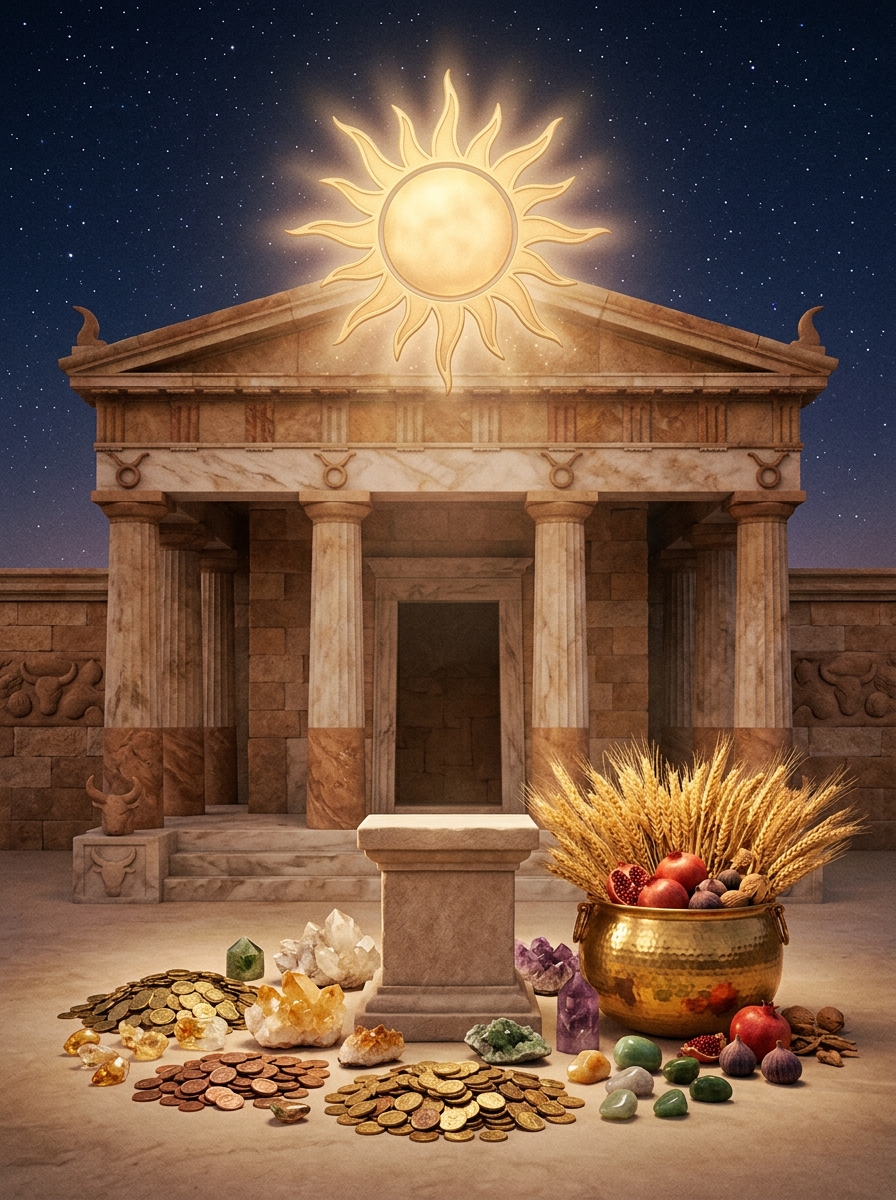
In the complex architecture of the natal chart, the Sun represents the absolute center of conscious awareness, the vital spark of the ego, and the hero’s journey toward individuation. When the Sun is placed in the Second House—traditionally associated with the fixed earth sign of Taurus and ruled by the planet Venus—the light of consciousness is directed squarely toward the material world. Here, the solar quest for identity is not fought in the realms of abstract ideas, intellectual arguments, or interpersonal drama, but in the slow, deliberate, and sometimes arduous work of building, creating, and cultivating tangible reality.
For the individual with this placement, life is an ongoing process of grounding solar energy into the physical plane. The Second House is the house of substance; it rules our personal resources, our finances, our physical bodies, and the sensory experiences that tether us to the earth. When the Sun resides here, the native seeks to answer a fundamental question: How do I instantiate my inner essence in a form that can be touched, seen, measured, and valued by the world? This is not a superficial placement focused solely on the accumulation of luxury items or the displays of conspicuous consumption. Rather, it is a profound journey of self-realization through the medium of the physical universe.
Liz Greene, a pioneer of psychological astrology, notes that the Second House is where the raw, unformed potential of the First House ego is forced to confront the limits and laws of material form. It is here that we learn that we cannot simply exist in a vacuum of potentiality; we must also produce. The solar individual must learn to take their creative fire and condense it into something durable. This requires patience, a virtue that does not always come easily to the solar ego, which naturally prefers instant recognition and dramatic displays of power. In the Second House, the Sun must learn the lessons of the agricultural cycle: clearing the soil, planting the seed, watering the ground, and waiting for the harvest. The core identity is forged through this interaction with matter, and the native discovers who they are by observing what they are capable of bringing into concrete manifestation.
Solar Vitality Meets the Earth: The Venusian Influence on the Ego
Because the Second House is historically linked with Venus, the planet of attraction, aesthetic value, and relational harmony, the Sun’s expression in this house is deeply colored by Venusian themes. The ego is driven to find beauty, order, and value in all things, and the solar drive for self-expression is channeled through the senses. The native may possess a heightened appreciation for the arts, architecture, gastronomy, and the natural world, viewing these physical expressions as direct mirrors of the divine order.
In this placement, the Sun’s vitality is intimately linked to physical well-being. If the native is disconnected from their body, or if their material surroundings are chaotic, ugly, or unstable, their solar light dims. They require comfort, stability, and aesthetic coherence to feel fully alive. The Venusian undercurrent also manifests as a desire to be appreciated for one’s personal qualities and resources. The individual seeks to become an attractor, drawing resources, people, and opportunities toward themselves by virtue of their inherent value. This stands in contrast to the martial energy of the First House, which seeks to conquer and assert itself through force. The Second House Sun shines by being a stable center of gravity, a rock upon which others can build, and a source of steady, nourishing warmth that fosters growth and security.
Mirroring Self-Worth: The Psychological Tie Between Self-Esteem and Personal Wealth
One of the most complex challenges for those with the Sun in the Second House is the psychological conflation of self-esteem (inner worth) with financial status (net worth). Because the Sun represents the core identity, any house it occupies becomes the primary arena where the individual seeks validation and a sense of personal significance. When this arena is the Second House of resources, the ego naturally seeks to prove its value by accumulating wealth, property, and status symbols.
This creates a psychological feedback loop where the individual’s sense of personal adequacy rises and falls with the balance of their bank account. In a culture that highly values material success and equates productivity with human dignity, this tendency can easily lead to a life of hyper-competitiveness and endless striving. The native may believe, consciously or unconsciously, that they are only as good as their last paycheck, or that their moral and intellectual value is directly proportional to their financial output. This is a fragile way to live, as it leaves the core identity vulnerable to the natural fluctuations of the economic climate and the unpredictable fortunes of career development.
The developmental task for the Second House Sun is to decouple these two concepts. They must learn that their intrinsic value as a human being is a given, independent of what they own, inherit, or produce, while still honoring their legitimate talent for material creation. When this integration is achieved, wealth stops being a psychological shield used to protect a fragile ego and becomes instead a creative medium through which the individual can express their inner nobility and values.
The Projection of the Ego onto the Object: A Jungian Perspective
To understand this dynamic more deeply, we can turn to the psychological framework of Carl Jung, who wrote extensively about projection—the process by which unconscious contents of the mind are cast onto external objects, people, or situations. For the Second House Sun, the "inner gold"—the symbol of the fully realized, integrated Self—is often projected onto actual, physical gold, or its modern equivalent: money, real estate, and high-value possessions.
When a person projects their inner value onto material objects, those objects take on a numinous, almost magical quality. A luxury car is no longer just a means of transportation; it becomes a physical manifestation of the owner's competence, power, and worthiness to exist. A house is not just shelter; it is proof of their place in the cosmic order. While this projection can provide a powerful motivation to achieve financial success, it also creates a deep psychological vulnerability. If the object is lost, damaged, or stolen, the individual does not just experience a financial loss; they experience a catastrophic collapse of the ego, as if a piece of their very soul has been torn away. The journey of individuation for the Second House Sun involves reclaiming this projected gold, recognizing that the beauty, stability, and power they admire in their possessions are actually qualities of their own psyche. The outer object is merely a canvas upon which the inner light of the Sun has been cast.
Re-imagining Money: Financial Stewardship, Stability, and Respect for Material Resources
To maturely integrate a Second House Sun, one must fundamentally re-imagine the nature of money. In the modern world, money is often treated as a neutral medium of exchange, a tool for consumption, or a scorecard in a game of social status. For the Second House Sun, however, money must be understood as a form of crystallized energy. It represents the time, talent, and life force that have been expended to create value.
When the Sun shines its light into the Second House, it brings a natural intelligence, clarity, and curiosity to financial matters. These individuals are rarely indifferent to money; they think about it, study it, and seek to understand its laws. They have the potential to become excellent financial stewards, managing resources not out of greed or fear, but out of a deep respect for the material world. They understand that resources are finite and that their proper management is a form of art.
This stewardship extends beyond money to include all physical assets: land, buildings, tools, and even the physical body itself. The Second House Sun native is often drawn to conservation, restoration, and quality craftsmanship. They prefer to buy things that are built to last, recognizing that cheap, disposable goods represent a waste of energy and a disrespect for the materials used to make them. By cultivating this attitude of stewardship, they align themselves with the stabilizing, nourishing qualities of the earth, creating a secure foundation not just for themselves, but for their families and communities.
Cultivating Financial Stewardship as a Spiritual Duty
In many esoteric traditions, the material world is not seen as separate from the spiritual world, but as its densest expression. In the Qabalah, the physical plane is Malkuth, the Kingdom, which is the final vessel into which the divine light flows. From this perspective, the management of money and resources is not a mundane distraction from spiritual life, but a direct test of spiritual maturity.
For the Second House Sun, learning how to handle money with integrity, generosity, and wisdom is a central part of their spiritual path. This means avoiding both the trap of greedy hoarding (which stems from a lack of trust in the abundance of life) and the trap of irresponsible asceticism (which often hides a fear of the practical demands of reality). True financial stewardship involves viewing wealth as a trust, a tool to be used for the preservation of beauty, the support of life, and the creation of stable structures that allow human culture to flourish. When the native approaches finance with this attitude, their work becomes a form of practical alchemy, transforming raw material into a vehicle for the expression of higher values.
Monetizable Skills: Harnessing Inner Talents to Achieve Outer Autonomy
The path to self-realization for the Sun in the Second House is closely linked to the discovery and development of their innate talents. The Second House is not just the house of inherited wealth or lucky windfalls; it is the house of the assets we generate ourselves through the application of our personal skills. The Sun here demands that the individual look within to find their unique capabilities and then figure out how to offer those capabilities to the world in a way that generates tangible return.
This process of talent development is essential for the native’s sense of autonomy. If they are dependent on others for their financial security—whether that means relying on a spouse, family inheritance, or a patron—their solar energy can become blocked or distorted. They need to know that they can stand on their own two feet, that their survival is guaranteed by their own competence. This realization is the true source of their confidence.
The talents of a Second House Sun are typically practical, creative, and sensory. They are people who work well with raw materials, whether that means managing financial portfolios, designing beautiful spaces, cultivating gardens, cooking gourmet food, or crafting high-quality physical objects. They have a natural feel for value; they can look at a piece of land, a business proposal, or a work of art and instinctively know what it is worth and how it can be improved. By dedicating themselves to mastering these practical skills, they build a solid foundation of self-reliance that no external economic shift can destroy.
The Alchemy of Turning Potential into Tangible Capital
Every human being is born with a unique set of potentials, but potential alone does not buy food or build shelter. The journey of the Second House Sun is to perform the alchemical work of transforming this raw, unrefined potential into actual, functional capital. This requires a process of distillation, concentration, and hard labor.
In the language of alchemy, this is the stage of coagulatio—making the volatile solid. It is not enough for the native to have creative ideas or spiritual insights; they must find a way to give those ideas a body. If they are writers, they must sit down and write the book; if they are designers, they must build the prototype; if they are financial planners, they must create the spreadsheet. This process of translation is often difficult, as it forces the individual to confront the limitations of the medium they are working with and the demands of the marketplace. However, it is precisely through this struggle with the physical world that the ego is strengthened and matured. By seeing the results of their labor reflected in a thriving business, a beautiful home, or a healthy bank account, the Second House Sun confirms their own power and agency.
Material Devotion: How a Second House Sun Expresses Love and Relationship Security
In relationships, the Sun in the Second House manifests a love style that is deeply grounded, loyal, and physically expressive. For these individuals, love is not just a collection of romantic feelings or intellectual compatibility; it is a concrete commitment that must be demonstrated through practical actions and material support. They show affection by providing for their partners, buying high-quality gifts, cooking delicious meals, and creating a safe, comfortable, and beautiful home environment.
This material devotion is a double-edged sword. On one hand, it makes the Second House Sun native an incredibly reliable and supportive partner. They are the ones who will make sure the bills are paid, the house is in good repair, and the pantry is stocked with high-quality food. They offer a steady, comforting presence that can be deeply reassuring to partners who are more volatile or anxious. They show their love through their physical presence, their touch, and their willingness to share their resources.
On the other hand, this placement can lead to relationship dynamics where love is commodified or used as a tool for control. The native may try to "buy" affection or use their financial power to keep their partner dependent on them. They may also struggle with possessiveness, viewing their partner as another valuable asset that they own and must protect. To build healthy relationships, the Second House Sun must learn to respect their partner’s autonomy and understand that the most valuable things in life—trust, intimacy, and freedom—cannot be bought, sold, or controlled.
The Pentacles of Devotion: Concrete Love Languages
To understand the relational style of the Second House Sun, it is useful to look at the Suit of Pentacles in the Tarot, which corresponds to the earth element and the Second House. In the Rider-Waite-Smith deck, the Pentacles depict scenes of building, farming, trading, and domestic stability. They represent the slow, patient creation of value through work and stewardship.
For the Second House Sun, love is expressed through the "Pentacles way." It is a love language of physical touch, practical acts of service, and material gifts that have real, lasting value. A hand-crafted piece of furniture, a carefully selected investment, or a weekend spent working together in the garden are, to this native, far more meaningful expressions of devotion than a dozen roses or a dramatic love poem. They look for partners who share their respect for the material world and who are willing to work alongside them to build a stable, prosperous life. They need to feel that their relationship is built on a solid foundation of shared values, physical comfort, and mutual support, creating a sanctuary where both partners can thrive.
Tangible Production: Career Paths Rooted in Asset Management, Creation, and Sustained Effort
The career path of a Second House Sun is rarely characterized by sudden, chaotic shifts or a desire for transient fame. Instead, these individuals seek careers that offer stability, tangible results, and the opportunity to build something of lasting value over a long period. They are builders, managers, and creators who thrive in environments where effort is directly rewarded with concrete progress.
Common career paths for this placement include:
- Finance and Asset Management: Banking, investment planning, real estate, accounting, and wealth management. The native’s natural understanding of value and resource preservation makes them highly competent stewards of other people's money.
- Design and Craftsmanship: Architecture, interior design, culinary arts, landscaping, fashion, and traditional crafts. These fields allow the individual to combine their Venusian appreciation for beauty with their practical, hands-on skills.
- Agriculture and Resource Management: Farming, forestry, conservation, environmental science, and sustainable development. These careers connect the native directly to the earth, the ultimate source of all wealth and security.
- Appraisal and Curation: Art dealing, antique appraisal, gemology, and museum curation. The Second House Sun has an eye for quality and can easily distinguish between genuine worth and superficial imitation.
Regardless of the specific field, the key to career satisfaction for the Second House Sun is the feeling of tangible production. They need to see the results of their work at the end of the day. A job that is entirely abstract, bureaucratic, or disconnected from the creation of physical value will eventually drain their vitality. They require a sense of ownership over their work and a clear connection between their labor and their financial reward.
The Solar Work Ethic and the RWS Eight of Pentacles
The archetype of the craftsman is beautifully represented in the Rider-Waite-Smith Tarot by the Eight of Pentacles. In this card, we see a young man focusing entirely on his work, carving out pentacles one by one and hanging them on the wall. There is no audience, no applause, and no shortcut. There is only the repetition of the craft and the gradual development of mastery.
For the Second House Sun, this card represents the ideal work ethic. They are at their best when they can lose themselves in the details of their work, focusing on the quality of the product rather than the opinions of others. This slow, steady dedication is what Steven Forrest refers to as the "developmental journey of the earth houses." It is not about quick wins or overnight success. It is about the accumulation of small, daily actions that eventually add up to a monumental achievement. By embracing this craftsmanship mentality, the Second House Sun native ensures that their career is built on a foundation of actual competence, rendering them indispensable in their chosen field.
The Shadow of Accumulation: Overcoming Scarcity Anxiety and Material Clinging
Like all astrological placements, the Sun in the Second House has its shadow side. The primary shadow of this position is a deep, often unconscious anxiety about scarcity. Because the individual’s identity is so closely tied to their material security, the prospect of financial loss or poverty can trigger an existential dread that is entirely out of proportion to the actual physical danger.
This anxiety can manifest in several destructive ways:
- Hoarding and Greed: The native may accumulate money and possessions far beyond what they actually need for comfort and security, driven by a belief that they will never have enough. This hoarding behavior stifles the natural flow of resources and can lead to a dry, sterile life.
- Material Rigidity: The individual may become resistant to any form of change or risk, prioritizing safety and financial predictability over growth, adventure, and emotional fulfillment. They may stay in dead-end jobs or unhappy relationships simply because they offer material security.
- Devaluing the Non-Material: In its extreme form, the Second House Sun shadow can lead to a cynical materialism that views everything—including art, relationships, and spirituality—through the lens of cost and utility. The individual may judge others solely by their net worth and dismiss any pursuit that does not yield a clear financial return.
To overcome these shadow tendencies, the Second House Sun must confront their fear of the void. They must learn to trust in their own resilience and in the natural abundance of life, recognizing that their capacity to create wealth is an internal talent that cannot be taken away from them, even if their external circumstances change.
The Lord of Material Trouble: Crowleyan Shadows of the Four of Pentacles
In the Thoth Tarot, created by Aleister Crowley, the Four of Pentacles is titled "Power," but it carries a warning about the stagnation that comes from trying to hold onto power too tightly. The card represents a state where the flow of energy has been blocked because the individual is obsessed with security and structure.
For the Second House Sun, this is the warning of the Four of Pentacles. When the fear of loss dominates the psyche, the individual becomes like the figure on the card—clinging to their coins, unable to move, unable to create anything new. They are locked in a prison of their own making. Crowley’s system warns that true power lies in the dynamic flow of energy, not in its containment. To unlock their full solar potential, the native must learn the art of circulation. They must be willing to spend, to invest, and to give, trusting that the energy they release will return to them in accordance with the laws of life.
Spiritualizing the Concrete: Mature Integration of Net Worth and Inner Value
The ultimate task for the individual with the Sun in the Second House is to achieve a mature synthesis of the physical and the spiritual. This involves recognizing that the material world is not an obstacle to spiritual growth, but the very place where spiritual growth occurs. The goal is to spiritualize the concrete—to bring the light of conscious awareness into every aspect of their physical existence, from the way they manage their business to the way they care for their body.
In this integrated state, the native understands that wealth is not an end in itself, but a resource to be used in the service of life. They no longer use their possessions to bolster a fragile ego or ward off an irrational fear of scarcity. Instead, they view their financial success as a creative achievement, a reflection of their inner alignment with the laws of nature and value.
This integration leads to a state of true self-reliance, where the individual is grounded in their own worth, comfortable in their own body, and capable of creating beauty, stability, and abundance wherever they go. They become a source of strength and nourishment for others, demonstrating that it is possible to live a life that is both materially successful and spiritually rich.
Frequently Asked Questions
What does the Sun in the Second House mean for career success?
The Sun in the Second House is generally a very favorable placement for career success, particularly in fields that involve the management, creation, or appraisal of material resources. It indicates a strong natural intelligence regarding financial matters, a high capacity for sustained effort, and a deep drive to achieve tangible results. These individuals are builders who excel at turning abstract ideas into profitable businesses or beautiful physical structures. However, to achieve true satisfaction, they must ensure their work aligns with their personal values, rather than pursuing wealth solely for the sake of security or social status.
How does this placement affect romantic relationships?
In relationships, a Second House Sun shows love through practical actions, physical touch, and material care. They are highly reliable, loyal, and protective partners who seek to build a stable, comfortable life with their loved ones. However, they must watch out for a tendency to treat their partners as possessions or to use financial security as a tool to control the relationship. True intimacy for this placement requires learning to trust their partner's independence and realizing that emotional security cannot be bought or contractually guaranteed.
What is the primary psychological shadow of a Second House Sun?
The primary shadow of this placement is scarcity anxiety. Because the native's sense of self-worth is closely tied to their material assets, they may harbor a deep fear of poverty or loss that drives them to hoard resources, avoid necessary risks, or evaluate others purely by their financial status. Overcoming this shadow requires decoupling self-esteem from net worth and learning to trust in their own inner talents and resourcefulness rather than relying solely on external accumulations.
Does this placement guarantee wealth?
While the Sun in the Second House gives a strong focus on finance and a talent for resource management, it does not guarantee wealth. A chart must always be read as a whole, and factors such as the sign on the house cusp, the condition of Venus (the house ruler), and aspects to the Sun will greatly influence the external outcome. However, this placement does guarantee that the journey of understanding, acquiring, and managing resources will be a central theme in the individual's life and a primary path for their personal growth.
How can a Second House Sun balance spiritual growth with material desires?
A Second House Sun balances these areas by viewing the material world as a direct reflection and extension of the spiritual plane. Rather than seeing money and possessions as spiritually corrupting, they can treat their financial resources as a trust to be managed with integrity, generosity, and wisdom. By using their wealth to support life, preserve beauty, and build stable, helpful structures, they transform their material efforts into a meaningful spiritual practice.
How does the sign of the Second House cusp modify this placement?
The sign on the cusp of the Second House determines how the native goes about acquiring and managing resources. For example, a Second House Sun in Aries may be highly entrepreneurial and willing to take bold financial risks, but may struggle with impulsive spending. A Sun in Virgo, by contrast, will be extremely analytical, detail-oriented, and cautious with money, finding security in meticulous budgeting and planning. The sign provides the behavioral style, while the Sun in the Second House represents the core drive to find identity through value creation.
Comments
Loading comments…