The Nodal Axis in Houses 2 & 8: From Psychic Depths to Personal Ground
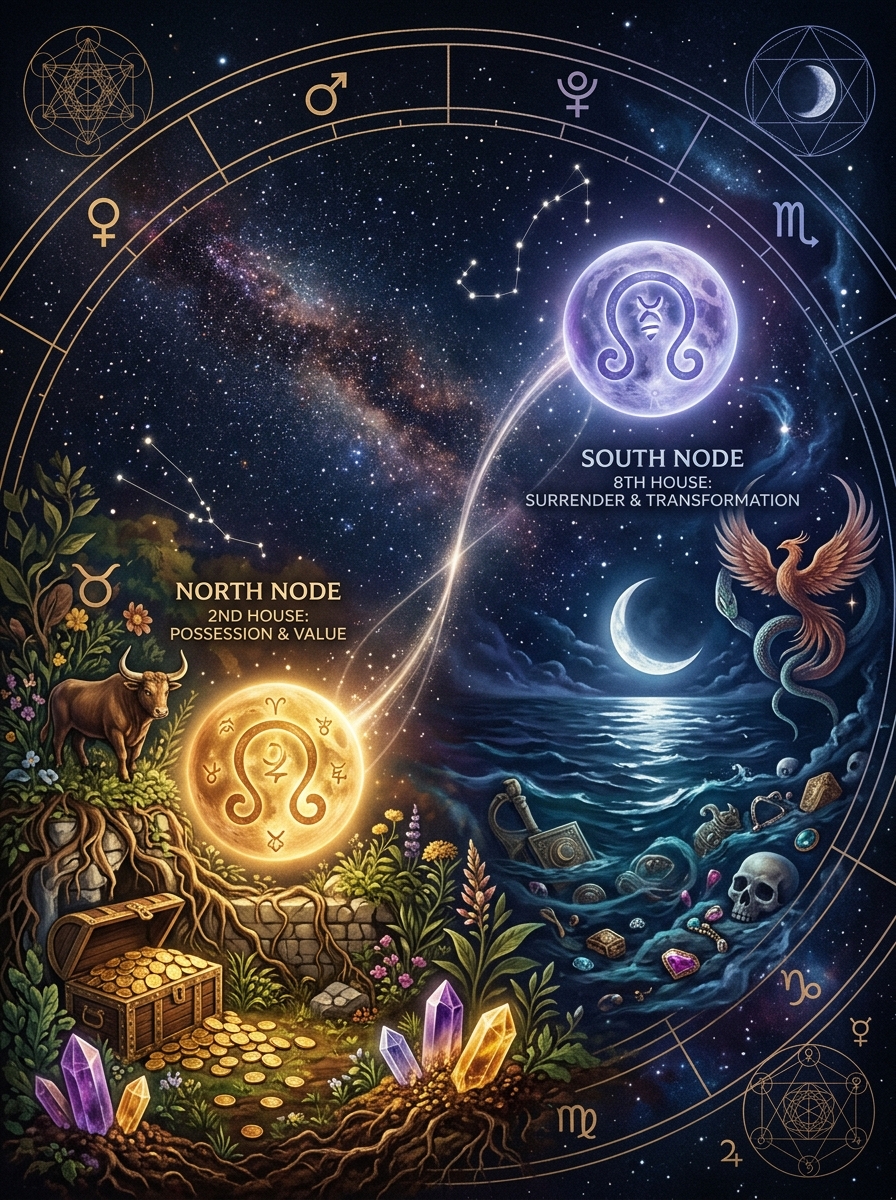
The Karmic Journey of the Second-Eighth House Nodal Axis
The lunar nodes in astrology are not planets. They are mathematical points — the intersections of the Moon's orbit with the ecliptic — and they move through the zodiac in a slow retrograde cycle that takes approximately eighteen and a half years to complete. Yet despite their geometric nature, no placement in a birth chart carries more evolutionary weight. The South Node marks where the soul has already been, the patterns it has mastered and perhaps over-relied upon. The North Node marks the directional pull of growth — not comfort, not ease, but genuine forward movement.
When this axis falls across the second and eighth houses, the soul is navigating one of the most psychologically complex terrains in the horoscope: the territory of ownership, desire, mortality, and the perpetually uneasy question of what truly belongs to you.
The second house governs personal resources, self-worth, the body's relationship to the physical world, simple pleasures, and the slow, patient accumulation of what a person needs to feel genuinely secure. It is the house of my money, my values, my voice, my possessions. The eighth house governs shared resources, psychological depths, inheritance, sexuality, transformation through loss, and the invisible currents of power and obligation that flow between people in intimate bonds. It is the house of our money, our secrets, our mutual entanglement. Where the second house is mine, the eighth house is theirs — and somehow you are caught in it.
For the soul born with the South Node in the eighth house and the North Node in the second, the karmic narrative is one of gradual, often painful disentanglement. You arrive in this life already fluent in the eighth house's language: crisis, intensity, psychological complexity, the seductive pull of other people's resources, and the way power works when it moves underground. The territory of the eighth house feels like home even when it is burning. What feels unfamiliar — even slightly embarrassing in its ordinariness — is the quiet, embodied, patient work of the second house: building something simple, sensory, and genuinely your own.
This is not a short journey. Liz Greene, whose foundational work on depth psychology and astrology remains essential reading for anyone working seriously with the natal chart, observed that the fixed axis of Taurus and Scorpio carries a particular quality of psychic grip — a refusal to release what it has grasped, whether that something is a resource, a relationship, or a wound. The nodal axis in houses two and eight lives inside that same fixed tension. The work here is not a single cathartic breakthrough. It is a years-long, sometimes decades-long reorientation of identity from merger to individuation, from psychic intensity to embodied peace.
Steven Forrest, one of the foremost voices in contemporary evolutionary astrology, frames the nodal axis as a story of soul intention across lifetimes. The South Node in the eighth house, in his framework, suggests a soul that has lived deeply inside crisis, transformation, and the labyrinth of other people's psychology. It has earned genuine gifts — psychic perception, the ability to metabolize loss, an unflinching capacity to look at what others refuse to acknowledge. The North Node in the second house represents the soul's present-life assignment: to take those hard-won gifts and ground them in something self-generated, self-owned, and materially real.
The journey from house eight to house two is, at its core, a journey from dissolution to definition. From the formless merging of the eighth house to the solid, sensory, clearly bounded terrain of the second. It asks you to stop swimming in depth and to stand on ground.
The Psychic Archaeology of the South Node in the Eighth House
The eighth house is one of the most misunderstood in traditional astrology, often reduced to death, inheritance, and sex — a grim triptych that misses the house's fuller psychological dimension. In the modern psychological astrology tradition, the eighth house is better understood as the domain of radical transformation through merger: those moments when two separate identities come into such intense contact that one or both are fundamentally altered. It is the house of what happens when something passes irrevocably — through death, through betrayal, through a financial entanglement that rewrites the power dynamic of a relationship, through a trauma that dismantles an old self so that a new one can emerge.
With the South Node here, the soul arrives carrying the residue of precisely these experiences. There is a particular kind of person who has the South Node in the eighth house, and you may recognize yourself in this description: someone who feels most alive in the middle of intensity, who gravitates toward emotionally complex situations and people, who processes the world through layers of meaning rather than surface appearance, and who can become genuinely uncomfortable when life is simple, stable, and uneventful. The stillness of an ordinary Tuesday can feel more threatening than a crisis, because the crisis is known territory.
The Weight of Other People's Resources
One of the signature expressions of the South Node in the eighth house is a complicated and often unconscious relationship to other people's money and resources. In past incarnations — or in the earlier formative chapters of this lifetime — the soul may have survived, and perhaps thrived, by relying on resources that were not independently generated. An inheritance. A partner's income. Family money that came with invisible strings and unspoken obligations. Financial support from someone who wielded it as a form of control.
The psychological pattern this creates is subtle and persistent. People with this placement often tell themselves they don't care much about money, that financial matters feel crass or beside the point compared to deeper concerns. But underneath that apparent indifference is usually a complicated web of beliefs about deserving, ownership, and the safety of financial dependence. Money may feel safer when it comes from someone else, because money you earn yourself means you are fully accountable for your own survival — a terrifying proposition for a soul conditioned to the eighth house's strategy of merger.
Carl Jung's concept of the shadow is useful here. The second house — your own earning capacity, your own values, your own material needs — can function as a kind of shadow for the eighth house South Node soul. It is precisely the qualities most needed (self-sufficiency, clearly personal values, financial independence) that feel the most foreign and, at times, the most threatening.
The Seductive Pull of Crisis
There is another pattern that appears consistently with the South Node in the eighth house: a tendency to gravitate toward situations that require psychic or emotional crisis to resolve. This isn't masochism, exactly, but something more complex — a deep-seated belief that transformation only happens through catastrophe, that the self can only be remade in the furnace of breakdown. The eighth house, at its shadow edge, teaches that meaning is only accessible through extremity.
This pattern can show up in practical financial behavior as well as emotional life. The person repeatedly waits until a financial situation reaches crisis level before acting. They are drawn to boom-and-bust economic cycles, to high-risk financial arrangements, to situations where someone else's financial crisis becomes their problem to solve. Or they unconsciously create emotional upheaval in relationships rather than tolerating the ordinary, quiet season of stable partnership.
The evolutionary challenge is not to avoid transformation — that would be impossible, and would dishonor the genuine wisdom the eighth house carries. The challenge is to stop requiring crisis as the only doorway into depth. The North Node in the second house proposes a radical alternative: that meaning can be found in continuity, that the self can develop through patient accumulation rather than only through explosive loss.
The Archetypal Tension: Integrating Taurus and Scorpio Dynamics
The second and eighth houses correspond archetypally to Taurus and Scorpio — the two fixed signs of earth and water, and one of the zodiac's most potent and psychologically loaded polarities. Understanding the archetypal dimension of this axis illuminates why the nodal work here is so specifically demanding.
Fixed signs, by their nature, hold. They resist change. They consolidate. They build structures — whether those structures are material, emotional, or psychological — and then maintain them with extraordinary tenacity. The fixed quality in the context of the nodal axis means that both the South Node patterns and the North Node growth edge are unusually resistant to easy movement. This soul doesn't shift its fundamental orientations lightly or quickly. When it moves, it moves with permanence. But it takes time and often significant external pressure to get there.
Scorpio's Transformative Grip — The Familiar Shadow
The eighth house's archetypal resonance with Scorpio gives the South Node here a particular flavor of intensity. Scorpio is the sign of sustained psychological pressure — the capacity to hold a difficult truth in the psyche without flinching, to metabolize what others would project away, to maintain awareness of the subterranean currents running beneath polished social surfaces. These are genuinely powerful gifts, and a soul that has inhabited the eighth house across lifetimes carries them with real fluency.
But Scorpio's shadow is equally powerful: the impulse to control what cannot be controlled, to weaponize psychological insight as a form of power, to use the knowledge of another person's vulnerabilities not in service of their healing but as leverage. The South Node in the eighth house can carry this Scorpionic shadow in its behavioral patterns — a tendency toward emotional manipulation that operates so subtly it barely registers as such, a habit of holding information asymmetrically in relationships, or an unconscious pull toward entanglements that confirm a dark, cyclical vision of human nature.
The Scorpionic grip also manifests as the inability to leave a psychic space even when it is clearly destructive. The person remains in financially damaging relationships because the emotional bond feels too deep to sever. They stay in crisis-mode financial situations because the familiar intensity of the eighth house feels more real than the possibility of stable peace.
Taurus as Antidote — Earthing the Untethered Soul
The North Node in the second house draws on Taurus's archetype, and here the contrast with Scorpio is instructive. Where Scorpio descends, Taurus grounds. Where Scorpio dissolves boundaries in the crucible of merger, Taurus builds them — slowly, deliberately, and with great attention to what is real and tangible and sensory. Where Scorpio says "I will be transformed by what I encounter," Taurus says "I will build what I need in order to remain myself."
Taurus is the sign of patience, sensory intelligence, and the relationship between the self and the material world. It values continuity, beauty, the pleasures of the physical body, and the slow accumulation of security. In the second house, these qualities take on their most personal expression: this is your body, your money, your values, your voice, your time. Mine. Not ours. Not theirs. Mine.
For the soul accustomed to the eighth house's blur of merger and dissolution, the Taurus-flavored second house can initially feel too simple — even boring. The work of building personal financial security, of identifying your own values independent of a partner's or family's influence, of learning to enjoy sensory pleasure without it immediately becoming entangled in another person's emotional world — these feel almost anticlimactic compared to the psychic fireworks of the eighth house. That sense of anticlimax is precisely the signal that you're moving in the right direction. The North Node rarely feels exciting at first. It feels foreign, slightly awkward, and suspiciously ordinary. That's the point.
Relational Shadows: Financial Co-Dependency and Power Struggles
The 2-8 nodal axis plays out most visibly — and most painfully — in intimate relationships. This is the axis of what's mine, what's yours, and what happens when those boundaries collapse. For the South Node in the eighth house, the collapse of those boundaries is a deeply familiar experience, and one that the soul will unconsciously recreate unless it has done significant work to recognize the pattern.
The Merging Compulsion
There is a quality of relationship the eighth house South Node gravitates toward that can best be described as psychic merger — an intimacy so total that the two people's financial lives, emotional lives, psychological material, and sense of identity become indistinguishable. This is not the same as deep intimacy, though it wears that appearance. Genuine intimacy requires two clearly defined individuals who choose to be fully present with each other. Merger requires the dissolution of individuality. The feeling of merger can be extraordinary — the electric sense of having found your other half, the oceanic bliss of psychic union. But it is not sustainable, and its collapse is invariably painful.
The financial dimension of this merging compulsion is particularly diagnostic. People with the South Node in the eighth house often find themselves, years into a relationship, unable to clearly answer the question: whose money is this? Not because of healthy partnership and shared finances, but because the financial entanglement has become a proxy for the emotional one. The money holds the relationship together in the absence of other bonds. Or the financial dependency is the only remaining leverage in a relationship that has otherwise deteriorated into a power struggle.
Money, Power, and the Invisible Contract
The eighth house is the house of invisible contracts — those unspoken agreements between people that govern who owes what to whom, who holds power, and what the terms of the relationship actually are beneath the stated surface. Financial arrangements in relationships with a prominent eighth house signature are rarely just financial. They carry enormous symbolic weight.
The classic South Node in the eighth house relational pattern involves some version of the following: one person provides financial support or security (whether resources, stability, or emotional holding), and the other person provides something less quantifiable — psychic intensity, erotic magnetism, psychological insight, a sense of depth and meaning. The arrangement feels essential to both parties because it meets real needs. But it also creates a power imbalance that eventually becomes untenable.
The person with the South Node in the eighth house may occupy either side of this dynamic at different points in their life. What remains constant is the pull toward financial entanglement as a form of relational bonding — and the unconscious fear that genuine financial independence would somehow rupture the bond.
The North Node in the second house offers a different model. It asks: what if your financial self-sufficiency could coexist with deep love? What if having your own money, your own income, your own clear economic identity, actually made you a more present and genuine partner — because you were choosing the relationship freely, not because you were financially trapped in it? What if your value in a relationship came from who you genuinely are, rather than from what you provide or what you need?
Answering the Second House Call: Cultivating Self-Worth and Personal Self-Sufficiency
The North Node in the second house is a call to self-origination. Not the self-obsession that a misreading of this axis sometimes produces, but the quiet, steady act of generating a life — financially, materially, and psychologically — that is genuinely your own. This is the work of answering the second house's essential question: what do I actually value? Not what my family values, not what my partner has convinced me to value, not what a crisis-level emotional state tells me I need. What do I, in my body, in my ordinary daily life, actually care about?
What the Second House Actually Asks For
The second house is often mischaracterized as being simply about money. It is about money, but only because money is the contemporary West's most legible form of value exchange. At its deeper level, the second house is about the relationship between the self and the material world — what the self needs to feel genuinely secure, and what values guide the self's choices about how to generate, spend, and protect those resources.
For the North Node person in the second house, the first task is identification. What are your actual skills — not the skills that made you useful in someone else's crisis, not the psychic sensitivity that allowed you to survive an emotionally volatile family, but the skills that, if developed and offered in exchange for money, would sustain you independently? The second house North Node invites a kind of practical self-inventory that can feel almost ruthlessly ordinary after the sweeping psychological drama of the eighth house South Node. What can you build? What can you make? What can you sell, create, teach, or provide that someone else genuinely needs?
This question is not a betrayal of depth. It is depth, redirected.
The Slow Accumulation of Genuine Security
The second house operates on Taurus time — slow, patient, and cumulative. The financial and psychological security the North Node here asks you to build doesn't arrive all at once in a single inheritance check or windfall (eighth house style). It arrives through the unremarkable daily practice of earning, saving, discerning, and choosing. A savings account you contribute to regardless of relationship status. A skill developed over years of practice. A clear sense of what you will and won't accept in a financial arrangement, applied consistently even when it's uncomfortable.
This Taurus-flavored accumulation extends beyond money. It includes the accumulation of sensory pleasure and physical well-being. The second house governs the body's relationship to the physical world, and one of the most powerful forms of North Node work here is the development of a relationship to your own body that isn't mediated by crisis or other people's needs. Regular time in nature. Food prepared and eaten with attention. Physical rest taken without guilt. The body, in the second house, is not a vehicle for psychic experience — it is an end in itself, worthy of care and pleasure simply because you inhabit it.
Jung, in his explorations of the shadow and the process of individuation, repeatedly returned to the idea that genuine psychological development requires the integration of the despised ordinary — the parts of life we consider too humble, too material, too simple to be spiritually significant. For the eighth house South Node soul, the despised ordinary is precisely the second house terrain: budget spreadsheets, savings goals, the patient tending of a single career or financial strategy without the drama of constant reinvention. Integrating these "ordinary" domains is, paradoxically, the most transformative work available to this nodal placement.
Practical Alchemy: Daily Practices for the 2-8 Nodal Journey
Understanding the 2-8 nodal axis at an intellectual or archetypal level is valuable, but the North Node in the second house is, above all, a call to embodied practice. The second house does not respond to insight alone. It responds to repeated, concrete, sensory action. The following practices are offered not as a complete program, but as starting points for the daily alchemy this nodal axis requires.
Somatic Anchoring and the Reclamation of the Physical Body
The eighth house South Node soul often lives at a slight remove from the body — perceiving the world through emotional or psychic information rather than through physical sensation. This is an adaptive strategy: in environments of crisis and emotional volatility, learning to operate psychically rather than sensorially helps navigate unpredictable terrain. But it becomes a liability when the environment changes and stability becomes possible.
Somatic anchoring practices — approaches that bring attention back into the physical body through sensation — are among the most powerful tools for this nodal work. This can mean something as simple as a daily practice of lying on the floor and noticing the weight of your body against the earth. It can mean regular time spent in physical contact with unmediated nature: hands in soil, feet on grass, water on skin. It can mean bodywork, yoga, or any practice that teaches the nervous system that the body is a safe place to inhabit.
Cooking is one of the most underrated practices for North Node in the second house. It brings together multiple second house themes: the use of physical skill, the connection to the body's needs, the conversion of raw materials (resources) into nourishment (value), and the grounding pleasure of a sensory process that produces a tangible result. The act of making a meal from scratch, for the person accustomed to living in psychic emergency, can be quietly revolutionary.
Financial Sovereignty as Spiritual Practice
The financial dimension of this nodal work needs to be treated with the same seriousness as the psychological dimension. For many people with the South Node in the eighth house, the mere idea of tracking their own finances — looking clearly at what they earn, what they spend, what they have — carries an edge of anxiety or shame. That anxiety is data. It points directly to the North Node work.
Begin with clarity. Not with a budget that will shame you into austerity, but with an honest, non-judgmental accounting of your current financial reality. What do you earn? What do you actually spend? Where in your finances are you still entangled with other people's resources or expectations? Where have you abdicated financial decisions to someone else because making them yourself felt too exposing?
The goal is not financial isolation — the healthy second house can absolutely include partnership, shared expenses, and financial interdependence in appropriate measure. The goal is financial self-knowledge. The ability to answer, on any given day, the question: if this relationship ended tomorrow, could I support myself? Not comfortably, perhaps. Not without adjustment. But could you stand on your own financial ground? For the North Node in the second house, the honest answer to that question — and the steady work of making it a yes — is among the most genuinely sacred undertakings available.
Treat each financial decision you make from your own values, rather than from someone else's pressure or from crisis-reflex, as an act of spiritual self-assertion. The second house, unglamorous as it is, is where this soul's liberation is located. Not in the depths. On the ground.
The Long Arc: Integration, Not Rejection
It would be a misreading of evolutionary astrology to conclude that the work of the North Node requires the complete abandonment of the South Node's gifts. The South Node in the eighth house has endowed the soul with capacities that are genuinely rare: the ability to perceive what lies beneath the surface of human interaction, to maintain psychological presence in situations of extreme difficulty, to metabolize loss and emerge transformed, to hold space for other people's darkness without recoiling. These are gifts. They don't become liabilities until they are the only available strategy.
The integration this axis asks for is not a rejection of the eighth house, but rather a recalibration. Bring your perceptiveness and psychological depth into the service of your own life — your own financial decisions, your own creative work, your own body's needs. Stop spending your psychic gifts entirely on other people's crises. Stop allowing the eighth house's intensity to swallow the ordinary, beautiful, mundane terrain of the second house.
When the Eighth House Serves the Second
There is a particular alchemy that becomes available when this integration advances. The eighth house's gifts — psychological depth, the capacity to see through illusion, the relationship to transformation — can be channeled into genuine second house territory. The person who deeply understands how power and money work in human relationships (eighth house) may become extraordinarily effective at building their own financial sovereignty (second house), because they can see clearly the invisible contracts and manipulations they once unconsciously participated in, and refuse to enter them again.
The capacity to metabolize loss, central to the eighth house South Node's experience, becomes a genuine financial asset in the second house: the person who can sit with uncertainty and discomfort without catastrophizing is better equipped to make long-term financial decisions than someone who panics at every market fluctuation. The psychic perceptiveness that the South Node has sharpened over lifetimes can become the ground of a genuine vocation — one that generates independent income and is fully, personally, irreducibly yours.
Building the Floor, Not the Ceiling
In evolutionary astrology, the North Node is not a destination so much as a direction. You never fully arrive. What you do, over years and decades, is build increasing familiarity and comfort with the North Node's terrain, and decreasing compulsive reliance on the South Node's familiar ruts. For the 2-8 nodal axis, the metaphor is architectural. The eighth house gave you a ceiling — the experience of height, depth, extremity, and transformative pressure. The North Node in the second house is building you a floor.
A floor is less dramatic than a ceiling. It doesn't offer vaulted grandeur or the vertigo of great height. But you can stand on it. You can build on it. You can lay down on it when you're exhausted and feel the solid support beneath you without it giving way. For a soul that has spent lifetimes in the air, in the depths, in the psychic pressure of the eighth house — the floor is everything.
Build it one plank at a time. One savings deposit, one honest financial conversation, one pleasure taken in the body without it becoming an emotional crisis, one value asserted with quiet confidence. This is the work. It's not glamorous. It is, for the soul with the South Node in the eighth house, the most radical thing you can do.
Frequently asked questions
- What does it mean to have the South Node in the eighth house?
- Having the South Node in the eighth house suggests that your soul carries deep familiarity with crisis, shared resources, psychological intensity, and the energy of other people's money or power. You may have spent past lifetimes — or earlier chapters of this one — navigating inheritances, debt, trauma, or intense emotional entanglements. The challenge is that these patterns feel comfortable even when they're destructive, because they're your default psychic territory. The South Node here confers genuine perceptive gifts and a rare capacity for psychological depth, but the evolutionary work involves knowing when those gifts are serving you and when they're trapping you in compulsive intensity that belongs to another time, another relationship, or another life entirely.
- What is the North Node in the second house trying to teach me?
- The North Node in the second house is calling you toward personal self-sufficiency, sensory grounding, and the development of your own values independent of other people's influence. It asks you to build material security through your own efforts, to identify what genuinely belongs to you — your talents, your body, your money, your peace — and to stop measuring your worth through someone else's emotional or financial barometer. The second house North Node doesn't offer the psychic electricity of the eighth house, but it offers something rarer for this nodal placement: a floor beneath your feet. Stability, earned and owned, is the destination.
- Is the 2-8 nodal axis connected to past-life experiences or childhood conditioning?
- In evolutionary astrology, as articulated by practitioners like Steven Forrest and framed within the Jungian tradition, the South Node represents ingrained soul-level patterns — habits that may have served survival in another context but now create limitation. For the 8th house South Node, these patterns often include experiences of powerlessness, financial dependency, loss of resources to others, or deep psychological wounding around trust and merger. Whether you interpret this literally as past-life residue or symbolically as early childhood conditioning around money, parental emotional volatility, or inherited family crisis, the psychic imprint is real and needs conscious integration rather than perpetual re-enactment.
- How does this nodal axis show up in intimate relationships?
- In relationships, this axis tends to produce either magnetic intensity and emotional merging that feels fated, or financial entanglement that becomes a substitute for genuine intimacy. People with this placement often unconsciously seek partners who 'rescue' them financially or emotionally, or conversely, they become the rescuer — either way, financial boundaries dissolve and psychological enmeshment follows. The North Node work involves loving deeply while maintaining your own economic identity and emotional center. The goal isn't emotional detachment. It's the capacity to be fully present in love without losing yourself in another person's psychic field.
- What practical steps help someone actively work with a North Node in the second house?
- Practical work includes: establishing a personal savings account that belongs to you alone and contributing to it consistently regardless of your relationship status; identifying your natural talents and finding concrete ways to generate income or value from them; developing a regular physical practice that anchors you in the sensory world — gardening, cooking, bodywork, or extended time in nature; building a personal value system that doesn't shift based on a partner's or family member's approval; and practicing the assertion of ownership over your time, space, and money without guilt or apology. The second house path is unglamorous but profoundly stabilizing. It asks you to trust simplicity as a form of spiritual accomplishment.
- Can someone have this nodal axis reversed — North Node in the eighth house?
- Yes, and that reversal represents an entirely different evolutionary assignment — essentially the mirror image of everything described here. A North Node in the eighth house is called toward depth, psychological transformation, intimacy with mortality, and the conscious ability to merge resources and energy with others. That soul is being asked to release Taurus-style self-sufficiency, comfort-hoarding, and avoidance of complexity in favor of Scorpionic surrender and full psychological engagement. That placement carries its own distinct challenges around excessive self-reliance and the refusal to be transformed by another person. This article focuses specifically on the North Node in the second house and South Node in the eighth house configuration.
Comments
Loading comments…