Sun in Leo, Moon in Sagittarius: The Crowned Centaur
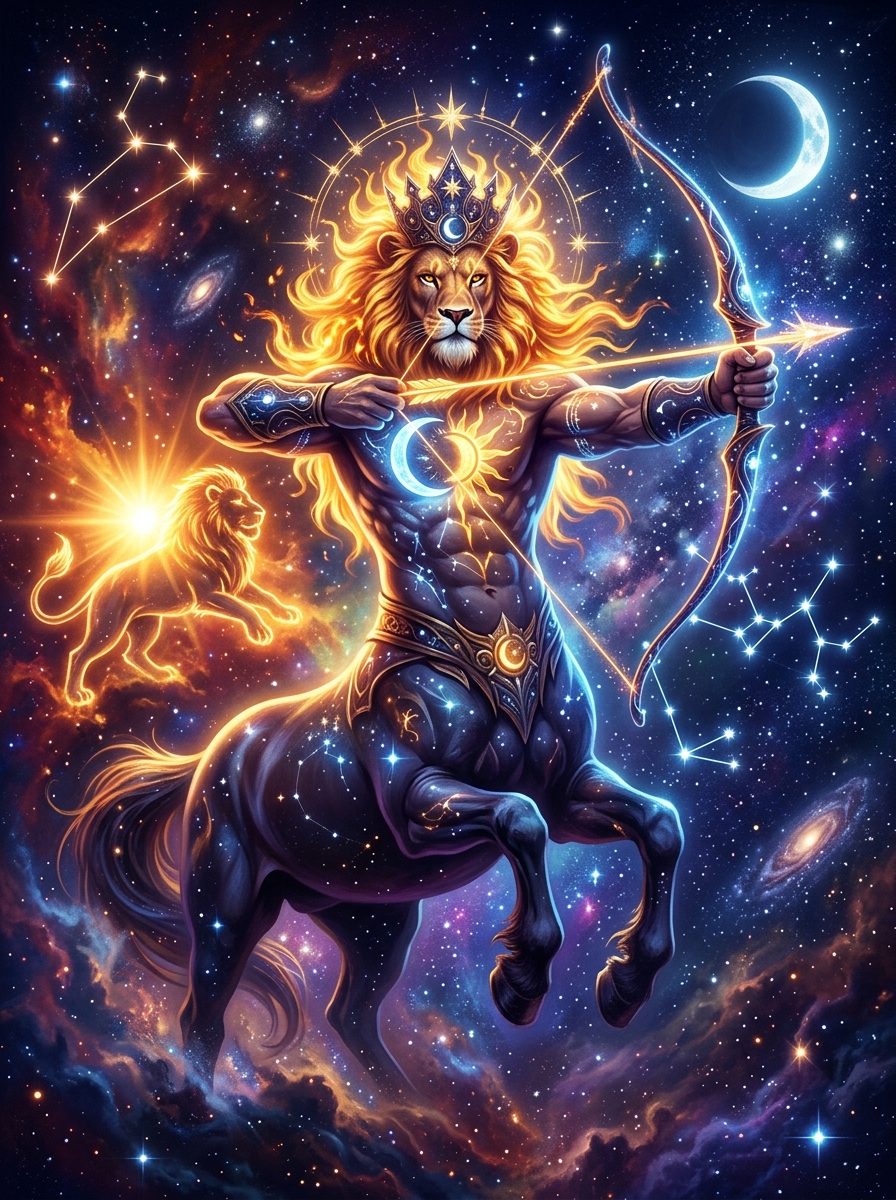
The Double-Fire Dynamic: Harmonizing Solar Ego and Lunar Freedom
When the Sun occupies Leo and the Moon holds court in Sagittarius, the birth chart catches fire twice — and the resulting configuration is anything but redundant. These two luminaries, the conscious self and the emotional underworld, speak the same elemental language yet carry radically different grammatical structures. Leo's fire is fixed: concentrated, sovereign, burning at a singular center like a star that has no intention of moving. Sagittarius's fire is mutable: restless, expansive, a brushfire that leaps from hillside to hillside, igniting everything in its path and never pausing long enough to be contained.
Carl Jung distinguished between the ego — the complex at the center of conscious awareness — and what he called the feeling-toned complexes that animate behavior from the unconscious. In astrological terms, the Sun describes the ego's developmental project, the life task the self is consciously working to enact. The Moon describes something older, more instinctive: the substrate of mood, emotional reactivity, and habitual feeling that colors every experience before rational interpretation even gets a chance. When both of these celestial bodies fire from the same element, the integration curve is gentler than it would be for a water-fire or air-earth pairing. There is a baseline sympathy here, a shared frequency. But sympathy is not identity, and the tension between Leo's fixity and Sagittarius's mutability is the engine that makes this combination genuinely complex.
Fixed Fire and Mutable Fire: A Conversation Between Modes
Leo, as a fixed sign, channels the fiery archetype into a stable, self-referential structure. The fixed quality sustains. It persists. Steven Forrest, in The Inner Sky, notes that fixed signs are the signs of concentrated power — they resist change not from stubbornness alone but from a deep instinct that identity requires roots, that something must hold still long enough to become itself. Leo's creative project is ultimately about becoming someone: developing a self so distinctive, so luminous, so undeniably present that the world cannot look away. This is not vanity in its base form; it is the cosmic imperative of individuation driven by solar fire.
Sagittarius operates on entirely different terms. As the mutable fire sign, it is designed for expansion rather than concentration, for philosophy rather than performance. Liz Greene, writing in The Astrology of Fate, situates Sagittarius within the domain of Jupiter's principle — the drive toward meaning, synthesis, and the infinite horizon. The Moon here is emotionally at home in movement, in the open road, in the intellectual quest that has no final destination. Where Leo's fire wants to be something, Sagittarius's fire wants to understand everything.
This is the central internal conversation for every Sun Leo–Moon Sagittarius native. The ego craves recognition, demands a stage, builds an identity around charisma and creative mastery. The emotional self, meanwhile, resists being pinned down by that very identity — it wants to roam, to question, to remain permanently unfinished. At their best, these two impulses collaborate: the Leo Sun provides the gravitational center, the personal myth around which a life story coheres, while the Sagittarius Moon ensures that the story remains open, philosophically alive, and never collapses into self-parody or ego rigidity.
The Elemental Advantage: Why Double Fire Works
There is genuine fortune in this configuration. When the Sun and Moon share an element, the individual experiences less internal friction than those carrying cross-elemental luminaries. The emotional register and the executive will are composed of the same raw material. For this native, feeling enthusiastic and acting enthusiastically are not separate operations — they arise simultaneously, without the translation lag that plagues, say, a fire Sun with a water Moon. When something inspires this person, they are inspired everywhere: in their ambitions, in their gut reactions, in their physical energy, in their generosity.
This doubles the output of fire's signature gifts. Optimism. Vision. Courage before the new. The capacity to inspire others by sheer infectious belief. Double-fire people are, at their most integrated, the ones in any room who seem to be lit from the inside — who make enthusiasm contagious, who orient groups toward possibility rather than limitation. Robert Hand, in Horoscope Symbols, identifies fire as the element associated most directly with identity-formation, the drive to prove oneself real and distinct in the world. With both luminaries in fire, that drive is constant, pervasive, and self-reinforcing.
The Crowned Centaur: Visionary Leadership and Cosmopolitan Vocations
The centaur is Sagittarius's traditional glyph — a being split between the animal body and the archer's aspiring aim, always pointing toward a distant target just above the visible horizon. Crown the centaur: add Leo's royal solar authority to that already philosophically charged archetype and you begin to understand the vocational destiny latent in this combination. The Sun Leo–Moon Sagittarius native is not merely ambitious. They are ambitious in service of a larger vision, and they instinctively understand — usually quite early in life — that their personal gifts are meant for public deployment.
Professional Domains Where This Configuration Thrives
The vocational sweet spots for this combination cluster around roles that demand both personal magnetism and intellectual breadth. International business leadership is a natural habitat: the Leo Sun provides executive presence and the confidence to command attention in high-stakes rooms, while the Sagittarius Moon ensures genuine comfort across cultures, time zones, and value systems. This is the person who travels for work without experiencing it as sacrifice, who genuinely enjoys the foreignness of foreign places.
Higher education — particularly in leadership, philosophy, law, theology, or comparative literature — offers another natural fit. The desire to teach, to transmit a vision of what the world could be, is strong here. Liz Greene's psychological astrology places the Sun in Leo in direct conversation with the archetype of the king or queen — a figure whose role is not merely to rule but to illuminate, to model what human excellence looks like in embodied form. When that Leo Sun operates through a Sagittarius Moon, the illumination takes on pedagogical color. This native teaches by example, certainly, but also by explicit proclamation — they want to articulate the philosophy behind the example, to name the principle at work in what they're doing.
Global communications, publishing, broadcast media, and international journalism are all vocational domains that reward exactly this blend of personal authority and philosophical expansiveness. The spoken word is especially powerful for this combination. The voice carries warmth, conviction, and scale. Think of the great motivational tradition in American culture — the TED Talk, the keynote address, the university commencement speech — and you are imagining the arena where Sun Leo–Moon Sagittarius people often feel most fully alive.
The Need for an Audience and a Cause
What matters for vocational fulfillment is that neither element be suppressed. A career that provides intellectual scope but no personal recognition will leave the Leo Sun restless and resentful. A career that provides attention and prestige but no philosophical depth will leave the Sagittarius Moon bored and emotionally hollow. The sweet spot is roles that are simultaneously personal — places where this individual's unique character genuinely matters — and larger-than-personal, causes and projects that extend beyond ego gratification into something genuinely meaningful.
Steven Forrest's concept of the South Node aside, the integrative mandate here is clear even without examining the nodal axis: this combination reaches its highest expression when the Leo confidence is enrolled in the Sagittarius mission. When the stage is not merely a place to be seen but a platform for a genuine vision of human possibility. When the fire of individuality burns in service of something worth lighting.
Emotional Needs: The Sagittarius Moon's Quest for Autonomy and Adventure
The Moon describes what we need to feel emotionally safe — not what we logically decide we want, but what the gut, the nervous system, and the deep instinctive self require in order to settle into a sense of okay-ness. For the Sagittarius Moon, that need is inseparably bound to freedom. Not freedom in an abstract political sense, though that matters too, but freedom as a concrete felt experience: the ability to move, to explore, to change direction without having to justify the detour to anyone.
Space as Emotional Oxygen
People with the Moon in Sagittarius are emotionally regulated by movement — both literal and intellectual. A day spent trapped in routine administrative work, in a relationship that demands constant emotional accounting, or in a philosophical framework that has stopped growing will produce a specific kind of unease in this native that they may not immediately recognize as emotional distress. It doesn't announce itself as sadness or anxiety in the conventional forms. Instead it appears as restlessness, as a low-grade irritability that has no obvious target, as a sudden urge to book a flight to somewhere they've never been.
This emotional pattern has significant implications for daily life architecture. The Sagittarius Moon needs to structure its existence so that novelty and expansion are baked into the routine, not saved for vacations. A regular philosophy reading practice, a standing commitment to learning something new each month, an ongoing relationship with people from different cultural backgrounds — these are not luxuries for this Moon placement. They are maintenance.
The Fire Moon and Emotional Processing
Fire Moons — Aries, Leo, and Sagittarius — process emotion differently than the other elemental Moon placements. Where water Moons (Cancer, Scorpio, Pisces) tend to immerse in feeling, and earth Moons (Taurus, Virgo, Capricorn) tend to manage it through practical action, fire Moons tend to transmute emotion into expression. They do not sit with feelings so much as act from them, speak them, dramatize them. The Sagittarius Moon does this through the speech act of interpretation — it wants to name the emotional experience, to assign it a philosophical framework, to turn the feeling into a story that points somewhere meaningful.
This is the Moon that, in the aftermath of a heartbreak, almost immediately begins asking "what did this teach me?" Not as a defense mechanism to avoid grief — though it can become that — but as a genuine expression of how this psyche makes meaning. Liz Greene's work on the Moon points consistently toward the idea that the Moon's sign describes not just what we need but how we need — the modal style of emotional nourishment. For Sagittarius, that style is expansive, interpretive, and forward-facing.
Conflict Between Leo's Loyalty and Sagittarius's Freedom Drive
There is an internal tension worth naming here. The Leo Sun builds its identity partly through long-term commitments — to people, to creative projects, to institutions that recognize its worth. Fixed signs sustain. They are faithful. The Leo principle, at its best, creates loyalty that is noble rather than merely habitual.
The Sagittarius Moon, however, has an emotional allergy to anything that feels like a cage — including commitments that have become routine. The Moon's instinctive pull toward the next horizon can create a lived experience of restlessness that the Leo Sun finds embarrassing and the outer social world finds confusing. "I thought you were so committed to this relationship, this job, this city — what happened?" What happened is the Sagittarius Moon reached the edge of its current growth territory and began looking for new country. The integration work here is not to suppress one in favor of the other but to understand that the Leo Sun's sustained commitments and the Sagittarius Moon's need for expansion can coexist — if the commitments are chosen well enough that they keep growing.
Romantic Compatibility: Passion, Independence, and Shared Journeys
In love, the Sun Leo–Moon Sagittarius native is among the most naturally captivating in the zodiac and among the most difficult to sustainably partner. The captivation is real. The Leo Sun creates warmth, drama, generosity, and the particular kind of romantic intensity that makes a partner feel like the center of the universe — because, when Leo loves, they genuinely mean it. The Sagittarius Moon brings adventure, intellectual excitement, philosophical companionship, and a refusal to let the relationship calcify into mere habit.
What This Native Needs from a Partner
The non-negotiables are clarity: intellectual stimulation, a partner who has their own passionate vision for their life and doesn't need the Leo Sun to supply all the meaning and direction. The Sagittarius Moon is drawn toward people who are going somewhere — philosophically, professionally, geographically. A partner who is comfortably stationary, who finds settled routine emotionally satisfying, will eventually feel suffocating to this native even if that same partner is deeply kind and genuinely loving.
There must also be room for each person to have their own independent trajectory. This is not code for emotional unavailability — the Leo Sun is, in fact, deeply devoted and deeply invested in partnership. But the Sagittarius Moon needs the experience of personal freedom even within a committed relationship. Couples who build lives with a genuine sense of dual sovereignty — two individuals choosing each other without collapsing into each other — tend to bring out the best in this configuration.
Most Compatible Pairings
Air signs — Gemini, Libra, and Aquarius — tend to work particularly well with this combination. Air brings intellectual vitality, social breadth, and a flexible relational style that doesn't crowd the Sagittarius Moon's need for space. Gemini in particular mirrors the Sagittarian love of ideas in constant motion. Libra provides the aesthetic sophistication and relational grace that the Leo Sun finds genuinely beautiful. Aquarius offers the combination of emotional independence and visionary idealism that speaks directly to both luminaries.
Fellow fire signs — Aries and Sagittarius — can create electric partnerships of tremendous mutual inspiration, though the lack of complementary grounding can make practical life-building challenging. Two fire-dominant people tend to ignite brilliantly and sometimes burn through their reserves just as brilliantly.
Compatible fire–air combinations are especially promising: a partner with fire or air prominent in their own chart, particularly in personal planets (Sun, Moon, Venus, Mars), will tend to appreciate rather than be overwhelmed by this native's intensity and need for perpetual forward motion.
Where Relationships Break Down
The most common relational failure mode for Sun Leo–Moon Sagittarius is a mismatch of depth and commitment timeline. The Leo Sun wants to be chosen publicly, consistently, and with a kind of unconditional quality that feels royal in its totality. The Sagittarius Moon, meanwhile, can make early romantic gestures that feel like grand commitment but are actually expressions of enthusiasm in the present tense — arrows aimed at a target that may move. When a partner interprets those gestures as long-term covenant and the Sagittarius Moon later needs to revise, the resulting disappointment can be severe on both sides.
Honesty about this pattern — learning to distinguish between "I am deeply excited about you right now" and "I am committing to you for the long arc" — is one of the central relational maturation tasks for this combination.
Psychological Shadows: Arrogance, Extravagance, and Blunt Dogmatism
Every astrological configuration carries a shadow — the constellation of qualities that emerge when the configuration's gifts are overextended, undisciplined, or operating in the absence of self-awareness. For Sun Leo–Moon Sagittarius, the shadow is generated by the same double-fire intensity that produces the most compelling qualities of the configuration. The very amplitude that makes this person inspiring can, without conscious cultivation, tip into something considerably less flattering.
The Arrogance of Double Fire
Aleister Crowley, writing in his typically blunt style about solar symbolism, observed that the Sun's influence always risks producing a kind of solipsistic certainty — the assumption that what is visible from one's own vantage point is the totality of what exists. Doubled by Sagittarius's philosophical self-confidence, this risk becomes acute. The shadow of Sun Leo–Moon Sagittarius is a person who is not merely confident but unquestionable in their own estimation — who delivers opinions as pronouncements, who confuses personal conviction with universal truth, and who experiences disagreement not as intellectual friction to be welcomed but as either stupidity to be corrected or disloyalty to be punished.
This manifests in subtle and not-so-subtle ways. The Leo Sun can develop a pattern of centering every conversation in its own experience, steering group discussions back to personal narratives, and becoming visibly deflated when the spotlight shifts. The Sagittarius Moon can moralize — delivering philosophical lectures in social contexts where people wanted connection, not curriculum. The combination of Leo's dramatic conviction and Sagittarius's missionary impulse can produce someone who is simultaneously impossible to ignore and exhausting to spend extended time with.
Bluntness as a Failure Mode
Sagittarius is among the bluntest placements in the zodiac. Jupiter's expansive quality applies not just to vision but to speech — there is a directness that at its best is refreshingly honest and at its worst is socially destructive. When the Sagittarius Moon's arrow-mouth is fueled by Leo's fiery conviction, the potential for unintentional cruelty through sheer tactlessness becomes significant. This native does not, as a rule, mean to wound. They are genuinely surprised when their observation — offered in a spirit of honest helpfulness — lands like an attack. The concept that sometimes the unsaid is more merciful than the said does not come naturally to this combination.
Restlessness, Extravagance, and the Problem of Follow-Through
The mutable quality of the Sagittarius Moon means that emotional investment can dissipate as quickly as it arrives. Projects started with visionary fanfare sometimes stall when the initial inspiration fades and the stubborn implementation work begins. The Leo Sun has more fixed follow-through than many fire placements — it does persist — but the Sagittarius Moon can undermine that persistence by simply finding the next horizon more emotionally compelling than the current one.
Extravagance is a related shadow. Both Leo and Sagittarius are associated with abundance, generosity, and a philosophical orientation toward more — more experience, more beauty, more gesture, more life. This is wonderful until it meets the reality of finite resources. Financial imprudence, overcommitment of time and energy, grand gestures that cannot be sustained — these are familiar pitfalls in the Sun Leo–Moon Sagittarius biography.
Path to Integration: Balancing Leo Pride with Sagittarian Wisdom
Jung's concept of individuation — the lifelong process of becoming more wholly oneself by integrating the conscious and unconscious dimensions of the psyche — offers the most useful frame for understanding what development looks like for this configuration. The task is not to become a "better Leo" or a "more disciplined Sagittarius" but to allow the conversation between these two principles to deepen and mature over time, until they are genuinely in dialogue rather than alternating monologues.
Learning to Receive Feedback
One of the most transformative growth edges for Sun Leo–Moon Sagittarius is the development of genuine receptivity — the capacity to be changed by what others offer, including criticism. The double-fire confidence that makes this person effective in leadership roles can also create an invisible armor against the kind of feedback that would most benefit them. Leo's pride can experience criticism as an attack on identity; Sagittarius's philosophical self-assurance can deflect it with an explanatory framework that makes the critic appear small.
Real integration means developing what Steven Forrest calls the humility of the solar journey: the recognition that the self is not yet complete, that the story is still being written, and that other characters in the story carry information the protagonist needs. This is not a call to self-abnegation — Leo's solar authority is real and worth protecting. It is a call to make that authority permeable, to allow it to be informed rather than only to inform.
Anchoring the Vision in Embodied Practice
The shadow of double fire is, among other things, a shadow of abstraction — a tendency to live at the level of the inspiring idea rather than descending into the concrete, sensory, patient work of manifestation. The integration path involves developing a consistent practice that grounds the visionary fire in physical reality: a discipline that requires daily commitment, incremental improvement, and tolerance for the unglamorous middle stages of any worthwhile endeavor.
This doesn't need to be punitive. It should, ideally, be a practice that honors both the Leo need for creative expression and the Sagittarius need for philosophical meaning. A daily writing practice. A sustained athletic commitment. Long-form artistic or intellectual projects with multi-year horizons. The point is sustained engagement with something that will not yield to the first burst of fire alone — that requires the slower, less dramatic fire of patient dedication.
The Wisdom of the Sagittarius Moon in Service of Leo's Legacy
At the highest expression of this configuration, the Sagittarius Moon's philosophical broadness becomes the corrective for Leo's potential parochialism. Where Leo can sometimes mistake local recognition for universal significance, Sagittarius widens the lens. Where Leo can confuse the personal story with the archetypal story, Sagittarius insists on the larger frame. The great teachers, visionary leaders, and cultural figures who carry this configuration at its most integrated are those who have learned to deploy their personal charisma not in service of their own aggrandizement but in service of a genuine vision — philosophical, humanitarian, or spiritual — that exceeds any single life.
This is the crowned centaur in its fullest meaning: the royal personal authority of Leo, hitched to the archer's trajectory toward truth. A self that is fully itself and fully in service of something larger. The paradox that runs through all of Leo's highest development — that you become most sovereign when you give yourself most completely — is here resolved through the Sagittarius Moon's natural appetite for meaning beyond the self. The fire doesn't diminish. It finds its right scale.
Practices and Archetypal Support
Practically speaking, the integration practices most useful for this combination tend to involve conscious limitation — choosing one philosophy and going deep rather than sampling many, choosing one medium of creative expression and mastering it rather than perpetually beginning, choosing one community of commitment and staying long enough to be genuinely known. None of this runs against the native's deepest nature; it simply requires the more mature expression of that nature to prevail over the more adolescent one.
Journaling in the tradition of depth psychology — using writing not as performance but as honest self-inquiry — is a particularly powerful tool. The Leo Sun's comfort with narrative meets the Sagittarius Moon's philosophical reflexivity. The result, when practiced consistently, is a growing capacity to witness the self honestly: to see where pride has hardened into rigidity, where enthusiasm has masqueraded as commitment, where bluntness has wounded without intending to wound.
The transpersonal planetary realm — Jupiter's expansive idealism checked by Saturn's demand for structural integrity — describes the developmental arc most relevant here. In the progression of any Sun Leo–Moon Sagittarius life, the moments of greatest maturation typically come not when the fire is burning hottest but when it meets the resistance that forces it to choose: scatter or deepen. Every time this native chooses depth, the crowned centaur takes another step toward the target.
FAQ
<FAQSection items={[ { q: "What does it mean to have Sun in Leo and Moon in Sagittarius?", a: "Having the Sun in Leo and the Moon in Sagittarius means your conscious identity — the self you are building and expressing in the world — is shaped by Leo's fixed-fire archetype: creative, charismatic, loyal, and hungry for genuine recognition. Your emotional baseline and instinctive reactions, however, are governed by Sagittarius's mutable fire: philosophical, freedom-loving, adventurous, and oriented toward meaning beyond the personal. Together, these placements produce someone who leads with warmth and dramatic presence while being emotionally driven by the need to understand, explore, and expand. The integration task is learning to let Leo's sovereign authority serve Sagittarius's genuinely larger vision, rather than keeping them in separate compartments." }, { q: "What are the core strengths of Sun Leo and Moon Sagittarius?", a: "The core strengths of this combination are substantial and genuinely rare in their combination. Double-fire optimism means this native doesn't just intellectually endorse positive thinking — they feel it in their bones, and that felt optimism is contagious to everyone in their vicinity. Magnetic leadership presence allows them to command attention and inspire loyalty without forcing either. Philosophical breadth, generated by the Sagittarius Moon, ensures their leadership isn't merely personal — it's anchored in a vision that others can join. Generosity, both material and emotional, is characteristic of both placements at their best. And a natural cosmopolitanism — the ability to move across cultures, ideas, and value systems with genuine curiosity rather than anxiety — makes this combination unusually effective in global or cross-cultural arenas." }, { q: "What are the shadow traits of this Sun-Moon combination?", a: "The shadow side of Sun Leo–Moon Sagittarius runs directly through the combination's greatest strengths. The same confidence that makes this person inspiring can tip into arrogance — a difficulty receiving feedback, a tendency to deliver opinions as facts, a subtle (or not-so-subtle) assumption that their perspective is the most important one in the room. Sagittarius's directness, amplified by Leo's conviction, can produce unintentional bluntness that wounds without malicious intent. The Sagittarius Moon's restlessness can undermine the Leo Sun's capacity for sustained commitment, creating patterns of brilliant beginnings and abandoned middle acts. Extravagance — financial, energetic, emotional — is a recurrent pitfall. And the combination's philosophical self-assurance can shade into dogmatism: the missionary certainty that their particular truth is THE truth." }, { q: "Who is most romantically compatible with Sun Leo, Moon Sagittarius?", a: "The best long-term partners for Sun Leo–Moon Sagittarius are typically those who bring intellectual vitality, genuine personal vision, and a relational style that honors independence without being emotionally unavailable. Air sign placements — particularly Gemini, Libra, and Aquarius — tend to work well because they match the intellectual energy without creating a competing fire dynamic that can become overwhelming. Aries and fellow Sagittarius placements create electric mutual inspiration but may lack the grounding complement the relationship needs. Earth sign partners (Taurus, Virgo, Capricorn) can provide stabilizing ballast but may ultimately find the Leo–Sagittarius restlessness difficult to live with long-term. The single most important compatibility factor is whether the partner has a strong, autonomous sense of direction for their own life — this native needs to be chosen by someone who is actively going somewhere, not someone who is waiting to be taken along." }, { q: "How does the Sagittarius Moon affect the emotional life of someone with Sun in Leo?", a: "The Sagittarius Moon transforms the emotional life of this Leo Sun in several important ways. First, it makes the emotional register more philosophical and less personally intense than a Leo Moon would produce — this person is deeply feeling but needs to make meaning of feelings quickly, to contextualize them within a larger interpretive framework. Raw, unnarrated emotion doesn't sit comfortably for long. Second, the Sagittarius Moon creates a genuine emotional need for freedom and movement — space is not a luxury but a psychological necessity. Third, it accelerates emotional recovery. Fire Moons in general, and Sagittarius especially, tend toward emotional resilience and forward-facing processing rather than extended grief or rumination. This is a strength in navigating setbacks and a potential vulnerability in relationships, where partners may feel that difficult emotional territory is not being adequately honored. Finally, the Sagittarius Moon adds a layer of emotional authenticity: what this person tells you they feel, they generally actually feel — the performative quality that sometimes afflicts Leo expressive style is tempered by the Sagittarian allergy to pretense." }, { q: "What careers are best suited to Sun Leo and Moon Sagittarius?", a: "Vocational fulfillment for this combination requires two non-negotiable ingredients: personal visibility and philosophical scope. Careers that offer one without the other will eventually feel incomplete. The most natural fits include international business leadership, higher education (particularly in law, philosophy, theology, or the humanities), broadcast and global media, motivational speaking, publishing, religious or spiritual leadership, the law (particularly international law or advocacy work), and roles that involve sustained cross-cultural engagement. The common thread is that these are all arenas where the individual's personal authority genuinely matters AND where the work points toward something larger than any single person — a body of knowledge, a cause, a community, a vision for what society could become. Creative fields with a public platform — theater directing, film, large-scale artistic production — also fit well, particularly when those projects carry genuine thematic ambition rather than being purely entertainment-focused." } ]} />
Comments
Loading comments…