Sagittarius Sun, Aries Moon: The Enthusiastic Seeker
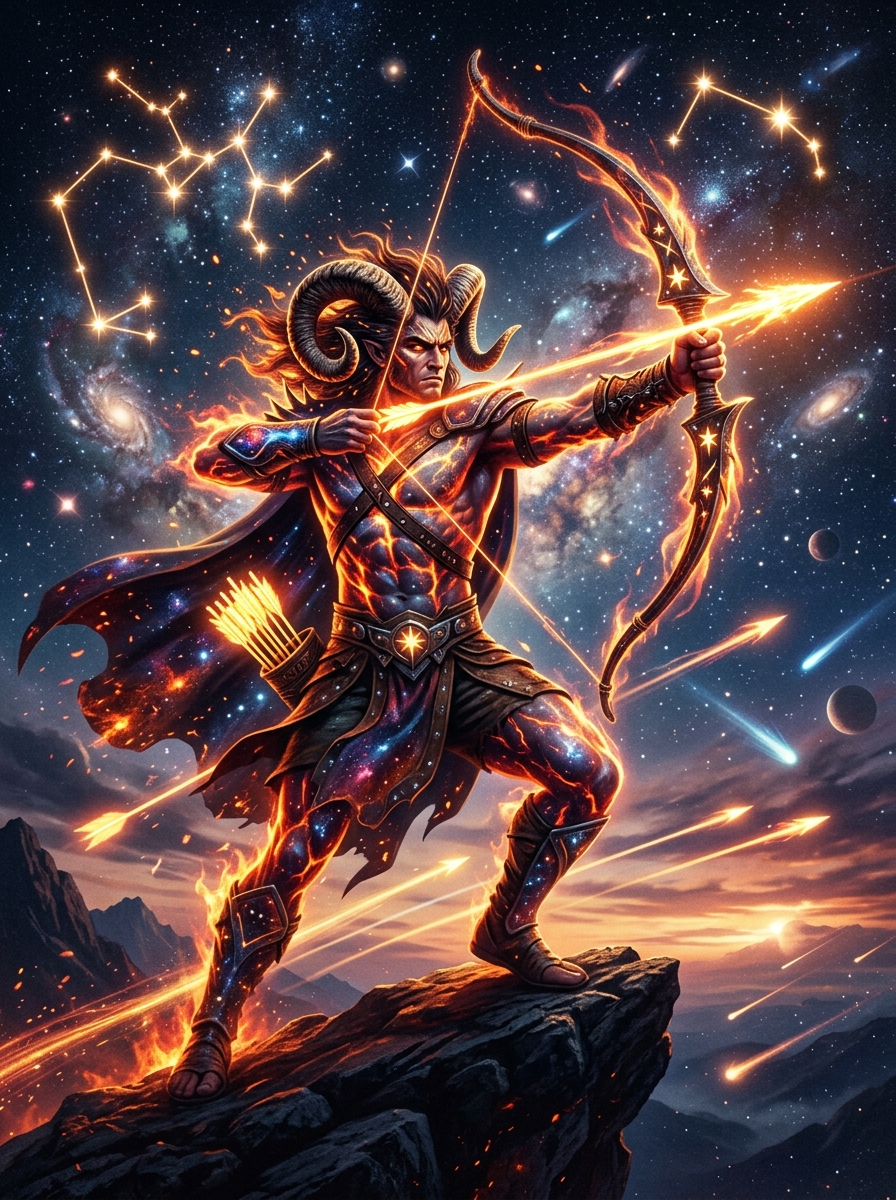
The Double-Fire Personality: Where Mutable Vision Meets Cardinal Drive
Two Flames, One Soul
In the Western astrological tradition, fire is the element of spirit, will, and transformative energy. Every fire sign burns, but each burns with a different temperament: Aries ignites, Leo sustains, Sagittarius radiates. When a person carries fire in both the Sun and the Moon, the inner landscape is dominated by this element in a way that shapes every reflex, every ambition, and every relationship. For those born with a Sagittarius Sun and Aries Moon, the question is never whether to act, but how far and how fast.
Sagittarius is mutable fire. The archer does not simply burn in place — it launches, it seeks, it aims at a horizon that keeps receding beautifully into the distance. Mutable signs are the integrators of the zodiac, holding the capacity to synthesize experience into meaning. Jupiter, the great amplifier, rules Sagittarius and lends the Sun sign its characteristic expansiveness: the broad worldview, the love of foreign cultures and philosophies, the instinct to find the larger pattern in any situation. A Sagittarius Sun person experiences identity not as a fixed thing but as a continuous adventure in understanding.
Aries is cardinal fire. Where Sagittarius seeks, Aries initiates. Cardinal signs carry the energy of beginnings, of raw directive force, of the first spark that sets everything else in motion. Mars, the planet of desire, courage, and confrontation, rules Aries and lends the Moon sign an emotional register that is immediate, unmediated, and intensely personal. An Aries Moon person does not process feelings in a leisurely way — they react to them, often before the conscious mind has fully registered what has happened.
The Synthesis: Fire That Moves and Fire That Acts
When you combine mutable fire in the Sun with cardinal fire in the Moon, you produce a person whose inner life and outer identity are in remarkable alignment — and whose primary mode of being in the world is enthusiastic forward motion. The Sagittarius Sun sets the philosophical coordinates: where are we going, and why does it matter? The Aries Moon provides the ignition: let's go, now, without deliberation.
Liz Greene, in her foundational work on psychological astrology, wrote about the fire signs as expressions of the intuitive function in Jung's typology — the capacity to perceive possibility and potential rather than simply what exists in the present moment. For the Sagittarius Sun–Aries Moon person, this intuition is doubled. They see futures that others cannot yet imagine, and they possess the emotional urgency to pursue those futures before anyone else has finished debating whether they are realistic. This is one of the most genuinely pioneering signatures in the zodiac.
The natural harmony between these two placements also means that this person rarely experiences the kind of internal conflict between head and heart that plagues more mixed-element combinations. A Scorpio Sun with an Aquarius Moon, for instance, must constantly negotiate between the need for emotional depth and the need for intellectual distance. The Sagittarius–Aries person faces a different challenge: not which fire to follow, but how to prevent the combined heat from consuming everything in its path before the moment is truly right.
Jupiter and Mars: The Alchemical Synergy of Expansive Faith and Bold Action
The Two Rulers in Dialogue
In classical astrology, Jupiter and Mars are the two great masculine planets — not in the reductive gender sense, but in the archetypal sense of outward-directed, action-oriented energy. Jupiter is the principle of expansion, abundance, and meaning-making. Mars is the principle of desire, assertion, and the willingness to fight for what matters. When these two planetary rulers govern the most personal points in a chart — the Sun and the Moon — their dialogue becomes the central dynamic of an entire life.
Jupiter's influence on the Sagittarius Sun expresses itself as an innate sense of faith — not necessarily religious faith, though that is certainly possible, but a deeper epistemological optimism. The Sagittarius Sun person genuinely believes, at a constitutional level, that the world is comprehensible, that truth is discoverable, and that the search for it is worth any inconvenience. This faith can be one of the most magnetic qualities in the human personality. People are drawn to those who genuinely believe in something larger than themselves.
Mars as Emotional Fuel
Mars's rulership of the Aries Moon adds something critical to this equation: conviction with teeth. Jupiter can inflate and expand indefinitely — it is the largest planet in our solar system, and its symbolic nature reflects this tendency toward excess. Left unchecked, Jupiter's influence produces the enthusiast who overpromises, the philosopher who loses himself in abstraction, the traveler who never comes home. Mars provides the corrective pressure: the Aries Moon demands that belief be enacted, that ideals meet the resistance of reality, that the Sagittarian vision be tested in actual combat with the world.
Aleister Crowley, one of the most prolific (if controversial) figures in twentieth-century Western esotericism, wrote extensively about Mars as the planet of initiation through conflict — the idea that true spiritual and personal development requires the willingness to be opposed, to confront, and to be changed by that confrontation. For the Sagittarius Sun–Aries Moon individual, the Aries Moon ensures that Jupiter's expansive faith does not remain safely theoretical. The emotional body wants to test the vision, wants to fight for it, wants to know through direct experience whether the belief holds under pressure.
Practical Alchemy: Where the Two Principles Meet
The alchemical result of this Jupiter–Mars dialogue is one of astrology's most effective combinations for visionary action. These individuals do not merely dream large — they move toward their dreams with the speed and decisiveness of a martial archetype. Where a Sagittarius Sun with a Pisces Moon might spend years refining and contemplating a vision before acting, the Aries Moon compresses that timeline dramatically. The emotional body simply will not wait. There is an impatience that is genuinely productive: it prevents the paralysis by analysis that afflicts more reflective types.
This combination also produces extraordinary courage — not the stoic endurance of Capricorn or the emotional resilience of Scorpio, but the bright, almost naive courage of the hero who has not yet learned to be afraid. Steven Forrest, in The Inner Sky, describes Aries as the warrior before battle, when the adrenaline of possibility is still stronger than the memory of wounds. The Sagittarius Sun–Aries Moon person carries this warrior energy at an emotional level throughout life, which can be profoundly inspiring to witness and occasionally exhausting to be in relationship with.
Relationship Dynamics: Love, Freedom, and the Search for a Worthy Companion
What This Person Needs in a Partner
No astrological placement illuminates relationship needs more clearly than the Moon sign. The Moon governs the instinctual emotional self — the part of us that reaches out for comfort, safety, and connection before the rational mind has offered its opinion. With the Moon in Aries, the emotional needs are specific and non-negotiable: independence, respect, and the experience of genuine adventure alongside someone who matches their energy.
The Aries Moon does not love tentatively. When this placement is attracted to someone, the feeling arrives fully formed and urgent — there is no slow warming-up, no cautious exploration of possibilities. The Aries Moon person falls in, completely and immediately, and expects the other person to meet them there. This can be intoxicating for partners who love intensity and directness. It can be terrifying for those who prefer a slower emotional rhythm.
Paired with a Sagittarius Sun, this emotional directness is wrapped in the archer's characteristic charm: the philosophical wit, the storytelling, the genuine interest in the other person's beliefs and life experience. Sagittarius has a gift for making people feel that the conversation they are having is the most interesting conversation happening anywhere on Earth. When that warmth combines with the Aries Moon's full-contact emotional presence, the Sagittarius–Aries person can be one of the most captivating presences in any room.
The Freedom Imperative
The single most consistent feature of this combination's relationship patterns is the absolute non-negotiability of personal freedom. Sagittarius, as the most liberty-loving sign of the zodiac, experiences restriction as an existential threat rather than a mere inconvenience. The Aries Moon amplifies this with its own version of freedom-need: the right to act on impulse, to initiate, to refuse to be defined or contained by another person's expectations.
This does not mean the Sagittarius Sun–Aries Moon person is incapable of commitment. It means that their commitment must feel chosen rather than required, expansive rather than confining. The healthiest long-term relationships for this placement tend to involve partners who have their own rich inner lives and independent pursuits — people who are genuinely interesting and genuinely busy, who do not need the Sagittarius–Aries person to be their entire world.
Partners who confuse love with possession, or who express their care through excessive proximity and control, will trigger the Aries Moon's most volatile defensive responses. The Sagittarius Sun will attempt to intellectualize its way out of the relationship ("we have fundamental philosophical differences") while the Aries Moon simply wants to escape. The combination of these two exits can make this placement appear emotionally inconsistent: articulating high-minded reasons for needing space while simultaneously behaving like a restless animal in a too-small enclosure.
Ideal Partnership Dynamics
The most sustaining partnerships for this combination share several key qualities. First, intellectual companionship: the Sagittarius Sun requires a partner who can engage with ideas at depth, who reads, who thinks, who brings their own perspectives into genuine dialogue rather than simply agreeing. Intellectual flatness is a slow poison for Sagittarius — it does not inspire dramatic conflict so much as a quiet draining of interest.
Second, shared adventure: the Aries Moon needs to do things with a partner, not just discuss them. Travel, physical challenge, creative risk-taking, entrepreneurial ventures — these are the currencies of intimacy for this placement. The couple that explores together, argues passionately about what they have discovered, and then packs up to discover something new is enacting the Sagittarius–Aries love language in its purest form.
Third, and most subtly, this placement needs a partner who can hold their ground. The Aries Moon, despite its assertiveness, is deeply attracted to strength. A partner who consistently yields, who has no strong opinions, who simply mirrors back whatever the Sagittarius–Aries person wants to hear, will eventually lose their appeal entirely. The warrior archetype needs a worthy opponent — or at least a worthy ally who can push back with genuine conviction.
Career Vocations: Dynamic Fields for the Pioneering Spirit
The Architecture of Meaningful Work
For the Sagittarius Sun–Aries Moon individual, work is not a means to an end — it is an expression of identity. These are not people who can maintain a strict separation between who they are and what they do professionally. The Sagittarius Sun requires that work feel meaningful, connected to some larger purpose or truth-seeking mission. The Aries Moon requires that work be immediate and consequential — that the results of one's efforts be visible and felt rather than abstract and deferred.
The combination of these two requirements produces a professional profile that gravitates toward fields where vision and action are equally prized.
Fields of Natural Excellence
Law and advocacy represent one of the clearest natural fits for this placement. The legal system, particularly in its most contentious forms — criminal defense, civil rights law, international arbitration — requires exactly the combination of philosophical breadth (Jupiter/Sagittarius) and combative directness (Mars/Aries) that this placement naturally possesses. The Sagittarius Sun can hold the larger framework of justice and principle in mind even while the Aries Moon fights case by case with full commitment.
Journalism and documentary work, particularly in the tradition of investigative or conflict-zone reporting, suits this combination well. The Sagittarius Sun provides the philosophical frame — the belief that truth matters and that its discovery serves the public good. The Aries Moon provides the personal courage to go where the story is, even when that involves genuine risk. This is the placement of reporters who travel to conflict zones, of documentarians who spend years following a single story because they believe it needs to be told.
Entrepreneurship and venture creation represent another natural domain. The Sagittarius Sun is an excellent visionary — capable of seeing market or social needs before they are obvious to others, and of communicating that vision compellingly. The Aries Moon supplies the initiative energy that is so often the bottleneck in any venture: the willingness to begin before everything is perfectly prepared, to hire before the budget is confirmed, to ship before the product is perfect.
Athletics and physical coaching draw on the Aries Moon's embodied, kinetic energy and the Sagittarius Sun's capacity for motivational leadership and philosophical framing. This is the placement of coaches who not only teach technique but transmit an entire philosophy of competition and excellence — figures for whom sport is a vehicle for developing character rather than merely accumulating victories.
Higher education and philosophy represent the quieter but equally powerful professional expression of this energy. The Sagittarius Sun, at its most developed, produces teachers and thinkers of genuine scope — people who synthesize across disciplines, who bring an integrative perspective to complex questions, who make large ideas accessible without dumbing them down. The Aries Moon ensures that these intellectuals are never merely academic: they want to change minds, shift perspectives, and produce real effects in the world through their ideas.
The Autonomy Requirement
Across all these fields, one constant applies: this combination requires meaningful professional autonomy. Being told precisely how to do their job — being supervised, second-guessed, or constrained by bureaucratic process — is both inefficient for the organization and genuinely corrosive to this individual's vitality. They perform best when given a clear goal and wide latitude for how to achieve it. Micromanagement is, for the Sagittarius Sun–Aries Moon person, a form of violence against the spirit.
The Shadow Side: Dogmatic Impatience and the Flight from Complexity
The Shape of the Shadow
In Jungian psychology, the Shadow is not simply the negative or destructive part of the personality — it is the unlived, unacknowledged part, the qualities that have been pushed below conscious awareness because they do not fit the ego's preferred self-image. For the Sagittarius Sun–Aries Moon person, whose self-image tends to be constructed around qualities like vision, courage, truth-seeking, and inspirational leadership, the Shadow contains the complementary opposites: doubt, cowardice, intellectual dishonesty, and the temptation to follow rather than lead.
But the Shadow also contains something more specific and more relevant to this placement's daily life: the capacity for dogmatic impatience. This is the configuration's most characteristic shadow expression, and it operates on multiple levels simultaneously.
Dogmatism: The Inflation of Vision
Jupiter's shadow is inflation — the expansion that becomes grandiosity, the faith that becomes fanaticism, the worldview that becomes the only worldview. When Jupiter rules the Sun, the danger is that personal beliefs become identified with universal truth. The Sagittarius Sun person genuinely experiences their philosophical conclusions as discoveries rather than mere opinions — they believe they have found the truth, not merely constructed a perspective. This can produce remarkable intellectual confidence, but it can also produce a specific kind of blindness: the inability to genuinely hear contradicting evidence because the existing framework feels so complete and so obviously correct.
Liz Greene, writing about Jupiter–Sun configurations in The Outer Planets and Their Cycles, observed that Jupiter's influence on the Sun produces individuals who experience themselves as intermediaries between the divine order and ordinary human experience — a role that can be genuinely inspired or genuinely insufferable depending on the degree of psychological integration. The Sagittarius Sun at its shadow expression preaches rather than converses, lectures rather than explores, and confuses certainty for wisdom.
Impatience: The Emotional Short-Fuse
The Aries Moon compounds this tendency by adding emotional urgency to intellectual conviction. When the Sagittarius Sun has arrived at a truth and the Aries Moon is ready to act on it, any obstacle — including the legitimate perspectives of other people — feels like an unconscionable delay. The combined energy of Jupiter's expansiveness and Mars's combativeness produces a person who can move from philosophical enthusiasm to genuine anger with startling speed when their vision is challenged or their progress is impeded.
This impatience is not simply a character flaw to be corrected. It is a misapplication of a genuine strength. The speed and decisiveness that make the Aries Moon so effective in actual emergencies becomes destructive when applied to situations that require careful, iterative development — negotiations, complex relationships, creative projects that need time to find their form. The Sagittarius–Aries person's emotional body does not distinguish between "slow because impossible" and "slow because unfolding correctly." Both feel equally intolerable.
Practical Avoidance
A subtler shadow expression is the habitual avoidance of practical complexity. Sagittarius, as a mutable sign, excels at synthesis and vision but often struggles with execution and maintenance. The archer aims at the horizon but rarely does the unglamorous work of sharpening the arrows, replacing the bowstring, or tending to the equipment that makes the quest possible. When the Aries Moon adds an emotional aversion to anything that feels static or repetitive, the result is a person who can brilliantly launch new ventures and then quietly abandon them at exactly the point where steady, unsexy follow-through would determine whether they succeed or fail.
This avoidance often expresses itself as a series of enthusiastic beginnings with ambiguous endings — projects and commitments that simply trail off rather than being formally completed or formally abandoned. The Sagittarius Sun rationalizes this as "moving on to bigger things," while the Aries Moon simply can no longer sustain emotional engagement with something that has lost its freshness. The person may not even recognize the pattern as avoidance, because they are always genuinely excited by whatever they are doing next.
Path of Growth: Cultivating Patience, Depth, and the Discipline of Staying
The Developmental Task
Every astrological combination carries within it not only a description of what someone is but a map of what they are becoming. The Sagittarius Sun–Aries Moon person's developmental task is not to diminish their fire — that would be both futile and wrong. Fire is their most authentic expression, and the world genuinely needs the vision and courage this combination brings. The task is to build a container for the fire: structures of patience, depth, and sustained presence that allow the flame to illuminate rather than merely consume.
Jung wrote about the process of individuation — the lifelong movement toward psychological wholeness — as necessarily involving the integration of opposites. For the Sagittarius–Aries person, the undeveloped opposite is earthy patience: the capacity to stay with a single thing long enough for its depths to reveal themselves, to endure the unglamorous middle of any process without fleeing toward the next beginning.
Cultivating Active Listening
One of the most transformative practices for this placement is the cultivation of genuine active listening — not the strategic pause while waiting for their turn to speak, but the genuine suspension of the urge to advise, reframe, or inspire in order to simply receive what another person is communicating.
The Sagittarius Sun's instinct is to see where someone's experience fits into a larger philosophical framework and to offer that framework as a gift. The Aries Moon's instinct is to find a solution and execute it immediately. Both of these impulses, however well-intentioned, can function as ways of not truly hearing the other person. Someone who simply needs to be witnessed in their experience — not advised, not reframed, not fixed — will feel unseen by this combination's default mode, even when the Sagittarius–Aries person is trying their hardest to be helpful.
The Practice of Completion
Developing the habit of completion — not the perfectionistic completion of making everything perfect before releasing it, but the honest completion of following a commitment through to its natural end — is one of the most practically impactful growth areas for this placement.
This means building in systems that compensate for the emotional body's tendency to lose interest once a project moves out of its exciting early phase. External accountability structures — partners, deadlines, regular reviews, public commitments — can provide the external Mars that the Aries Moon forgets to apply internally once the initial urgency has faded. This is not a failure of character but an intelligent adaptation to how this nervous system actually works.
Embracing Complexity and Contradiction
Perhaps the deepest growth edge is intellectual: learning to live comfortably in uncertainty, to hold competing truths simultaneously without requiring them to resolve into a single clear answer. Jupiter's expansion can ultimately move from the inflation of certainty to the genuine spaciousness of wisdom — the understanding that more is known about what we do not yet understand than about what we do. This movement, from the young Sagittarius who knows to the mature Sagittarius who wonders, is one of the most beautiful transformations in the zodiacal developmental arc.
The Aries Moon supports this growth when it is directed not toward defending existing convictions but toward the courage of genuine exploration — the willingness to be changed by what one discovers.
Somatic Connection: The Anatomy and Physical Alignment of the Warrior Centaur
The Body as Map
In medical astrology, each sign governs specific areas of the physical body. These correspondences are not meant as diagnostic tools — they are symbolic languages that illuminate how the energy of a placement manifests in somatic experience, where this configuration's vitality concentrates, and where its characteristic tensions tend to accumulate.
Sagittarius governs the thighs, hips, and sciatic nerve, as well as the liver — the organ of Jupiter, associated with metabolism, detoxification, and the processing of excess. The centaur symbol of Sagittarius is particularly revealing here: the body of a horse fused with the torso and mind of a human. The power of this configuration lives in the lower body — in movement, in locomotion, in the physical embodiment of the quest. These are people who need to move their bodies the way other people need to sleep or eat. Stillness, for an extended period, is not rest — it is deprivation.
Aries governs the head, face, and adrenal response. The first sign of the zodiac, Aries concentrates its energy at the very top of the body — in the eyes that seek the horizon, the jaw that sets with determination, the adrenal glands that flood the system with the neurochemistry of readiness. The Aries Moon individual experiences emotion primarily as a physical event in the upper body and head: the flush of anger or excitement, the sudden forward thrust of engagement, the headache that accompanies sustained frustration.
The Physical Profile and Needs
For the Sagittarius Sun–Aries Moon person, the body is not a vehicle for the spirit but an equal partner in the quest. Physical movement is not optional self-care — it is the primary mechanism through which this person processes emotion, integrates experience, and maintains psychological equilibrium. A Sagittarius–Aries person who is forced into prolonged physical inactivity will typically become emotionally dysregulated in ways that may confuse even them, since the direct connection between bodily state and emotional state is rarely fully conscious.
The most sustainably healthy physical practices for this combination tend to involve both challenge and movement — not the meditative stillness of yoga or the repetitive motion of swimming laps, though these can be valuable supplements, but the engaged physicality of martial arts, trail running, competitive team sports, long-distance hiking, or high-intensity training that combines physical demand with strategic thinking. The Sagittarian body loves to cover ground; the Aries Moon needs the physical equivalent of a fight — something to push against.
The Liver and Adrenals: Managing Excess
The liver and adrenal glands, as the respective Sagittarian and Arian organs, tell an important story about this combination's most characteristic health vulnerability: the tendency toward excess. Jupiter's influence on Sagittarius predisposes toward generous consumption — of food, drink, experience, stimulation, and commitment. The liver is literally the organ that processes and filters excess; when overtaxed, it is the first system to signal that the Sagittarian appetite has outrun its container.
The adrenal glands, associated with Aries and the Mars-driven stress response, are under consistent demand from a person who lives in a state of ongoing readiness and urgency. Chronic high-intensity living — whether through actual external demands or through the internally generated urgency of the Aries Moon's emotional register — eventually produces adrenal fatigue: the paradox of feeling simultaneously exhausted and unable to rest.
Sustainable health for this placement involves building in genuine periods of restoration — not as reluctant concessions to weakness, but as the intelligent maintenance of the system that generates this extraordinary vitality. The centaur, after all, needs to care for the horse that carries it.
Frequently asked questions
- What does having a Sagittarius Sun and Aries Moon mean for my personality?
- It means your core identity — the self you are actively growing into — is shaped by Sagittarius's hunger for meaning, philosophical breadth, and freedom, while your emotional instincts and gut reactions are governed by Aries's cardinal fire: quick, direct, and intensely personal. In practice, you lead with enthusiasm and idealism (Sun), and when anything feels threatening to your independence or integrity, you react fast and with force (Moon). The combination produces someone whose convictions feel genuinely embodied rather than merely intellectual — you don't just *believe* in your philosophy, you *live* it, often at full speed.
- Is Sagittarius Sun Aries Moon compatible with earth signs in love?
- There is genuine complementarity here, though it takes conscious effort from both parties. Earth-sign partners (Taurus, Virgo, Capricorn) offer the Sagittarius Sun–Aries Moon native the grounding and follow-through they so often lack. In turn, the double-fire partner injects adventure, vision, and vitality into the relationship. The friction is real: earth signs tend to prize stability and deliberation, while this combination prizes momentum and spontaneity. Long-term success usually depends on whether the earth-sign partner genuinely loves being swept along by big ideas, and whether the Sagittarius–Aries person can respect a slower, more methodical approach to life without dismissing it as timid.
- What careers are best for Sagittarius Sun Aries Moon people?
- Any field that combines intellectual breadth with physical action and tangible leadership is a strong fit. Athletics, law, international business, journalism, documentary filmmaking, adventure travel, higher education, entrepreneurship, emergency medicine, military strategy, and the ministry or philosophical counseling are all domains where this placement excels. The crucial variable is autonomy — this person performs brilliantly when given room to innovate and initiative, and suffocates under micromanagement or narrow specialization. They need a career that feels like a *quest*, not a routine.
- What is the biggest shadow for Sagittarius Sun Aries Moon?
- The deepest shadow is the combination of dogmatism and impatience — what you might call 'fire without a container.' Sagittarius, ruled by Jupiter, can inflate its own beliefs into unquestionable truth, dismissing nuance or counterevidence. When the Aries Moon adds emotional urgency to that dynamic, the person can become not just opinionated but combative, rushing to a conclusion and then defending it with the full force of their identity. The subtler layer of this shadow is the avoidance of complexity: because action feels so natural and reflection feels tedious, these individuals can unconsciously flee from the difficult inner work that would make their idealism genuinely transformative rather than merely dramatic.
- How does the Sagittarius Sun Aries Moon handle stress and emotional overwhelm?
- Under stress, this combination typically moves rather than sits. The Aries Moon's first impulse is kinetic — exercise, confrontation, or rapid change of environment. The Sagittarius Sun then tries to reframe the stressor within a larger philosophical narrative ('this is just a lesson,' 'everything happens for a reason'), which is often genuinely useful, but can also become a strategy for bypassing grief or vulnerability. The growth edge here is learning to *feel the feeling first* before reframing it. Physical outlets remain essential — running, martial arts, or any vigorous body-based practice provides genuine emotional regulation. The danger is using constant motion as a way to stay permanently ahead of the emotional material that needs processing.
- Which famous people have a Sagittarius Sun and Aries Moon?
- Precise birth data is required to confirm Moon signs, so any public list should be taken as approximate. That said, the archetypal profile of the Sagittarius Sun–Aries Moon — the bold idealist who turns philosophy into direct action — maps onto figures like Winston Churchill (Sagittarius Sun, confirmed Aries Moon), whose rhetorical conviction and refusal to yield under pressure mirror this placement's energy almost exactly. The pattern also resonates with pioneering thinkers and activists who refused the status quo not merely as a protest but as a life-defining crusade — individuals for whom belief was never passive.
Comments
Loading comments…