The Succedent Houses in Astrology: Stabilizers of the Birth Chart
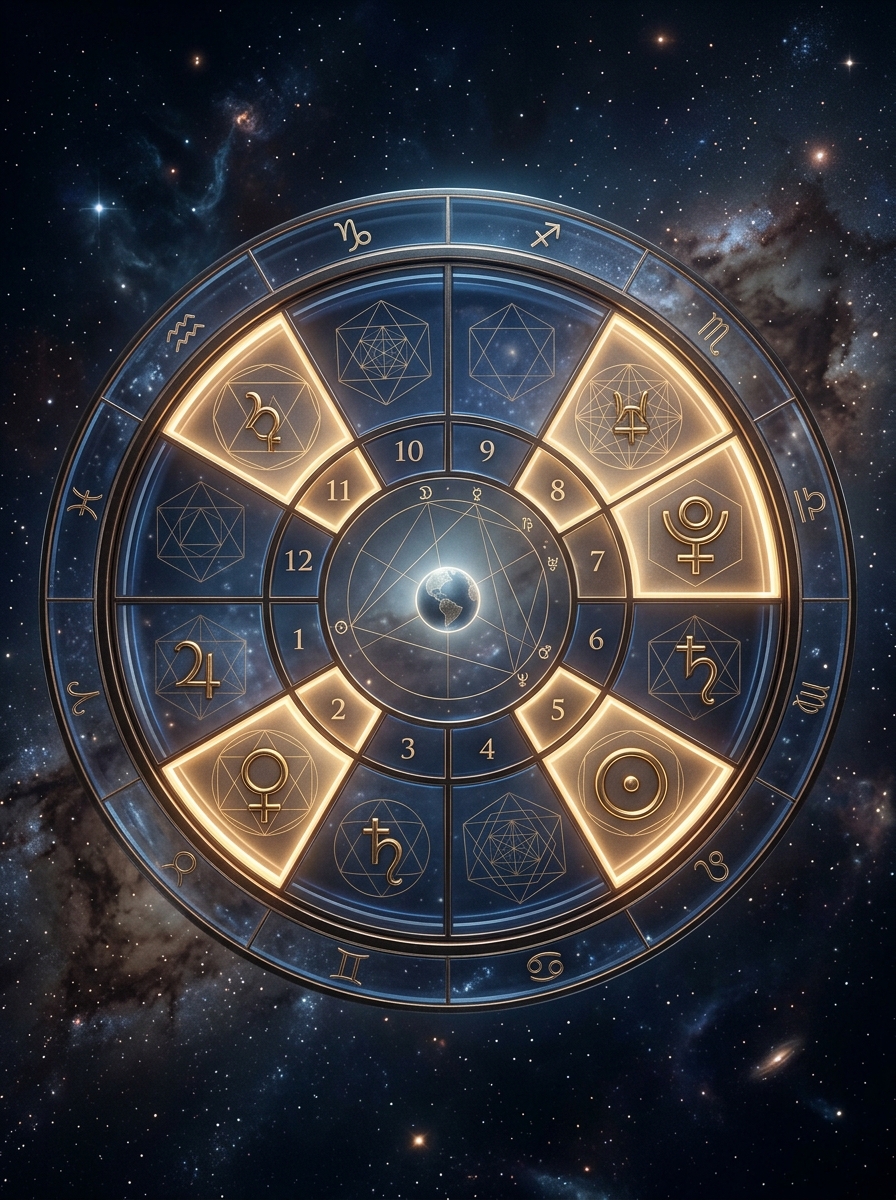
The Architecture of Sustenance: Defining the Succedent Houses
Astrology is built upon dynamic cycles of movement, growth, and integration. When we analyze the circular wheel of a birth chart, we are looking at a living mandala that maps the evolution of human consciousness. Among the most crucial structures within this wheel are the twelve houses, which are divided into three distinct developmental categories: the angular, the succedent, and the cadent houses. This ternary cycle reflects the foundational process of life itself—initiation, consolidation, and distribution. The succedent houses, consisting of the Second, Fifth, Eighth, and Eleventh houses, serve as the crucial middle phase of this cycle. They are the cosmic anchors, the spaces where the raw, initiating impulses of the angular houses are given form, stability, and enduring value.
Without the succedent houses, the psychic energy initiated in the angular houses would simply disperse into the ether. If the First House initiates the raw sense of individual selfhood, it is the Second House that stabilizes this identity by asking what that self owns, values, and needs to survive physically. If the Fourth House establishes the subjective root system of home, family, and emotional safety, the Fifth House consolidates this foundation into creative self-expression, joy, and individual sovereignty. If the Seventh House initiates the awareness of the relational other, the Eighth House deepens and stabilizes this union through shared resources, psychological fusion, and joint values. Finally, if the Tenth House initiates professional structure and public standing, the Eleventh House preserves and expands this status by weaving it into collective networks, friendships, and long-term social aspirations.
The Epanaphora: Climbing to the Angles
Historically, classical astrologers referred to the succedent houses by the Greek term epanaphora, which translates literally to "rising up" or "carrying upward." Astronomically, this refers to the daily rotation of the Earth. As the sky moves, planets located in the succedent houses are rising up toward the angles—specifically, they are climbing toward the Eastern Horizon (Ascendant) or the Meridian (Midheaven). Because of this motion, traditional astrology viewed these houses as climbing toward potency. They represent resources that are actively moving toward manifestation, waiting to be utilized by the angles of action. They represent the accumulated capital, both literal and psychological, that the individual has at their disposal to fuel their active engagement with the outer world.
Unlike the angular houses, which represent immediate, direct, and dynamic action in the physical world, the succedent houses operate with a quieter, more concentrated strength. Modern psychological astrology classifies the strength of planetary placements in these houses as moderate and constructive. While a planet in an angular house demands immediate expression and often manifests as external events over which we have little control, a planet in a succedent house requires conscious application. It does not force itself upon the environment with the same loud urgency; instead, it offers a reliable, steady reservoir of energy that can be cultivated through discipline, patience, and deliberate effort. It requires the individual to actively cultivate, develop, and maintain the planetary qualities present there rather than expecting them to automatically burst forth.
Psychological Containment and the Jungian Vessel
From a psychological perspective, the succedent houses represent the development of the ego's containment system. Carl Jung wrote extensively about the necessity of a strong ego container to withstand the chaotic currents of the unconscious. In the birth chart, the succedent houses act as this container. They are the psychic territories where we build security, define our values, assert our creative autonomy, navigate the depths of intimacy, and find our place within the collective tribe. They are the fields of psychological cultivation where we learn that raw potential is useless without the steady work of sustenance and consolidation.
Without this containment, the individual remains at the mercy of raw impulse. A strong first-house ego with a weak second-house foundation can lead to a hollow personality that acts out but has no internal substance or self-worth. Similarly, a tenth-house career drive with a weak eleventh-house social network will eventually collapse under its own weight, lacking the community support and shared ideals necessary to sustain its public standing. The succedent houses are the vital shock absorbers of the psyche, translating the friction of active life into enduring structure.
The Ternary Cycle of the Zodiac: Angular, Succedent, and Cadent
To fully appreciate the role of the succedent houses, one must understand their position within the ternary cycle of the zodiac. This cycle represents a universal law of development: first, energy is launched; second, it is stabilized; third, it is adapted and integrated. This three-step rhythm repeats four times around the wheel, mapping the progression of human consciousness through the four quadrants of life.
The angular houses (the First, Fourth, Seventh, and Tenth) represent the initiating spark. They correspond to the cardinal quality, carrying a dynamic, outward-projecting force. Here, we confront the raw demands of beginnings. The Ascendant launches the physical self; the Imum Coeli establishes the private domain; the Descendant initiates relationship; the Midheaven projects the career. In these houses, life happens quickly, and we are forced to act. The energy is intense, highly visible, but often unstable and reactive.
The succedent houses immediately follow the angular houses. They correspond to the fixed quality, acting as the stabilizing ground. Once the initial spark of the angle has been struck, the succedent house captures that energy and turns it into something solid. For example, after the self is born in the First House, the Second House asks: "Now that I am here, how do I sustain myself?" The energy shift from angular to succedent is a shift from kinetic action to potential power, from movement to accumulation, and from impulse to endurance. Here, we build the foundations that prevent the initiating spark from burning out too quickly.
Finally, the cadent houses (the Third, Sixth, Ninth, and Twelfth) follow the succedent houses. They correspond to the mutable quality, serving as zones of distribution, transition, and learning. Once energy has been initiated (angular) and consolidated (succedent), it must be shared, questioned, and adapted to prepare for the next cycle. The cadent houses dismantle the rigid structures of the succedent houses, ensuring that security does not degenerate into stagnation. This ternary loop is the heartbeat of astrological dynamics, showing how stability is always preceded by action and always followed by adaptation.
The Four Quadrants and their Succedent Anchors
If we trace the ternary cycle through the four quadrants, we see a beautiful developmental journey. In the first quadrant (Houses 1-3), the First House initiates individual physical identity, which is consolidated in the Second House through material resources and self-worth, and eventually shared and adapted in the Third House through local communication and intellectual curiosity. In the second quadrant (Houses 4-6), the Fourth House initiates our private roots and emotional foundations, which the Fifth House consolidates into creative self-expression and individual play, before the Sixth House refines and integrates these skills through daily service, health, and routine work.
In the third quadrant (Houses 7-9), the Seventh House initiates our relationships with others, which the Eighth House deepens and consolidates through shared resources, intimate bonding, and psychological transformation, before the Ninth House expands these relational lessons into philosophical and spiritual truth. Finally, in the fourth quadrant (Houses 10-12), the Tenth House initiates our public vocation and societal authority, which the Eleventh House stabilizes through friendships, social networks, and humanitarian goals, before the Twelfth House dissolves these public structures back into the collective unconscious, completing the cycle and preparing for the rebirth of the self at the Ascendant.
The Fixed Quality and the Power of Concentration
The psychological connection between the succedent houses and the fixed signs of the zodiac—Taurus, Leo, Scorpio, and Aquarius—is profound. Fixed signs are characterized by their resilience, concentration of energy, and resistance to external disruption. Similarly, the succedent houses are the domains where we express our greatest capacity for persistence, loyalty, and focus. Here, we build psychological fortifications that allow us to withstand the storms of life.
Psychic Libido and the Concentration of Focus
In psychological astrology, as championed by Liz Greene, the fixed energy of the succedent houses represents the concentration of libido (psychic energy) toward specific goals. In the Second House, this concentration is directed toward the material plane and personal values, anchoring our physical survival. In the Fifth House, it is focused on the creative ego and individual self-expression, anchoring our unique identity. In the Eighth House, it is turned inward toward the emotional depths of relational fusion and psychological transformation, anchoring our capacity for intimacy. In the Eleventh House, it is directed toward collective ideals and group cohesion, anchoring our sense of belonging.
This concentration of energy provides us with the necessary stamina to achieve long-term objectives. However, because these houses are linked to fixed energy, they also carry the shadow of rigidity. There is an inherent reluctance to change the patterns established within the succedent houses. We may cling to material possessions in the Second House, demand constant validation for our creative output in the Fifth, refuse to let go of toxic relational dynamics in the Eighth, or become dogmatic about our ideological alliances in the Eleventh. The lesson of these houses is to find the delicate balance between preservation and stagnation. We must learn to maintain our boundaries without allowing them to become rigid walls that cut us off from the natural flow of life.
When we look at the planets residing in these houses, we find the areas of our lives where we are called to build lasting structures. If Saturn is in a succedent house, the lesson of consolidation is slow, requiring us to overcome deep-seated fears of inadequacy before we can access the stable foundation. If Jupiter resides here, we find an abundance of resource and a natural confidence in our ability to sustain ourselves, though we must guard against complacency. Regardless of the specific planets involved, the succedent houses demand that we show up, do the work of maintenance, and respect the slow process of growth. They show us that the things of lasting value in this life require time, dedication, and a willingness to stay the course.
The Second House: Materialization of Resource and Self-Worth
The Second House is the first of the succedent houses, succeeding the First House of identity. Traditionally associated with the sign of Taurus and ruled by Venus, this house represents our relationship with the material world. It is the domain of money, possessions, physical resources, and our personal values. Psychologically, however, the Second House goes far deeper than the contents of our bank accounts; it is the ultimate container for our self-worth.
From Tangible Assets to Internalized Self-Worth
In the First House, we emerge into the world as a distinct entity. We have a body, a presence, and a direct impact on our environment. But this raw existence is fragile without the stabilizing grounding of the Second House. The Second House asks us to materialize our presence. It represents the physical body as our primary resource, the food we use to nourish it, and the material assets we acquire to ensure our physical survival. It is here that we learn the laws of the physical plane—that we must manage our resources wisely if we wish to sustain our existence. We must learn to feed ourselves, build shelter, and navigate the material reality with practical intelligence.
Modern evolutionary astrologers, such as Steven Forrest, emphasize that the Second House is not merely about what we own, but how we feel about our ability to support ourselves. If we carry deep wounds around our self-worth, these wounds will inevitably project onto our financial lives. We may struggle to charge what we are worth, hoard money out of a deep-seated fear of lack, or define our entire value as human beings by our material output. The work of the Second House is to align our external resources with our internal values, realizing that true material security is an outward reflection of an internalized sense of value.
When planets inhabit the Second House, they describe the nature of our resources and the psychological tools we use to build security. The Sun in the Second House suggests that our identity is intimately tied to our resources and values, demanding that we develop financial independence to feel fully alive. Moon in the Second House indicates that our emotional security is closely linked to our material surroundings, leading to fluctuations in our financial life that mirror our emotional tides. The challenge of the Second House is to cultivate self-esteem that is resilient enough to withstand the inevitable shifts of the material world. We must build a value system that is rooted in who we are, rather than what we possess.
The Bodily Container and the Physics of Possession
Furthermore, the Second House represents our relationship with our physical senses and the body itself. It is the sensory container that allows us to experience the material world. If we are alienated from our Second House, we may treat our body as a machine to be driven, rather than a sacred vessel to be honored. Developing a healthy Second House placement involves reclaiming our physical senses—taste, touch, sight, sound, and smell—and learning to find pleasure in the physical plane. By honoring the physical container, we create a stable base of operations for our consciousness, allowing us to interact with the world from a place of grounded presence and material competence.
The Fifth House: Creative Expression and the Sovereign Self
The Fifth House is the succedent house of the second quadrant, succeeding the Fourth House of home, roots, and emotional safety. Associated with the sign of Leo and ruled by the Sun, the Fifth House is the territory of individual creative expression, romance, pleasure, children, and play. It is the stage where the ego, having secured its emotional roots in the private sanctuary of the Fourth House, steps out into the light to declare its unique presence.
The Lion's Roar: Individuation and Creative Risk
If the Fourth House is the hidden foundation of the house, the Fifth House is the vibrant garden where we invite others to play. Psychologically, this house represents the birth of the sovereign self. Here, we are not merely reacting to our family conditioning or trying to survive; instead, we are actively participating in the joy of creation. The Fifth House is where we take risks—not out of desperation, but out of a sense of play and adventure. It is the domain of the artist, the performer, and the child within us all. It is here that we announce our presence to the world, declaring our uniqueness through our creative endeavors.
In the Fifth House, we learn that self-expression is a vital component of psychological sustenance. Without play, romance, and creative outlets, the psyche becomes dry and sterile. This house asks us to find what makes us feel uniquely alive and to share it with the world without fear of rejection. It is also the house of children, who represent the ultimate projection of our creative potential into the future. Through Fifth House activities, we reconnect with the spontaneous, uninhibited joy of the inner child, keeping our psychic energy fresh and vital.
Planets in the Fifth House show how we seek joy, express our creativity, and experience romance. Venus in the Fifth brings a love of beauty, art, and romantic drama, making self-expression an aesthetic and relational pursuit. Mars in the Fifth injects competitive drive, passion, and physical vitality into our creative projects, demanding that we express ourselves with force and courage. The shadow of the Fifth House, however, lies in the potential for narcissism and a constant demand for external applause. The ultimate goal of this house is to create for the sheer joy of creation, anchoring our sense of self in our own creative sovereignty, rather than depending on the validation of the crowd.
To fully master the Fifth House, we must learn to play without attachment to outcomes. In a culture that demands constant productivity and monetization of our hobbies, the Fifth House is a revolutionary space. It insists that we paint, write, dance, or love simply because it brings us joy. This playfulness is not frivolous; it is the essential nourishment that keeps the creative spirit alive. By taking the risk to express our authentic self, we step into our own royalty, radiating our light into the world with confidence and warmth.
The Eighth House: Fusion, Transformation, and Shared Resources
The Eighth House is the succedent house of the third quadrant, succeeding the Seventh House of partnership. Traditionally associated with Scorpio and ruled by Pluto (and Mars), this house is one of the most complex and misunderstood areas of the birth chart. It governs shared resources, sexuality, inheritances, debts, psychological rebirth, and the integration of the shadow.
Alchemical Rebirth and the Underworld Journey
In the Seventh House, we meet the other. We establish partnerships, sign contracts, and learn the art of compromise. But a partnership remains superficial if it does not move into the alchemical fire of the Eighth House. The Eighth House is where the boundaries between "me" and "thee" dissolve. It is the house of deep relational fusion, where we merge our resources, our bodies, and our psychological realities with another human being. This fusion is not always comfortable; it requires the death of the isolated ego so that a deeper, shared entity can be born. It demands that we let go of our individual control and learn to trust another with our most vulnerable parts.
Esoteric astrologers, referencing the work of authors like Aleister Crowley and A.E. Waite, view the Eighth House as the gate of initiation. It is the space of symbolic death and rebirth. Here, we must confront our psychological shadow—the parts of ourselves we hide, deny, or project onto our partners. This includes our deepest fears, our hidden desires, our control dynamics, and our wounds around vulnerability. The Eighth House demands total honesty; it is the space where we learn that true intimacy is impossible without the willingness to look into the darkness and transform what we find there. It is the underworld journey of the psyche, where we are stripped of our illusions so that we can emerge stronger and more integrated.
When planets occupy the Eighth House, they point to the areas of our lives where we will experience profound psychological crises and subsequent rebirth. Saturn in the Eighth can indicate deep fears of intimacy, sexual blockages, or struggles with shared finances, requiring the individual to build trust slowly and dismantle defensive walls. Uranus in the Eighth can bring sudden, disruptive changes in shared resources or unexpected psychological awakenings. Through the trials of the Eighth House, we discover that our greatest crises are also our greatest opportunities for transformation, allowing us to rise from the ashes of our old identity like the phoenix.
This alchemical process is essential for our psychological growth. By confronting our shadow in the Eighth House, we reclaim the projection of our disowned parts. We stop blaming others for our pain and take responsibility for our own psychological healing. This work is difficult and often painful, but it yields the priceless gold of authentic empowerment and relational depth. It is the path by which we move from codependency to conscious relationship, using the fire of intimacy to forge a resilient and integrated self.
The Eleventh House: Collective Alliances and Aspirations
The Eleventh House is the final succedent house, succeeding the Tenth House of career, public status, and authority. Associated with the sign of Aquarius and ruled by Uranus (and Saturn), this house governs friendships, groups, networks, collective associations, social reform, and our hopes and wishes for the future.
The Social Web: Sustaining the King's Court
While the Tenth House represents the peak of our individual achievement in the outer world—our professional authority and public standing—the Eleventh House asks us to look beyond our personal ambitions. It is the space where we realize that our individual success is hollow if it does not contribute to the wider collective web. Here, we take the authority and status we built in the Tenth House and use it to support group efforts, social causes, and humanitarian ideals. The Eleventh House is the domain of the reformer, the community organizer, and the visionary. It is where we align our individual will with the needs of the group.
Psychologically, the Eleventh House represents our need to belong to a community of like-minded individuals. It is where we find our tribe—people who share our intellectual passions, our political beliefs, or our spiritual aspirations. In this house, we learn the value of collaboration and collective intelligence. We discover that by pooling our resources and aligning our visions with others, we can achieve far more than we ever could alone. It is also the house of our highest aspirations, where we project our dreams into the future and work toward their manifestation. It represents the networks that sustain our public standing, providing the social capital that keeps our tenth-house achievements afloat.
Planets in the Eleventh House indicate how we interact with groups and what role we play within our social networks. Jupiter in the Eleventh suggests a natural capacity for leadership within organizations, an abundance of supportive friendships, and a broad, optimistic vision for the future of society. Neptune in the Eleventh can bring deep idealistic aspirations for collective harmony, but also the danger of disillusionment with friends or group dynamics. The challenge of the Eleventh House is to remain true to our individual sovereignty (cultivated in the opposite Fifth House) while fully participating in the collective work of building a better world.
Furthermore, a healthy Eleventh House allows us to participate in the collective without losing our sense of self. It is easy to conform to group pressure or lose ourselves in the mob mentality of the crowd. The Eleventh House demands that we bring our unique individuality to the group, using our personal talents to serve the collective goal. By working together in friendships and social networks, we create the support systems that sustain us through the challenges of life. We find strength in numbers, realizing that our hopes and wishes for the future are shared by a community that stands beside us.
Frequently Asked Questions
How do planets placed in succedent houses manifest in terms of strength?
In traditional astrological house division, planets in succedent houses (the 2nd, 5th, 8th, and 11th) are considered to have moderate strength. They are not as immediate or overtly active as planets in angular houses, which tend to manifest as dramatic external events. Instead, succedent planets represent stable, concentrated internal resources that require conscious development. They provide the endurance and stamina needed to sustain projects, relationships, and values over the long term, acting as reliable reservoirs of energy that grow stronger with deliberate focus and maturity. They represent developmental potentials that we must work to unlock.
What is the primary difference between the fixed signs and the succedent houses?
While both fixed signs (Taurus, Leo, Scorpio, Aquarius) and succedent houses share the qualities of preservation, consolidation, and resistance to change, they operate on different dimensions of the birth chart. Fixed signs represent a specific quality of energy, a temperamental style, and a way of processing experience. Succedent houses, on the other hand, represent the concrete arenas of life where that stabilizing energy is applied. For example, Taurus is the fixed earth sign of stability, while the Second House is the actual life area of finances, physical resources, and personal values.
Why is the Eighth House considered a succedent house if it deals with crisis and transformation?
Although the Eighth House is associated with intense psychological crises, death, and rebirth, it is fundamentally a succedent house because its core function is the stabilization and consolidation of relationship. It succeeds the Seventh House of partnership. Once a relationship is initiated in the Seventh House, it must be consolidated through the shared resources, deep emotional fusion, and psychological vulnerability of the Eighth. The crises and transformations of the Eighth House are the alchemical tools used to burn away ego blockages, thereby securing and sustaining the union. Without this deep work, relationships would remain superficial contracts.
Can a birth chart with many succedent planets lead to inertia or resistance to change?
Yes, an emphasis on succedent houses in a birth chart can indicate a strong psychological drive for security and preservation, which can manifest as inertia or resistance to change. Because these houses are aligned with fixed energy, individuals with a high concentration of planets here may cling to comfortable financial situations (2nd house), familiar creative expressions (5th house), toxic relational dynamics (8th house), or outdated group ideologies (11th house). The growth path for these individuals is to consciously integrate the mutable energy of the succeeding cadent houses, learning when to let go and adapt to the changing cycles of life.
How do the angular houses directly feed into the succedent houses?
The relationship between the angular and succedent houses is one of cause and effect, or initiation and sustenance. The angular houses initiate a new phase of experience, throwing raw energy into the world. The succedent houses immediately capture this raw impulse, grounding it into concrete reality. For instance, the First House initiates the raw physical self, which the Second House then sustains with material resources. The Fourth House establishes our emotional roots, which the Fifth House projects outward into creative expression. The Tenth House establishes our professional career, which the Eleventh House then sustains and validates through social networks and collective alliances.
What happens when there are no planets in a succedent house?
An empty succedent house does not mean that the life areas associated with that house are inactive or unimportant. In modern psychological astrology, an empty house simply means that there is no concentrated planetary focus or tension in that specific area. The house is still ruled by the planet that rules the sign on its cusp, and that ruling planet's placement and aspects in the chart will describe how the individual navigates the themes of that house. We still earn money (2nd house), create (5th house), experience intimacy (8th house), and engage with groups (11th house) even if these houses are empty.
Comments
Loading comments…